
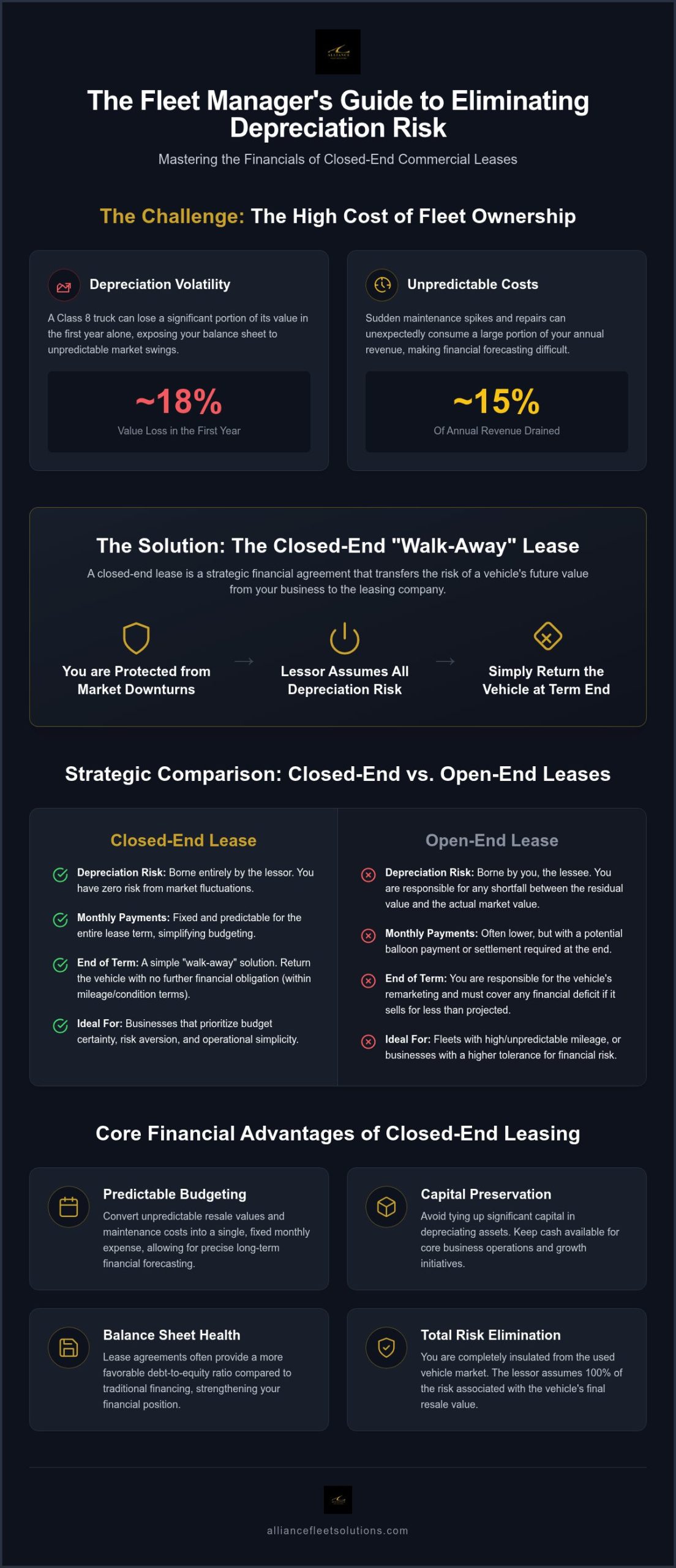
A Class 8 truck can lose roughly 18% of its value within the first year, a reality that often leaves fleet managers at the mercy of a volatile used vehicle market. If you’re tired of watching your balance sheet fluctuate based on resale values you can’t control, you’re likely considering a closed-end lease for commercial vehicles as a way to regain stability. Most logistics professionals agree that unpredictable depreciation and sudden maintenance spikes, which can drain 15% of annual revenue, are the primary hurdles to maintaining a healthy budget. You need a solution that protects your capital while keeping your drivers in reliable, modern equipment.
This 2026 guide will teach you how to master the financial and operational mechanics of these leases to eliminate depreciation risks once and for all. By shifting the burden of residual value to the lessor, you’ll secure fixed monthly costs and a seamless walk-away solution at the end of your term. We’ll examine how this structure stabilizes your fleet budget, explore the latest 2026 tax benefits like the 76 cents per mile IRS rate, and show you how a proactive leasing partnership turns technical upkeep into a strategic business advantage.
Key Takeaways
- Understand how a closed-end lease for commercial vehicles transfers depreciation risk to the lessor, providing a “walk-away” solution that protects your bottom line from market downturns.
- Stabilize your fleet budget by converting unpredictable resale values into fixed monthly expenses, allowing for more accurate long-term financial forecasting.
- Identify the optimal mileage tiers and maintenance protocols required to avoid overage fees and keep your fleet in peak operational condition.
- Evaluate the strategic differences between open-end and closed-end structures to select the lease model that best aligns with your specific utilization patterns and risk tolerance.
- Leverage a partnership model that integrates vehicle acquisition, custom upfitting, and fractional fleet management to streamline your operations and maximize ROI.
Defining the Closed-End Lease for Commercial Fleets
A closed-end lease for commercial vehicles is a strategic financial agreement where the risk of the vehicle’s future value rests entirely on the lessor, not your business. In the logistics and industrial sectors, this is often called a “walk-away” lease. You pay for the use of the equipment over a set period, and when that time is up, you simply return the keys. This structure is the industry standard for companies that prioritize budget certainty over the potential, yet often volatile, gains of vehicle resale.
To understand the mechanics of this arrangement, you need to be familiar with three core components. First, the capitalized cost represents the total value of the vehicle, including any professional upfitting required for your specific trade. Second, the residual value is the expert’s prediction of what the vehicle will be worth at the end of the term. Finally, the lease term defines the duration of the agreement. For a deeper look at the legal and structural framework, you can review this foundational guide on What is a Closed-End Lease? to see how these elements interact to create a fixed-cost environment.
How the Walk-Away Provision Works
The walk-away provision is the primary advantage of a closed-end structure. It gives you the contractual right to exit the lease without worrying about whether the used vehicle market has crashed. When the term ends, the vehicle remarketing process becomes the leasing company’s responsibility. Your only obligations are to ensure the vehicle meets the pre-defined mileage limits and “normal wear and tear” condition standards. This allows your team to focus on core operations rather than negotiating trade-ins or managing auctions for aging assets.
Lessor vs. Lessee Responsibilities
In a professional leasing partnership, the division of labor is clear and logical. The lessor typically holds the title and manages the administrative burden of plates and registration. This setup keeps the depreciation risk off your balance sheet, protecting your financial ratios. As the lessee, your responsibilities include maintaining comprehensive insurance coverage and adhering to a rigorous maintenance schedule. While you don’t own the asset, you have full operational control, allowing you to source and upfit vehicles that meet your specific national requirements before the lease even begins. This collaborative approach ensures the equipment remains safe and compliant throughout its entire service life.
Predictable Budgeting: The Financial Logic of Closed-End Structures
Financial stability in the logistics sector depends on your ability to forecast expenses with precision. Choosing a closed-end lease for commercial vehicles transforms a major variable expense into a fixed operational cost. Unlike traditional financing, where interest rates for new business auto loans can hover between 4.99% and 5.74% as of August 2026, a closed-end structure locks in your commitment. This predictability allows fleet managers to allocate resources to growth initiatives rather than bracing for market shifts.
Preserving working capital is essential for maintaining a competitive edge. When you purchase a vehicle, you tie up significant capital in a depreciating asset that loses approximately 18% of its value in the first 12 months. Leasing keeps that cash available for core business operations. From a balance sheet perspective, these agreements often provide a more favorable debt-to-equity ratio than traditional debt. By reviewing various Commercial Financing Options, you can see how manufacturers structure these deals to support business liquidity. For companies without a dedicated fleet manager, our fractional fleet management model further optimizes these financial benefits by providing expert oversight without the full-time overhead.
Eliminating Depreciation Volatility
The used vehicle market is notoriously cyclical. If you own your fleet, a sudden downturn in resale values can create a massive shortfall when it’s time to cycle out old equipment. With a closed-end lease, this volatility is no longer your concern. You are protected against unexpected drops in resale value because the lessor assumes the risk of a “soft” market. Market volatility is effectively hedged through fixed residuals established at the start of the contract, giving you a guaranteed exit strategy regardless of economic conditions.
Tax and Accounting Advantages
The 2026 tax code offers specific incentives for fleet operations. While owned vehicles qualify for a $1,220,000 Section 179 deduction limit, lease payments are typically 100% tax-deductible as an operating expense. This simplifies accounting by replacing complex depreciation schedules with predictable, single-line entries. In 2026, businesses can still take a 20% bonus depreciation on owned assets, but the schedule is phasing out. Leasing offers a consistent tax shield that doesn’t rely on fluctuating depreciation rules. We recommend consulting with a tax professional to ensure you are maximizing these benefits for your specific fleet profile.
Navigating Mileage and Maintenance: Operational Best Practices
Operational success with a closed-end lease for commercial vehicles depends on accurate forecasting at the start of the contract. Setting realistic mileage tiers is the most effective way to avoid the financial friction of end-of-term adjustments. In 2026, industry data shows that excess mileage fees typically range from $0.15 to $0.25 per mile. If your fleet operates on high-utilization routes, choosing a higher tier upfront is almost always more cost-effective than paying penalties later. Understanding what is a closed-end lease helps clarify that these tiers exist to protect the vehicle’s residual value, which the lessor has guaranteed on your behalf.
Managing the condition of the asset is equally vital for a seamless exit. In a heavy-duty industrial context, “normal wear and tear” does not mean neglect. It refers to the expected degradation of a vehicle that has been properly maintained and operated within its intended capacity. We recommend utilizing telematics and GPS solutions to monitor usage patterns in real-time. These tools provide the data necessary to rotate vehicles between high and low-mileage routes, ensuring the entire fleet stays within contractual limits while alerting you to mechanical issues before they escalate into costly repairs.
Integrating Professional Upfitting
One of the most significant advantages of our partnership model is the ability to source and upfit vehicles before the lease begins. Custom shelving, racks, and specialized branding are essential for operational efficiency, and these costs can be amortized directly into your fixed monthly payment. This preserves your capital for other business needs. However, you must plan for the end of the term. Most closed-end agreements require vehicles to be returned in a “de-kitted” state or a specific configuration, so it is important to discuss these requirements during the initial acquisition phase to ensure a clean hand-off.
Maintenance Management for High Uptime
A rigorous maintenance management plan is the backbone of a successful closed-end agreement. Because you must return the vehicle in a condition that reflects proactive care, scheduled service intervals are mandatory, not optional. This discipline does more than just satisfy a contract; it significantly reduces unplanned downtime and extends the reliable service life of your equipment. By treating maintenance as a strategic business solution rather than a mechanical chore, you ensure that every asset in your fleet meets return standards while maximizing your daily ROI.
Closed-End vs. Open-End: A Strategic Comparison for 2026
Choosing the right lease structure requires you to decide where your business is most comfortable carrying risk. While recent securitization data shows open-end leases account for 99.63% of the total market, a closed-end lease for commercial vehicles is gaining traction among businesses that prioritize insulation from market volatility. The decision rests on a simple trade-off: do you want to bet on the resale market, or do you want a guaranteed exit? Understanding this distinction is the first step toward a more predictable fleet budget.
In an open-end agreement, you face market risk. If the used vehicle market softens, you owe the difference between the depreciated value and the actual sale price at the end of the term. Conversely, a closed-end lease shifts that burden to the lessor. Your primary risk becomes operational. You must manage mileage and vehicle condition, but your monthly budget remains untouched by external economic shifts. This predictability acts as the essential backbone of a stable logistics operation, especially in a year where resale values are expected to remain fluid.
When to Choose Closed-End
- Service Fleets: Ideal for plumbing, HVAC, or electrical contractors with predictable, local routes.
- Delivery Vans: Best for “last-mile” operations that operate within a set geographic radius.
- Executive Vehicles: Suitable for high-quality passenger vehicles where maintenance is easily managed.
- Risk-Averse Planning: Use this model when your priority is zero exposure to the used vehicle market.
The Open-End Alternative
High-mileage fleets or those operating in extreme environments often find the “walk-away” terms of a closed-end lease too restrictive. These scenarios typically utilize a Terminal Rental Adjustment Clause (TRAC), which offers greater flexibility in exchange for assuming resale risk. For a deeper dive into how these models impact your bottom line, read our Open-End vs. Closed-End comparison. This guide helps you weigh flexibility against predictability to find the right balance for your specific cash flow needs.
Deciding between these structures doesn’t have to be a solo effort. Our team acts as a supportive partner, helping you analyze your route data to determine which model maximizes your ROI. Ready to stabilize your fleet budget? Consult with our fleet specialists today to determine which leasing model fits your 2026 operational goals.
Maximizing Fleet ROI with Alliance’s Integrated Leasing Solutions
Alliance Fleet Solutions doesn’t just sign contracts; we act as the operational backbone for your fleet. While a closed-end lease for commercial vehicles provides the financial shell, true ROI comes from how you manage the asset within that structure. By integrating leasing with efficient fleet operations, you ensure every mile driven contributes to your bottom line rather than eroding it. We manage the entire lifecycle, from sourcing the right chassis to handling the final remarketing, so you don’t have to juggle multiple vendors or administrative burdens.
Operating costs extend far beyond the monthly lease payment. Fuel is often a fleet’s second-highest expense, and it’s highly variable. By leveraging our fuel management programs, you can lower your Total Cost of Ownership (TCO) through data-driven consumption tracking and fraud prevention. This holistic approach ensures the savings you gain through fixed lease costs aren’t lost at the pump. Our national service coverage means these optimizations apply across your entire operation, regardless of where your vehicles are deployed.
Fractional Fleet Management Support
Many mid-sized organizations lack the budget for a full-time fleet manager but still face high-stakes logistics challenges. Our fractional fleet management model fills this gap by providing expert oversight on an as-needed basis. We use telematics and GPS solutions to make data-driven decisions on your behalf, ensuring your drivers stay safe and compliant. You receive customized reporting that clarifies lease performance and ROI, giving you the clarity needed for long-term planning without the overhead of an additional executive salary.
The Value of Professional Upfitting
A vehicle is only productive when it’s road-ready and tailored to your specific trade. Our partnership model allows us to handle professional upfitting before your lease term even begins. Whether you need specialized racks for HVAC tools or custom shelving for logistics, we ensure these configurations are durable and compliant with lease return standards. Having a single point of contact for both vehicle acquisition and upfitting eliminates the coordination delays common with stationary competitors. It keeps your drivers on the road and your revenue flowing from day one.
Stabilizing Your Fleet Operations for 2026 and Beyond
A closed-end lease for commercial vehicles isn’t just a financing choice; it’s a strategic shield against the volatility of the used vehicle market. By locking in fixed monthly costs and shifting depreciation risk to a trusted partner, you protect your working capital and simplify your long-term forecasting. Success requires setting realistic mileage tiers and maintaining a proactive service schedule to ensure a seamless walk-away experience at the end of your term.
Whether you need custom upfitting tailored to your industry or expert vehicle remarketing for maximum lifecycle value, Alliance Fleet Solutions provides the national support your growing fleet requires. We act as your strategic backbone, allowing you to focus on core business growth while we handle the technical complexities of equipment management. Partner with Alliance Fleet Solutions for your next commercial lease and gain the expert control your operation deserves. We look forward to helping you build a more resilient and efficient fleet.
Frequently Asked Questions
What happens if I exceed the mileage limit on a closed-end lease?
You will pay a pre-negotiated excess mileage fee for every mile over the contractual limit. In 2026, these fees typically range from $0.15 to $0.25 per mile. These costs are settled at the end of the term when you return the vehicle. To manage this risk, we recommend using telematics to monitor usage in real-time and rotating vehicles between high and low-utilization routes to stay within your tiers.
Is a closed-end lease better for tax purposes than buying a vehicle?
A closed-end lease for commercial vehicles often provides superior budget simplicity because lease payments are typically 100% tax-deductible as an operating expense. While buying allows for Section 179 deductions, which are capped at $31,300 for certain vehicles in 2026, leasing eliminates complex depreciation schedules. This allows you to claim a consistent deduction throughout the term without managing the tax implications of asset disposal or fluctuating resale values.
Can I customize or upfit a commercial vehicle under a closed-end lease?
Yes, professional upfitting is a standard part of our acquisition process. You can customize vehicles with specialized shelving, racks, and branding before the lease term begins. These costs are often amortized into your fixed monthly payments, preserving your working capital. You simply need to ensure that the upfits are durable and that the vehicle is returned in the specific “de-kitted” state or configuration required by your contract.
What is the difference between a closed-end lease and a TRAC lease?
The primary difference lies in who carries the residual value risk. In a closed-end lease, the lessor assumes all market risk, allowing you to walk away at the end of the term. A TRAC lease is an open-end structure where you are responsible for the difference if the vehicle sells for less than its projected value. While TRAC leases offer flexibility for extreme usage, they lack the guaranteed budget protection of closed-end agreements.
Who is responsible for maintenance on a closed-end commercial lease?
The lessee is responsible for all maintenance and repairs required to keep the vehicle in safe, operational condition. While the lessor holds the title, you must adhere to the manufacturer’s service schedule to satisfy the “normal wear and tear” return standards. Implementing a formal maintenance management plan is the most effective way to prevent downtime and ensure you don’t face unexpected reconditioning charges at the end of the lease term.
Can I terminate a closed-end lease early if my business needs change?
Early termination is possible, though it typically involves fees or a settlement of the remaining lease balance. These contracts are designed for a fixed duration to provide the lowest possible monthly payment. If your business anticipates rapid growth or shifting requirements, our fractional fleet management experts can help you structure a fleet strategy that balances long-term stability with the necessary operational agility to handle change.
What defines “normal wear and tear” for a commercial truck?
Normal wear and tear includes minor cosmetic issues like small paint chips or tire tread wear consistent with your mileage tier. It does not include structural damage, broken glass, or mechanical failures resulting from deferred service. Because a closed-end lease for commercial vehicles is a walk-away solution, the vehicle must be returned in a condition that allows for immediate remarketing. We provide clear inspection guidelines to ensure this transition is transparent.
How is the residual value determined in a closed-end lease?
Residual value is determined by industry experts who forecast the vehicle’s future worth based on historical data, the lease term, and your selected mileage tier. This figure is locked in at the start of the contract, regardless of how the used vehicle market performs over the following years. This fixed residual is what allows your business to avoid the 18% first-year depreciation hit typical of new Class 8 truck acquisitions.