
Is your fleet a strategic driver of growth, or is it quietly eroding your bottom line through depreciating assets and mounting repair bills? With the 2026 IRS business mileage rate now at 76 cents per mile, the financial stakes for commercial operations have never been higher. Deciding between fleet leasing vs buying is no longer a simple procurement task; it’s a high-stakes decision that impacts your capital allocation and operational agility. You likely feel the pressure of rising maintenance costs on older vehicles and the heavy administrative burden of title and registration management.
We understand that your priority is keeping your drivers safe and your uptime high without tying up millions in equipment. This guide offers a comprehensive analysis of the financial and operational factors to help you optimize your fleet’s total cost of ownership. We will examine the latest 2026 tax regulations, including the $2,560,000 Section 179 deduction limit, and compare open-end versus closed-end leasing models. By the end, you’ll have a clear roadmap to achieving predictable monthly expenses and maximizing resale value at the end of every vehicle’s lifecycle.
Key Takeaways
- Evaluate how different capital allocation strategies impact your company’s balance sheet and long-term cash flow stability.
- Analyze the critical differences between fleet leasing vs buying to determine which model offers the best ROI for your specific 2026 operational goals.
- Streamline your daily operations by comparing the administrative costs of internal vehicle management against the efficiency of outsourced maintenance and fuel programs.
- Optimize your vehicle lifecycle by learning how to time acquisitions and remarketing to capture the highest possible resale value.
- Discover how fractional fleet management provides the technical expertise you need to scale your logistics without increasing your permanent headcount.
The 2026 Fleet Landscape: Why the Lease vs. Buy Debate Matters
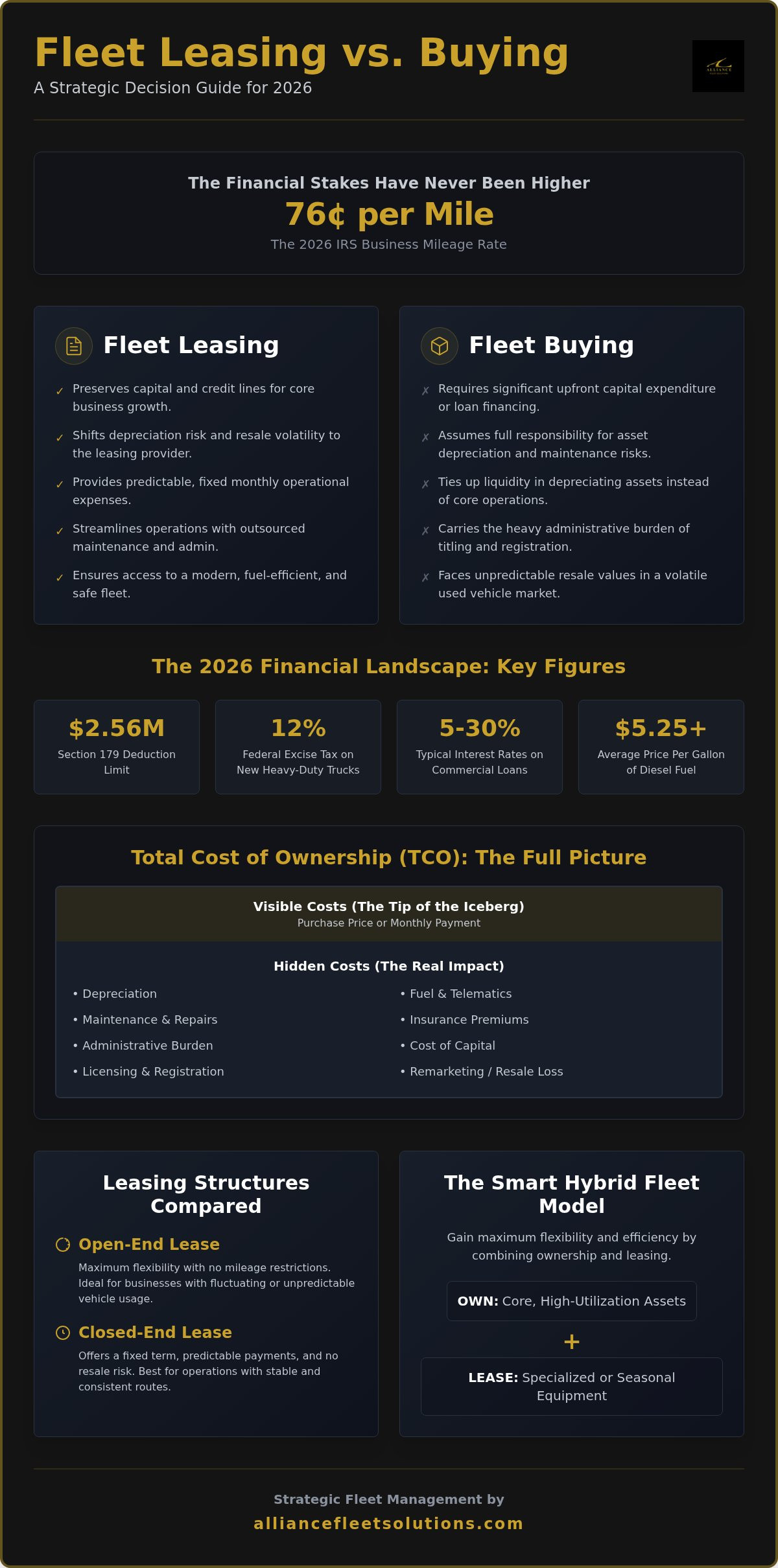
The logistics sector moves fast, and your acquisition strategy must keep pace. In the current economic environment, the choice between fleet leasing vs buying isn’t just about who holds the title. Buying represents a traditional ownership model where you assume all depreciation and maintenance risks. Leasing, on the other hand, shifts the focus toward operational access and predictable payments. To grasp the Vehicle Leasing Fundamentals, you must view these options as financial tools rather than just ways to get trucks on the road. A “one-size-fits-all” approach often leaves businesses with either too much capital tied up in aging assets or too little control over their specialized equipment.
Total Cost of Ownership (TCO) serves as the most critical metric for 2026. It goes beyond the initial price tag to include every cent spent over the vehicle’s lifecycle. If you only look at the monthly payment or the purchase price, you’ll miss the hidden drains on your revenue. These include administrative time spent on licensing, the cost of capital, and the inevitable drop in resale value. A strategic partner helps you look at the full picture so you don’t end up with a fleet that costs more to maintain than it generates in profit.
Projected Operational Costs for 2026
Managing a fleet in 2026 requires a sharp eye on fluctuating expenses. National averages for diesel fuel currently hover between $5.25 and $5.40 per gallon, while regular gasoline sits around $4.00 to $4.07. These high fuel costs combine with rising insurance premiums and a shortage of specialized technicians to squeeze margins. While the Section 179 deduction limit of $2,560,000 offers a significant tax incentive for those buying equipment, the 12% Federal Excise Tax on new heavy-duty trucks remains a heavy burden. Inflation makes tying up capital in depreciating assets risky. The buying power of that cash might be better utilized in core business growth rather than being locked in a truck that loses value every day.
The Rise of the Hybrid Fleet Model
Many successful operations now adopt a hybrid approach to fleet management. This strategy involves owning core, high-utilization assets while using a commercial lease for specialized or seasonal equipment. It provides the flexibility needed to scale national operations without the administrative nightmare of managing a massive, aging owned fleet. Telematics and GPS Solutions play a vital role here. By analyzing real-time performance metrics, managers can pinpoint exactly when an owned vehicle becomes a liability due to rising maintenance costs. This data-driven insight often triggers the switch from owning to leasing, ensuring that every vehicle in the rotation contributes to a healthy bottom line.
Financial Mechanics: Capital Allocation and Cash Flow
Analyzing the financial mechanics of fleet leasing vs buying requires looking beyond the sticker price. Purchasing a vehicle often demands a significant upfront capital expenditure or a loan with interest rates currently ranging from 5% to 30%. This cash outlay ties up your liquidity, potentially limiting your ability to invest in core expansion or research. Commercial leasing, by contrast, preserves your credit lines. It transforms a massive capital expense into a manageable operational cost. Fixed payments provide financial predictability even as market interest rates fluctuate, making the choice between fleet leasing vs buying a critical debate for any growing operation.
Vehicle depreciation is another silent profit killer for owners. When you buy, you’re responsible for the asset’s declining value on your balance sheet. In 2026, used commercial vehicle prices saw an 8.8% year-over-year increase, but mileage on trade-ins is also rising, with a median of 77,507 miles in Q2. This volatility makes predicting future resale value difficult. Leasing shifts this risk to the provider, ensuring your capital isn’t trapped in a depreciating asset. These Benefits of Fleet Leasing allow you to maintain a modern, efficient fleet without the financial drag of ownership.
Open-End vs. Closed-End Leasing Structures
Choosing the right structure depends on your operational needs. Open-end leasing provides maximum flexibility for businesses with fluctuating mileage. Since there are no mileage restrictions, you avoid overage penalties and can benefit from any equity gained if the vehicle sells for more than the residual value. Closed-end leases offer a walk-away solution. You pay for the portion of the vehicle’s life you use and return it at the end of the term. If your annual mileage is predictable, a closed-end model effectively mitigates your remarketing risk.
Tax Implications and Depreciation Strategies
The 2026 tax environment offers specific advantages for both paths. Under Section 179, businesses can deduct up to $2,560,000 for qualifying equipment placed in service this year. While this is a powerful tool for buyers, leasing allows you to expense the entire monthly payment as an operational cost. This often provides a more immediate tax benefit than traditional depreciation schedules. To see how these rules fit into a broader operational plan, consult our 2026 Strategic Guide for Business Growth.
If you’re ready to optimize your cash flow, exploring professional Vehicle Acquisition strategies can help you secure the right equipment under the right terms.
Operational Realities: Maintenance, Fuel, and Telematics
The true test of your acquisition strategy happens on the road, not the balance sheet. When comparing fleet leasing vs buying, many managers overlook the administrative weight of ownership. Owning a fleet means your team handles every title, registration, and repair order. This burden often pulls focus away from your core business objectives. When a vehicle goes down, the revenue loss isn’t just the repair bill; it’s the missed deliveries and idle driver hours. Leasing structures often streamline these processes, allowing you to treat your fleet as a service rather than a series of mechanical headaches.
Telematics and GPS Solutions act as the nervous system for modern commercial operations. While you can install these systems in owned vehicles, leasing often makes it easier to keep your hardware current. Integrating data across a leased fleet allows for seamless tracking of driver behavior and engine health. This visibility helps you identify the “maintenance cliff” before it results in a roadside failure. Whether you choose fleet leasing vs buying, your ability to act on real-time data determines your ultimate uptime and driver safety record.
Reducing Downtime through Managed Maintenance
Internal maintenance scheduling is a complex juggling act that often leads to inconsistent service. Contrast this DIY approach with professional maintenance management. These programs provide your drivers with access to national vendor networks and pre-negotiated labor rates that an independent owner simply can’t match. By utilizing a data-driven schedule, you ensure every vehicle remains compliant with safety regulations. This proactive stance prevents minor issues from escalating into catastrophic failures, keeping your operation moving without the stress of managing a shop.
Fuel Efficiency and Monitoring
Fuel remains one of your largest recurring expenses, especially with diesel prices averaging between $5.25 and $5.40 in late 2026. Implementing fuel management programs is essential for preventing fraud and optimizing consumption. There is a powerful synergy between telematics and fuel cards; you can verify that the fuel pumped matches the vehicle’s location and tank capacity in real time. Leasing also offers a distinct advantage here: it allows you to cycle in newer, more fuel-efficient models every few years. Aging owned assets often see a steady decline in MPG, which quietly erodes your margins over time.
Lifecycle Strategy: From Acquisition to Remarketing
Strategic fleet management requires a clear vision of the vehicle’s entire life before it ever hits the road. When evaluating fleet leasing vs buying, the acquisition phase is often where companies lose the most money through poor planning. Standardizing your vehicle acquisition ensures that every unit in your national operation meets the same specifications, which simplifies driver training and maintenance. By timing your vehicle cycling correctly, you avoid the “maintenance cliff” where repair costs suddenly spike and outpace the asset’s remaining value. A proactive acquisition strategy sets the foundation for a predictable, high-performing fleet.
Professional Upfitting and Customization
Off-the-shelf vehicles rarely meet the specific demands of heavy-duty industrial work. Professional upfitting transforms a standard chassis into a specialized tool, directly improving driver efficiency and safety. When comparing fleet leasing vs buying, the ability to roll these technical costs into a single contract is a major operational advantage. If you choose to buy, you must pay for these modifications upfront. However, leasing allows you to finance the upfitting costs directly into the monthly payment, preserving your cash flow. Selecting standardized, high-quality upfits also protects the vehicle’s residual value. Durable, industry-standard modifications are much easier to sell on the secondary market than highly niche, non-standard configurations that limit your pool of potential buyers.
Maximizing Resale through Professional Remarketing
Disposing of an owned vehicle is a labor-intensive process that often yields subpar returns for busy managers. Internal disposal involves managing title transfers, finding buyers, and negotiating prices while your capital remains trapped in an idle asset. Professional Vehicle Remarketing removes this burden entirely. The process begins with a detailed inspection and professional cleaning to ensure the asset shows its best value. We then utilize multi-channel sales strategies to reach a broad audience of buyers, from wholesalers to retail markets. With used heavy-duty truck inventory down 36% as of July 2026, the timing of your sale is critical. Data-driven remarketing ensures you sell when demand is highest, capturing maximum equity for your next acquisition cycle.
Partner with experts in Vehicle Remarketing to ensure you capture the highest possible return on your fleet investment.
Making the Decision: Why Partnership Outperforms Ownership
Ownership is often mistaken for control, but in the high-stakes logistics sector, true control comes from operational agility. The decision between fleet leasing vs buying shouldn’t be a binary choice made in a vacuum. It requires a deep dive into your company’s long-term capital strategy and its capacity to handle administrative friction. While purchasing might seem straightforward, the hidden costs of managing titles, registrations, and maintenance often outweigh the perceived benefits of equity. A strategic partnership allows you to offload these burdens, ensuring your leadership team stays focused on revenue-generating activities rather than mechanical downtime.
Choosing a path for 2026 involves balancing the immediate tax benefits of Section 179 against the long-term predictability of a managed lease. When you partner with experts, you gain access to a lifecycle strategy that prioritizes efficient fleet operations. This collaborative approach turns your fleet from a depreciating liability into a strategic business asset. By evaluating fleet leasing vs buying through the lens of total cost of ownership, you can identify exactly where your current model is leaking cash and implement a more resilient structure.
The Value of Fractional Fleet Management
Many small-to-medium enterprises (SMEs) face a common hurdle: they’re large enough to need expert oversight but too small to justify a full-time, six-figure fleet manager. Fractional Fleet Management bridges this gap by providing professional-level expertise on a part-time or project basis. This model covers essential tasks like regulatory compliance, vendor negotiations, and complex data analysis. It’s a scalable solution that gives you the technical depth of a national carrier without the permanent headcount. For a growing business, this means your fleet remains optimized and compliant while you remain lean and focused on expansion.
Choosing the Right Strategic Partner
A dependable partner acts as the backbone of your functional operation. At Alliance Fleet Solutions, we move beyond transactional vendor relationships to act as a supportive, no-nonsense expert for our clients. We provide tailored leasing structures and professional upfitting that match your specific industry needs. Our goal is to alleviate the stress of equipment failure by projecting calm, expert control over every vehicle’s lifecycle. To evaluate your current strategy, consider this final executive checklist:
- Is your capital better utilized in core business investments than in depreciating vehicle assets?
- Do your current maintenance costs fluctuate wildly or follow a predictable monthly schedule?
- Does your team have the bandwidth to manage vehicle remarketing for maximum resale value?
- Are you leveraging real-time telematics data to reduce fuel waste and improve driver safety?
- Would your operation benefit from expert-level oversight without a full-time hire?
Securing Your Fleet’s Financial Future in 2026
The debate over fleet leasing vs buying ultimately comes down to how you value your capital and your time. While ownership offers long-term equity, it also brings the volatility of rising maintenance costs and the heavy administrative burden of asset disposal. By shifting your focus toward the total cost of ownership, you can move away from reactive fixes and toward a proactive strategy that prioritizes uptime and driver safety. Successful operations in 2026 don’t just manage vehicles; they leverage them as flexible tools for growth.
A strategic partnership provides the technical depth needed to navigate high interest rates and fluctuating fuel prices. We provide specialized professional upfitting to ensure your equipment meets industry demands, along with comprehensive remarketing services to capture maximum value at the end of the lifecycle. Whether you need flexible open-end or closed-end leasing options, our goal is to act as the backbone of your functional operation. It’s time to stop managing mechanical headaches and start leading your business toward sustainable efficiency. Optimize your fleet strategy with Alliance Fleet Solutions and take command of your operational ROI today.
Frequently Asked Questions
Is it better to lease or buy fleet vehicles for a small business?
Deciding on fleet leasing vs buying for a small business often comes down to capital preservation. Leasing is usually the superior choice for operations looking to keep credit lines open for core growth. While buying creates an asset, it also ties up liquidity in a depreciating vehicle. Leasing provides lower monthly payments and predictable expenses. Small operations benefit from cycling into newer trucks every few years, reducing the risk of catastrophic repair bills.
What are the main tax benefits of leasing commercial vehicles?
The primary tax advantage of leasing is the ability to deduct the entire monthly payment as an operational expense. This differs from buying, where you must follow complex depreciation schedules over several years. While the 2026 Section 179 limit of $2,560,000 offers a large immediate deduction for buyers, leasing provides a consistent, year-over-year tax shield. This simplifies accounting and ensures your tax benefits align closely with your actual cash outflows for vehicle use.
How does open-end leasing differ from closed-end leasing for businesses?
Open-end leasing places the residual value risk on the lessee, making it ideal for high-mileage or specialized commercial use without overage penalties. If the vehicle sells for more than the projected residual value, your business keeps the equity. Closed-end leasing is a walk-away model where the lessor assumes the depreciation risk. This is better for businesses with predictable, lower mileage that want to return the vehicle at the end of the term with no further financial obligation.
What is vehicle remarketing and how does it help my business?
Vehicle remarketing is the professional process of inspecting, preparing, and selling a fleet vehicle at the end of its service life to capture maximum resale value. Instead of managing a slow internal disposal process, a remarketing partner uses multi-channel sales to reach wholesale and retail buyers. This ensures you receive the highest possible return on your investment. With used heavy-duty inventory down 36% in July 2026, professional timing is essential to capitalize on high demand.
Can I customize or upfit a leased commercial vehicle?
Yes, professional upfitting is a standard part of commercial vehicle acquisition and can be fully integrated into a lease agreement. This allows you to finance specialized racks, shelving, or bodies directly into your monthly payment rather than paying for them upfront. By customizing the vehicle to your specific industry needs, you improve driver efficiency and safety. Standardized upfits also help maintain a higher residual value, making the eventual remarketing process more successful for your operation.
How does fleet leasing impact my company balance sheet?
Choosing fleet leasing vs buying significantly impacts your financial profile by shifting capital expenditures into operating expenses. This strategy keeps your debt-to-equity ratio low and preserves credit lines for other strategic investments. Unlike owning, where the full vehicle value and debt appear on the books, leasing allows for a more streamlined balance sheet. This flexibility is vital in the 2026 economic landscape, where maintaining liquidity is a primary goal for logistics managers.
What is the typical lifecycle of a leased commercial truck?
A typical commercial truck lifecycle lasts between 36 and 60 months, depending on your annual mileage and application. The goal is to cycle the vehicle out before it hits the maintenance cliff, where repair costs and downtime begin to exceed the asset’s value. In 2026, used vehicles are entering the market with higher median mileage, around 77,507 miles. Leasing ensures you replace aging trucks with newer, more fuel-efficient models before they become a liability to your uptime.
Does leasing include maintenance and fuel management?
Commercial leasing can be bundled with comprehensive maintenance management and fuel programs to create a total fleet solution. These programs provide access to national vendor networks with pre-negotiated rates and prevent fraud through real-time fuel card monitoring. While the base lease covers the vehicle acquisition, adding these management services ensures predictable monthly operational expenses. This integration allows your team to focus on logistics while experts handle the technical and administrative details of keeping the fleet running.