
78% of fleet leaders rank cost savings as their top priority in 2026, yet many are still watching maintenance costs climb by over 40% compared to just five years ago. With national diesel averages hitting $5.35 per gallon and the recent expiration of federal EV tax credits, implementing aggressive fleet optimization strategies is the only way to protect your bottom line. You likely feel the constant pressure of rising insurance premiums and the frustration of seeing underutilized vehicles sit idle while your overhead grows. It’s a high-stakes environment where a single maintenance spike can derail an entire quarter’s budget.
We understand that operational downtime isn’t just an inconvenience; it’s a direct threat to your professional reputation. This article will show you how to transform your fleet from a cost center into a strategic asset by leveraging integrated leasing, professional upfitting, and data-driven management. We’ll explore seven proven methods to lower your cost per mile, increase vehicle uptime, and streamline your entire procurement and disposal process. By the end, you’ll have a clear roadmap to turn your vehicles into the reliable backbone of a more efficient, profitable operation.
Key Takeaways
- Learn how to select the right leasing structure to preserve capital and navigate the high-interest rate environment of 2026.
- Discover why professional upfitting is essential for creating work-ready vehicles that improve driver safety and long-term asset value.
- Gain visibility into hidden operational costs by integrating telematics and fuel management programs into your daily workflow.
- Identify the “sweet spot” for vehicle replacement by executing data-driven fleet optimization strategies that balance repair costs against depreciation.
- Understand the impact of proactive maintenance management on vehicle uptime and how expert remarketing maximizes your return at the end of the lifecycle.
What is Fleet Optimization and Why Does It Matter in 2026?
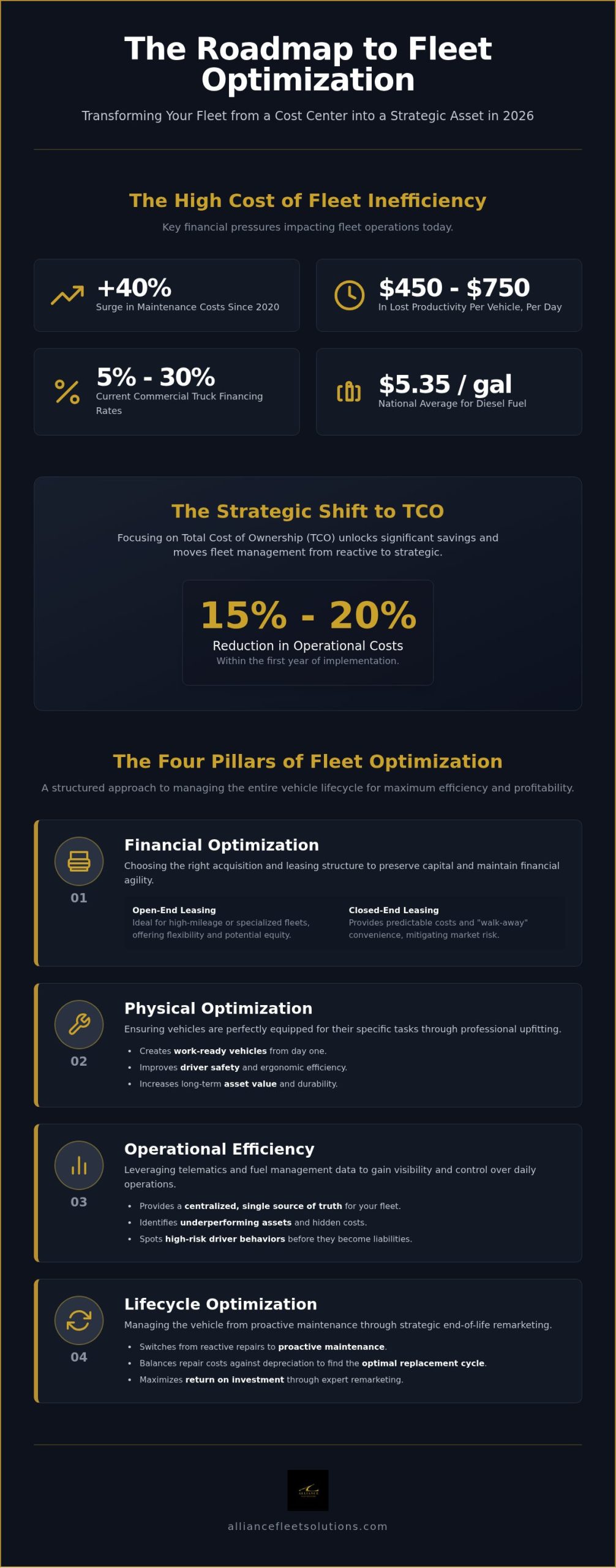
Fleet optimization is the proactive, end-to-end management of a vehicle’s entire lifecycle. It isn’t just about keeping trucks on the road; it’s about ensuring every asset contributes to your company’s profitability from the moment of acquisition to the final remarketing sale. In 2026, this discipline has become a survival requirement. With commercial truck financing rates currently ranging from 5% to as high as 30% and vehicle maintenance costs having surged 41% since 2020, the old way of “buying and driving” is no longer sustainable. You need a transition from reactive repairs to strategic asset management to stay competitive.
The primary metric for success is Total Cost of Ownership (TCO). This figure encompasses every cent spent on a vehicle, including depreciation, upfitting, and administrative overhead. Businesses that implement comprehensive fleet optimization strategies typically see a 15% to 20% reduction in operational costs within the first year. By focusing on TCO rather than just the initial sticker price, you gain a clear-eyed view of your fleet’s true impact on your balance sheet.
The True Cost of Fleet Inefficiency
Inefficiency hides in the gaps between your line items. While fuel is a visible expense, the hidden costs of insurance premiums and accelerated depreciation often do more damage to your margins. Perhaps the most punishing factor is the “Downtime Domino Effect.” When a vehicle is sidelined, you’re not just paying for a mechanical fix. You’re losing between $450 and $750 per day in lost productivity and risking the long-term trust of your customers. Relying on “good enough” maintenance is a gamble that eventually results in unpredictable, high-cost failures. Strategic management eliminates these surprises by prioritizing reliability over temporary savings.
Moving from Tactical to Strategic Management
There is a fundamental difference between just owning trucks and managing a fleet. Tactical management is reactive and fire-focused. Strategic management, however, uses centralized data to create a single version of truth for your entire operation. It allows you to spot underperforming assets or high-risk driver behaviors before they become liabilities. Transitioning to professional fleet management services provides the essential infrastructure for this change. It shifts your role from a supervisor of equipment to a partner in business growth. By adopting these fleet optimization strategies, you ensure that your fleet remains a resilient, scalable asset regardless of how the logistics market shifts in the coming years.
Financial Optimization: Choosing the Right Leasing Structure
The method you choose for vehicle acquisition is your most impactful lever in lowering TCO. While many managers focus on fuel or repairs, the financial structure of your fleet dictates your long-term agility. In a year where commercial financing rates fluctuate between 5% and 30%, capital preservation is no longer just a preference; it’s a necessity for growth. Leasing allows you to keep cash in your business while transferring the risk of technological obsolescence to the provider. This is particularly vital as vehicle technology evolves rapidly, making fleet optimization strategies that prioritize flexibility far more effective than rigid ownership models.
Open-End vs. Closed-End Leasing Strategies
Choosing between lease types depends entirely on your operational needs. Open-end leasing, often involving a Terminal Rental Adjustment Clause (TRAC), offers the most flexibility for high-mileage or specialized fleets. You aren’t bound by strict mileage limits, and you benefit from any equity at the end of the term. Conversely, closed-end leasing provides predictable monthly costs and “walk-away” convenience, protecting you from market volatility at the time of disposal. Each model has distinct tax implications, and selecting the right one ensures your balance sheet remains healthy. If you’re unsure which path fits your specific duty cycle, exploring professional open-end leasing options can provide the clarity needed to make a strategic choice.
Vehicle Acquisition and Procurement Timing
Optimization doesn’t start on the road; it starts at the factory. Professional vehicle acquisition leverages fleet-specific incentives and volume pricing that are unavailable to retail buyers. By aligning your procurement with specific ordering cycles, you avoid the high markups and availability delays common in the secondary market. This proactive approach ensures you maintain a young, fuel-efficient fleet that requires fewer repairs. Timing your replacements correctly balances the cost of new equipment against the rising maintenance expenses of aging trucks. A well-timed acquisition strategy prevents the “retail trap” and ensures your vehicles are work-ready exactly when your contracts demand them.
Physical Optimization Through Professional Upfitting
Professional upfitting is the bridge between vehicle acquisition and a productive workday. It involves the strategic customization of a vehicle with specialized equipment, shelving, and technology to meet specific industry tasks. This is where fleet optimization strategies move from the balance sheet to the physical asset. A generic cargo van is just a shell; an upfitted van is a mobile workstation. By prioritizing ergonomic designs, you reduce driver fatigue and minimize the risk of repetitive strain injuries. Additionally, using weight-optimized aluminum shelving and composite racks instead of heavy steel improves fuel economy and reduces wear on tires and brakes.
Standardizing your upfit packages across the entire fleet simplifies both driver training and long-term maintenance. When every vehicle in your lineup has an identical layout, technicians can perform repairs faster, and drivers can switch between assets without a learning curve. This consistency is the backbone of a reliable operation, ensuring that your equipment supports your team rather than slowing them down.
Designing the ‘Work-Ready’ Vehicle
A properly upfitted vehicle acts as a force multiplier for your field staff. Consider the impact of organization: a technician who saves just 15 minutes per stop through better tool accessibility can reclaim up to 2.5 hours of productive time in a typical 10-stop day. Professional upfitting integrates power solutions, such as high-output inverters and auxiliary battery systems, alongside specialized storage that keeps high-value tools secure. Beyond daily efficiency, these modifications protect the vehicle’s interior from damage. This preservation is a critical component of your remarketing strategy, as a well-maintained cargo area significantly increases the asset’s resale value when it’s time to cycle the vehicle out of service.
Safety and Compliance Integration
Safety shouldn’t be an afterthought; it must be engineered into the build phase. Professional installations include crash-tested partitions that protect drivers from shifting cargo during sudden stops or collisions. Every modification must adhere to national safety standards and stay within the vehicle’s Gross Vehicle Weight Rating (GVWR) to ensure stable handling and braking performance. By incorporating lighting packages, backup sensors, and safety tech during the initial upfit, you create a safer environment for your employees. Standardizing these high-quality installations reduces your corporate liability and ensures that every vehicle you put on the road meets a consistent, high-performance safety benchmark.
Operational Efficiency: Telematics and Fuel Management
Data is the engine that powers modern fleet optimization strategies. While your leasing structure provides the financial foundation and upfitting ensures your vehicles are work-ready, operational efficiency depends on how those assets move every day. Achieving this requires a systematic approach to data collection and analysis. Start by implementing telematics to gain real-time visibility into idle time and routing. This transparency allows you to identify “outlier” drivers whose habits might be driving up costs or “outlier” vehicles that require immediate intervention. By deploying professional fuel management programs, you can effectively curb unauthorized spending and gain control over one of your largest variable expenses. Integrating these systems with maintenance alerts prevents roadside failures, while monthly reporting helps you adjust load distributions for maximum efficiency.
Managing a fleet without these tools is like flying blind. You’re forced to rely on guesswork instead of concrete evidence. To take control of your operations, explore our telematics and GPS solutions today.
The Power of Real-Time Telematics
Telematics provides a direct window into the health and location of your fleet. By monitoring engine diagnostics, you can catch small sensor issues or cooling problems before they escalate into catastrophic engine swaps. This proactive visibility is essential for maintaining uptime. Geofencing adds another layer of security, allowing you to recover stolen assets quickly and ensure vehicles remain “on-task” during work hours. Beyond security, GPS data optimizes your dispatching by reducing total miles driven. It ensures your drivers take the most efficient routes, cutting down on unnecessary wear and tear while improving your response times for customers.
Fuel Cost Control Strategies
Fuel remains a volatile and significant expense, with diesel prices recently hitting a national average of $5.35 per gallon. One of the most effective ways to lower this cost is by addressing idle time. In many heavy-duty vehicles, one hour of idling is equivalent to one gallon of fuel. By using telematics to track and reduce these instances, you can see immediate savings. Implementing fuel cards is another critical step; they prevent slippage, eliminate unauthorized purchases, and streamline your accounting processes. Unlike retail pump strategies where you’re at the mercy of local pricing, internal fuel management programs offer the data needed to negotiate better rates and monitor every drop of fuel your fleet consumes.
Lifecycle Optimization: Maintenance and Remarketing
Lifecycle optimization is the final, essential piece of the puzzle. While acquisition and upfitting set the stage, maintenance management keeps the operation profitable over time. It serves as the heart of vehicle uptime; every hour a truck spends in the shop is an hour it isn’t generating revenue. Finding the “sweet spot” for vehicle replacement is a critical skill within successful fleet optimization strategies. This balance requires you to track the exact moment when rising repair costs for an aging asset begin to outweigh the depreciation of a new one. For mid-sized businesses, fractional fleet management offers a way to access this high-level expertise and oversight without the burden of a full-time executive salary.
By treating your vehicles as a rolling investment rather than just a tool, you ensure that every dollar spent on upkeep contributes to the eventual resale value. This lifecycle approach prevents the common mistake of over-investing in a vehicle that should have been cycled out months prior. It turns maintenance from a necessary evil into a calculated business solution that preserves your capital for future growth.
Predictive vs. Preventive Maintenance
Standard preventive maintenance usually relies on fixed, arbitrary intervals like every 5,000 miles. Predictive maintenance takes this further by using actual engine load data and telematics to schedule service exactly when it’s required. This approach prevents over-servicing and catches potential catastrophic failures before they result in a roadside emergency. Utilizing centralized maintenance hubs allows you to exert expert control over vendor costs and ensures consistent quality regardless of where your vehicles are operating. A single-bill maintenance solution reduces the administrative burden on your back office, consolidating hundreds of monthly invoices into one manageable report.
Strategic Remarketing and Disposal
Optimization continues until the asset is finally sold. Trading a vehicle in at a local dealer is frequently the least efficient disposal method because it leaves significant equity on the table. Professional vehicle remarketing leverages national auction networks and specialized wholesale channels to find the highest bidder for your specific equipment. Your detailed maintenance records are the most valuable tool in this process. They provide the documented proof of care that buyers demand, which directly translates to higher returns. By closing the loop with a strategic disposal, you recover the maximum amount of capital to reinvest in the next generation of your fleet.
Future-Proof Your Fleet for 2026 and Beyond
Successful fleet management in 2026 requires a shift from reactive maintenance to a comprehensive lifecycle approach. By aligning your leasing structure with your duty cycle and ensuring every vehicle is work-ready through professional upfitting, you build a foundation of reliability. Integrating real-time telematics and fuel programs then provides the visibility needed to eliminate waste and protect your margins. These fleet optimization strategies aren’t just about cutting costs; they’re about building a resilient operation that can weather market volatility.
You don’t have to manage these complexities alone. From customized leasing structures for national fleets to expert vehicle remarketing that maximizes your ROI, we provide the technical authority and partnership you need. Our comprehensive maintenance and fuel program management ensures your team stays on the road while we handle the operational heavy lifting. Partner with Alliance Fleet Solutions to optimize your operations today and turn your fleet into your business’s strongest strategic asset. You have the tools to take control; now it’s time to put them into motion.
Frequently Asked Questions
What is the most effective way to start optimizing a small fleet?
The most effective way to start is by establishing a clear data baseline. You can’t optimize what you don’t measure. Begin by centralizing your records for fuel spend, maintenance invoices, and vehicle age. Implementing a basic telematics solution is often the quickest way to gain visibility into driver behavior and idle time. This initial step provides the necessary insights to identify immediate waste and prioritize which assets need replacement or reconfiguration first.
How much can telematics actually save a business in fuel costs?
Businesses typically see a 15% to 20% reduction in operational costs within the first year of using data-driven tools. Fuel savings are driven primarily by reducing excessive idling and optimizing routes. Since one hour of idling can consume a full gallon of fuel in heavy-duty vehicles, tracking this behavior provides an immediate boost to your bottom line. These tools also help eliminate unauthorized fuel spend by matching GPS locations with fuel card transactions.
Is it better to lease or buy vehicles for fleet optimization?
Leasing is often the better choice for optimization because it preserves your working capital for core business growth. It allows you to cycle through newer, more fuel-efficient vehicles without the risk of owning a depreciated asset. Open-end leasing provides the flexibility required for specialized industrial use, while closed-end structures offer predictable monthly expenses. Ownership ties up cash and forces you to handle the complex disposal process yourself, often resulting in lower returns.
How does professional upfitting affect the resale value of a truck?
High-quality, professional upfitting significantly boosts an asset’s resale value by protecting the vehicle’s structural integrity. Standardized shelving and partitions prevent interior damage and make the vehicle “work-ready” for the secondary market. Buyers in national auction networks pay a premium for vehicles with documented, high-grade equipment already installed. This professional approach ensures your trucks remain valuable assets rather than just worn-out tools at the end of their lifecycle.
What is fractional fleet management and who needs it?
Fractional fleet management provides mid-sized businesses with the expertise of a seasoned fleet director without the expense of a full-time executive salary. It is ideal for companies with 15 to 75 vehicles that need professional fleet optimization strategies but lack the internal resources to execute them. This model offers a supportive partnership, giving you access to volume pricing and strategic lifecycle planning that typically only national-scale fleets enjoy.
Can fleet optimization strategies help with insurance premiums?
Optimization strategies directly lower insurance premiums by reducing your fleet’s overall risk profile. Telematics data allows you to identify and coach high-risk driving behaviors like harsh braking or speeding before an accident occurs. Additionally, standardized safety upfitting, such as crash-tested partitions and better lighting, demonstrates a commitment to safety that underwriters reward. Proving that your vehicles are well-maintained and monitored gives you significant leverage during annual premium negotiations.
What are the common pitfalls of a DIY fleet optimization approach?
Common DIY pitfalls include reactive maintenance and inefficient vehicle disposal. Without professional oversight, managers often miss the “sweet spot” for replacement, leading to massive repair bills for aging assets. DIYers also tend to buy vehicles at retail markups and sell them at trade-in prices, losing money on both ends of the lifecycle. A lack of centralized data makes it impossible to see the true Total Cost of Ownership across the entire fleet.
How often should I review my fleet’s TCO data?
Review your TCO data at least once a month to ensure your fleet optimization strategies are performing as expected. Monthly reviews allow you to spot sudden spikes in maintenance costs or fuel consumption before they derail your quarterly budget. While lifecycle planning and replacement cycles are typically assessed annually, consistent monthly monitoring ensures you stay ahead of technician labor shortages and fluctuating parts prices. This steady rhythm keeps your operation organized and profitable.