
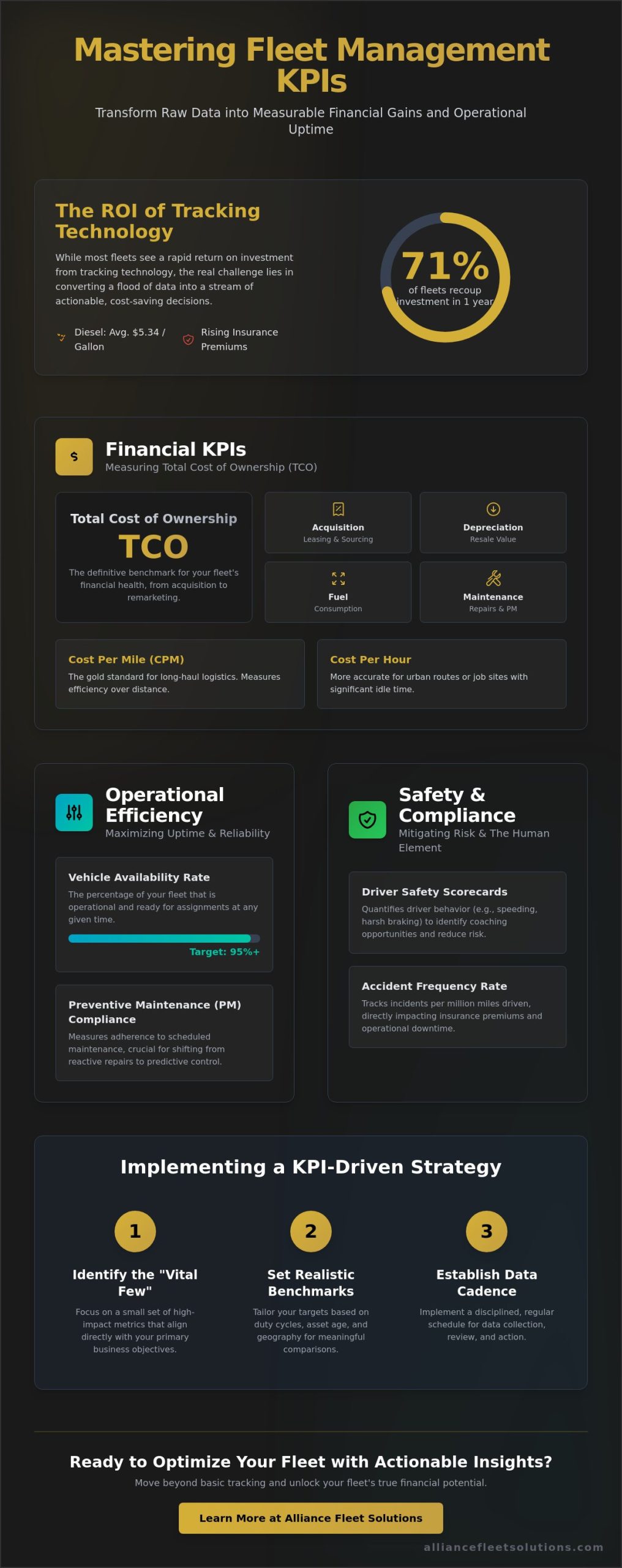
71% of fleets that implement tracking technology recoup their entire investment within a single year, yet many managers still struggle to turn that raw data into measurable financial gains. In an era where diesel prices average $5.34 per gallon and insurance premiums continue to climb, mastering the right key performance indicators for fleet management is no longer a luxury. It is a fundamental survival strategy for your bottom line.
We understand the frustration of watching your total cost of ownership rise while your telematics dashboard overflows with metrics that don’t seem to drive decisions. You need clarity, not just more data. This guide promises to help you master the essential metrics that drive fleet profitability, reduce costs, and optimize operational uptime. We will provide a streamlined list of actionable KPIs that help you reduce maintenance expenses and determine the exact right time for vehicle replacements, moving your operation from reactive maintenance to predictive financial control.
Key Takeaways
- Shift from reactive tracking to predictive optimization to align your fleet’s performance with long-term business objectives.
- Master the essential key performance indicators for fleet management, specifically Total Cost of Ownership (TCO), to pinpoint exactly where capital is being lost.
- Improve operational reliability by prioritizing vehicle availability rates and maintaining strict preventive maintenance compliance.
- Utilize driver safety scorecards and accident frequency rates to mitigate risk and lower escalating insurance costs.
- Implement a high-impact strategy by identifying the “Vital Few” metrics and establishing a disciplined data collection cadence.
What are Key Performance Indicators for Fleet Management?
At its core, What are Key Performance Indicators for Fleet Management? involves using quantifiable measurements to gauge the long-term health and performance of your vehicle assets. These metrics serve as the vital bridge between daily operational tasks and your company’s overarching financial objectives. In the current logistics environment, simply collecting data is no longer sufficient. You must transform that data into actionable intelligence that reduces costs and increases reliability across your entire operation.
The 2026 logistics landscape has moved past basic tracking. With GPS fleet tracking adoption reaching 80% this year according to the 2026 Fleet Technology Trends Report, the focus has shifted entirely toward optimization. Managers no longer just ask where a truck is located. They ask how that truck’s performance affects the quarterly P&L. Without a clear benchmark, your telematics data is just noise. High fuel consumption or frequent repairs only become meaningful when compared against a standard that reflects your specific business goals. You need clarity to make high-stakes decisions.
The Role of Data in 2026 Fleet Operations
Predictive analytics have fundamentally replaced the reactive reporting of the past decade. Instead of reviewing a breakdown after it happens, modern key performance indicators for fleet management allow you to anticipate failures before they occur. Real-time visibility across national operations ensures that every decision is based on current facts rather than week-old spreadsheets. By integrating telematics, GPS solutions, and fuel management data into a single source of truth, you eliminate the silos that often lead to expensive administrative errors and missed optimization opportunities.
Setting Realistic Benchmarks for Your Industry
A one-size-fits-all approach to benchmarking is a recipe for failure. A local delivery van has a completely different duty cycle than a heavy-duty truck hauling freight across state lines. To find success, you must compare your performance against national industry averages while adjusting for your specific vehicle types and operational demands. Effective key performance indicators for fleet management must account for these variables:
- Duty Cycles: Stop-and-go city driving vs. steady highway miles.
- Asset Age: Newer vehicles should naturally outperform older models in fuel efficiency and uptime.
- Geography: Regional terrain and weather conditions significantly impact wear and tear.
By aligning your KPI targets with business-wide financial goals, you ensure that every maintenance dollar spent is an investment in your company’s growth. This proactive approach alleviates the stress of operational downtime and positions your fleet as a strategic business asset rather than a mere cost center.
Financial KPIs: Measuring Total Cost of Ownership (TCO)
Total Cost of Ownership (TCO) stands as the definitive benchmark for your fleet’s financial health. It moves beyond the sticker price of a vehicle to encompass every cent spent from acquisition to remarketing. Understanding Financial KPIs: Measuring Total Cost of Ownership (TCO) is essential for managers who need to justify capital expenditures to stakeholders. In 2026, this metric must account for volatile financing rates, which currently range from 5% to 30% depending on credit profiles, and rising insurance costs that can reach over $900 per month per vehicle. This comprehensive view ensures you aren’t just tracking expenses but managing a strategic business asset.
Cost per Mile (CPM) remains the gold standard for long-haul logistics. However, if your fleet operates in high-density urban areas or involves heavy equipment use, Cost per Hour often provides a more accurate picture of efficiency. A truck idling at a job site for six hours isn’t moving miles, but it is consuming fuel and accumulating engine wear. Choosing the wrong metric leads to skewed data and poor replacement decisions. When you align your key performance indicators for fleet management with the specific duty cycle of your assets, you gain the clarity needed to optimize your bottom line.
Acquisition and Leasing Metrics
Your acquisition strategy dictates your long-term depreciation curve. Implementing open-end leasing can significantly affect your balance sheet KPIs by providing more flexibility than traditional closed-end structures. This model allows you to monitor the “sweet spot” for vehicle replacement timing, ensuring you exit the asset before maintenance costs spike or resale value plummets. Professional vehicle sourcing also reduces upfront costs, which immediately lowers the starting point of your TCO calculation. Effective vehicle acquisition strategies ensure you start every asset’s lifecycle with a financial advantage.
Fuel and Variable Expense Tracking
In June 2026, with diesel prices averaging $5.34 per gallon and gasoline hovering around $4.10, fuel is likely your largest variable expense. Measuring fuel economy trends across different vehicle classes allows you to identify underperforming assets or aggressive driving habits. By using fuel management programs, you can identify slippage and unauthorized spend with precision. Calculating the ROI of telematics-driven routing improvements is also critical. If a new route reduces idling by just 10%, the cumulative savings across a national fleet can represent thousands of dollars in reclaimed profit. These key performance indicators for fleet management turn technical data into clear financial wins.
Operational Efficiency: Uptime and Maintenance KPIs
Financial health is nothing without operational reliability. While cost metrics tell you what you’ve spent, operational KPIs tell you why you’re spending it. The Vehicle Availability Rate is perhaps the most critical indicator of your daily readiness. It measures the percentage of your fleet that is actually available for service at any given time. If your availability drops below 95%, your operation is likely suffering from systemic maintenance delays or an aging fleet that can no longer meet demand. Every hour of downtime is lost revenue, and tracking these key performance indicators for fleet management helps you identify exactly where that revenue is leaking.
One often overlooked factor in operational efficiency is the quality of your equipment installation. Professional upfitting directly correlates with reduced mechanical failure. When components like shelving, liftgates, or auxiliary power systems are installed poorly, they place undue stress on the vehicle’s electrical and suspension systems. By investing in professional upfitting from the start, you eliminate the “phantom” repairs that often plague lower-quality builds. This proactive approach ensures that your assets spend more time on the road and less time in the shop for avoidable adjustments.
Preventive Maintenance (PM) Compliance is your first line of defense against the high costs of emergency repairs. Tracking this metric ensures that your vehicles receive service at the manufacturer’s recommended intervals, preventing minor issues from escalating into catastrophic engine or transmission failures. Referencing Top Fleet Management Key Performance Indicators can help you establish the baseline standards necessary for a high-performing logistics operation. By staying ahead of the repair curve, you stabilize your maintenance budget and protect the long-term value of your vehicles.
Maximizing Uptime Through Maintenance Management
Effective strategies for maintenance management focus on shifting from reactive fixes to a steady, logical schedule. You should track “Mean Time Between Failures” specifically for upfitted components to ensure your specialized equipment is as reliable as the chassis it sits on. For fleets with in-house shops, monitoring technician productivity and shop throughput ensures that when a truck does go down, it returns to the road quickly. This technical depth allows you to manage the mechanics of your business with the same precision as your finances.
Asset Utilization and Capacity Planning
Capacity planning requires a cold, hard look at asset utilization data. If certain vehicles consistently show low mileage or hours, they are likely underutilized assets that should be remarketed to reclaim capital. Balancing your fleet size with actual operational demand reduces the waste of maintaining “spare” vehicles that rarely see the road. Furthermore, upfitting vehicles for specific, multi-functional industry use can improve per-vehicle productivity. For specialized businesses like Elite Kitchens & Cabinets, which require precision in both product and delivery, maintaining this standard is vital; read more about their approach to quality design and service. This allows your team to complete more tasks with a smaller, more efficient fleet, directly improving your key performance indicators for fleet management.
Safety and Compliance: The Human Element of Fleet Data
Safety metrics are often viewed as purely defensive, yet they represent a significant financial lever in your operation. With commercial insurance premiums now ranging from $1,800 to over $10,800 annually per vehicle, your safety record is a primary driver of your fixed costs. Insurers in 2026 are increasingly using telematics data to set rates; fleets that demonstrate low-risk behavior through these key performance indicators for fleet management are seeing premium reductions between 15% and 30%. By tracking the human element, you protect your drivers and your profit margins simultaneously.
The Accident Frequency Rate, measured as incidents per million miles, provides a high-level view of your risk profile. However, daily operational safety starts with Inspection Pass Rates. Monitoring the completion and accuracy of Driver Vehicle Inspection Reports (DVIR) ensures that small mechanical defects are caught before they lead to a roadside failure or a DOT violation. When your drivers are held accountable through clear data, the entire culture of the fleet shifts toward reliability and expert control.
Telematics and GPS Solutions
Real-time monitoring has evolved beyond simple location tracking. As of early 2026, 46% of fleets utilize AI-enabled video telematics to provide objective context for harsh braking or speeding events. This technology allows you to move beyond raw data and implement targeted driver coaching programs that reward safe behavior. You can also monitor idling costs and set geofences to track service-level agreement (SLA) compliance, ensuring that your equipment is where it needs to be, when it needs to be there. To see how these tools can protect your business, explore our Telematics and GPS Solutions.
Regulatory Compliance and Risk Management
Compliance is a moving target that requires constant vigilance. As of February 7, 2026, the FMCSA has instituted stricter out-of-service orders for carriers using revoked Electronic Logging Devices (ELDs). Managing these key performance indicators for fleet management, along with permit and registration renewals, is essential to avoid costly fines and operational delays. For businesses that lack the bandwidth for a full-time compliance department, fractional fleet management provides the technical authority needed to ensure national compliance without the overhead of a permanent executive role. This partnership approach keeps your fleet legal and your managers focused on growth.
How to Implement a KPI-Driven Fleet Strategy
Implementing a high-impact strategy requires more than just installing hardware. It demands a disciplined framework that aligns your operational output with your company’s financial ambitions. The first step involves identifying the “Vital Few” metrics. While modern systems can track hundreds of data points, focusing on the three to five most impactful key performance indicators for fleet management prevents analysis paralysis. Whether your priority is mitigating the $5.34 per gallon diesel cost or improving vehicle availability, your selected metrics must serve as the primary levers for your 2026 business goals.
Establishing a consistent data collection cadence is essential to maintain momentum. Daily checks are necessary for safety alerts and fuel slippage, while monthly reviews provide the broader perspective needed for long-term trend analysis. When you communicate these results to stakeholders, focus on the financial impact. Securing budget buy-in becomes much easier when you can demonstrate how a 10% reduction in idling or a 15% drop in insurance premiums translates directly into reclaimed profit. You aren’t just reporting numbers; you are proving the value of your department.
From Data to Actionable Strategy
Visual dashboards serve as your early warning system, highlighting operational red flags before they become crises. These tools should allow you to see at a glance which vehicles are exceeding their maintenance budgets or which drivers require immediate coaching. Conducting quarterly fleet reviews allows you to adjust your targets based on actual performance and changing market conditions. By utilizing efficient fleet operations frameworks, you create a culture of continuous improvement that protects your bottom line.
The Advantage of Fractional Fleet Management
Many business owners understand the value of data but lack the bandwidth to perform deep-dive analysis. This is where fractional fleet management becomes a strategic asset. You can access expert-level insights and technical authority without the expense of a full-time executive hire. By outsourcing the heavy lifting of maintenance scheduling and fuel tracking, you free up your internal team to focus on core business growth. We act as your supportive partner, managing the complex key performance indicators for fleet management so you can lead with confidence. This collaborative approach ensures that your fleet remains a functional backbone of your operation, rather than a source of operational stress.
Mastering Your Fleet’s Future
Transitioning your operations from reactive fire-fighting to predictive control requires a disciplined focus on the right metrics. By mastering the essential key performance indicators for fleet management, you move beyond mere tracking and begin to drive real profitability. You’ve learned how Total Cost of Ownership (TCO) serves as your ultimate financial compass and why professional upfitting is the secret to maximizing vehicle uptime. These aren’t just technical tasks; they are strategic business solutions that protect your bottom line in a volatile market.
You don’t have to manage this complex data landscape alone. Whether you need customized upfitting and leasing solutions or the technical authority of fractional fleet management, a supportive partner makes the difference. With national service coverage and a commitment to your long-term success, we help you turn operational stress into expert control. Optimize Your Fleet Performance with Alliance Fleet Solutions today. Your fleet is the backbone of your business, and with the right strategy, it will remain your greatest asset.
Frequently Asked Questions
What are the most important KPIs for a small commercial fleet?
Focus on fuel economy, maintenance cost per vehicle, and safety incidents as your foundational metrics. Small fleets with under 10 vehicles often see adoption rates for GPS tracking between 40% and 50%, which makes capturing these data points much simpler. Prioritizing these specific key performance indicators for fleet management allows you to manage growth without losing control of your operational margins.
How do I calculate the total cost of ownership (TCO) for my vehicles?
Sum every fixed and variable expense from the point of vehicle acquisition until the asset is eventually remarketed. You must include lease payments, insurance premiums, taxes, fuel, and all maintenance costs. Subtracting the final resale value from this total reveals your true net cost. This calculation provides the technical depth required to make profitable replacement decisions and justify capital expenditures.
Can telematics really reduce my fleet insurance premiums?
Yes, telematics data provides the objective proof of safety that insurers use to determine your risk profile and set rates. In 2026, fleets demonstrating low-risk behavior through data are securing premium reductions between 15% and 30%. By sharing metrics on speeding and harsh braking, you transform your safety program from a defensive necessity into a proactive financial asset.
What is a good benchmark for vehicle downtime in the logistics industry?
A high-performing fleet should aim for a vehicle availability rate of at least 95% to ensure operational reliability. While benchmarks vary depending on your specific duty cycle, exceeding five days of unscheduled downtime per vehicle annually typically signals a failure in your preventive maintenance compliance. Keeping this number low is the most effective way to protect your service-level agreements and reputation.
How often should I review my fleet management KPIs?
Review your primary key performance indicators for fleet management on a monthly basis while monitoring safety and fuel alerts daily. Quarterly deep dives are essential for adjusting your strategic targets based on seasonal shifts or broader economic changes. This steady, logical rhythm ensures your management style remains proactive and mirrors the organized nature of a professional maintenance schedule.
What is the difference between vehicle utilization and vehicle availability?
Availability measures the percentage of your fleet ready for service, whereas utilization tracks how much those available assets are actually being used. A vehicle might be 100% available but only 10% utilized if it spends most of the week sitting idle in the yard. Balancing these two metrics helps you identify underutilized equipment that should be remarketed to reclaim capital.
How does vehicle upfitting impact my maintenance KPIs?
Professional upfitting reduces long-term maintenance costs by ensuring that specialized equipment does not place undue strain on the vehicle’s electrical or suspension systems. Poorly installed shelving, liftgates, or auxiliary power units often lead to premature failures and “phantom” repairs. High-quality, industry-specific upfitting stabilizes your repair budget and significantly extends the functional life of the entire asset.
Is fractional fleet management cost-effective for tracking these metrics?
Fractional fleet management is an extremely cost-effective solution for businesses that require expert-level data analysis without the expense of a full-time hire. It allows you to outsource the complex tasks of tracking maintenance schedules and fuel slippage to a seasoned professional. This partnership provides the technical authority needed to optimize your fleet while allowing your internal team to focus on core business growth.