
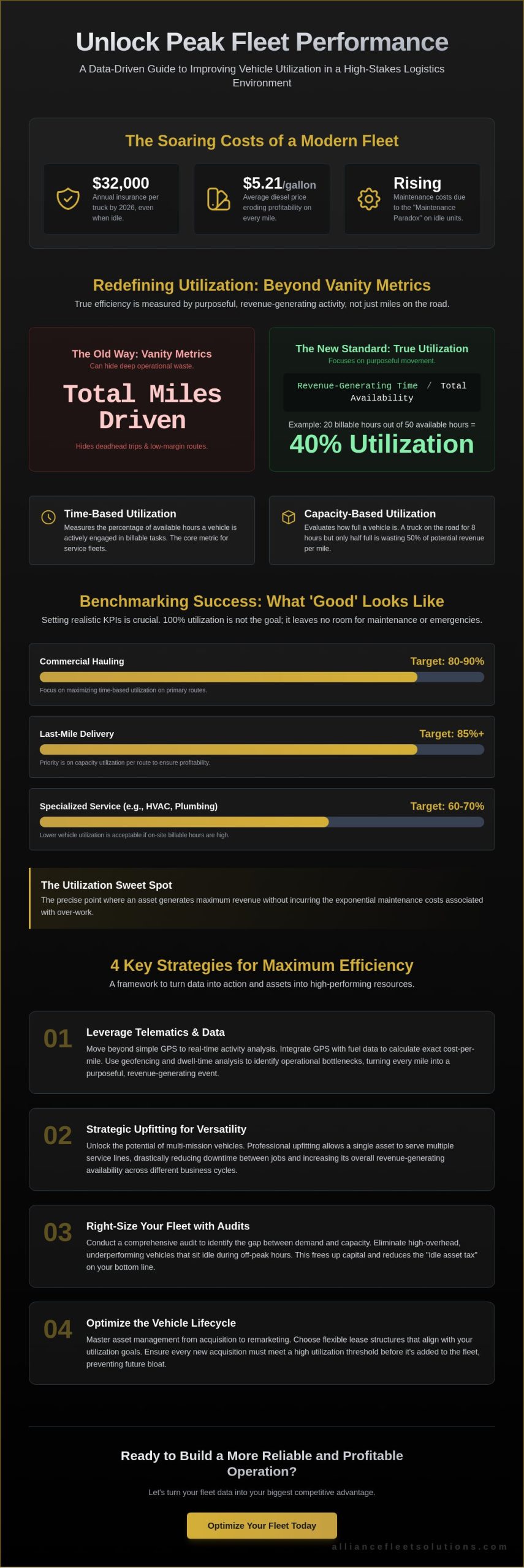
Did you know that in 2026, a single commercial truck can cost up to $32,000 annually just to insure, even if it spends half the week sitting idle? It’s a common frustration for fleet managers who see overhead climb while assets remain stationary during off-peak hours. You likely feel the pressure to justify your fleet size to stakeholders, especially with diesel prices averaging $5.21 per gallon and maintenance costs rising for older units. Learning how to improve vehicle utilization is no longer just an operational goal; it’s a financial necessity for survival in a high-stakes logistics environment.
We understand that you need more than just a spreadsheet. You need a strategic partnership and a clear roadmap to efficiency. This guide promises to show you how to eliminate idle time and reduce your total cost of ownership through data-driven management. We will preview a framework for measuring performance, strategies for right-sizing your fleet without compromising service, and ways to use telematics to turn technical data into business solutions. Let’s build a more reliable, profitable operation together.
Key Takeaways
- Move beyond vanity metrics like mileage to measure the ratio of revenue-generating time against total availability.
- Learn how to improve vehicle utilization by using telematics to pinpoint dormancy hotspots and turn real-time data into actionable route adjustments.
- Unlock the potential of multi-mission vehicles through professional upfitting, ensuring your assets can serve multiple service lines with minimal downtime.
- Identify the gap between demand and capacity with a right-sizing audit to eliminate high-overhead vehicles that sit idle during off-peak hours.
- Master the vehicle lifecycle by choosing lease structures that offer flexibility and ensuring every new acquisition meets a high utilization threshold.
Defining Vehicle Utilization in the 2026 Logistics Landscape
The Hidden Costs of Underutilized Assets
Underutilization is a silent drain on capital. You continue to pay for depreciation and lease payments on vehicles that aren’t moving, locking up funds that could drive business growth. There is also the “maintenance paradox.” Idle vehicles often require more frequent repairs than those in regular use. Seals dry out, batteries lose charge, and fluids degrade when they don’t reach operating temperatures. The Economics of car use shows that fixed costs like insurance and registration remain constant regardless of activity, making every stationary hour a direct hit to your bottom line. We see this as an opportunity to reallocate capital into higher-performing assets.
Benchmarking Success: What Does ‘Good’ Look Like?
Benchmarks vary by sector, but most commercial fleets should aim for a specific target. While a specialized service vehicle might only hit 60% due to on-site labor time, a delivery fleet should strive for 85% or higher. Setting realistic KPIs depends on your specific business cycle and service area. You don’t want 100% utilization, as that leaves no room for preventative maintenance or emergency calls.
- Commercial Hauling: Aim for 80-90% time-based utilization.
- Last-Mile Delivery: Focus on 85% capacity utilization per route.
- Specialized Service: Prioritize 60-70% utilization with high on-site billable hours.
The Utilization Sweet Spot is the precise point where an asset generates maximum revenue without incurring the exponential maintenance costs associated with over-work.
Leveraging Telematics and Data for Real-Time Visibility
In 2026, simply knowing where your trucks are isn’t enough to stay competitive. High-performing fleets have moved beyond basic location tracking to focus on real-time activity analysis. We now look at what a truck is doing at every moment of the shift. Predictive analytics have become the industry standard, allowing managers to anticipate maintenance needs and reassign tasks before a vehicle becomes a liability. By analyzing how to improve vehicle utilization through the lens of real-time activity, you can transform a reactive schedule into a proactive strategy.
Data integration is the key to this transition. By cross-referencing GPS coordinates with fuel management data, you can calculate the exact cost-per-mile for every asset in your fleet. This level of visibility helps you identify dormancy hotspots where vehicles sit for extended periods without contributing to the bottom line. It’s about turning every mile into a purposeful, revenue-generating event.
Telematics: Beyond Simple GPS Tracking
Modern telematics systems monitor the delta between engine hours and ignition time. If a vehicle’s engine is running but it isn’t moving, you’re losing money to excessive idling and unnecessary wear. We use geofencing to conduct “dwell time” analysis at customer sites and warehouses. If your drivers are consistently stuck at a specific loading dock for three hours, that’s an operational bottleneck, not a vehicle failure. Understanding How Telematics Transform Fleet Efficiency is the first step toward reclaiming that lost productivity and ensuring your drivers stay on schedule.
Turning Raw Data into Actionable Fleet Insights
Raw data is only valuable if your team can use it. We recommend creating a weekly Utilization Scorecard that highlights the performance of each asset. This report helps you identify “Ghost Assets”—vehicles that are officially assigned to a route but rarely leave the yard. These are the primary targets for remarketing or reallocation. A solid fleet management framework emphasizes that data must drive decisions regarding right-sizing and mileage reduction.
When you have this level of insight, justifying vehicle acquisition or disposal to stakeholders becomes a matter of facts rather than intuition. If you’re ready to gain this level of visibility, our Telematics and GPS Solutions provide the granular data needed to transform your operations. This data-driven approach is a critical component of how to improve vehicle utilization across the entire lifecycle of your fleet.
Strategic Upfitting and Maintenance: Maximizing Asset Versatility
While telematics identify where your operational gaps are, strategic upfitting provides the physical capability to fill them. Many managers overlook the fact that a vehicle’s utility is often limited by its internal configuration. If a van is built for a single specialized task, it will inevitably sit idle when that specific demand drops. Professional upfitting solves this by creating multi-mission vehicles that can transition between different service lines or seasonal requirements. When you analyze how to improve vehicle utilization, you must look at the physical versatility of the asset itself.
By designing modular interiors, one vehicle can serve as a mobile workshop in the morning and a delivery unit in the afternoon. This flexibility ensures that the asset remains in motion regardless of the specific job ticket. It transforms the vehicle from a single-purpose tool into a strategic business asset that adapts to your daily needs.
Upfitting for Multi-Purpose Utilization
Effective upfitting involves designing vehicle interiors that adapt to changing seasonal demands. For instance, removable bin systems and adjustable shelving allow a technician to swap out equipment kits in minutes. We have seen this strategy yield significant results; in one case, customized upfitting allowed a client to reduce their total fleet size by 15% because each vehicle could handle a wider variety of tasks.
Beyond daily efficiency, professional upfitting also impacts your long-term financial performance. High-quality, durable equipment protects the interior of the vehicle and can often be transferred to a new chassis during a cycle. This maintains the vehicle’s condition, which directly supports a higher remarketing value when it is time to sell. It is a proactive approach that maximizes value at both ends of the lifecycle.
Minimizing Downtime to Protect Utilization Rates
Maintenance is the other half of the utilization equation. You can’t utilize a truck that is stuck in the shop. A structured maintenance management program ensures that service is proactive rather than reactive. According to 2026 industry data, only 53.7% of fleet maintenance is currently scheduled. This means nearly half of all repairs are unexpected, causing massive dips in asset availability.
We advocate for an “Uptime Guarantee” mindset, where maintenance management keeps wheels turning by identifying potential failures before they cause a breakdown. Scheduling service during off-peak hours or weekends is a simple but effective way to avoid utilization dips during your busiest windows. For a deeper dive into these strategies, read our Strategic Guide to Maintenance Management. By coordinating these efforts, you ensure that your fleet is always ready for the next mission, which is a fundamental step in how to improve vehicle utilization across your entire operation.
Right-Sizing and Fractional Management Strategies
Building a resilient fleet doesn’t mean having a truck for every possible scenario. It means having exactly enough capacity to meet demand without leaving capital rotting in the yard. Many businesses maintain a surplus of vehicles just to handle their busiest week of the year, but this approach leads to massive overhead. Right-sizing is the strategic process of aligning your fleet capacity with actual service demand. By identifying the delta between your current inventory and your actual needs, you can eliminate the “idle asset tax” we discussed earlier. One effective method is implementing a pool vehicle system for non-dedicated assets, which allows multiple departments to share a single unit and ensures that support vehicles stay in motion.
Managing seasonal surges without over-procuring requires a shift in how you view vehicle acquisition. Instead of buying assets for peak periods, successful managers use flexible leasing models to scale up and down as needed. When you master how to improve vehicle utilization through right-sizing, you stop paying for potential and start paying for performance.
The Fractional Management Advantage
Many B2B fleets aren’t large enough to justify a full-time, six-figure fleet manager, yet they still face complex operational challenges. This is where fractional fleet management provides a distinct competitive advantage. You get expert oversight and objective utilization audits without the burden of a full-time salary. These specialists act as a supportive partner, using data to negotiate better lease terms and identify where capital is locked in underperforming steel. If you need this level of professional oversight to streamline your operations, explore our Fractional Fleet Management services to start optimizing your asset performance today.
Executing a Fleet Right-Sizing Plan
Execution starts with a 90-day utilization review. This step-by-step process evaluates every asset based on revenue generation and engine hours. If an asset consistently falls below your established benchmarks, it is a candidate for disposal or reallocation. We recommend the following steps for a successful audit:
- Data Collection: Gather 90 days of telematics and fuel data to establish a baseline.
- Asset Ranking: Rank vehicles by their revenue-per-mile and total hours of operation.
- Gap Analysis: Identify vehicles that are used less than 50% of their available time.
- Decision Phase: Decide whether to sell the asset through vehicle remarketing or move it to a high-demand region.
Reallocating underused assets to different departments is a practical way to address how to improve vehicle utilization without increasing your total cost of ownership. This proactive approach ensures that every vehicle in your fleet is earning its keep, providing the essential backbone for a functional and profitable operation.
Optimizing the Lifecycle: Acquisition to Remarketing
The journey toward peak efficiency begins long before a driver turns the key. True lifecycle management treats vehicle acquisition not as a simple purchase, but as a strategic investment in capacity. To master how to improve vehicle utilization, you must adopt a disciplined acquisition strategy: don’t add an asset to your fleet unless data proves you can utilize it at 85% capacity or higher. Buying for “worst-case scenarios” or “just-in-case” spikes is a recipe for the high overhead and idle time we’ve addressed throughout this guide.
Alliance Fleet Solutions acts as a strategic bridge during this process. We help you evaluate the technical requirements of your routes and match them with the right assets. This ensures that every new vehicle is perfectly suited for its intended mission, reducing the likelihood of it becoming a “Ghost Asset” that drains your margins while sitting in the yard. By starting with the right equipment, you set the foundation for long-term reliability and safety.
Leasing Models that Support Utilization
Your financial structure dictates your operational flexibility. For many B2B fleets, Open-End Leasing is the superior choice for maximizing utilization. Unlike Closed-End Leasing, which often imposes rigid mileage limits and strict term lengths, an open-end structure allows you to adjust your fleet size as market demands shift. If a specific service line underperforms, you can terminate the lease and move the capital elsewhere without the restrictive penalties of traditional models.
Aligning your lease terms with the projected utility of the vehicle is essential. If you know a truck’s primary mission will evolve or end in three years, your lease should reflect that reality. For a deeper look at how these financial structures fit into a broader growth strategy, see our Comprehensive Fleet Management Services Guide. This approach ensures your fleet remains agile and responsive to the fast-paced logistics sector.
Remarketing: Turning Underutilization into Capital
Vehicle remarketing is the ultimate solution for assets that no longer meet your utilization benchmarks. There’s a precise moment when an asset’s depreciation begins to outpace its utility, and missing that window can cost your business thousands in resale value. We help you identify this exit point by monitoring maintenance trends and market demand. Professional remarketing isn’t just about disposal; it’s about maximizing the return on your investment through expert control of the sales process.
By closing the loop, you can use the proceeds from remarketing to fund more efficient, upfitted assets that better serve your current needs. This creates a self-sustaining cycle of optimization. When you treat disposal as a strategic move rather than an afterthought, you solve the problem of how to improve vehicle utilization by ensuring every dollar of capital is tied to a high-performing asset. This disciplined approach is the backbone of a truly functional, profitable operation.
Take Control of Your Fleet Performance
Operational excellence requires moving beyond simple tracking to active asset management. By integrating telematics with strategic lifecycle planning, you ensure every vehicle in your yard is either generating revenue or being prepared for disposal. Understanding how to improve vehicle utilization gives you the power to justify costs to stakeholders and protect your bottom line against rising fuel and insurance premiums. It’s about making your capital work as hard as your drivers do every day.
Alliance Fleet Solutions is your dedicated partner in this journey. We offer the expert oversight of Fractional Fleet Management, the versatility of custom Professional Upfitting, and the reach of a national Remarketing Network to help you stay ahead of the competition. Optimize your fleet today with a professional utilization audit from Alliance Fleet Solutions.
You have the data and the strategy. Now, it’s time to turn those insights into a more profitable, reliable operation. We look forward to building a more efficient future alongside you.
Frequently Asked Questions
What is a good vehicle utilization rate for a commercial fleet?
A target utilization rate typically falls between 80% and 90% for standard delivery fleets, though specialized service vehicles may aim for 60% to 70% due to on-site labor requirements. These benchmarks represent the ratio of revenue-generating time against total availability. High-performing managers track these specific percentages to ensure that capital isn’t wasted on stationary assets that continue to accrue insurance and depreciation costs without providing a return.
How can telematics help specifically with vehicle utilization?
Telematics provide granular data on engine hours, ignition time, and idle periods, allowing you to see exactly when an asset isn’t moving. By identifying dormancy hotspots and dwell times at client locations, you can adjust routes to maximize active time. This data-driven approach is a primary tool for discovering how to improve vehicle utilization across complex, multi-region operations, transforming raw GPS coordinates into actionable business intelligence.
Is it better to have a smaller fleet with high utilization or a larger fleet with more flexibility?
A smaller, high-utilization fleet is almost always more profitable because it minimizes fixed costs like insurance, registration, and depreciation. While operational flexibility is important, you should achieve it through flexible leasing models or pool systems rather than maintaining idle backup vehicles. This lean strategy keeps your overhead low while ensuring every truck on the road is earning its keep, ultimately protecting your margins from the high cost of underused steel.
How does vehicle upfitting impact my fleet’s utilization?
Professional upfitting turns single-purpose vans into multi-mission assets that can handle different types of service calls throughout the week. By using modular shelving and specialized equipment, one vehicle can serve multiple departments or adapt to changing seasonal needs. This physical versatility reduces the need for redundant assets and ensures that your fleet remains active even as specific task demands fluctuate, allowing you to do more work with fewer vehicles.
What are the first signs that my fleet is underutilized?
The most obvious signs include consistent “Ghost Assets” that rarely leave the yard and a high ratio of engine hours compared to billable time. You might also notice rising maintenance costs for older, stationary vehicles or difficulty justifying your current lease payments to stakeholders during budget reviews. These symptoms indicate a clear gap between your current capacity and actual service demand, suggesting that your fleet is larger than your operations require.
Can fractional fleet management really improve my bottom line?
Fractional fleet management provides the expertise of a seasoned professional to conduct objective audits and negotiate better lease terms for your business. It allows mid-sized operations to access high-level strategic planning without the expense of a full-time executive salary. This expert oversight helps you identify how to improve vehicle utilization by pinpointing operational waste, optimizing your maintenance schedules, and streamlining your vehicle remarketing process for better capital recovery.
How often should I conduct a fleet utilization audit?
We recommend a comprehensive review every 90 days to stay ahead of market shifts and seasonal demand changes. A quarterly audit allows you to rank assets by revenue-per-mile and identify underperformers before they become a significant financial drain. This steady, logical rhythm ensures your fleet remains right-sized and responsive to your current business goals, mirroring the organized nature of a well-run maintenance schedule and preventing long-term waste.
What is the difference between vehicle utilization and vehicle productivity?
Utilization measures the time or capacity an asset is active, while productivity measures the specific output or revenue generated during that active time. A truck can have 100% utilization but low productivity if it is stuck in traffic or performing low-margin deliveries. Strategic management focuses on aligning both metrics to ensure that every active hour is also a highly profitable one, maximizing the return on every mile driven by your assets.