
If your fleet’s average operating cost has climbed toward the 2025 ATRI benchmark of $2.26 per mile, do you know exactly which line items are driving that surge? Most leaders feel buried under a mountain of telematics data, yet they still struggle to answer the board’s questions about bottom-line impact. It’s a common frustration. You have more visibility than ever, but less clarity on actual profit margins. Mastering fleet management reporting for executives is no longer about tracking GPS coordinates; it’s about translating every hard braking event and fuel transaction into a clear narrative of financial risk and operational opportunity.
We understand the pressure of justifying major capital investments while navigating the strict new FMCSA rules implemented in February 2026. This guide will show you how to cut through the noise and transform fragmented reports into a strategic ROI engine. You’ll learn to identify the high-level metrics that matter to the C-suite, from mitigating the $19,000 risks of DVIR falsification to optimizing your 2026 growth strategy. We’ll outline a streamlined framework that turns your operational data into a powerful tool for long-term fleet efficiency and boardroom confidence.
Key Takeaways
- Shift your focus from tactical vehicle monitoring to strategic fleet management reporting for executives to ensure every data point supports your 2026 growth goals.
- Identify the critical KPIs that drive bottom-line ROI, such as Total Cost of Ownership (TCO) per mile and asset utilization rates, to eliminate “ghost” vehicles that drain capital.
- Understand the four pillars of executive reporting—financial integrity, operational efficiency, risk mitigation, and sustainability—to build a comprehensive view of fleet health.
- Establish a streamlined reporting framework and cadence that aligns with your core business objectives, whether you are focused on cost-cutting or aggressive expansion.
- Discover how fractional fleet management and professional analysis bridge the gap between complex field operations and the high-level insights required in the boardroom.
Beyond the Odometer: Why Executives Need Strategic Fleet Reporting
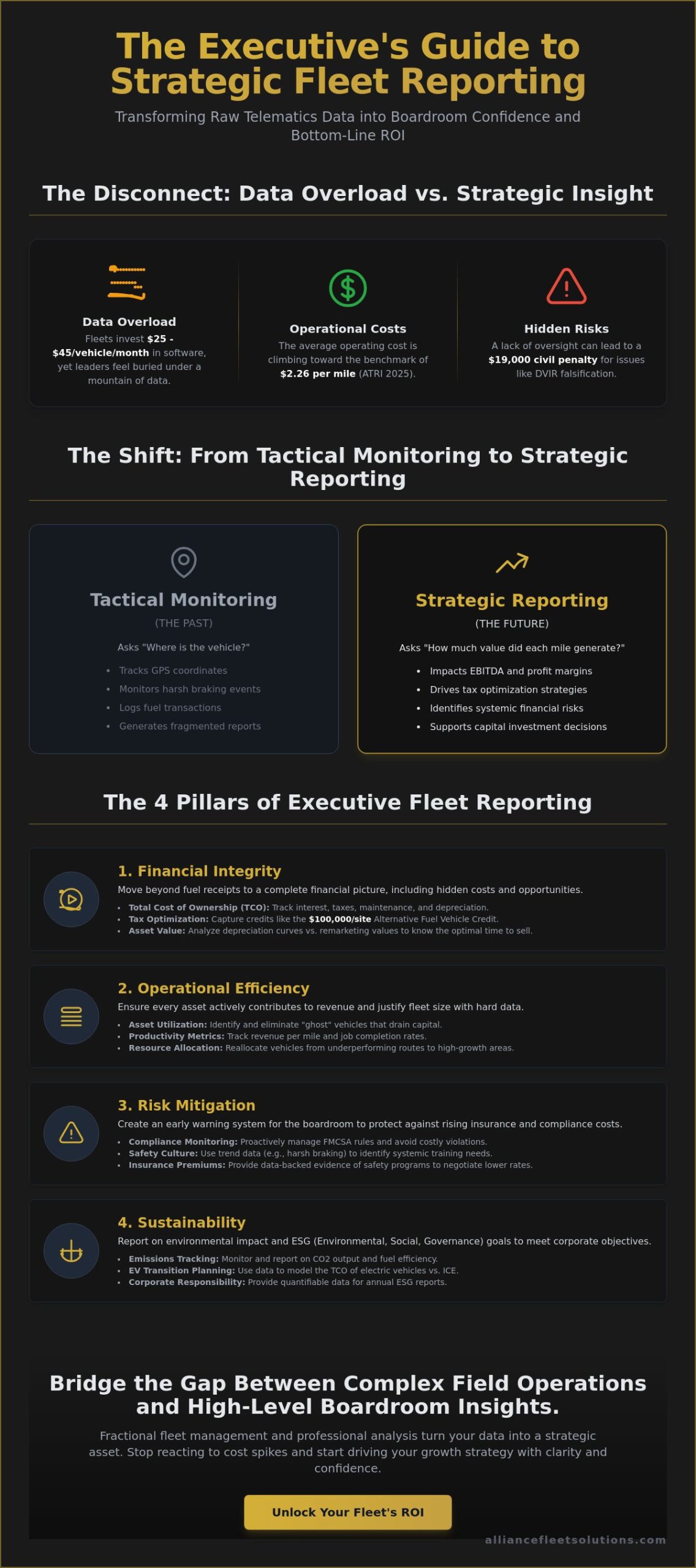
Tactical fleet monitoring tells you where a vehicle is at 2:00 PM. Strategic fleet management reporting for executives tells you how that vehicle’s movement impacts your EBITDA. In 2026, the gap between having data and having insights has widened. While telematics systems provide thousands of pings per hour, most executive teams struggle to connect these metrics to corporate KPIs like revenue per mile or tax optimization. To understand the full scope of these responsibilities, it helps to look at the broad definition of What is Fleet Management, which encompasses everything from vehicle tracking to complex maintenance schedules and financial oversight.
The financial consequences of reporting gaps are steep. Without a high-level view, hidden costs like accelerated depreciation and missed tax deadlines can erode profit margins. For instance, the June 30, 2026, deadline for the Alternative Fuel Vehicle Refueling Property Credit represents a 30% tax credit that requires precise documentation. If your reporting doesn’t flag these opportunities, you’re leaving up to $100,000 per site on the table. Effective fleet management reporting for executives serves as the bridge between raw operational data and the boardroom’s financial objectives.
Data alone solves nothing. When reports fail to account for rising insurance premiums or the 2026 FMCSA penalties, the board receives an incomplete picture of the company’s risk profile. Strategic reporting shifts the conversation from “how many miles did we drive?” to “how much value did each mile generate?” This alignment ensures that fleet performance is no longer an isolated operational metric but a core component of the company’s financial health.
The Data-Information Gap in Fleet Management
In 2026, mid-range fleet software costs between $25 and $45 per vehicle every month. Despite this investment, many leaders suffer from data overload. The C-suite doesn’t need a list of every harsh braking event; they need to know if those events indicate a systemic risk that could lead to a $19,000 civil penalty for DVIR falsification. Raw telematics data requires a layer of professional analysis to separate the signal from the noise. In a high-inflation environment, delayed reporting means you’re reacting to cost spikes weeks after they’ve already damaged your bottom line.
Fleet as a Strategic Asset vs. a Cost Center
Shifting the executive mindset from expense management to asset optimization is critical for long-term growth. This shift supports efficient fleet operations by ensuring that every dollar spent on acquisition or maintenance is tied to a measurable financial outcome. Strategic reporting provides the evidence needed to justify fleet expansion or downsizing. It identifies “ghost” vehicles that drain capital without contributing to revenue, allowing you to reallocate resources to high-performing routes and assets.
The 4 Pillars of Executive Fleet Management Reporting
Effective fleet management reporting for executives organizes complex logistics data into four distinct pillars: Financial Integrity, Operational Efficiency, Risk Mitigation, and Sustainability. While fleet managers handle the daily grind of dispatch and repairs, executives must view the fleet through these high-level lenses to protect the company’s capital. Forbes provides a comprehensive guide to fleet management that outlines these core responsibilities. In 2026, the stakes are higher than ever. With rising insurance premiums and tightening federal oversight, your reporting framework must act as an early warning system for the boardroom.
Financial Integrity and TCO Analysis
True financial visibility goes far beyond tracking fuel receipts. A strategic report must account for Total Cost of Ownership (TCO), which includes interest rates, tax liabilities, and the specific “tipping point” where a vehicle’s maintenance costs exceed its remaining value. Executives need to see how fuel management programs impact the P&L in real-time, especially as fuel prices fluctuate. By analyzing depreciation curves against current vehicle remarketing values, you can determine exactly when to cycle assets to maximize your return on investment. If you are struggling to find this clarity, partnering with a strategic fleet management team can provide the expert-level analysis required to optimize your capital allocation.
Risk Mitigation and Safety Reporting
In February 2026, the FMCSA implemented strict new rules regarding digital trails and mechanic signature verification. Executive reports must now prioritize compliance metrics to avoid devastating civil penalties. For example, a single HOS violation now carries a maximum penalty of $16,000. Your dashboard should translate driver behavior scores into tangible insurance premium savings. Using maintenance management as a liability shield is a critical strategy; it proves a proactive commitment to safety during roadside audits. Reports should highlight “red flags” like recurring DVIR falsifications before they trigger a full-scale federal audit.
The final pillar, Sustainability and Future-Proofing, is no longer a “nice-to-have” metric. As of 2026, Environmental, Social, and Governance (ESG) reporting is a priority for 46.1% of fleet managers. Executives must track the feasibility of EV transitions, keeping a close eye on the June 30, 2026, deadline for the Alternative Fuel Vehicle Refueling Property Credit. This 30% tax credit is a significant financial lever that requires precise reporting on charging installation costs. By grouping data into these four pillars, fleet management reporting for executives transforms from a technical chore into a powerful strategic asset.
KPIs that Drive ROI: The Executive Dashboard for 2026
A standard operations report shows you what happened yesterday. A strategic dashboard shows you where your capital is leaking. For the C-suite, fleet management reporting for executives must prioritize lifecycle value over daily activity logs. With the average cost of operating a truck reaching $2.26 per mile in 2025, every decimal point represents a significant impact on your annual EBITDA. To build a dashboard that actually drives decisions, you must look beyond the odometer and focus on metrics that reflect the true health of your assets. This approach aligns with the foundational principles found in a comprehensive guide to fleet management, which emphasizes the shift toward data-driven oversight.
Decoding TCO for the C-Suite
Total Cost of Ownership (TCO) per mile is the ultimate metric for any executive. A true TCO report doesn’t just track fuel and maintenance; it integrates acquisition costs, professional upfitting, interest, and eventual disposal values. Focusing solely on the purchase price is a common mistake that leads to poor long-term planning. By analyzing TCO data, you can make informed decisions between open-end and closed-end leasing structures. For example, if your TCO per mile is rising due to high maintenance on older vehicles, it signals a need for a more aggressive cycling strategy rather than just another repair bill. This lifecycle visibility allows you to treat your fleet as a revolving capital asset rather than a static expense.
Utilization and Productivity Metrics
Asset utilization identifies the “ghost” vehicles in your fleet—those assets that drain capital while sitting idle. In 2026, optimal utilization isn’t just about keeping wheels moving; it’s about ensuring each vehicle is assigned to its most profitable route. Telematics data provides the raw evidence, but your reporting must translate this into a percentage of capacity. When utilization rates drop below your industry’s benchmark, it provides clear justification for vehicle remarketing or fleet downsizing. High-performing organizations use these insights to optimize driver uptime, often leveraging comprehensive fleet management services to bridge the gap between field data and executive strategy.
Finally, tracking maintenance cost as a percentage of revenue provides a clear view of operational drag. If this ratio climbs, it indicates that your fleet is becoming a liability rather than an engine for growth. By monitoring remarketing value retention, you can measure the success of your initial acquisition strategy. Did those specific upfitting choices pay off at the auction block? Strategic reporting answers these questions, ensuring that your 2026 fleet management reporting for executives delivers more than just data; it delivers a clear path to sustained financial performance.
Building an Actionable Reporting Framework
A framework is a blueprint for decision-making. Without a clear definition of your core business objectives, even the most advanced telematics system will generate nothing more than expensive noise. Building a high-impact structure for fleet management reporting for executives begins with identifying whether your primary goal for 2026 is aggressive growth, radical cost-cutting, or strict risk reduction. Once your objectives are set, you must establish a reporting cadence that respects the executive schedule. Monthly summaries provide the pulse of the operation, while quarterly reviews allow for deeper dives into asset lifecycle strategy and capital allocation.
Successful integration requires merging multi-source data into a single source of truth. Your framework should pull from telematics, fuel card programs, and lease provider portals to create a 360-degree view of the fleet. This level of visibility ensures that when you present to the board, you aren’t just guessing at the impact of rising operational costs. You’re providing a data-backed narrative that connects field activity to the balance sheet. If your current systems lack this level of integration, partner with Alliance Fleet Solutions to build a custom reporting framework that aligns with your 2026 growth targets.
The Power of Exception Reporting
Executives don’t have time to sift through thousands of routine data points. They need to see the outliers. Exception reporting filters out the “normal” parameters of your fleet and highlights only the metrics that fall outside of your established thresholds. For example, you might set alerts for fuel variance exceeding 5% or maintenance overages that spike beyond your quarterly budget. By focusing on these high-impact strategic corrections, you reduce the noise and allow the C-suite to address systemic issues before they become financial liabilities. This proactive approach is the backbone of expert-level fleet oversight.
Visualizing Data for Faster Decision-Making
The way you present data is just as important as the data itself. Executive slide decks should favor heat maps and trend lines over dense spreadsheets. Heat maps can quickly identify geographic regions where idling is draining fuel budgets, while YoY performance comparisons show how your fleet stacks up against 2025 industry benchmarks. Trend lines provide far more strategic value to executives than static data points because they reveal the direction of fleet efficiency and financial health over time. This visual clarity ensures that your fleet management reporting for executives facilitates rapid, confident decision-making during high-stakes board meetings.
Leveraging Alliance Fleet Solutions for Executive Insight
Alliance Fleet Solutions understands that the most sophisticated telematics system is only as good as the decisions it informs. We bridge the gap between the granular data of field operations and the strategic requirements of the boardroom. By providing professional fleet management reporting for executives, we ensure that your team isn’t just seeing numbers, but clear paths toward financial optimization. Whether you’re managing a local delivery fleet or a complex national operation, our role is to act as your strategic backbone. We handle the technical complexities of asset lifecycle management so you can focus on high-level growth.
Fractional Management: Expert Analysis Without the Overhead
Fractional Fleet Management offers a solution for companies that need expert-level analysis without the overhead of a full-time executive fleet director. Our team acts as your partner, translating raw telematics and fuel data into actionable executive summaries. This service is especially vital for fleets requiring professional upfitting, where customized reporting must track the ROI of specific equipment configurations. By outsourcing the heavy lifting of data synthesis, your leadership team regains hundreds of hours previously lost to fragmented spreadsheets. We maintain reporting consistency across your entire national footprint, ensuring every asset follows the same efficiency benchmarks regardless of location.
Your 2026 Fleet Strategy Starts with Data
In the fast-paced logistics sector of 2026, a data-literate operation is your greatest competitive advantage. We help you move beyond reactive maintenance toward predictive reporting models that anticipate failures before they lead to downtime. This proactive approach maximizes ROI through data-driven vehicle remarketing and acquisition strategies. We analyze market trends to ensure you cycle your assets at the peak of their value, avoiding the steep depreciation curves that drain corporate capital. Your 2026 strategy shouldn’t rely on guesswork; it should be grounded in expert control and reliable partnership.
Don’t let fragmented reports hide the true cost of your operation. Contact Alliance Fleet Solutions for a Strategic Reporting Audit and turn your raw data into a powerful business solution today.
Mastering the Future of Fleet Strategy
Transitioning from raw telematics to high-level insights is the only way to protect your margins as operating costs continue to rise. We’ve explored how focusing on the four pillars of financial integrity, operational efficiency, risk, and sustainability provides the visibility needed to satisfy the board. By prioritizing exception reporting and clear data visualization, you can cut through the noise and address systemic issues before they impact your EBITDA.
Implementing a robust framework for fleet management reporting for executives isn’t just a technical upgrade; it’s a strategic necessity for 2026. Alliance Fleet Solutions provides the expert fractional fleet management and comprehensive TCO analysis you need to optimize every asset in your portfolio. With our national US service coverage, we act as a dependable partner to ensure your reporting is consistent, accurate, and actionable across all locations.
Don’t let valuable insights stay buried in your software. Optimize Your Executive Reporting with Alliance Fleet Solutions. Your data holds the key to significant ROI, and we’re ready to help you unlock it.
Frequently Asked Questions
What are the most important KPIs for fleet executives to monitor?
The most critical KPIs for executives include Total Cost of Ownership (TCO) per mile, asset utilization rates, and maintenance cost as a percentage of revenue. These metrics provide a high-level view of capital efficiency rather than just daily operational activity. Tracking these allows leadership to identify financial leaks and determine the precise moment to cycle vehicles for maximum remarketing value and capital recovery.
How often should an executive review fleet management reports?
Executives should review high-level summaries on a monthly basis, with more comprehensive strategic reviews conducted quarterly. The monthly cadence ensures you stay ahead of cost spikes and compliance risks, such as the 2026 FMCSA digital trail requirements. Quarterly reviews focus on long-term capital allocation, lease compliance, and evaluating the success of your vehicle acquisition strategy against 2026 growth goals.
What is the difference between operational and strategic fleet reporting?
Operational reporting focuses on daily tasks like route completion and real-time GPS tracking, while strategic reporting translates that data into financial and risk-mitigation insights. Strategic fleet management reporting for executives prioritizes lifecycle value, tax optimization, and insurance liability. It moves beyond vehicle locations to analyze how the fleet’s performance impacts your corporate EBITDA and long-term asset health.
Can fleet reporting help reduce corporate insurance premiums?
Reporting helps reduce insurance premiums by providing documented evidence of a proactive safety culture and lower risk profiles. By presenting insurers with consistent data on reduced harsh braking and improved driver behavior scores, you demonstrate a commitment to risk mitigation. In 2026, insurers increasingly favor carriers who can provide a digital trail of rigorous maintenance management and driver oversight to prevent high-cost accidents.
How do I calculate the true Total Cost of Ownership (TCO) for my fleet?
True Total Cost of Ownership is calculated by aggregating all expenses from vehicle acquisition and professional upfitting to fuel, maintenance, interest, and taxes, then subtracting the eventual remarketing value. It’s essential to include costs like administrative overhead and downtime impacts. This comprehensive view ensures you aren’t misled by a low initial purchase price, allowing for more accurate budgeting and capital planning.
What should I look for in a fleet management dashboard?
A high-quality executive dashboard should feature clear data visualization, multi-source integration, and robust exception reporting. You need a system that pulls data from telematics, fuel card programs, and lease providers into a single source of truth. Look for trend lines and heat maps that allow you to identify outliers quickly, ensuring you only spend time on data that requires a strategic correction or decision.
How does telematics data integrate into executive financial reports?
Telematics data integrates into financial reports by providing the empirical evidence needed to validate fuel management programs and asset utilization claims. This raw data is synthesized into high-level metrics that justify capital expenditures or fleet expansions. For executives, this integration ensures that financial forecasts are based on actual field performance rather than historical estimates, leading to more reliable 2026 growth projections.
What is exception reporting and why is it useful for CEOs?
Exception reporting is a filtering method that only highlights data points falling outside of predefined parameters, such as a 10% spike in maintenance costs. This is useful for CEOs because it eliminates data noise and focuses leadership attention on high-impact issues. Effective fleet management reporting for executives uses these alerts to trigger immediate strategic reviews, ensuring that systemic operational failures are handled swiftly and correctly.