
With the total cost of employing a full-time fleet manager now exceeding $130,000 per year, many mid-sized operations feel trapped between rising overhead and the need for expert oversight. You have likely felt the direct impact of fuel prices averaging $4.57 per gallon and the constant stress of uncontrolled maintenance spending. It is frustrating to manage a high-stakes logistics operation when operational downtime and a lack of clear replacement data keep you from making confident decisions. We understand that every dollar counts. You need a solution that acts as a strategic backbone for your business rather than just another line item on the balance sheet.
By accurately calculating the ROI of a fractional fleet manager, you can transform these operational headaches into a quantifiable competitive advantage. This 2026 guide provides a clear, dollar-for-dollar justification for professionalized management. You will learn how to slash your Total Cost of Ownership (TCO) by capturing the 20% to 30% in cost leakage that often goes unnoticed in unmanaged fleets. We will preview the specific financial impacts on fuel and maintenance, explain how to professionalize your reporting for stakeholders, and show you why a partnership model is the most reliable way to boost your bottom line.
Key Takeaways
- Identify the hidden costs of “accidental” fleet management and how missed preventative maintenance creates expensive operational downtime.
- Distinguish between hard savings in fuel and procurement and strategic gains like risk mitigation and reclaimed administrative time.
- Follow a structured, two-step framework for calculating the ROI of a fractional fleet manager by establishing a TCO baseline and isolating budget leakage.
- Compare the cost-efficiency of fractional expertise against the high overhead of full-time executive salaries for fleets under 100 units.
- Learn why a strategic partnership model utilizing telematics and fuel programs delivers a higher return than standalone software solutions.
The True Cost of the ‘Accidental’ Fleet Manager
Many business owners don’t set out to be fleet experts. Instead, they become “accidental” fleet managers by necessity. This role usually falls to an overworked operations manager or the owner themselves, who must squeeze vehicle oversight into an already packed schedule. While it might seem like you’re saving money by keeping these tasks in-house, the reality is often the opposite. When you begin calculating the ROI of a fractional fleet manager, you must first account for the massive opportunity cost of your team’s time. Every hour spent on vehicle titles, fuel card disputes, or coordinating repairs is an hour taken away from growing your business and serving your customers.
DIY management often results in a significantly higher Total Cost of Ownership (TCO). Without professional oversight, preventative maintenance schedules are the first thing to slip. A missed inspection or delayed service doesn’t just increase the risk of a breakdown; it creates a cycle of reactive repairs that are far more expensive than proactive upkeep. Professional fleet management ensures that these tasks are handled systematically, protecting your assets and your budget from the high price of neglect.
Hidden Costs of Unprofessional Lifecycle Management
Unprofessional management leads to “leakage” at every stage of a vehicle’s life. During acquisition, accidental managers often pay retail prices because they lack the time or industry connections to leverage fleet incentives. On the back end, poor vehicle remarketing can cost a company thousands of dollars per unit. If you don’t know the optimal time to sell or the best channels to use, you’re leaving money on the table. Fuel leakage is another silent budget killer. Without telematics data to monitor idling or unauthorized spending, fuel costs can spiral out of control, especially with 2026 prices averaging $4.57 per gallon.
The Stress of Operational Downtime
Operational downtime is a primary pain point for any logistics-heavy business. When a vehicle is off the road, the hourly cost isn’t just the repair bill. It includes lost revenue, driver wages for idle time, and potential late fees from clients. Reactive maintenance cycles destroy your ability to predict cash flow and meet deadlines. A fractional fleet manager shifts your operation from a defensive posture to a proactive one. By using data to predict when a vehicle needs service, they ensure that maintenance happens on your schedule, not the vehicle’s. This expert control keeps your fleet moving and your stakeholders satisfied.
The ROI Framework: Hard Savings vs. Strategic Gains
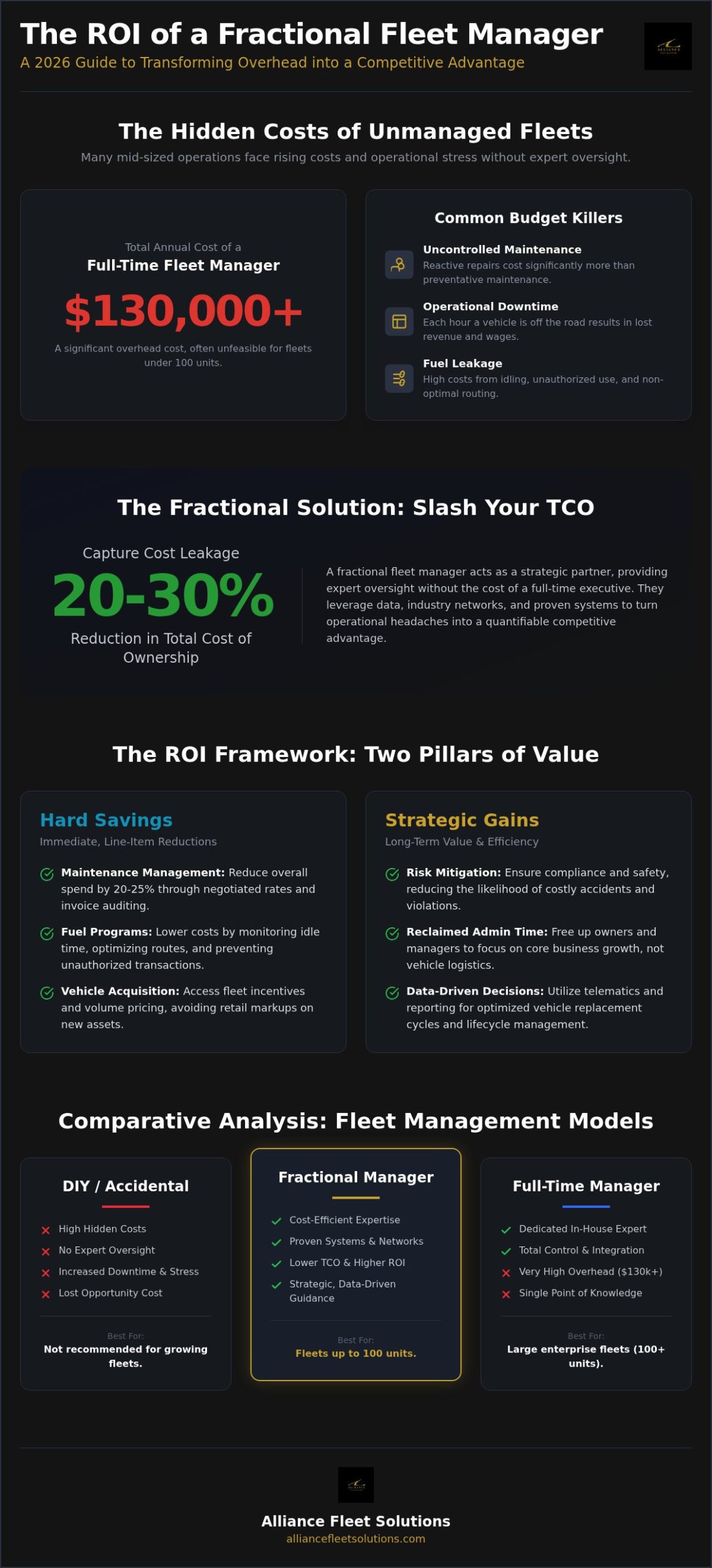
When calculating the ROI of a fractional fleet manager, it’s vital to look beyond simple cost-cutting. While software provides visibility, an expert partner provides execution. We categorize return on investment into two distinct pillars: hard savings and strategic gains. Hard savings represent the immediate, line-item reductions in your budget. Strategic gains build long-term value through risk mitigation, time reclamation, and operational efficiency. Both are essential for a healthy bottom line.
Accessing institutional knowledge is a primary driver of these gains. A fractional expert brings an existing network of vetted vendors and industry benchmarks. They understand how to negotiate labor rates and parts markups that a single-business owner often cannot access. By leveraging telematics data, they turn raw numbers into a roadmap for actionable savings. This includes identifying high-risk driver behavior or optimizing routes to lower engine wear. To see how these frameworks apply to your specific fleet, consider a Fractional Fleet Management consultation to identify your current leakage points.
Hard Savings: The Low-Hanging Fruit
Direct cost reductions often pay for the service itself within the first year. In maintenance management, managed networks typically reduce overall spending by 20% to 25% through pre-negotiated rates and rigorous invoice auditing. Fuel management programs further boost this by monitoring idle time and preventing unauthorized transactions. Professional vehicle acquisition ensures you receive fleet incentives and volume pricing. This allows you to avoid the retail markups that drain capital during fleet expansion.
Strategic Gains: Long-Term Value
Strategic value focuses on the total lifecycle of the asset. Professional vehicle remarketing maximizes resale value by timing the market and selecting the right sales channels. This stage is where many businesses lose thousands per vehicle due to poor timing. Choosing between Open-end vs. closed-end leasing also impacts your balance sheet and cash flow significantly. Finally, custom professional upfitting guarantees that every unit is mission-ready from day one. This reduces the time a new vehicle sits idle before it starts generating revenue for your operation.
Comparative Analysis: Fractional vs. Full-Time vs. DIY
Choosing the right management model is the next critical step in calculating the ROI of a fractional fleet manager. Many businesses fall into the “Full-Time Trap,” believing they need a dedicated executive to handle a fleet of 20 to 80 vehicles. In reality, hiring a full-time professional for a mid-sized fleet often leads to diminishing returns. You end up paying for a high-level salary when the actual workload doesn’t justify a 40-hour week. A fractional model solves this by providing the same level of expertise at a fraction of the cost, ensuring you only pay for the value you receive.
The “DIY Fallacy” is equally dangerous. This occurs when a business assumes an internal operations manager can handle the fleet for “free.” While there is no new line item on the payroll, the hidden costs are staggering. When a high-level manager spends 10 hours a week troubleshooting vehicle issues, you lose approximately $20,000 annually in lost productivity alone. This doesn’t account for the expensive mistakes a non-expert might make, such as missing warranty claims or overpaying for parts. Fractional services offer scalability that neither a full-time hire nor a DIY approach can match. As your fleet grows or shrinks, your management support adjusts accordingly, keeping your overhead lean and your operations agile.
Salary and Overhead Breakdown
As of July 2026, the national average salary for a full-time fleet manager has reached $102,474. When you factor in payroll taxes, health benefits, 401k matching, and office overhead, the true cost of employment often exceeds $130,000. For a company with 40 vehicles, that’s a management cost of $3,250 per unit before a single mile is driven. Fractional service fees replace this complex, rising expense with a predictable, flat-rate operational cost. This transition simplifies your balance sheet and removes the burden of recruiting and training specialized staff in a competitive labor market.
The Value of Institutionalized Efficiency
A fractional team provides “bench depth” that a single employee cannot offer. Instead of relying on one person’s knowledge, you gain access to a collective of experts who understand every nuance of the industry. This partnership grants you immediate access to advanced maintenance management systems without the heavy capital outlay required for proprietary software. You receive professionalized, consolidated reporting that serves as a single source of truth for your stakeholders. This clarity allows you to make vehicle replacement decisions based on hard data rather than guesswork, directly boosting your long-term ROI.
Step-by-Step: How to Calculate Your Fractional Fleet ROI
Moving from theory to practice requires a structured approach to your data. When calculating the ROI of a fractional fleet manager, you must move beyond looking at simple monthly invoices and start analyzing the entire lifecycle of your assets. This process reveals the “leakage” points where your budget is currently eroding due to lack of oversight. By following a consistent four-step framework, you can turn messy operational spreadsheets into a clear financial justification for professional management.
Gathering the Necessary Data
Before you can measure improvement, you need a transparent view of your current spending. Start by gathering fuel receipts, maintenance invoices, and lease agreements from the previous 12 months. Many businesses find that their internal records are incomplete, which is where telematics and GPS solutions become invaluable. These tools provide the raw data needed to identify actual versus reported vehicle usage, idling times, and off-route mileage. Total Cost of Ownership (TCO) represents the sum of every expense incurred by an asset from the moment of vehicle acquisition through its eventual disposal. Without this baseline TCO, any ROI calculation remains a guess rather than a strategic insight.
Once your data is organized, follow these four steps to find your net return:
- Step 1: Establish your baseline TCO. Sum all costs from the previous year, including depreciation, insurance, and administrative time.
- Step 2: Isolate leakage points. Identify specific areas where you’re overpaying, such as maintenance markups or excessive fuel waste from unmonitored idling.
- Step 3: Factor in strategic gains. Calculate the projected value of procurement discounts and the increased revenue from professional remarketing.
- Step 4: Subtract the management fee. Deduct the cost of the fractional service from your total savings and gains to find your net profit.
The ROI Formula
To express this as a percentage, use this simple formula: [(Total Savings + Strategic Gains) – Management Fee] / Management Fee. For example, consider a fleet of 25 vehicles with an annual fuel spend of $150,000 and maintenance costs of $75,000. Using verified industry data, a professional manager can reduce fuel costs by 14% and maintenance by 20%, generating $36,000 in hard savings. If they also secure an additional $10,000 through optimized remarketing, the total value created is $46,000. After you plug in the flat-rate service fee, the resulting percentage represents your true return. To get a precise audit of your current spending and see these formulas in action, contact our team for a Fractional Fleet Management analysis.
In the logistics sector, a “good” fleet ROI typically covers the cost of the service several times over within the first 18 months. This net return doesn’t just save money; it provides the capital needed to reinvest in newer, more efficient equipment. By calculating the ROI of a fractional fleet manager with this level of precision, you move from managing a cost center to leading a strategic business asset.
Maximizing Your Return with Alliance Fleet Solutions
Software alone cannot manage a fleet. While data provides visibility, it lacks the technical authority to negotiate vendor labor rates or the strategic foresight to time a vehicle’s exit from the fleet. Alliance Fleet Solutions bridges this gap by acting as a dedicated partner rather than a simple subscription service. We provide the essential backbone for your operations, ensuring that the insights gained from calculating the ROI of a fractional fleet manager translate into actual cash flow improvements. Our model focuses on execution, moving beyond raw numbers to deliver proactive solutions that protect your assets and your drivers.
We combine national reach with local expertise to manage fleets across the United States. This scale allows us to leverage national accounts for maintenance and procurement while maintaining the flexible, high-touch service your specific industry requires. Whether you’re managing 20 units or 100, our team ensures your vehicles stay mission-ready. By choosing a partner that understands the mechanics of the industry and the language of financial performance, you transform your fleet from a source of stress into a strategic business asset. It is the difference between simply seeing a problem and actually solving it.
Beyond Management: Integrated Solutions
Maximum ROI is achieved when every aspect of the vehicle lifecycle is synchronized. We integrate fuel management programs with fractional oversight to catch unauthorized spend and reduce idling in real time. This technical control extends to the very beginning of an asset’s life. Our professional upfitting services ensure that your vehicles are built for longevity and efficiency from day one, preventing the premature wear that often plagues unmanaged fleets. When it’s time to cycle out an asset, our vehicle remarketing services maximize your capital recovery by utilizing the most profitable resale channels available in 2026.
Take Control of Your Fleet’s Financial Future
The transition from an “accidental” manager to professional oversight is a defining moment for any growing business. It replaces the constant frustration of equipment failure with the peace of mind that comes from expert control. You no longer have to guess about vehicle replacement cycles or worry about rising insurance premiums. Our team provides the steady, logical rhythm your business needs to thrive in a fast-paced logistics sector. We handle the technical depth so you can focus on your core operations. Contact Alliance Fleet Solutions today for a tailored ROI analysis.
Secure Your Fleet’s Financial Future
Shifting from “accidental” management to professional oversight is the most effective way to eliminate budget leakage and operational downtime. You now have a clear, step-by-step framework for calculating the ROI of a fractional fleet manager, allowing you to present a data-driven justification for this strategic investment to your stakeholders. By reclaiming your team’s time and optimizing your vehicle lifecycle, you transform your fleet into a high-performing engine for growth.
Alliance Fleet Solutions acts as the essential backbone of your operation. We provide expert lifecycle management from acquisition to remarketing; we leverage a national service footprint to keep your drivers on the road regardless of where they operate. Our specialized upfitting and leasing expertise ensures that every unit in your fleet is mission-ready from day one. It’s time to stop reacting to equipment failures and start leading with expert control.
Schedule a Fleet Strategy Consultation with Alliance Fleet Solutions today to identify your specific savings opportunities and professionalize your reporting. We look forward to helping you build a safer, more efficient, and more profitable operation.
Frequently Asked Questions
What exactly does a fractional fleet manager do?
A fractional fleet manager provides high-level strategic oversight and day-to-day administrative control on a part-time basis. They handle vendor negotiations, maintenance scheduling, and regulatory compliance while focusing on long-term lifecycle planning. By acting as a professional partner, they allow your internal team to focus on core operations. This model delivers executive-level expertise without the burden of a full-time executive salary.
Is fractional fleet management worth it for a small fleet of 10 vehicles?
Yes, even small fleets benefit from professional oversight because the per-vehicle cost of downtime is often higher for smaller operations. A fractional manager helps 10-unit fleets access the same procurement discounts and managed maintenance rates typically reserved for much larger companies. This expertise prevents the “accidental manager” syndrome where an owner loses valuable hours to administrative tasks that could be handled more efficiently by a specialist.
How quickly can I expect to see a return on investment?
Most businesses begin seeing hard savings in fuel and maintenance within the first 90 days of implementation. When calculating the ROI of a fractional fleet manager over a longer horizon, most clients achieve a net positive return within 12 to 18 months. This timeline accounts for the stabilization of maintenance cycles and the implementation of more efficient fuel management programs that lower daily operational expenses.
Can a fractional manager help with vehicle procurement and leasing?
A fractional manager is essential for navigating the complexities of vehicle acquisition and choosing between open-end or closed-end leasing. They leverage industry connections to secure fleet incentives that aren’t available to retail buyers. By matching the right lease structure to your specific cash flow needs, they ensure your procurement strategy supports long-term financial health rather than just immediate vehicle needs.
What is the difference between fleet management software and a fractional manager?
Software is a data collection tool, while a fractional manager is the expert who interprets that data to take action. While software might show you that fuel costs are high, a manager will implement a fuel program to fix the issue and negotiate better rates with vendors. A fractional manager provides the human element of negotiation, strategy, and accountability that software alone cannot replicate.
How do you measure the ROI of improved driver safety and compliance?
Measuring the ROI of safety involves tracking reductions in insurance premiums, FMCSA fines, and accident-related downtime. Improved compliance also protects your business from the catastrophic legal costs associated with non-compliance. While these are often considered strategic gains, they provide significant financial protection by stabilizing your risk profile and ensuring your fleet remains operational under strict 2026 regulations regarding ELD compliance and drug testing.
Does fractional management require me to change my existing service vendors?
Fractional management doesn’t force you to abandon reliable local relationships, but it does involve auditing those vendors for cost-effectiveness and quality. A manager will compare your current labor rates and parts markups against industry benchmarks to ensure you aren’t overpaying. If your existing vendors meet these standards, the manager will focus on streamlining the communication and billing processes to save you administrative time.
What data do I need to provide for an accurate ROI calculation?
To get a precise result when calculating the ROI of a fractional fleet manager, you should provide 12 months of historical spending data. This includes fuel receipts, maintenance invoices, insurance premiums, and an estimate of the hours your internal staff currently spends on fleet-related tasks. Combining this with telematics data allows for a comprehensive TCO baseline that highlights exactly where professional management can drive the most value.