
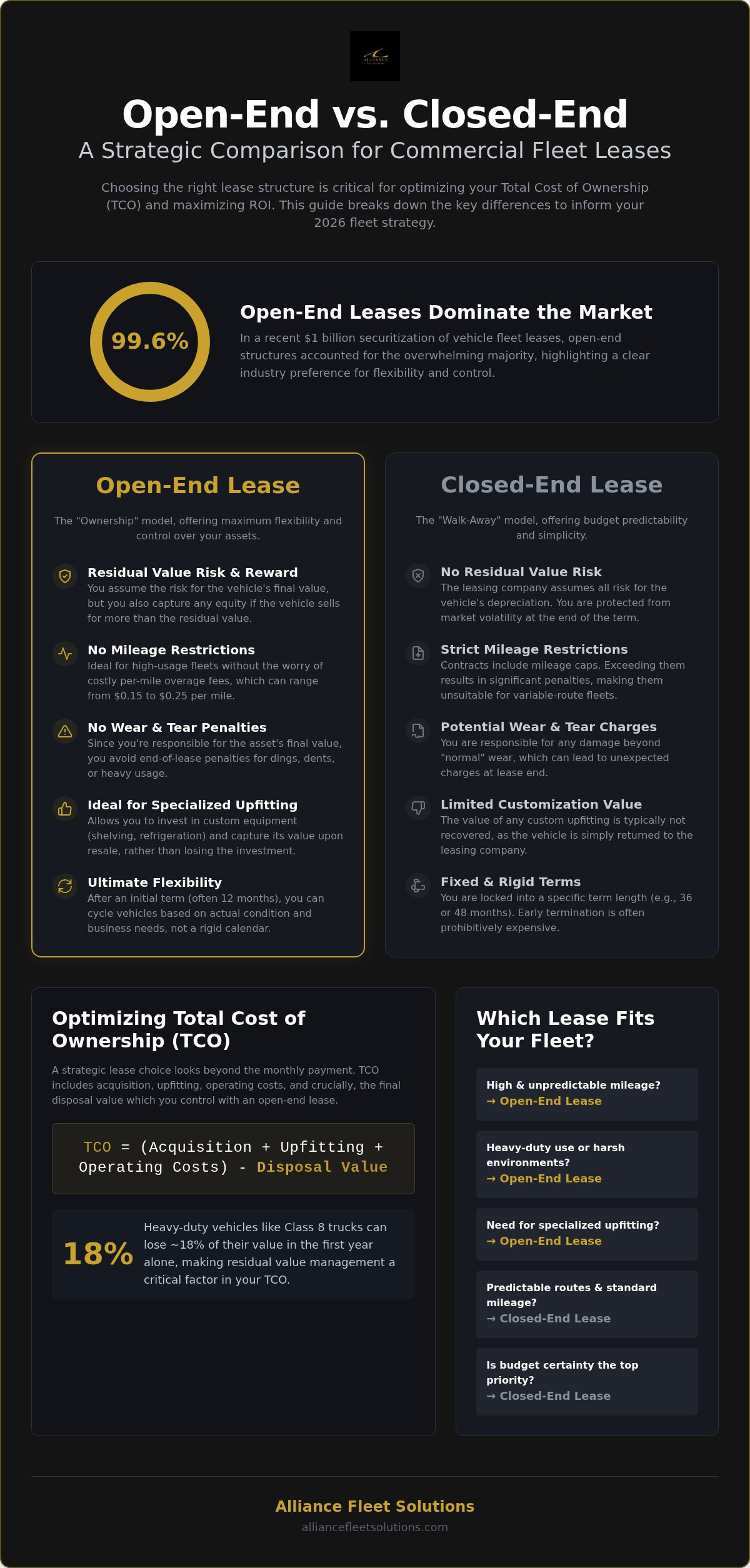
Did you know that in a recent $1 billion securitization of vehicle fleet leases, open-end structures accounted for a staggering 99.63% of the total? This overwhelming market preference highlights a critical reality when you’re weighing an open vs closed end lease commercial vehicles strategy for 2026. Most fleet managers feel the constant pressure of unpredictable end-of-lease fees and rigid mileage restrictions that don’t account for the daily realities of the logistics sector. It’s frustrating to manage specialized upfitted assets when a standard contract treats them like basic passenger cars.
We understand that your fleet is the backbone of your operation, and every dollar lost to unplanned downtime or poor remarketing hurts your bottom line. This guide will help you master the financial and operational differences between lease types so you can optimize your total cost of ownership and lifecycle strategy. We’ll explore how to maintain predictable monthly costs while gaining the flexibility to cycle vehicles based on actual wear. You’ll learn why the right lease structure, combined with expert vehicle disposal, can turn a standard expense into a strategic business asset.
Key Takeaways
- Learn how to select an open vs closed end lease commercial vehicles structure that aligns with your specific operational intensity and capital preservation goals.
- Understand the mechanics of TRAC leases to gain ownership-style flexibility and the potential to capture equity through professional remarketing.
- Identify when the predictability of a closed-end lease is the superior choice for fleets with fixed routes and standard mileage requirements.
- Discover how specialized upfitting and expert vehicle disposal strategies can significantly lower your fleet’s total cost of ownership.
- Explore how fractional fleet management provides the strategic oversight needed to scale your vehicle acquisition and maintenance nationwide.
Beyond the Monthly Payment: Why Your Lease Structure Dictates Fleet ROI
Successful fleet management starts with a fundamental shift in perspective. For many businesses, a lease isn’t just a way to get a van on the road; it’s a strategic capital preservation tool. The choice of an open vs closed end lease commercial vehicles agreement creates a ripple effect across your entire balance sheet. While one offers the comfort of financial predictability, the other provides the operational flexibility needed to scale a growing business. Understanding this core tension is the first step toward optimizing your fleet’s return on investment.
Residual value acts as the hinge for every contract. This estimated worth of the vehicle at the end of the term determines your monthly payment and your eventual financial liability. In the 2026 market, volatility makes this choice even more sensitive. Consider that Class 8 trucks typically lose approximately 18% of their value within the first 12 months of operation. When depreciation is that aggressive, your lease structure must be built to handle the swing. A miscalculation in residual value can lead to significant end-of-term expenses that erase months of operational profit.
The True Cost of a Commercial Vehicle
Looking past the monthly payment reveals the total cost of ownership (TCO). A truly effective strategy accounts for acquisition costs, specialized upfitting, and the final disposal value. Many managers rely on professional fleet management services to integrate these variables into a single, cohesive plan. Unlike retail leasing, which focuses primarily on low payments, commercial fleet structures are designed for asset utilization. If you’ve invested heavily in custom shelving, refrigeration, or crane bodies, you need a lease that recognizes that value and allows you to capture equity at the end of the term.
Identifying Your Fleet’s Operational Profile
Your operational profile dictates which lease model fits best. High-mileage fleets or those operating in rough-service environments, such as construction or heavy delivery, often find fixed contracts too restrictive. Closed-end leasing provides financial safety for predictable, low-mileage routes, but it can quickly become expensive if your drivers exceed mileage caps. Industry type is your first filter for an open vs closed end lease commercial vehicles selection. Consider these factors:
- Usage Patterns: Do your vehicles follow fixed routes, or do they travel variable distances based on demand?
- Asset Health: Does your industry involve heavy loads or off-road use that causes non-standard wear?
- Regulatory Shifts: The 2026 landscape includes updated CVSA out-of-service criteria, which may influence your ideal vehicle replacement cycle.
If your vehicles face harsh conditions or require specialized equipment, the flexibility of an open-end structure usually outweighs the fixed-cost appeal of a closed-end deal. It allows you to cycle vehicles based on their actual condition rather than a rigid calendar date.
The Mechanics of Open-End Leases and TRAC Clauses
Think of an open-end lease as the “ownership” model of the leasing world. It provides the control of asset ownership without the heavy upfront capital expenditure. When comparing an open vs closed end lease commercial vehicles agreement, the open-end structure stands out for its unique month-to-month flexibility. Typically, after an initial 12-month term, you can choose to cycle the vehicle out of your fleet whenever it makes the most financial sense. You aren’t locked into a rigid three or four-year window if your operational needs shift or if a vehicle begins to require excessive maintenance.
The core of this structure is the Terminal Rental Adjustment Clause (TRAC). This mechanism shifts the residual value risk from the leasing company to your business. Since you take on the risk, you also reap the reward. There are no mileage restrictions or wear-and-tear penalties because you’re ultimately responsible for the vehicle’s final sale price. If your fleet runs 50,000 miles a year, you don’t have to worry about the $0.15 to $0.25 per mile overage fees common in other contracts. This is a primary reason why 70% of commercial fleets prefer open-end lease structures.
Understanding the TRAC Adjustment
At the end of the lease, the vehicle is sold, and the net proceeds are compared against the remaining book value. In Scenario A, if the vehicle sells for more than its depreciated book value, your business receives the surplus as a refund or credit. This is often referred to as capturing equity. In Scenario B, if the market value is lower than the book value, you pay a deficiency payment to cover the difference. Success here depends on accurate depreciation scheduling. Setting a realistic monthly depreciation rate ensures your book value aligns with future market realities, protecting your cash flow from end-of-term surprises.
Why High-Utilization Fleets Prefer Open-End
High-utilization operations, such as 24/7 delivery services or long-haul logistics, find closed-end mileage caps impossible to manage. Open-end leases eliminate the “mileage trap” entirely. This structure also provides the freedom to modify and upfit vehicles. Because you aren’t returning the vehicle to a dealer lot for retail resale, you don’t face penalties for installing specialized shelving, refrigeration units, or heavy-duty cranes.
Strategic vehicle remarketing expertise is what turns this disposal process into a profit center. By targeting the right buyers at the right time, you can maximize the TRAC adjustment in your favor. If you’re looking to refine your disposal strategy, our team at Alliance Fleet Solutions can help you align your lease structure with your long-term ROI goals.
Closed-End Leases: Predictability, Mileage, and the ‘Walk-Away’ Model
While the open-end structure offers ownership-like flexibility, the closed-end lease is built for absolute financial certainty. In this model, the leasing company assumes the residual value risk. When you evaluate an open vs closed end lease commercial vehicles strategy, you’re essentially deciding who should carry the burden of market volatility. With a closed-end lease, your business isn’t responsible for what the vehicle sells for at the end of the term. You simply pay for the portion of the vehicle’s value you use, provided you stay within the agreed-upon contract parameters.
These parameters are rigid. A typical contract might span 36 months with a total mileage cap of 45,000 miles. At the end of that period, you have the “walk-away” benefit. You return the keys to the lessor, and as long as the vehicle meets mileage and condition standards, your financial obligation ends. This transfer of risk to the partner makes closed-end leasing an attractive option for businesses that prioritize fixed monthly expenses over the potential for equity gains.
The Hidden Costs of ‘Predictability’
The predictability of a closed-end lease comes with a specific set of rules that can lead to unexpected invoices if not managed carefully. Excess mileage charges are the most common pitfall. In 2026, these fees typically range from $0.15 to $0.25 per mile. For a fleet vehicle that inadvertently travels 10,000 miles over its cap, that’s a $1,500 to $2,500 penalty per unit. Additionally, strict “standard wear and tear” guidelines apply. Unlike an open-end lease where you might ignore a minor dent because you’re selling the vehicle anyway, a closed-end lessor will bill you for any damage that falls outside their specific retail-ready criteria.
These leases are often ideal for executive fleets or “clean” service industries. If your vehicles operate in controlled environments or follow predictable, low-mileage local routes, the risk of these penalties is low. It allows your team to focus on core operations without worrying about the secondary truck market.
Budgeting and Financial Reporting Advantages
From a treasury perspective, closed-end leases simplify cash flow forecasting. You know exactly what your fleet expense will be every month for the next three years, with zero end-of-term TRAC adjustments to settle. This level of transparency is essential for efficient fleet operations where predictable ROI is the primary goal. Even under 2026 ASC 842 standards, which require leases to appear on the balance sheet as right-of-use assets, the fixed nature of these payments keeps financial reporting straightforward. There’s a significant psychological and operational benefit to transferring depreciation risk to a partner, especially when current market data shows Class 8 trucks losing 18% of their value in the first year alone.
Strategic Comparison: Risk, Upfitting, and Total Cost of Ownership
Choosing between an open vs closed end lease commercial vehicles strategy requires a look at your long-term capital goals. While monthly payments are the most visible metric, the true winner is determined by how the structure handles your specialized equipment and end-of-life disposal. The following table provides a definitive comparison of these two models across core operational pillars:
| Feature | Open-End Lease (TRAC) | Closed-End Lease |
|---|---|---|
| Term | Flexible after 12 months | Fixed (e.g., 36–48 months) |
| Mileage | Unlimited; no penalties | Capped; fees apply for overage |
| Residual Risk | Lessee (Your Business) | Lessor (Alliance) |
| Upfitting | Full value captured at resale | Value often “zeroed out” |
| Disposal | Strategic remarketing for equity | Simple “walk-away” return |
A common objection is that leasing is more expensive than buying. However, this ignores the capital opportunity cost. In 2026, businesses can deduct the full cost of qualifying equipment up to $1,220,000 under Section 179. By leasing, you preserve your cash for core business growth while still benefiting from 20% bonus depreciation. This “ownership-lite” model allows you to deploy capital into revenue-generating activities rather than tying it up in a depreciating metal asset.
Upfitting and Residual Value: The Alliance Advantage
For fleets requiring specialized builds, the “upfitting factor” is the deciding variable. Most closed-end lessors treat custom shelving, refrigeration units, or crane bodies as a liability. They often “zero out” the value of this equipment because it makes the vehicle harder to sell on the retail market. In contrast, an open-end structure recognizes that professional upfitting adds significant value to secondary industrial buyers. By using an open-end lease, you can amortize the upfit costs and capture that residual value when the vehicle is sold, effectively lowering your total cost of ownership.
Risk Management: Who Should Hold the Bag?
Managing risk involves assessing your internal capacity to handle vehicle disposal. If you have the expertise to manage remarketing, an open-end lease allows you to turn disposal into a profit center. However, this requires a commitment to asset health. Proactive maintenance management is essential to protect the residual value in these contracts. Given that Class 8 trucks lose roughly 18% of their value in the first year, keeping a rigorous service schedule ensures your TRAC adjustment remains a refund rather than a deficiency payment.
If you are ready to build a fleet strategy that protects your capital and maximizes asset value, contact Alliance Fleet Solutions to speak with a fractional fleet expert today.
Designing Your Ideal Fleet Strategy with Alliance Fleet Solutions
Selecting the right open vs closed end lease commercial vehicles structure is not a one-time financial decision; it’s an ongoing operational strategy. At Alliance Fleet Solutions, we provide Fractional Fleet Management to give mid-market companies the same strategic oversight typically reserved for global corporations. This model allows you to leverage our expertise to determine which lease structure fits each specific asset in your fleet. We handle the heavy lifting of vehicle acquisition and national deployment, ensuring your trucks are custom-configured and ready for work the moment they arrive.
Our end-to-end approach bridges the gap between acquisition, professional upfitting, and vehicle remarketing. By managing the entire lifecycle, we eliminate the friction that often occurs when moving between different service providers. This cohesion is the essential backbone of a functional operation, turning your fleet from a source of stress into a strategic business asset. Before you sign your next contract, use this final checklist to ensure your strategy is sound:
- Utilization: Does the vehicle’s projected annual mileage exceed standard closed-end caps?
- Asset Customization: Does the vehicle require specialized upfitting that a closed-end lessor might undervalue?
- Disposal Capacity: Do you have the internal resources to manage remarketing, or do you need a partner to capture equity?
- Cash Flow Goals: Is your priority absolute monthly predictability or the long-term optimization of total cost of ownership?
- Lifecycle Timing: Does your industry require the flexibility to cycle vehicles based on actual wear rather than a fixed date?
Tailored Leasing Structures
A “hybrid” fleet is often the smartest move for diverse operations. You might place your executive and sales vehicles on closed-end leases for simple budgeting, while your high-utilization service vans remain on open-end TRAC leases. This allows you to customize terms to match the actual work cycle of each vehicle. We are committed to a transparent, no-nonsense financial partnership. We don’t just provide a lease; we provide a roadmap for asset optimization that respects the fast-paced nature of the logistics sector.
Maximizing ROI Through Active Management
Active management is what separates a high-performing fleet from an expensive one. We integrate telematics and GPS solutions to monitor mileage and wear in real-time, allowing for proactive adjustments before they become costly failures. When it’s time to cycle an asset, our remarketing experts fight for every dollar of equity. We target specialized industrial buyers who value your upfitting, ensuring you get the maximum return on your investment.
Don’t leave your fleet’s financial performance to chance. Partner with Alliance Fleet Solutions for a customized leasing analysis and let us help you build a strategy that drives your business forward.
Future-Proofing Your Fleet Financing Strategy
The decision between an open vs closed end lease commercial vehicles structure ultimately hinges on your specific operational demands and how you value asset flexibility. Whether you prioritize the walk-away simplicity of a closed-end model or the equity-capturing potential of an open-end TRAC lease, your choice dictates your long-term total cost of ownership. Managing these variables requires a strategic partner who understands that a lease is more than just a monthly payment; it’s a tool for capital preservation and business efficiency.
Alliance Fleet Solutions provides the national acquisition and deployment capabilities needed to scale your operations quickly. We combine professional upfitting tailored to your industry with expert vehicle remarketing to ensure you maximize every dollar at the end of the term. By integrating these services into a single, cohesive strategy, we help you eliminate the stress of unpredictable fees and operational downtime. This proactive approach ensures your fleet remains a high-performing asset rather than a financial burden.
Optimize your fleet financing with a custom lease strategy from Alliance Fleet Solutions. Our team is ready to help you navigate these high-stakes financial decisions with the expert control your business deserves. Let’s work together to build a more efficient, reliable, and profitable fleet today.
Frequently Asked Questions
What is the primary difference between an open-end and a closed-end lease?
The primary difference lies in who assumes the risk of the vehicle’s residual value at the end of the term. In an open-end lease, your business takes that risk, while in a closed-end lease, the leasing company assumes it. This fundamental distinction influences your choice between an open vs closed end lease commercial vehicles strategy based on how much control you want over the final asset disposal.
Can I switch from a closed-end to an open-end lease mid-term?
You typically cannot switch lease structures mid-term because they are distinct legal contracts with different depreciation schedules. If your operational needs change, you would generally need to terminate the current lease and start a new one. This process often involves early termination fees or settling the current vehicle’s book value before transitioning to a different financial structure.
How does a TRAC clause work in a commercial open-end lease?
A Terminal Rental Adjustment Clause (TRAC) is the settling mechanism used in open-end leases to align the vehicle’s book value with its actual market value at disposal. When the vehicle is sold, the proceeds are compared to the remaining balance on the lease. If the sale price is higher, your business receives a refund or credit. If it is lower, you pay the deficiency.
Which lease type is better for vehicles with heavy custom upfitting?
Open-end leases are almost always superior for vehicles with heavy custom upfitting. Closed-end lessors often zero out the value of specialized equipment like refrigeration units or cranes because they are harder to sell on the retail market. An open-end lease allows you to amortize these costs and capture their added value during the professional remarketing process.
Are there mileage limits on commercial open-end leases?
There are no mileage limits or overage penalties on commercial open-end leases. This flexibility is why high-utilization fleets, such as 24/7 delivery services, prefer this model. You don’t have to worry about the $0.15 to $0.25 per mile fees that are common in closed-end agreements when a vehicle exceeds its negotiated annual cap.
What happens if my vehicle is worth less than the residual value at the end of an open-end lease?
If your vehicle is worth less than the residual value at the end of an open-end lease, your business is responsible for a deficiency payment. This payment covers the gap between the actual sale price and the depreciated book value. Working with a partner to set accurate depreciation schedules and using expert remarketing services helps minimize the risk of these end-of-term surprises.
How do the 2026 lease accounting rules affect my business fleet?
Under 2026 ASC 842 standards, nearly all leases must be recorded on your balance sheet as right-of-use assets. This requires careful tracking of lease liabilities and assets for financial reporting. However, TRAC leases are specifically structured to meet IRS true lease criteria, which often allows the full monthly payment to be treated as a deductible operating expense for tax purposes.
Is maintenance included in open-end or closed-end commercial leases?
Maintenance is not inherently included in either lease type, but it can be bundled into a full-service lease agreement. Many fleets choose to add maintenance management to their contract to create a single, predictable monthly payment. This approach can reduce unexpected repair costs by as much as 30% while ensuring the vehicle’s residual value is protected through a documented service history.