
If your vehicle acquisition strategy hasn’t evolved since 2023, you’re likely overpaying for every mile your fleet travels. With interest rates and vehicle prices driving up total ownership costs by nearly 10% over the last 12 months, the margin for error has disappeared. You’ve likely felt the frustration of integration delays or the uncertainty of choosing between open and closed-end leasing models. It’s a high-stakes environment where a single procurement mistake can stall your operations for months.
We’ve developed this 2026 guide to help you regain control and build a predictable, high-performing fleet. You’ll learn how to master the complexities of procurement, from financial structures to total cost of ownership (TCO) calculations. This article provides a comprehensive checklist that covers every essential step, including how to streamline upfitting so your vehicles arrive ready-to-work. We’ll walk you through the technical details of fleet optimization to ensure your next purchase becomes a long-term strategic asset rather than a financial burden.
Key Takeaways
- Distinguish between simple purchasing and strategic vehicle acquisition to ensure every new asset aligns with your long-term operational goals.
- Learn how to leverage utilization data to define the “Job-to-be-Done” for every asset, ensuring your fleet remains lean and efficient.
- Evaluate the impact of open-end versus closed-end leasing to choose the financial structure that best protects your balance sheet and tax liability.
- Master the professional upfitting checklist to achieve a “Ready-to-Work” standard that eliminates initial downtime and maximizes immediate uptime.
- Discover how a fractional fleet management approach streamlines your procurement lifecycle and provides expert oversight without increasing fixed overhead.
What is Vehicle Acquisition in a Commercial Fleet Context?
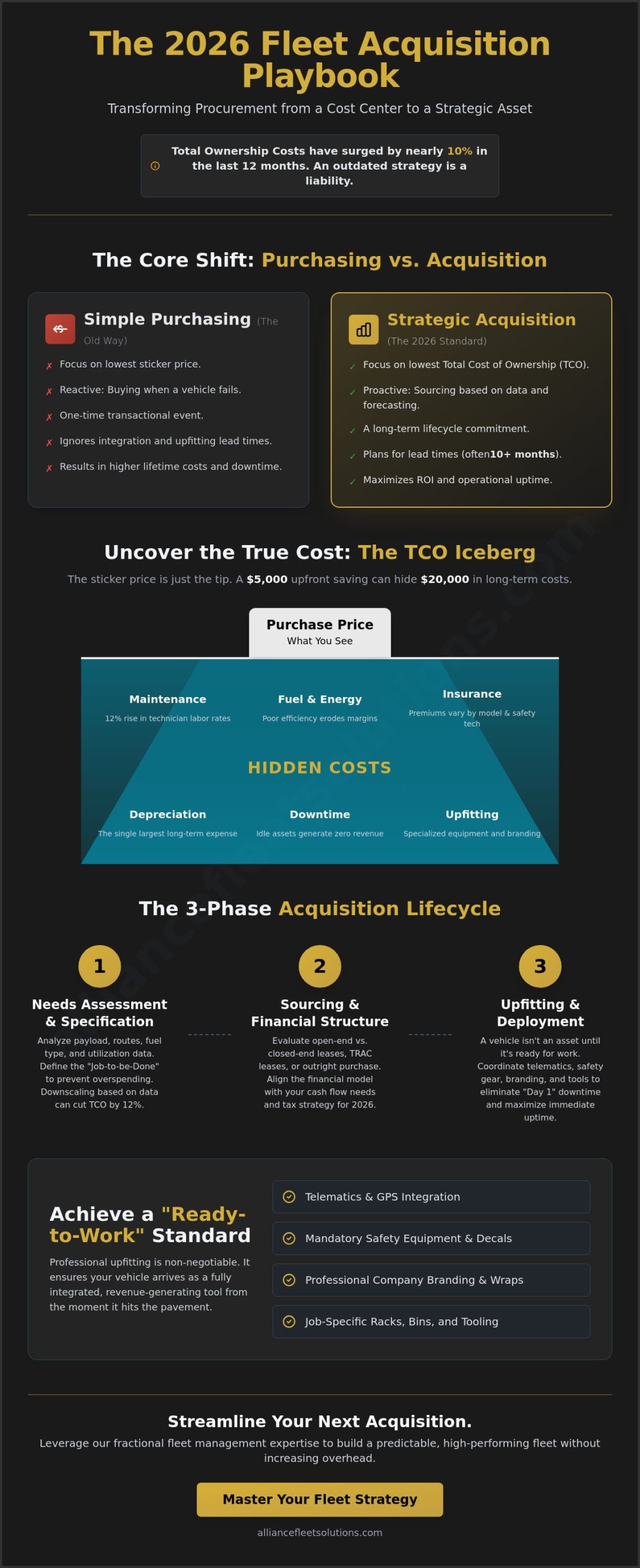
Vehicle acquisition is the strategic procurement of assets tailored for business operations. It isn’t a simple transaction at a dealership. In the 2026 logistics market, this process represents a high-stakes investment that dictates your company’s operational capacity for the next decade. Success requires shifting from reactive buying to proactive sourcing. If you wait until a truck breaks down to find a replacement, you’re already behind. Current market data shows that lead times for specialized heavy-duty assets can still exceed 10 months, making a forward-looking strategy essential for maintaining uptime.
Don’t confuse buying a truck with acquiring a fleet asset. Buying is a one-time event focused on price. Acquiring a fleet asset is a long-term commitment that integrates the vehicle into your comprehensive fleet management services ecosystem. This distinction matters because a vehicle that doesn’t fit your specific route requirements or maintenance capabilities becomes a liability rather than a tool. Effective Fleet management starts the moment you identify a need, long before a contract is signed.
The Vehicle Acquisition Lifecycle
The lifecycle of vehicle acquisition involves three critical phases that ensure every dollar spent supports business growth:
- Phase 1: Needs assessment and specification. You must analyze payload requirements, fuel types, and route topography. Choosing a Class 8 sleeper for short-haul urban deliveries is an expensive mistake that kills your margins.
- Phase 2: Sourcing and financial structuring. This involves deciding between Fair Market Value (FMV) leases, TRAC leases, or outright cash purchases based on your 2026 tax strategy and cash flow needs.
- Phase 3: Upfitting and delivery. A truck isn’t ready for work until it’s equipped with the right telematics, safety gear, and branding. Coordination during this phase prevents your new asset from sitting idle for weeks.
Total Cost of Ownership (TCO) vs. Purchase Price
The lowest sticker price often leads to the highest lifetime cost. While a budget-friendly model might save $5,000 upfront, poor fuel economy or frequent part failures can cost you $20,000 over five years. TCO is the sum of all expenses from procurement to disposal. You have to look at the big picture to protect your bottom line.
A smart vehicle acquisition strategy factors in depreciation, insurance premiums, and projected maintenance management costs. In 2026, labor rates for specialized technicians have risen by 12% compared to 2024 levels, so choosing vehicles with high reliability ratings is more important than ever. We focus on assets that maximize your return on investment by staying on the road and out of the shop.
Operational Needs Assessment: The Pre-Acquisition Checklist
Success in 2026 requires moving beyond simple replacement cycles. You’ve got to analyze real-time data to justify every vehicle acquisition. Start by defining the “Job-to-be-Done.” A vehicle isn’t just an asset; it’s a tool for a specific task. If your telematics data shows a truck averages only 60% of its payload capacity, downscaling to a lighter weight class can slash your total cost of ownership by 12% annually. Don’t buy for the “worst-case scenario” if that scenario only happens 2% of the time. Buy for the daily reality of your routes.
Defining Vehicle Specifications
Precision in specs prevents regulatory headaches and operational bottlenecks. You must categorize assets by weight class to ensure compliance with 2026 DOT standards. Use the GSA Fleet vehicle purchasing guide to cross-reference procurement standards with your specific operational needs. Terrain factors are equally critical. A 5% grade increase can reduce fuel efficiency by 15% if the powertrain isn’t optimized for that environment. Selection also hinges on your energy strategy. While EVs offer lower maintenance, their viability depends on regional charging density. For remote routes or regions with strained grids, integrating fuel management programs ensures your traditional ICE or hybrid assets remain cost-effective. Ensure every new unit includes Level 2 Advanced Driver Assistance Systems (ADAS) and native telematics to maximize safety and data capture from day one.
Utilization and Replacement Cycles
Identifying the “sweet spot” for replacement is a mathematical exercise, not a guess. Most logistics firms find that maintenance costs spike by 22% once a heavy-duty asset crosses the five-year mark or 150,000 miles. By leveraging data from efficient fleet operations, you can pinpoint under-performers that drain your budget through frequent unscheduled repairs. If an asset’s downtime exceeds 8% of its scheduled run-time, it’s a candidate for immediate replacement. This data-driven approach ensures you aren’t retiring healthy vehicles too early or keeping “zombie” trucks on the road that cost more to fix than they generate in revenue.
Proactive planning keeps your fleet moving and your margins protected. If your current data reveals rising downtime across older units, consider how a dedicated fleet maintenance partner can help you stabilize your current operations while you finalize your next vehicle acquisition phase. This alliance ensures your transition to new equipment doesn’t disrupt your existing service commitments.
Evaluating Financial Structures: Open-End vs. Closed-End Leasing
Your choice of financial structure dictates your fleet’s agility for the next five years. While many managers prioritize the physical specs of a truck, the vehicle acquisition method impacts your tax liability and balance sheet more than the engine size does. Cash is not always king. Tying up $250,000 in a depreciating asset limits your liquid capital. Data from 2024 fleet benchmarks shows that companies reinvesting that same capital into core operations see a 14% higher return on investment compared to those who buy vehicles outright.
Alliance Fleet Solutions acts as a strategic partner, helping you choose between structures that maximize cash flow. We don’t just deliver trucks; we deliver financial stability. Whether you need to keep debt off your balance sheet or want to leverage tax depreciation, the lease type matters. We streamline the process by aligning your fleet’s lifecycle with your company’s fiscal goals.
Open-End Leasing: Flexibility for High-Mileage Fleets
Open-end leases are the workhorses of the heavy-duty world. These utilize a Terminal Rental Adjustment Clause (TRAC). This means you’re responsible for the vehicle’s value at the end of the term. If you run a high-mileage operation exceeding 80,000 miles annually, this is your best bet. You avoid the rigid mileage penalties found in other contracts. However, the final payment depends on the resale market. If the truck sells for more than the projected residual, you keep the profit. If it sells for less, you cover the gap. It’s a structure built for those who treat their fleet with expert care and want the lowest monthly payments.
Closed-End Leasing: Predictability and Risk Mitigation
Closed-end leases, often called walk-away leases, offer total predictability. These are ideal for service fleets with fixed routes and standard usage, typically capped at 15,000 miles per year for light-duty vehicles. The lessor bears the risk of the vehicle’s future value. You pay a set monthly fee and return the keys at the end. This structure eliminates the stress of fluctuating resale markets; it’s a fixed cost that makes budgeting simple. You must monitor wear-and-tear clauses closely, as excessive damage can lead to surcharges. Alliance Fleet Solutions tailors these agreements to ensure your monthly payments align perfectly with your predictable revenue cycles.
Choosing the right path requires a deep dive into your operational data. Consider these factors:
- Annual Mileage: Over 25,000 miles usually favors open-end structures.
- Asset Treatment: Do you want the vehicle on your balance sheet as an asset or an expense?
- Remarketing Capability: Do you have the resources to sell used units, or do you prefer the lessor to handle disposal?
The goal of a smart vehicle acquisition strategy is to ensure your fleet remains a tool for growth, not a drain on your reserves. When evaluating fleet management companies in Denver and beyond, understanding these financial structures is essential to selecting a partner who can align leasing options with your specific operational and fiscal goals. We help you navigate these technical financial waters so you can focus on the road ahead.
The Professional Upfitting and Deployment Checklist
Successful vehicle acquisition doesn’t end when the contract is signed; it ends when the key turns and the asset generates revenue. A truck sitting in a lot waiting for shelving or safety lights is a liability, not an asset. Fleet managers often focus on the purchase price while overlooking the “Ready-to-Work” standard. This standard dictates that a vehicle must be fully equipped and compliant the moment it reaches the driver. Achieving this requires synchronized coordination between OEMs, local dealers, and upfitters. According to 2024 industry benchmarks, uncoordinated upfitting schedules can delay deployment by an average of 18 days, which directly impacts your bottom line.
Balance is critical when designing your build. While custom solutions solve specific operational hurdles, excessive customization can tank your resale value. Fleet leaders should aim for an 80/20 rule: 80% standardized components that appeal to the secondary market and 20% specialized tools for your specific trade. This strategy ensures the vehicle remains a liquid asset while still meeting the technical demands of your daily operations.
Critical Upfitting Components
Your upfit should prioritize ergonomic efficiency and operator safety. Storage solutions like adjustable shelving, bins, and heavy duty partitions for service vans prevent cargo shifts and reduce technician search time by approximately 15 minutes per job. Safety is equally vital. High-visibility strobes, beacons, and interior LED upgrades are mandatory for 2026 safety compliance in many municipal contracts. Finally, modern fleets require robust power management. Installing 2,000-watt inverters and auxiliary batteries during the initial build prevents the “dead battery” syndrome often caused by aftermarket charging stations added later by drivers. Understanding the full strategic ROI of professional upfitting helps fleet managers justify these investments and build a compelling business case for properly equipped vehicles.
- Storage: Lockable cabinets and spill-proof bins for organized tool management.
- Safety: 360-degree strobe coverage and motion-activated interior lighting.
- Power: Pure sine wave inverters to protect sensitive diagnostic electronics.
Telematics and Branding Integration
Integrating technology during the vehicle acquisition process is a non-negotiable step for modern fleet optimization. Pre-installing GPS and telematics hardware during the upfit saves 4 to 6 hours of labor compared to post-delivery installations. This allows for immediate data harvesting on fuel economy and driver behavior from mile one. Similarly, vehicle wrapping should occur in a climate-controlled upfit facility to ensure 100% adhesion and professional finish. This turns your fleet into a mobile billboard, providing an estimated 30,000 to 70,000 daily impressions per vehicle in urban areas.
The final step is a rigorous quality control inspection. This 50-point check should verify that every bolt is torqued, every light functions, and all telematics signals are broadcasting correctly. It’s the last line of defense against early-cycle downtime. To keep your fleet moving and minimize technical delays, maximize your fleet uptime with a professional deployment strategy.
Managing the Procurement Lifecycle with Alliance Fleet Solutions
Successful vehicle acquisition involves more than simply signing a purchase order. It requires a comprehensive strategy that connects the initial buy to the eventual disposal. Alliance Fleet Solutions serves as a strategic partner, integrating every stage of the procurement funnel to ensure your fleet remains a competitive advantage rather than a logistical burden. Our fractional fleet management model allows your business to leverage high-level procurement expertise without the burden of a full-time executive salary, which often exceeds $125,000 in the current market.
We focus on closing the loop between acquisition and remarketing. The profit your company realizes at the end of an asset’s life is largely determined by the decisions made during the initial purchase. By selecting specifications that retain high resale value and implementing strict maintenance protocols, we help you maximize your return on investment. This circular approach ensures that today’s acquisition defines tomorrow’s disposal profit. It transforms a standard capital expense into a manageable, predictable lifecycle cost.
The Advantage of a Single Point of Contact
Fleet managers frequently lose 10 to 15 hours of productivity each week by juggling communications between dealers, upfitters, and leasing companies. This “vendor merry-go-round” creates data silos and leads to costly delays. We eliminate this inefficiency by providing a centralized point of contact for your entire procurement lifecycle. Our team handles the coordination; this provides you with unified data reporting that makes forecasting simple and accurate. Whether you are adding five trucks or fifty, our alliance-based approach allows you to scale at the exact pace your business requires. We keep your focus on core operations while we manage the technical details of your vehicle acquisition needs.
Next Steps: Building Your 2026 Acquisition Plan
Preparation for the coming year should begin immediately to avoid the production delays that impacted 18% of fleet orders in previous cycles. Start by following these concrete steps:
- Perform a Fleet Audit: Identify units that have surpassed 250,000 miles or those where maintenance costs have spiked by more than 15% year-over-year.
- Establish a Procurement Calendar: Map out your needs for the next 12 months to secure production slots before the typical Q3 deadline for 2026 models.
- Consult Your Partner: Meet with an Alliance Fleet Solutions advisor to review your utilization data and refine your equipment specifications for better uptime.
Taking these steps now ensures that your strategy is proactive, cost-effective, and aligned with your long-term business goals. We don’t just provide services; we build an alliance that supports your growth. Contact us today to begin auditing your current fleet and securing your 2026 assets.
Future-Proof Your Fleet for 2026 and Beyond
Navigating the complexities of fleet growth requires more than just a purchase order. It demands a rigorous approach to financial structures and precise upfitting standards that meet specific operational demands. By 2026, fleet managers must balance open-end versus closed-end leasing options to protect their bottom line against market volatility. Success hinges on a 360-degree view of the procurement lifecycle, ensuring every commercial truck or van is configured for maximum utility from day one. A fragmented vehicle acquisition strategy leads to costly downtime and missed delivery windows.
Alliance Fleet Solutions serves as your comprehensive B2B leasing and upfitting expert. We specialize in complex commercial truck and van configurations while providing dedicated fleet lifecycle management support. We don’t just provide equipment; we deliver a roadmap for sustainable growth. Our team focuses on maximizing your uptime and streamlining the deployment of specialized assets so your business stays ahead of the competition.
Partner with Alliance Fleet Solutions to build a strategic acquisition plan that maximizes your ROI.
Let’s build a more resilient fleet together.
Frequently Asked Questions
What is the difference between vehicle acquisition and simple vehicle leasing?
Vehicle acquisition is a comprehensive strategic process that includes sourcing, financing, and upfitting, whereas simple leasing is strictly a financial arrangement to use an asset. A 2024 report from the NAFA Fleet Management Association shows that managers who view this as a strategic acquisition rather than a simple transaction see a 12% improvement in asset utilization. We focus on the entire lifecycle to ensure your fleet remains a strategic asset.
How does an open-end lease benefit a commercial business fleet?
An open-end lease benefits a commercial fleet by offering flexible terms and no mileage restrictions. This structure is vital for the 40% of service fleets that fluctuate in monthly mileage based on seasonal demand. It allows your business to treat the vehicle as an owned asset for tax purposes while maintaining the cash flow benefits of a lease. It’s a smart way to keep capital fluid while growing your operation.
Why should I prioritize professional upfitting during the acquisition phase?
Professional upfitting ensures your vehicles are ready for immediate deployment and meet specific safety standards. Statistics from the NTEA indicate that properly upfitted vehicles reduce on-site search time for tools by 15% per service call. We prioritize this phase to maximize your uptime and ensure your technicians have the exact layout they need for peak performance. Don’t wait until the vehicle is on the lot to plan your interior configuration.
Is it better to buy used or lease new vehicles for a service fleet in 2026?
Leasing new vehicles is the superior choice for 2026 fleets to stay ahead of rapidly changing emissions regulations and technology. The EPA Clean Trucks Plan mandates stricter standards beginning with 2027 models, so securing 2026 leases now protects your operation from the 18% price hike expected on newer engine technologies. It’s a proactive way to maintain a modern, compliant fleet without the heavy maintenance costs of used inventory.
How long does the vehicle acquisition process typically take?
The vehicle acquisition process typically takes between 6 and 9 months from the initial planning phase to the final delivery. Lead times for Class 4 through 7 chassis averaged 210 days in late 2024 due to ongoing component availability issues. You should start your checklist at least three quarters before your desired deployment date to avoid operational gaps and ensure your upfitting partner has adequate shop time.
What role does telematics play in the acquisition of new fleet vehicles?
Telematics provides the foundational data needed to measure the return on investment for every new asset. By installing these systems at the point of delivery, you can monitor the 90% idling reduction targets set by most modern sustainability programs. This data allows us to partner with you to refine maintenance schedules based on real-world usage rather than arbitrary dates. It’s about turning a machine into a data-driven business tool.
Can I customize a leased vehicle with professional upfitting?
You can customize a leased vehicle with professional upfitting, provided you use an open-end lease structure. Most commercial lessors report that 85% of their service fleet clients install custom shelving, ladder racks, or power inverters before the vehicle enters service. We coordinate this process during the acquisition phase so your fleet is work-ready the moment it arrives. It doesn’t make sense to pay for a vehicle that isn’t ready to produce revenue.
How do I calculate the Total Cost of Ownership (TCO) for a new acquisition?
You calculate TCO by totaling the purchase price, interest, fuel, insurance, and maintenance, then subtracting the projected resale value. Data from the 2025 Fleet Cygnus report indicates that maintenance costs usually represent 12% of the total cost over a five-year period. Tracking these metrics helps you identify the exact point when a vehicle becomes more expensive to maintain than to replace. It’s the only way to truly understand your fleet’s profitability. For a broader framework on selecting the right strategic partner to manage these costs, review our guide to evaluating fleet management companies for B2B solutions in 2026.