
According to a 2023 industry study by Geotab, fleets leveraging advanced analytics can slash fuel expenses by 15%, yet many operators remain stuck in a cycle of reactive repairs. You likely installed GPS hardware to gain control, but now you’re drowning in dozens of daily alerts while maintenance costs continue to climb. It’s frustrating to have the data but lack the clarity to stop a breakdown before it starts. This is where effective telematics performance monitoring becomes your most valuable asset. It transforms those noisy notifications into a clear roadmap for fleet optimization and long-term reliability.
You’ve probably realized that just seeing a vehicle on a map doesn’t protect your profit margins or improve driver safety. In this 2026 guide, we’ll show you how to filter the digital noise and focus on the actionable metrics that actually drive down your Total Cost of Ownership. You’ll learn to implement predictive maintenance alerts that prevent costly roadside failures and streamline your entire shop workflow. We’re moving past simple tracking to build a strategic alliance between your data and your mechanics, ensuring every mile driven contributes to a healthier bottom line.
Key Takeaways
- Discover how to transition from basic GPS tracking to strategic performance diagnostics that drive long-term asset value and operational efficiency.
- Identify the five critical KPIs that allow you to maximize ROI by transforming raw vehicle data into actionable business insights.
- Learn to eliminate the costly “break-fix” cycle by leveraging predictive maintenance and real-time fault code monitoring to ensure maximum uptime.
- Understand how specialized upfitting impacts vehicle diagnostics and why tailored telematics performance monitoring is vital for accurate reporting in custom fleets.
- Evaluate the strategic benefits of a managed fleet alliance versus a software-only approach to streamline your data interpretation and decision-making.
What is Telematics Performance Monitoring in 2026?
Telematics has evolved into a sophisticated strategic asset management tool. It represents the convergence of telecommunications and informatics, moving far beyond basic location services. By 2026, a fleet telematics system functions as a central nervous system for logistics operations. This technology doesn’t just track assets; it interprets the complex language of vehicle health to drive business decisions. The industry has moved past the era of simple GPS “breadcrumbing” to enter a phase of deep performance diagnostics.
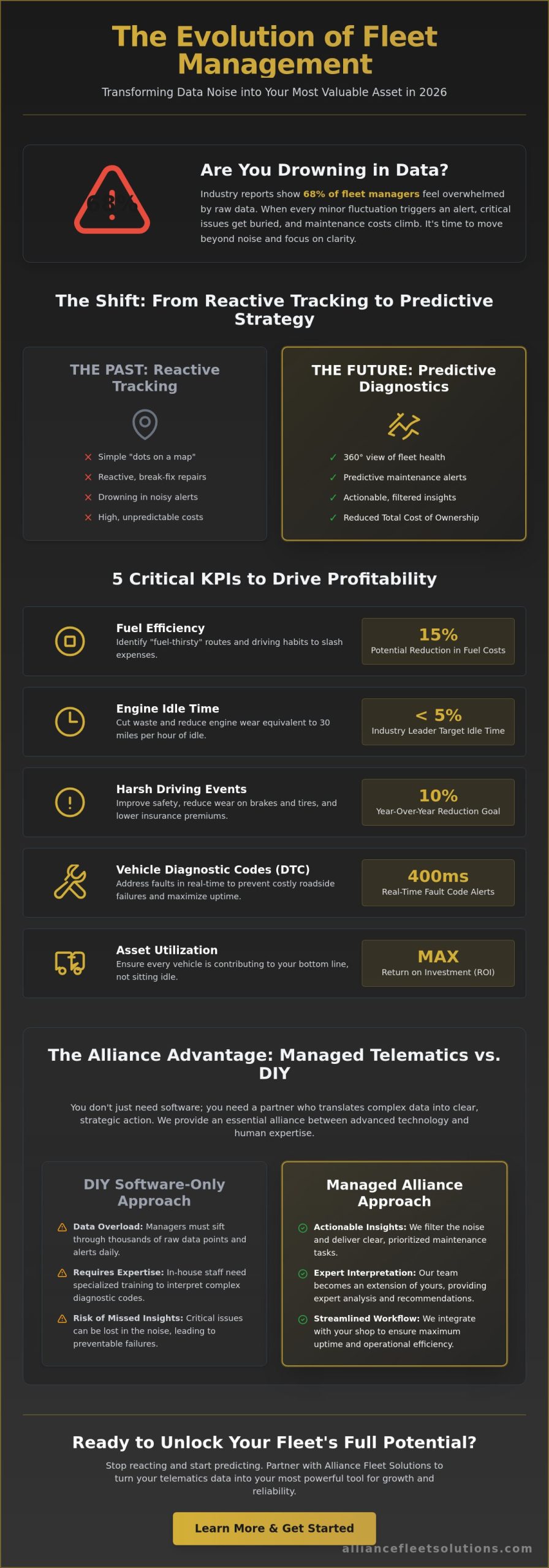
This evolution brings a new challenge: Data Fatigue. Industry reports from late 2025 suggest that 68% of fleet managers feel overwhelmed by the sheer volume of raw data hitting their dashboards. When every minor sensor fluctuation triggers an alert, critical mechanical issues often get buried. More data doesn’t automatically lead to better outcomes. It often leads to paralysis. Effective telematics performance monitoring filters this noise, turning raw numbers into clear, actionable maintenance priorities. At Alliance Fleet Solutions, we view this as an essential alliance between advanced technology and human expertise. You don’t just need software; you need a partner who understands how to use that data to maximize uptime and reduce total cost of ownership.
The Core Components: TCU, OBD-II, and the Cloud
The Telematics Control Unit (TCU) serves as the vehicle’s brain, processing thousands of data packets every second. Through deep CAN-bus integration, these units pull real-time engine health data directly from the vehicle’s internal network via the OBD-II port. In 2026, high-speed 5G-Advanced data transmission allows these systems to flag critical faults in under 400 milliseconds. This speed is vital for real-time alerts that prevent engine derates. When the cloud receives this data, it’s immediately analyzed against historical performance benchmarks to predict failures before they happen.
Beyond GPS: The Performance Monitoring Spectrum
Modern fleet management distinguishes between simple location tracking and deep behavioral or mechanical monitoring. While GPS tells you where a truck is, performance monitoring tells you how efficiently it’s getting there and what mechanical stress it’s enduring. Performance monitoring is the synthesis of driver behavior and vehicle health data. By analyzing the relationship between hard braking events and brake pad wear, or idle time and fuel injector health, we provide a 360-degree view of your operations. To fully optimize your fleet, you must integrate these insights with broader telematics and gps solutions that prioritize long-term reliability over basic dots on a map. This holistic approach ensures your telematics performance monitoring strategy actually moves the needle on your bottom line.
Critical KPIs for Data-Driven Fleet Performance
Telematics performance monitoring transforms raw data into a strategic roadmap for fleet longevity. To move the needle on profitability, managers must focus on metrics that provide a clear view of operational health. Tracking the right data points allows you to identify inefficiencies before they become expensive liabilities. The top five metrics that directly impact your bottom line include fuel consumption, engine idle time, harsh driving events, vehicle diagnostic codes, and asset utilization rates.
Establishing realistic benchmarks is the first step toward optimization. In 2026, industry leaders target an idle time of less than 5% and a 10% year-over-year reduction in harsh braking events. These aren’t just arbitrary numbers; they’re the difference between a high-performing fleet and one that bleeds capital. Effective reporting uses an “Active Voice” approach. Instead of simply reviewing what happened last month, your dashboard should tell you what to do next. If data shows a 15% spike in fuel use on a specific route, the system should prompt a route audit or a vehicle inspection immediately. Research from the Federal Motor Carrier Safety Administration underscores the impact of a telematics system on improving safety and operational outcomes by providing this level of granular visibility.
Fuel Efficiency and Idling Metrics
Excessive idling is a silent profit killer. Every hour of idle time can waste up to one gallon of fuel and adds significant engine wear, equivalent to 30 miles of driving. Modern telematics identifies “fuel thirsty” routes where traffic patterns or terrain force inefficient habits. Integrating comprehensive fuel management programs allows you to correlate driver behavior with pump costs, revealing exactly where your budget is disappearing. By addressing these habits, fleets often see a 7% to 12% reduction in total fuel expenditures.
Driver Safety and Behavioral Scoring
Safety data provides a proactive way to manage risk. By monitoring harsh braking, rapid acceleration, and speeding, you can create behavioral scores for every operator. Many fleets now use gamification to turn these scores into a competition, which improves driver retention and performance. Documenting these safety improvements is a powerful tool when negotiating with providers to reduce insurance premiums. When you prove your drivers are 25% safer than the industry average, your premiums should reflect that lower risk profile. To ensure your safety data aligns with regulatory requirements, pairing these insights with a robust fleet safety compliance framework helps you stay ahead of DOT audits and avoid costly penalties. If you’re looking to turn these insights into action, partnering with an expert for fleet maintenance solutions ensures your vehicles stay as safe as your data suggests.
Maximizing Uptime via Predictive Maintenance Monitoring
The old break-fix mentality is a liability for modern logistics. Waiting for a truck to smoke on the shoulder before calling a technician costs your business more than just a repair bill; it destroys your delivery schedule and erodes client trust. Telematics performance monitoring shifts the power back to the fleet manager. Instead of reacting to mechanical failures, you use live data to predict them. This proactive stance transforms maintenance from a surprise expense into a controlled, strategic process. Uptime isn’t just a goal. It’s the definitive metric of a healthy, profitable fleet operation.
The transition from reactive to predictive maintenance is the most effective way to protect your margins. When you rely on a break-fix model, you’re letting the equipment dictate your schedule. Predictive systems allow you to identify wear and tear on components like alternators or cooling systems weeks before they fail. This foresight means you can schedule repairs during planned downtime, ensuring your drivers stay on the road during peak delivery windows.
Real-Time Diagnostics and Fault Code Management
Modern telematics systems don’t just alert you to an engine light. They prioritize data so you don’t suffer from alert fatigue. The system distinguishes between “Critical” codes that require immediate stops and “Informational” codes that you can address at the next scheduled service. This intelligence prevents unnecessary roadside calls while ensuring you don’t ignore a brewing disaster. By linking mileage and engine hours directly to your maintenance management pillar, the software automates service scheduling. You’ll never miss an oil change or a brake inspection because a paper log was lost or a driver forgot to report an odometer reading.
Reducing the Total Cost of Ownership (TCO)
Extending the lifecycle of a Class 8 vehicle by even 12 months significantly lowers your TCO. Telematics performance monitoring provides the granular data needed to make these high-stakes decisions. You can see which assets are performing efficiently and which are becoming “money pits” that require disposal. Every hour of prevented downtime saves an average of $100 in operational costs, based on 2024 industry benchmarks for heavy-duty vehicles.
- Calculate ROI by tracking the reduction in emergency towing fees.
- Monitor fuel efficiency trends to identify engine degradation early.
- Use digital records to prove vehicle health during the remarketing process.
This ROI becomes even clearer during vehicle remarketing. A truck with a complete, digitally-verified maintenance history commands a higher resale value. You aren’t just fixing trucks; you’re protecting your capital investments through data-backed disposal and replacement strategies. This level of control is what separates industry leaders from those struggling to keep up with rising overhead.
The Impact of Custom Upfitting on Performance Data
Standard factory settings assume a vehicle is operating in its base configuration. Once you add specialized equipment like cranes, refrigeration units, or heavy-duty racks, the physical profile of the truck changes completely. A 2024 NTEA report indicates that custom upfits can add anywhere from 500 to 3,000 pounds to a vehicle’s curb weight. This added mass, combined with altered aerodynamics, means that “out of the box” telematics performance monitoring often produces skewed results. You can’t measure a service van with a 20% increase in drag against the same benchmarks as a standard delivery unit. It’s a different machine with different requirements.
Calibrating your data to your specific industry use case is the only way to achieve true visibility. Without this adjustment, your system might flag a driver for poor fuel economy when they’re actually performing at peak efficiency for their specific load. Professional upfitting is a variable that you must track to understand your true return on investment. It’s about moving beyond generic data and looking at the specific mechanical strain your equipment places on the engine and chassis. When your monitoring software understands the physical reality of the truck, the insights become actionable rather than distracting.
Monitoring Auxiliary Equipment
Tracking the truck’s movement is only half the battle. You need to know how your specialized tools are performing to manage costs effectively. Power Take-Off (PTO) monitoring allows you to distinguish between wasteful idling and active equipment usage. This is vital for cranes or bucket trucks where engine hours don’t always correlate with mileage. Custom sensors for temperature or weight can also feed directly into your central hub. This integration prevents unexpected battery drain from high-draw electronics, such as 3,000-watt inverters, and ensures your upfits aren’t causing premature engine wear. It’s about protecting the asset and the equipment it carries.
Optimizing Custom Fleet Configurations
Data from your current fleet should dictate your future purchases. If telematics performance monitoring shows that a specific rack configuration increases fuel consumption by 12% across your fleet, it’s time to re-evaluate that design for your next build. Alliance Fleet uses this operational data to help you select upfit packages that maximize utility while minimizing weight and drag. We focus on matching the right hardware to your real-world performance metrics. This proactive approach ensures that every vehicle you put on the road is built for maximum uptime and efficiency. It’s a strategic partnership that turns raw data into a more capable fleet.
The Alliance Advantage: Managed Telematics vs. DIY
Many fleet owners fall into the trap of believing that a software subscription alone solves operational inefficiencies. While a DIY approach offers basic visibility, it often leads to data fatigue. Fleet managers frequently find themselves buried under thousands of alerts, from minor speeding events to routine sensor pings. Without a dedicated analyst, this information remains stagnant. Transitioning to a managed solution shifts your focus from being a passive data collector to a strategic decision-maker who acts on telematics performance monitoring insights in real-time.
An external partner provides the necessary alliance to bridge the gap between raw numbers and mechanical action. You don’t just need a dashboard; you need a system that triggers a mobile repair unit before a minor leak becomes a roadside breakdown. This proactive stance ensures that your 2026 fleet goals stay on track, turning technology investments into measurable uptime. It’s about moving beyond “where are my trucks” to “how are my trucks performing.”
Fractional Management: Expertise Without the Overhead
Hiring a full-time fleet analyst is a significant expense that many mid-sized operations cannot justify. Fractional management offers a solution by providing expert oversight without high salary and benefits costs. An Alliance expert monitors your data remotely, acting as a professional filter for your daily alerts. They distinguish between a simple sensor glitch and a critical engine failure. For a deeper dive into the technical setup, you can review our fleet management software guide for implementation tips that streamline this transition.
Our team doesn’t just watch the screen. We interpret the reports to identify patterns, such as a 12% increase in idle time across a specific route or a recurring brake issue in a specific vehicle class. This level of scrutiny allows you to optimize your maintenance schedule based on actual wear rather than arbitrary calendar dates. It’s the difference between guessing and knowing.
Strategic Roadmap to Fleet Optimization
Moving from basic GPS tracking to comprehensive telematics performance monitoring requires a phased approach. It starts with data hygiene, ensuring your sensors are calibrated and reporting correctly. From there, we move to performance benchmarking, comparing your fleet against 2026 industry standards for fuel efficiency and safety. A long-term partnership ensures these gains aren’t temporary. We provide the roadmap to sustain a 15% to 20% reduction in overall maintenance costs through disciplined, data-driven habits.
Success in modern logistics requires more than just hardware; it requires a partner who understands the high stakes of your business. Partner with Alliance Fleet Solutions to transform your fleet data into a strategic asset and secure your competitive edge.
Drive Your Fleet Toward a High-Uptime Future
By 2026, the competitive edge for commercial carriers will rely on moving beyond basic GPS tracking toward comprehensive telematics performance monitoring. Integrating predictive maintenance protocols helps prevent the road failures that cost national fleets significant productivity every year. When you align custom upfitting with data-driven insights, you eliminate the technical friction that often plagues specialized vehicle builds. This holistic approach transforms raw data into a strategic shield against rising operational costs.
Alliance Fleet Solutions provides industry-leading expertise in fractional fleet management for national commercial fleets. Our team delivers custom upfitting solutions that are fully integrated with performance monitoring to ensure every component performs as expected. We have a proven track record of reducing TCO for national partners by streamlining complex maintenance cycles. You don’t need to tackle these technological shifts in isolation. Partner with an expert team that understands the mechanics of your business as well as the data behind it.
Maximize your fleet uptime with an Alliance Fleet Solutions telematics strategy.
Your fleet’s potential is waiting; let’s unlock it together.
Frequently Asked Questions
What is the difference between GPS tracking and telematics performance monitoring?
GPS tracking identifies where a vehicle is located, while telematics performance monitoring captures how it’s operating. GPS provides coordinates to track routes and arrivals. Telematics integrates with the engine’s J1939 or OBD-II port to pull real-time data on fuel consumption, engine fault codes, and braking patterns. This deeper level of insight allows fleet managers to transition from simple asset tracking to comprehensive fleet optimization.
Can telematics performance monitoring really reduce my insurance costs?
You can reduce insurance premiums by up to 15% through the implementation of data-driven safety programs. Insurers often offer discounts to fleets that share telematics data to prove lower risk profiles and safer driving habits. By documenting reduced accident rates and consistent safety compliance, you provide the actuarial evidence needed to negotiate lower rates. This proactive approach turns your safety data into a financial asset for the business.
How does telematics integrate with my existing maintenance management plan?
Telematics integrates with your maintenance plan by triggering automatic service alerts based on real-time odometer readings and engine hours. Instead of manual spreadsheets, the system sends a notification when a truck reaches its 10,000-mile oil change interval. This ensures your preventive maintenance stays on schedule, which helps maximize uptime and prevents the $450 average daily cost of unplanned vehicle downtime. It’s about being proactive rather than reactive.
Is telematics data difficult to manage for small to mid-sized fleets?
Modern telematics platforms utilize user-friendly dashboards that simplify data management for fleets with as few as 5 vehicles. You don’t need a dedicated data scientist because the software prioritizes the most critical alerts for you. Cloud-based systems aggregate complex engine diagnostics into simple status indicators. This allows small business owners to focus on their core operations while the system handles the technical monitoring and reporting.
What are the most important KPIs to track in a commercial fleet?
The most critical KPIs for a commercial fleet include fuel economy, idle time percentage, and driver safety scores. Monitoring idle time is vital because an average heavy-duty truck consumes about one gallon of fuel per hour while idling. You should also track engine fault codes and harsh braking events to identify mechanical issues before they lead to roadside failures. These metrics provide a clear roadmap for improving your bottom line and operational efficiency.
How does telematics improve driver retention and safety?
Telematics improves safety by providing real-time feedback that can reduce accidents by 20% according to industry safety reports. Drivers appreciate the objective data because it protects them from false claims and allows for fair performance bonuses. By using driver scorecards, you create a culture of transparency and recognition. This professional environment helps retain top talent who value safety and clear communication over guesswork and manual logs.
Can I monitor specialized upfitted equipment through telematics?
You can monitor specialized upfitted equipment like cranes, bucket trucks, and refrigeration units through Power Take-Off sensors. Telematics systems track when the equipment is active, how long it runs, and its overall fuel consumption. This data is essential for maintaining expensive hydraulic systems and ensuring compliance for temperature-sensitive cargo. It allows you to manage your entire asset portfolio, not just the truck chassis, through a single integrated interface.
How much does a telematics performance monitoring system cost per vehicle?
Industry data from 2024 indicates that telematics performance monitoring typically costs between $20 and $45 per vehicle each month. This subscription fee usually covers the cellular data connection and the software platform access. Hardware costs for the plug-in devices often range from $0 with a long-term contract to $200 for a one-time purchase. Investing this amount helps you avoid the high costs of major engine repairs and excessive fuel waste.