
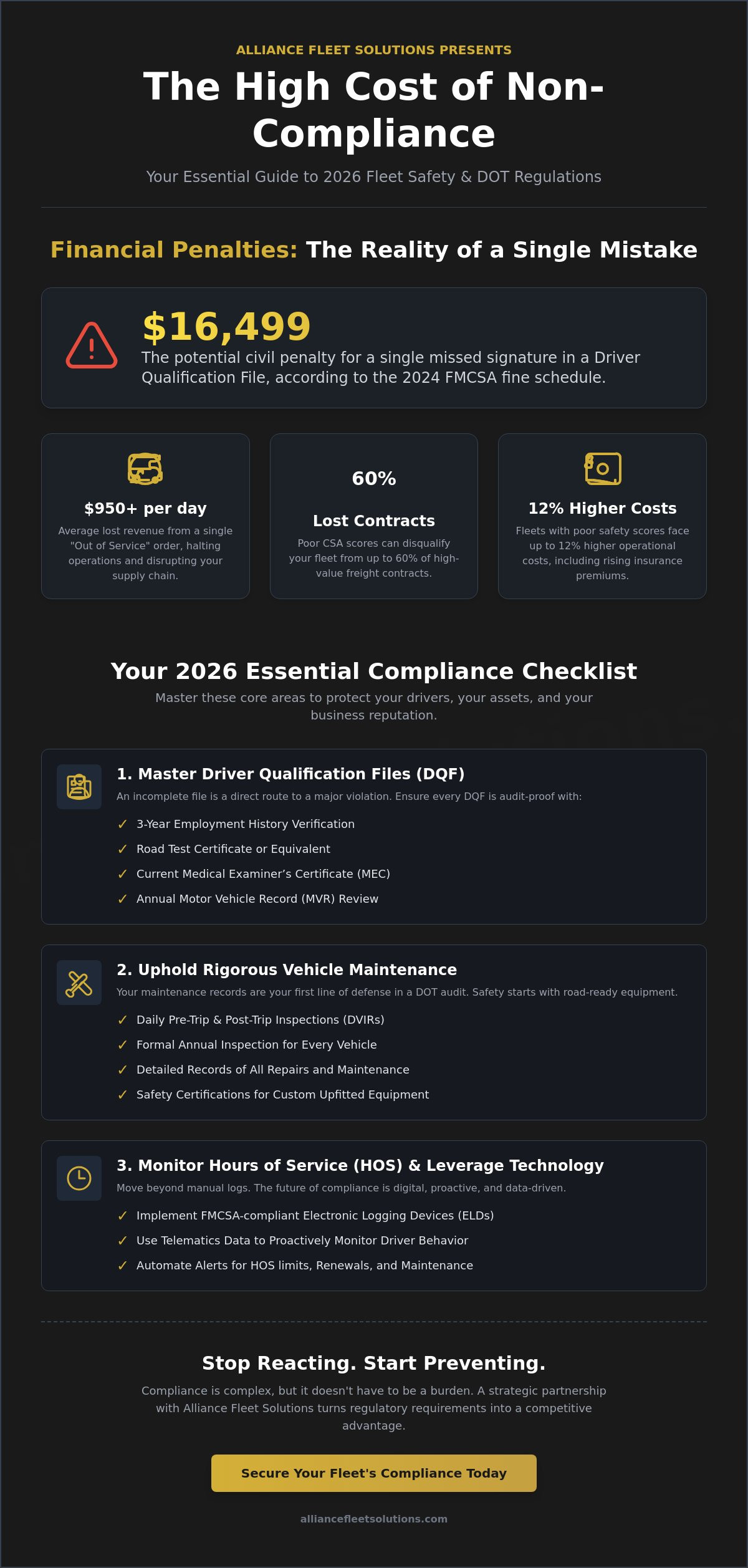
What if a single missed signature in a driver qualification file cost your company $16,499 in civil penalties? According to the FMCSA’s 2024 fine schedule, that’s the reality for managers who let fleet safety compliance slip through the cracks. You’re likely already feeling the pressure of rising insurance premiums and the constant threat of “out of service” orders that halt your operations. It’s a heavy burden to carry when you’re also trying to maximize uptime and manage a national team of drivers. We understand that the paperwork alone can feel like a barrier to actual growth.
Alliance Fleet Solutions is here to act as your strategic partner in managing these high-stakes requirements. We’ve built this guide to help you master the complexities of DOT regulations with a streamlined 2026 framework that replaces stress with professional control. You’ll gain a clear, daily operational checklist and proven methods to track real-time driver behavior across your entire organization. This article previews the essential steps to improve your CSA scores and build a culture of safety that keeps your trucks moving and your business profitable.
Key Takeaways
- Identify the updated 2026 DOT and FMCSA standards to ensure your fleet remains compliant in an increasingly complex regulatory landscape.
- Master the essential documentation for Driver Qualification Files and Hours of Service to protect your business from costly audits and downtime.
- Leverage advanced telematics and ELD data to automate fleet safety compliance and transition your team toward a proactive, data-driven safety culture.
- Learn how strategic vehicle upfitting and configuration prevent overweight violations while maximizing the long-term safety and performance of your equipment.
- Discover how a fractional fleet management partnership can streamline your administrative workload and provide expert-level oversight for fleets of any size.
Understanding Fleet Safety Compliance in 2026
Fleet safety compliance in 2026 has evolved from a simple legal requirement into a sophisticated digital framework. It’s no longer just about passing an annual inspection or keeping a clean logbook. Modern fleet management demands a proactive approach where safety data integrates directly into your daily operations. The Department of Transportation (DOT) and the Federal Motor Carrier Safety Administration (FMCSA) now utilize predictive modeling and real-time telematics data to assess carrier risk. This shift means your compliance status is live, visible, and constantly affecting your bottom line.
Viewing fleet safety compliance as a strategic asset allows your business to maximize uptime and secure better insurance rates. Data from 2025 industry reports shows that fleets with high safety ratings enjoy up to 12% lower operational costs compared to those with marginal scores. We’ve moved beyond manual record-keeping. The 2026 environment is digital-first, relying on automated systems to flag maintenance needs before they become violations. This proactive stance transforms compliance from a burden into a tool for fleet optimization and business growth.
The Consequences of Non-Compliance
The financial impact of a single DOT violation is staggering. In 2026, civil penalties for serious safety violations frequently exceed $17,000 per occurrence. Beyond the fines, your Compliance, Safety, Accountability (CSA) scores act as a public report card. A poor score can disqualify your fleet from 60% of high-value freight contracts. Additionally, “Out of Service” (OOS) orders trigger immediate supply chain disruptions. An OOS order costs an average of $950 per day in lost revenue, which doesn’t include the price of emergency mobile repairs or towing services.
Key Regulatory Bodies and Standards
The Federal Motor Carrier Safety Regulations (FMCSRs) remain the core standard for interstate commerce. However, managers must also account for state-specific mandates that often exceed federal requirements, particularly regarding emissions and driver rest periods. Staying current with 2026 regulatory updates is critical, as the FMCSA has introduced new protocols for electronic logging device (ELD) data verification and automated driving system (ADS) safety reporting. We help you streamline these complex requirements, ensuring your fleet remains a dependable pillar of your business strategy.
The Essential 2026 Fleet Safety Compliance Checklist
Compliance isn’t just a legal hurdle; it’s a shield for your business. According to Large Truck Injury Facts, large trucks were involved in 5,930 fatal crashes in 2022, which represents a 49% increase since 2013. These statistics emphasize why maintaining a rigorous fleet safety compliance program is vital for protecting your drivers and your bottom line. Managers who neglect these details face more than just fines; they risk the very reputation of their operation.
Mastering Driver Qualification Files
A compliant Driver Qualification File (DQF) requires more than a simple job application. In 2026, every file must contain a three-year employment history, a road test certificate, and a current Medical Examiner’s Certificate (MEC). You’re also required to conduct annual Motor Vehicle Record (MVR) reviews to identify high-risk behaviors before they lead to an incident. Managing these documents manually often leads to human error. Many savvy managers now utilize a fleet management software approach to automate renewal alerts and ensure no driver hits the road with expired credentials.
Vehicle Maintenance Records and Inspections
Safety starts with the machine. Your team must execute and document daily pre-trip and post-trip inspections (DVIRs) without exception. Beyond daily checks, Federal Motor Carrier Safety Administration (FMCSA) regulations demand a formal annual inspection for every commercial motor vehicle. Developing a systematic maintenance management schedule ensures that your assets remain compliant and road-ready. If you operate specialized vehicles, ensure all custom upfitted equipment meets current safety certification standards to avoid costly roadside citations. Keeping detailed records of every repair and inspection isn’t just good practice; it’s your primary defense during a DOT audit.
Your 2026 strategy must also prioritize Hours of Service (HOS) monitoring. Electronic Logging Devices (ELDs) must be fully operational, and your managers should review logs weekly to catch violations early. Participation in the Drug and Alcohol Clearinghouse is another non-negotiable pillar of fleet safety compliance. You must conduct annual queries for all current drivers and pre-employment queries for new hires. Finally, maintain an accurate accident register for three years. This log must include the date, location, driver name, and number of injuries or fatalities. Reporting timelines are strict; accidents involving a fatality or a vehicle being towed require immediate and precise documentation. If you need help keeping your equipment in peak condition to pass every inspection, consider how a dedicated mobile repair partner can boost your uptime and safety scores.
Leveraging Telematics for Proactive Compliance
Fleet safety compliance used to be a rearview mirror activity where managers reviewed logs long after a trip ended. In 2026, technology enables immediate intervention. Electronic Logging Devices (ELDs) automate Hours of Service (HOS) tracking, which removes the manual errors that often lead to costly fines. These devices sync directly with the vehicle engine to ensure every minute of driving is recorded with precision. This data is vital for adhering to the regulatory frameworks established by the Federal Motor Carrier Safety Administration. By integrating GPS data, you can verify that drivers remain on approved, safe routes and avoid hazardous or restricted areas.
Monitoring Driver Behavior in Real-Time
Implementing telematics performance monitoring provides an unfiltered view into the cab. You’ll receive automated alerts for speeding, harsh braking, and seatbelt usage. These metrics help identify the 15% of drivers who statistically account for the majority of fleet risk. Gamification turns this raw data into a constructive safety culture. By ranking drivers based on safety scores, you encourage healthy competition and professional pride. A 2025 study indicated that fleets using active driver coaching reduced harsh braking events by 31% within the first quarter of implementation.
Predictive Maintenance as a Safety Tool
A vehicle’s mechanical integrity is a cornerstone of fleet safety compliance. Modern telematics and gps solutions monitor engine diagnostics to flag issues before they cause a roadside catastrophe. This proactive approach keeps your trucks on the road and your drivers out of harm’s way. When you address a “check engine” light immediately, you avoid the risk of a high-speed breakdown or a catastrophic engine failure during a haul.
- Engine Diagnostic Alerts: Catch cooling system or oil pressure issues before the engine fails.
- Brake Health Tracking: Monitor wear patterns to ensure stopping power is never compromised.
- Improved CSA Scores: Well-maintained vehicles pass roadside inspections, keeping your safety rating high.
This integration ensures that vehicle health remains a strategic asset rather than a liability. It’s about moving from a reactive “fix it when it breaks” mindset to a controlled, expert management style that maximizes uptime and protects lives. By connecting these data points into your overall safety management plan, you create a shield of data that protects your business from liability and keeps your operations running smoothly.
Vehicle Configuration: The Physical Side of Safety
True fleet safety compliance isn’t just about driver behavior or digital logs; it starts with the physical integrity of the vehicle. A truck that isn’t configured for its specific mission becomes a liability the moment it leaves the lot. Professional upfitting serves as the foundation for this safety, ensuring that every shelf, partition, and rack is engineered to handle the rigors of the road. When assets are fit for purpose from day one, you eliminate the mechanical stress that leads to premature wear and catastrophic failure. Managers who prioritize vehicle configuration reduce the risk of roadside breakdowns and ensure their equipment can withstand the demands of 2026 logistics cycles. Aligning vehicle specs with actual operational loads prevents the mechanical strain that often results in expensive downtime and safety hazards.
Professional Upfitting and Compliance
Upfitting is a strategic component of risk management. Improperly installed cargo equipment can shift during transit, which alters the vehicle’s center of gravity. Data from the FMCSA indicates that cargo securement issues and overweight violations represent approximately 13% of all roadside inspection violations. By matching vehicle specifications to operational loads, managers prevent these common pitfalls. High-quality partitions do more than organize tools; they provide a physical barrier that protects drivers during sudden stops.
Safety Equipment and Technology Add-ons
Modern fleets rely on aftermarket technology to maintain fleet safety compliance and protect drivers. Integrating dash cams and 360-degree camera systems provides the visibility needed to navigate tight urban environments. According to the Insurance Institute for Highway Safety, collision avoidance systems can reduce rear-end crashes by 50%. However, these tools are only effective if they’re calibrated correctly. Improperly installed sensors can provide false positives or fail during a critical moment, making professional installation essential for long-term reliability.
The physical configuration of your fleet is the first line of defense against accidents and regulatory fines. By treating every vehicle as a specialized tool rather than a generic asset, you create a safer environment for your drivers and a more predictable maintenance schedule for your business. This proactive approach to upfitting and technology integration ensures your fleet remains a strategic asset rather than a growing liability.
Ready to optimize your vehicles for maximum safety and uptime? Partner with Alliance Fleet Solutions to build a more resilient, compliant fleet today.
Building an Alliance: Outsourcing Compliance Management
Managing a modern fleet requires more than just keeping trucks on the road. It demands a level of administrative precision that many organizations struggle to maintain internally. The “Fractional Fleet Manager” model has emerged as a vital solution for 2026, offering mid-sized and growing fleets access to enterprise-grade safety protocols without the overhead of a full-time executive salary. By outsourcing these high-stakes tasks, you shift the burden of fleet safety compliance from your desk to a team of dedicated specialists who live and breathe Department of Transportation (DOT) regulations.
A strategic partnership does more than just fill out forms. It integrates efficient fleet operations directly into your safety culture. When maintenance schedules and compliance logs align, you eliminate the friction that leads to equipment failure and driver fatigue. This proactive stance is your strongest defense against the FMCSA. A dedicated partner ensures that every vehicle and driver file is ready for scrutiny before an inspector ever knocks on your door. This approach can reduce administrative overhead by as much as 30%, allowing your internal team to focus on core logistics and growth.
Audit Readiness and Consulting
Don’t wait for a formal FMCSA review to discover your weaknesses. Our team conducts rigorous mock audits that mirror official inspections, identifying gaps in hours-of-service (HOS) data or vehicle maintenance records before they become liabilities. If a formal review occurs, you gain expert representation to manage the process and protect your safety rating. We go beyond immediate fixes by developing a long-term Safety Management Plan (SMP). This living document evolves with changing federal regulations, keeping your operation ahead of the curve and out of the crosshairs of enforcement officials.
Maximizing ROI Through Safety
Safety is not just a cost center; it’s a revenue protector. Documented safety excellence allows fleets to negotiate lower insurance premiums, often resulting in a 10% to 15% reduction in annual costs. Additionally, correcting unsafe driving habits through data-driven coaching can lower fuel consumption by up to 12%, according to industry benchmarks. To secure your operation’s future and protect your bottom line, Partner with Alliance Fleet Solutions today. We’ll help you turn fleet safety compliance into a competitive advantage through the following benefits:
- Reduced Litigation Risk: Proper documentation is your best defense in “nuclear verdict” scenarios.
- Higher Uptime: Preventive maintenance identified through compliance checks keeps trucks moving.
- Driver Retention: Drivers prefer working for organizations that prioritize their safety and simplify their paperwork.
- Expert Oversight: Access to specialized knowledge that stays current with 2026 regulatory shifts.
Future-Proof Your Operations for 2026
The landscape of fleet safety compliance moves fast. By 2026, managers must integrate real-time telematics data with physical vehicle configurations to maintain high uptime. You can’t rely on outdated spreadsheets when modern regulations require proactive maintenance and precise fuel management. Success depends on a unified strategy that bridges the gap between digital monitoring and physical repairs. Effective managers will prioritize these technical integrations to avoid costly downtime and regulatory penalties.
Since 2018, Alliance Fleet Solutions has provided family-owned expert guidance to help businesses navigate these complex requirements. Our national maintenance and upfitting network ensures your equipment stays on the road while our strategic telematics integration tracks every mile. We’ve built our reputation on being a strategic asset rather than just a service provider. You’ll gain a partner dedicated to your long-term reliability and safety. We understand the high stakes of the logistics industry and work to keep your business moving forward.
Secure your fleet and streamline compliance with Alliance Fleet Solutions
Let’s build a safer, more efficient future for your drivers together.
Frequently Asked Questions
What is the primary goal of fleet safety compliance?
The primary goal of fleet safety compliance is to minimize operational risk and protect your drivers while maximizing vehicle uptime. By adhering to FMCSA standards, you prevent accidents that account for 15% of annual carrier operating costs. It’s not just about passing audits; it’s about building a reliable foundation for your business operations.
How often should I audit my Driver Qualification Files?
You should audit your Driver Qualification Files at least once every 12 months to ensure continued regulatory alignment. Federal law 49 CFR 391.25 requires an annual review of each driver’s Motor Vehicle Record to verify they remain qualified for duty. Missing a single expiration date can lead to civil penalties exceeding 1,000 dollars per violation.
Do small fleets need to follow the same DOT rules as large carriers?
Small fleets must follow the exact same federal regulations as large carriers if their vehicles exceed 10,001 pounds GVWR in interstate commerce. The DOT doesn’t offer exemptions based on the number of trucks you own. Whether you run 2 vans or 200 heavy-duty trucks, the safety standards and reporting requirements remain identical.
What are the most common violations found during a DOT audit?
The most frequent violations involve hours-of-service errors and lighting or brake defects. In 2023, the FMCSA reported that 20.9% of roadside inspections resulted in out-of-service orders due to mechanical failures. Regular preventive maintenance is the only way to keep your fleet on the road and avoid these costly delays.
How does telematics data help with fleet safety compliance?
Telematics data streamlines fleet safety compliance by providing real-time alerts for speeding, harsh braking, and engine fault codes. This technology can reduce high-risk driving behaviors by 40% within the first year of implementation. It turns raw data into actionable insights, allowing managers to intervene before a safety event occurs.
Can professional upfitting affect my vehicles safety compliance?
Professional upfitting ensures your vehicle modifications comply with Federal Motor Vehicle Safety Standards (FMVSS). Improperly installed equipment can shift center-of-gravity limits or exceed axle weight ratings, leading to dangerous handling. We partner with you to ensure every modification maintains the structural integrity and legal weight limits of your assets.
What is a CSA score and why does it matter for my business?
Compliance, Safety, Accountability (CSA) is a ranking system used by the FMCSA to identify high-risk motor carriers for interventions. Scores are updated monthly based on roadside inspection data from the previous 24 months. If your score exceeds 65% in categories like Unsafe Driving, you’ll likely face a formal DOT audit or increased insurance premiums.
Is an ELD required for all commercial fleet vehicles in 2026?
Electronic Logging Devices (ELDs) are mandatory for most commercial vehicles manufactured after the year 2000. Drivers who operate within a 150 air-mile radius and return to their home terminal daily remain exempt under the short-haul provision. However, if a driver exceeds this limit more than 8 times in any 30-day period, they must use a compliant ELD.