
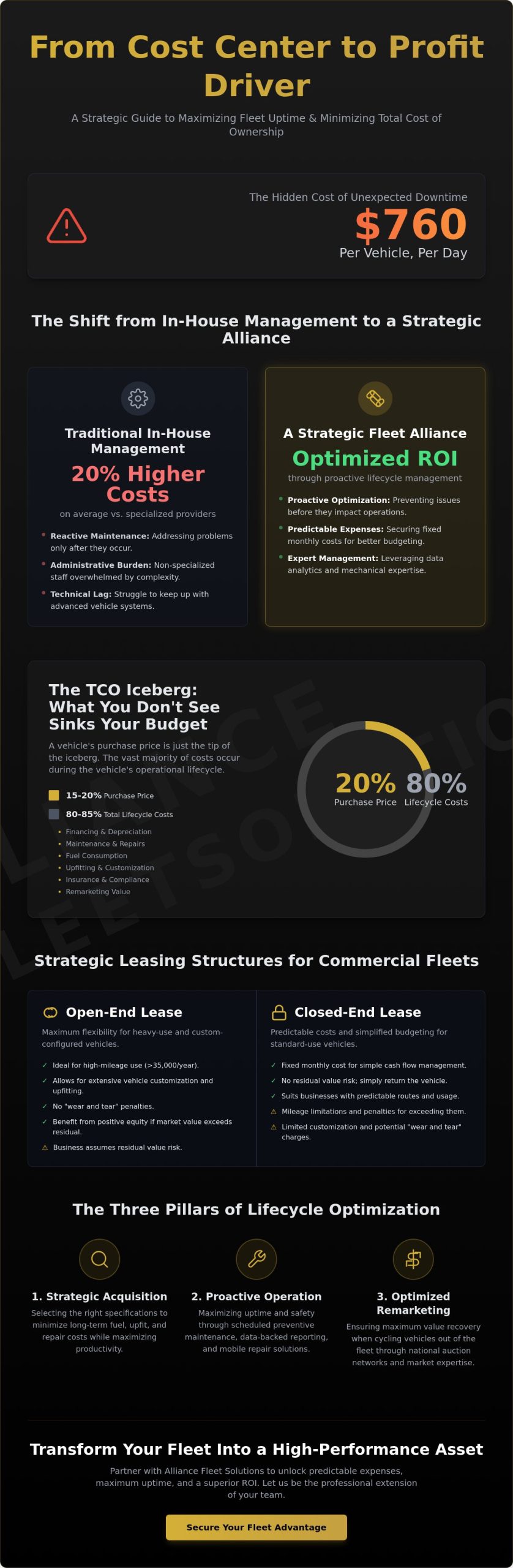
Does your current vehicle strategy actually protect your bottom line, or is it just a line item that masks the true cost of operational failure? Recent industry benchmarks from 2024 indicate that unexpected downtime can cost a fleet up to $760 per vehicle per day. For businesses evaluating fleet management companies denver, the selection process for 2026 requires more than a simple vendor checklist. You likely agree that unpredictable maintenance and the complexities of sourcing specialized upfits create a constant drain on your focus. It’s difficult to maintain momentum when your backbone is sidelined by preventable mechanical issues.
This guide provides the framework to transition from basic oversight to a strategic fleet alliance that minimizes your total cost of ownership while maximizing uptime. We’ll show you how to secure predictable monthly expenses and ensure your custom-configured vehicles arrive ready for immediate work. You’ll also discover how data-backed reporting on fleet health can transform your operations into a proactive, high-performance engine for growth.
Key Takeaways
- Learn how to transition from reactive maintenance to a proactive asset optimization strategy that secures long-term vehicle uptime.
- Identify the specific leasing structures and acquisition strategies that minimize your total cost of ownership and boost bottom-line profitability.
- Discover why the most effective fleet management companies denver offers are those providing comprehensive maintenance management and scalable fuel programs.
- Understand how professional upfitting transforms generic vehicles into specialized tools that directly increase technician productivity and operational efficiency.
- Explore how fractional fleet management serves as a scalable solution, acting as a professional extension of your internal team to handle complex logistics.
The Evolution of Modern Fleet Management Services
Modern fleet management in 2026 has transitioned from a backend administrative task to a core strategic driver. It’s no longer just about keeping wheels turning; it’s a holistic lifecycle approach that governs an asset from the moment of purchase to its final disposal. Fleet management now requires a sophisticated blend of data analytics, mechanical expertise, and financial foresight. Leading fleet management companies denver prioritize proactive asset optimization over reactive maintenance. This shift ensures that every vehicle remains a high-performing asset rather than a liability waiting to break down.
A successful strategy rests on three specific pillars. First, Acquisition involves selecting the right specifications for the job to minimize long-term fuel and repair costs. Second, Operation focuses on maximizing uptime through scheduled preventive maintenance and mobile repair solutions. Third, Remarketing ensures the company recovers maximum value when it’s time to cycle the vehicle out of the fleet. While local operational reliability is the primary goal for many, maintaining a national perspective allows businesses to leverage larger data sets and procurement power.
Why In-House Management is Becoming Obsolete
Managing a fleet internally has become increasingly risky and expensive. By 2026, vehicle complexity has surged due to integrated telematics, advanced driver-assistance systems, and proprietary software requirements. Non-specialized staff often struggle to keep up with these technical advancements, leading to a massive administrative burden that eats into daily profits. Industry data shows that companies managing fleets in-house often face 20% higher operational costs compared to those using specialized providers. For a deeper look at these shifting dynamics, refer to our comprehensive fleet management services guide to see how the industry has changed.
The Role of an Alliance in Business Growth
Strategic Acquisition and Leasing Structures
Procurement strategies act as the primary lever for long-term fleet profitability. A vehicle’s purchase price typically represents only 15% to 20% of its total lifecycle cost. The remaining 80% is determined by how it’s financed, utilized, and maintained. In the high-altitude, variable climate of Colorado, partnering with experienced fleet management companies denver ensures that your acquisition strategy accounts for local wear and tear. This level of foresight prevents the financial drain of rapid depreciation or unexpected mechanical failures.
Strategic sourcing also leverages national purchasing power. This allows smaller local fleets to access the same volume discounts as enterprise-level logistics firms. By centralizing the buy, you reduce the per-unit cost and gain priority status with manufacturers. This is crucial during supply chain fluctuations. Understanding What Is Fleet Management? helps clarify how these high-level financial decisions impact your daily operational budget.
Open-End vs. Closed-End Leasing: Which Fits Your Business?
Open-end leases offer the greatest flexibility for commercial applications. These agreements allow for unlimited mileage and extensive vehicle customization. The business assumes the residual value risk; however, it also reaps the rewards if the vehicle’s market value exceeds the book value at the end of the term. This is ideal for heavy-use vocational trucks that might see 35,000 miles or more annually. Many service fleets prefer this model because it avoids the “wear and tear” penalties associated with consumer-style leases.
Closed-end leases provide a fixed monthly cost, which simplifies budgeting for businesses with predictable routes. You return the vehicle at a set date and walk away. This structure suits businesses prioritizing cash flow consistency over asset ownership. Under current ASC 842 accounting standards, both models now impact balance sheets, but their tax treatment for depreciation varies. Most fleet management companies denver recommend open-end structures for specialized equipment to maintain control over the asset’s lifecycle.
Optimizing the Procurement Process
Vehicle sourcing requires precise technical knowledge to avoid costly mistakes. Utilizing a strategic vehicle acquisition checklist ensures every truck meets your exact operational requirements. Over-specing a vehicle results in unnecessary weight and higher fuel consumption. Under-specing leads to engine strain and increased downtime. Both scenarios erode your bottom line quickly.
Lead-time management is another critical factor. As of early 2026, delivery windows for specialized chassis can still span six to twelve months. Proactive managers work to forecast needs well in advance. This prevents the “panic buying” of off-the-lot inventory that doesn’t actually fit your workflow. When you align your procurement with a partner like Alliance Fleet Solutions, you ensure that every asset is built for maximum uptime from the moment it hits the road.
Maximizing ROI Through Professional Upfitting
A base vehicle is just raw material. For high-performing organizations, professional upfitting acts as the bridge that transforms a generic cargo van or truck into a precision-engineered tool. When you partner with top-tier fleet management companies denver, the focus shifts from simply buying vehicles to optimizing mobile workspace efficiency. Integrated upfitting during the initial acquisition phase eliminates the need for secondary downtime, often reducing total lifecycle costs by 12% to 18% compared to aftermarket modifications performed months later. By configuring the vehicle correctly from day one, you ensure your team hits the ground running with everything they need to succeed.
The Financial Case for Customized Fleet Vehicles
Building a strong business case for professional upfitting requires looking beyond the initial invoice. High-quality, modular components actually preserve the vehicle’s interior, protecting its residual value. Data from 2025 remarketing reports indicates that vehicles with professional-grade, drill-free mounting systems command higher resale prices because the structural integrity of the chassis remains intact. Technicians spend an average of 45 minutes a day searching for tools in unorganized vehicles. Professional upfitting recovers that lost time, allowing for one additional service call per day. Upfitting ROI is a direct measure of reduced field-service time and the subsequent increase in daily job completion rates.
Safety and Ergonomics in Fleet Configuration
Safety isn’t a luxury; it’s a financial imperative. Professional configurations reduce workplace injuries by placing heavy equipment within ergonomic reach, directly lowering insurance premiums and workers’ compensation claims. A 2024 industry study showed that ergonomic shelving systems can reduce strain-related injuries by up to 22%. By referencing standards found in GSA Fleet Management Solutions, managers can implement standardized layouts that simplify technician training and equipment maintenance. This consistency ensures that a driver in one truck knows exactly where the safety gear is located in another, regardless of the specific unit they’re operating. Modern upfits also future-proof your assets by integrating mounting points for advanced telematics and 5G-enabled safety sensors. This proactive approach is why the best fleet management companies denver has to offer prioritize strategic configuration over basic delivery.
Critical Criteria for Evaluating Fleet Management Companies
Choosing a partner to oversee your assets is a high-stakes decision that directly impacts your bottom line. When you evaluate fleet management companies denver, you’re looking for a strategic alliance rather than a simple service provider. A 2024 industry report indicates that companies with professional fleet oversight reduce total cost of ownership by an average of 14% within the first two years. To achieve these results, you must look for specific operational capabilities that go beyond basic record-keeping.
- Fractional Management: Smaller operations often don’t need a full-time fleet director. Look for providers offering fractional support that scales with your growth, providing expert oversight without the six-figure executive salary.
- Remarketing Strategy: A vehicle’s lifecycle doesn’t end at the last mile. Your provider should have a proven strategy to maximize resale value; this often reclaims 25% to 35% of the original asset cost.
- Dedicated Industry Experts: Generalists don’t understand the specific stress of heavy-duty logistics. You need a single point of contact who knows your sector and speaks the language of uptime.
The Importance of Maintenance and Fuel Oversight
Preventive maintenance is your primary defense against catastrophic equipment failure. Data from 2023 shows that unplanned repairs cost 4 times more than scheduled maintenance. A robust program ensures every asset follows a strict schedule, which keeps your trucks on the road and out of the shop. Fuel programs are equally vital. By implementing nationwide fuel cards and monitoring spend, fleets typically eliminate the 3% to 7% of operational leakage caused by unauthorized transactions or inefficient refueling patterns. Integrating this data into your broader strategy allows you to see the true cost per mile for every vehicle in your fleet.
Telematics: Turning Data into Actionable Insights
Telematics has evolved far beyond simple GPS tracking. Modern solutions allow you to monitor driver behavior, such as harsh braking or excessive idling, which can reduce fuel efficiency by up to 10% per vehicle. By 2026, the industry will shift almost entirely toward predictive maintenance models. This means using real-time telematics data to identify a failing component before it causes a breakdown. High-performing fleet management companies denver use these insights to optimize routing, which can shave 5% off total mileage. This proactive approach transforms raw data into a roadmap for increased safety and profit.
Effective fleet management requires more than just software; it requires a partner committed to your operational success. If you’re ready to improve your uptime and control costs, contact Alliance Fleet Solutions today to discuss a tailored strategy for your business.
The Alliance Advantage: Fractional Management and Partnership
Growing a business requires intense focus. You can’t afford to split your attention between core operations and mechanical logistics. Alliance Fleet Solutions acts as a direct extension of your internal team. We handle the technical complexities so you can scale without friction. This partnership isn’t just about repairs; it’s a strategic service alliance built on reliability. By taking a holistic view of your assets, we target the lowest total cost of ownership to protect your bottom line.
What is Fractional Fleet Management?
Fractional fleet management allows you to access C-suite expertise without committing to a $150,000 executive salary. Our team handles the heavy lifting of vendor negotiations and lease management. In 2024, the average fleet manager oversaw 50 to 100 units; by 2026, data suggests that automation and complex remarketing markets will require even deeper specialization. We fill that gap with professional authority.
Managing your vehicle lifecycle requires constant vigilance. We oversee everything from acquisition to the final sale in the remarketing market. This ensures you don’t leave money on the table when it’s time to rotate your inventory. Among fleet management companies denver businesses trust, Alliance stands out by providing this high-level oversight on a scalable basis. We provide the expert control needed to stabilize your overhead.
Building Your Fleet Alliance for 2026
The time to move past reactive repairs is now. Waiting for a breakdown costs 3 to 4 times more than a scheduled preventive maintenance stop. Our partnership focuses on strategic fleet optimization. We provide a dependable, solution-oriented framework that keeps your drivers on the road. This isn’t a transactional relationship. It’s a long-term commitment to your fleet’s health and your company’s reputation.
Using mobile repair capabilities allows us to maximize your uptime. We bring the shop to you, ensuring your logistics chain remains unbroken. As you look toward 2026, viewing your fleet as a strategic asset rather than a necessary expense creates a massive competitive advantage. Our no-nonsense approach removes the stress of equipment failure.
Fleet management companies denver often focus on the immediate fix; we focus on your long-term return on investment. We streamline your processes, ensure safety compliance, and maximize the lifespan of every heavy-duty asset in your yard. Partnering with Alliance means choosing a backbone of reliability for your functional fleet. We are ready to help you dominate the road ahead.
Drive Your Business Forward With Strategic Fleet Leadership
Success in 2026 requires more than just maintaining vehicles; it demands a proactive approach to the entire lifecycle. You’ve seen how professional upfitting and strategic acquisition structures directly impact your bottom line. By prioritizing fractional management, your business gains the technical authority of a full-scale department without the heavy overhead. When you evaluate fleet management companies denver, look for a partner that understands the high-stakes nature of modern logistics.
Alliance Fleet Solutions has operated as a family-owned business since 2018, providing the stability and expert control your operations need. We manage the complete lifecycle from initial acquisition to final remarketing, ensuring every vehicle remains a high-performing asset. Our specialized professional upfitting expertise means your trucks are ready for work the moment they arrive. It’s time to stop reacting to downtime and start optimizing for long-term reliability and safety.
Partner with Alliance Fleet Solutions for a smarter approach to your commercial fleet and secure the backbone of your business today. We’re ready to build a lasting alliance that keeps your drivers safe and your deliveries on schedule.
Frequently Asked Questions
What is the difference between fleet management and fleet leasing?
Fleet leasing is a financial arrangement focused on vehicle acquisition, while fleet management involves the ongoing operational oversight of those assets. Leasing typically covers the initial 36 to 60 month contract and depreciation schedules. Management handles the daily lifecycle, including preventive maintenance, fuel tracking, and safety compliance to maximize uptime. It’s a strategic partnership that ensures your vehicles remain productive throughout their entire service life.
How does fractional fleet management work for small to mid-sized businesses?
Fractional fleet management gives smaller organizations part-time access to a senior-level fleet expert instead of hiring a full-time staff member. This model allows companies with 15 to 50 vehicles to gain professional oversight without paying the $90,000 average salary of a dedicated manager. It ensures local operators benefit from the same data-driven optimization used by the top fleet management companies denver to control costs and streamline logistics.
Why is professional upfitting better than using a local aftermarket shop?
Professional upfitting ensures that specialized equipment, such as shelving or hydraulic lifts, integrates perfectly with the vehicle’s electrical and structural systems. Certified upfitters follow strict OEM guidelines to preserve factory warranties, which prevents the $2,500 average cost of repairing improper electrical splices later. We prioritize these strategic installations to eliminate mechanical failures and ensure your team stays safe on the road while maintaining high resale value.
Can a fleet management company help reduce my insurance premiums?
Yes, fleet management companies lower insurance costs by implementing driver safety programs and telematics that track risky behaviors. According to industry data from 2024, businesses using active monitoring see a 20 percent reduction in accident frequency. By documenting a consistent commitment to preventive maintenance and driver training, you present a lower risk profile to underwriters, which often leads to better rates during annual policy renewals.
What are the benefits of open-end leasing for high-mileage commercial fleets?
Open-end leasing offers maximum flexibility because it doesn’t include mileage restrictions or wear-and-tear penalties at the end of the term. This structure is ideal for service trucks that regularly exceed 30,000 miles per year. The lessee assumes the residual value risk, which results in lower monthly payments compared to closed-end alternatives. It’s a practical solution for businesses that need to adjust their vehicle replacement cycles based on actual usage.
How does vehicle remarketing impact the total cost of ownership?
Effective vehicle remarketing reduces the total cost of ownership by maximizing the resale price of an asset at the end of its life. Selling a well-maintained truck at the five-year mark can recoup 35 percent of the original purchase price. Strategic timing and professional cleaning ensure you exit the asset before major repair costs spike. This revenue is then reinvested into newer, more efficient models to keep your fleet modern.
What should I look for in a telematics and GPS solution for my trucks?
You should prioritize a solution that offers real-time engine diagnostics and J1939 plug-and-play compatibility for heavy-duty vehicles. A robust system provides sub-second data transmission to monitor idling time and fuel waste accurately. Partnering with fleet management companies denver ensures your telematics data integrates directly into your maintenance schedule. This visibility allows you to address small mechanical issues before they turn into expensive roadside breakdowns.