
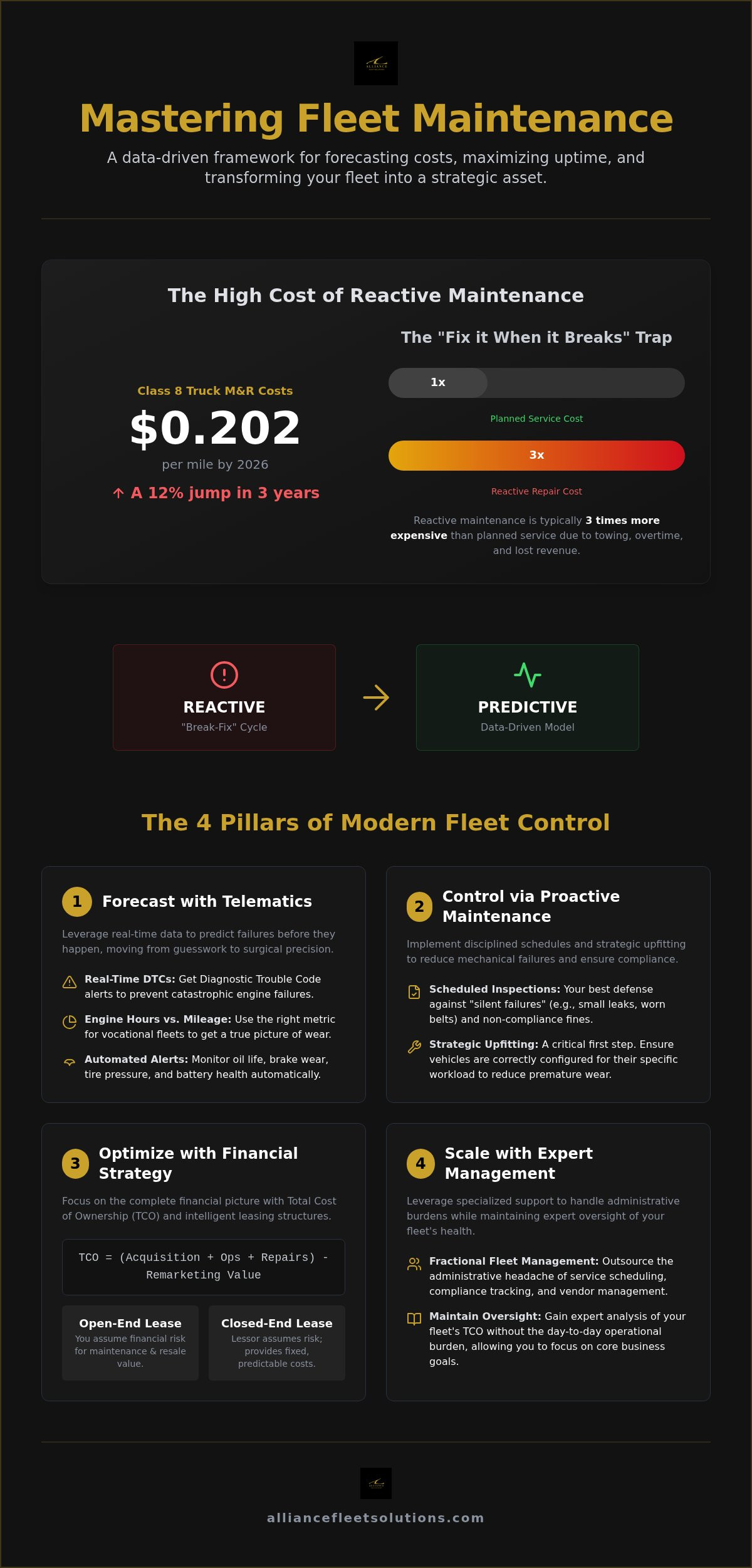
With maintenance and repair costs for Class 8 trucks climbing to $0.202 per mile in 2026, a 12% jump in just three years, the traditional “fix it when it breaks” approach is no longer a viable business strategy. You’ve likely felt the sting of an unpredictable repair spike that wiped out your quarterly budget or watched service revenue vanish while a vehicle sat in the shop. It’s frustrating to manage a fleet when you lack visibility into which assets are becoming money pits. We know you need a dependable way to stabilize these costs and keep your drivers on the road.
This guide provides a masterclass on how to forecast and control fleet maintenance expenses using data-driven techniques and professional operational frameworks. We’ll show you how to transform your maintenance department from a reactive cost center into a strategic business asset. We’ll explore the latest FMCSA digital compliance rules, explain how telematics drive predictive forecasting, and provide a clear framework for deciding when to repair or remarket a vehicle. By the end of this article, you’ll have the tools to achieve a flat-line budget and maximize your fleet’s reliability.
Key Takeaways
- Learn how to leverage telematics and GPS solutions to shift from reactive repairs to a predictive model that significantly reduces equipment downtime.
- Discover why professional upfitting is a critical first step in reducing mechanical failure by ensuring vehicles are correctly configured for their specific workloads.
- Master how to forecast and control fleet maintenance expenses by analyzing lifecycle data and engine hours to eliminate budget-draining financial surprises.
- Understand how choosing between open-end and closed-end leasing structures fundamentally shifts your maintenance responsibilities and long-term financial risk.
- Explore how fractional fleet management allows you to outsource the administrative headache of service scheduling while maintaining expert oversight of your total cost of ownership.
The Hidden Variables of Fleet Maintenance and Total Cost of Ownership (TCO)
Understanding the financial health of your operation starts with a clear definition. Fleet maintenance forecasting is the process of using historical data and vehicle lifecycles to estimate future repair spend. It’s the backbone of professional Fleet management, yet many businesses still treat repairs as an unavoidable surprise. Statistics show that reactive maintenance is typically three times more expensive than planned service. When a truck breaks down on the highway, you aren’t just paying for a part. You’re paying for emergency towing, expedited shipping, and technician overtime. Learning how to forecast and control fleet maintenance expenses means identifying the “tipping point” where the cost of keeping a vehicle on the road exceeds its actual market value. Once an asset reaches this stage, every dollar spent on repairs is essentially lost capital that could have been better allocated toward vehicle acquisition.
Breaking Down Maintenance Categories
Your bottom line depends on the ratio of preventative to corrective maintenance. High-performing fleets prioritize preventative care to catch “silent failures,” such as minor oil leaks or worn belts, before they escalate into catastrophic engine damage. Scheduled inspections are your best defense against the cost of non-compliance. In safety-regulated industries, a single failed inspection leads to heavy fines and a damaged safety profile. This makes it harder to secure lucrative contracts or maintain low insurance premiums. A disciplined approach to inspections ensures that your equipment remains a strategic asset rather than a liability.
Calculating the Real Cost of Downtime
The mechanic’s bill is only the tip of the iceberg. To find the real impact of a breakdown, you must quantify lost revenue per hour for every downed vehicle. If a truck isn’t moving, it isn’t earning. Beyond the immediate financial loss, excessive downtime erodes customer trust and puts long-term contract retention at risk. Reliability is your brand’s promise to your clients, and frequent failures break that promise. Total Cost of Ownership (TCO) in fleet maintenance represents the sum of all acquisition, operational, and repair costs minus the eventual remarketing value of the asset. By focusing on TCO rather than just the repair bill, you gain a clearer picture of your fleet’s true efficiency.
Forecasting Maintenance Needs with Telematics and Predictive Analytics
Modern fleet managers no longer rely on guesswork or paper logs to manage their assets. By implementing telematics and GPS solutions, you can transition from a reactive “break-fix” cycle to a sophisticated predictive model. This technology provides the raw data necessary to understand how to forecast and control fleet maintenance expenses with surgical precision. Instead of waiting for a driver to report a strange noise, you receive instant notification of a vehicle’s health. This allows you to schedule repairs before a minor fault becomes a roadside emergency.
A critical component of this data strategy is choosing the right metrics. While mileage is the standard for long-haul trucking, engine hours often provide a more accurate picture for vocational fleets or vehicles that spend significant time idling. Proper Fleet Management & Optimization requires analyzing these data points to identify “lemon” models that consistently underperform. When you see a specific make or year requiring 20% more shop time than the rest of your fleet, you have the evidence needed to accelerate its remarketing schedule. Real-time diagnostic trouble codes (DTCs) act as an early warning system, preventing catastrophic engine failures that can cost tens of thousands of dollars.
Leveraging Telematics for Real-Time Insights
Telematics units do more than just track location. They provide automated alerts that ensure routine maintenance never slips through the cracks, including:
- Real-time oil life and fluid level monitoring
- Brake pad wear and tire pressure sensors
- Battery health and alternator output alerts
Beyond mechanical data, these systems monitor driver behavior, such as harsh braking or rapid acceleration. Excessive aggressive driving puts unnecessary strain on transmissions and tires, driving up your long-term costs. Integrating this data directly into your maintenance management software creates a seamless digital trail, making it easier to audit your spend and prove compliance with updated FMCSA standards.
Building a 12-Month Predictive Budget
With a year of telematics data, you can build a highly accurate 12-month budget. This forecast should account for vehicle age and expected annual utilization while also factoring in seasonal spikes like winterization or cooling system checks. Mastering how to forecast and control fleet maintenance expenses requires this level of granular detail to ensure your budget remains predictable through every season. You must also adjust your expectations based on current inflation and parts availability trends. For businesses looking to refine these projections, partnering with experts in Telematics and GPS Solutions provides the high-level oversight needed to stabilize your annual spend.
Controlling Expenses Through Preventative Maintenance and Strategic Upfitting
Controlling your budget starts before the vehicle ever hits the road. Professional upfitting isn’t just about storage or aesthetics; it’s the foundational step in maintenance control. When equipment is custom-engineered for its specific task, you prevent the mechanical stress that leads to premature failure. This proactive physical strategy, combined with a “No-Exceptions” preventative maintenance policy, provides the stability needed when you’re learning how to forecast and control fleet maintenance expenses. By standardizing your fleet with similar makes and configurations, you drastically reduce parts inventory complexity and the time required for mechanic training.
Centralized maintenance management allows you to leverage the power of scale. When you manage multiple assets under a unified framework, you gain the ability to negotiate national account pricing for high-turnover items like tires and brake pads. This isn’t just about saving a few dollars per unit; it’s about creating a predictable cost structure that aligns with the State DOT’s Maintenance Equipment Fleet Management Decisions regarding lifecycle analysis and data-driven budgeting. Auditing every repair shop invoice ensures you aren’t paying for “upsells” or unnecessary services that don’t contribute to the vehicle’s longevity.
The Upfitting-Maintenance Connection
Improper weight distribution is a silent killer of fleet profitability. If an upfit is too heavy or poorly balanced, it places localized stress on the suspension and braking systems, leading to frequent corrective repairs. By choosing durable, lightweight materials and custom configurations that respect the vehicle’s chassis limits, you extend the asset’s service life. This physical optimization ensures the vehicle operates within its designed parameters, reducing the frequency of unscheduled shop visits. It’s much easier to manage costs when the vehicle isn’t fighting against its own hardware.
Vendor Management and National Accounts
Establishing Service Level Agreements (SLAs) with your repair partners is essential for maximizing uptime. These agreements should prioritize your fleet during peak periods, ensuring your trucks aren’t sitting at the back of the line while revenue vanishes. National accounts provide consistent pricing across different regions, which simplifies the process of how to forecast and control fleet maintenance expenses for multi-state operations. Regular audits of these partnerships keep vendors accountable and ensure your maintenance spend is strictly focused on essential, high-ROI activities that keep your drivers safe and your trucks moving.
Financial Control: Budgeting Models and Leasing Structures
Financial planning is the final piece of the puzzle. While previous sections focused on data and hardware, your choice of financing determines who carries the financial weight of a catastrophic engine failure. Understanding open-end vs. closed-end leasing is vital because these structures fundamentally change your maintenance responsibility. A fixed-cost maintenance program allows you to trade variable repair risk for total budget certainty. It turns a volatile expense into a predictable monthly line item. This shift is essential for any manager seeking how to forecast and control fleet maintenance expenses without the stress of “black swan” repair events.
Tax implications also play a role in your long-term strategy. You must decide whether to capitalize major overhauls or treat them as operating expenses. Capitalized maintenance can improve your balance sheet, while operating expenses provide immediate tax relief. Balancing these financial levers requires a partner who understands both the garage floor and the boardroom. If you want to stabilize your cash flow, exploring Closed-End Leasing options can provide a significant shield against unpredictable repair costs.
Lease Structures and Maintenance Risk
Choosing the right lease is a strategic decision about risk tolerance. Closed-end leases often transfer the “tail-end” maintenance risk to the lessor. You pay a set amount, and at the end of the term, you walk away without worrying about the vehicle’s residual value or late-life mechanical issues. Conversely, open-end leases offer maximum flexibility and are common in heavy-duty sectors. They allow you to retain control over service quality and benefit from any equity built in the vehicle. For small to mid-sized fleets, full-service lease options can be a smart way to bundle maintenance costs into a single, manageable payment.
Remarketing as a Cost-Recovery Strategy
Maintenance isn’t just an expense; it’s an investment in the asset’s final sale price. A well-documented maintenance history increases resale value by 15-20% compared to vehicles with spotty records. Buyers pay a premium for the peace of mind that comes with a rigorous service log. How to forecast and control fleet maintenance expenses effectively involves timing the market perfectly. You want to sell the vehicle before it enters its major repair cycle, typically just before a significant engine or transmission overhaul is due. Professional Vehicle Remarketing services ensure you capture this value, effectively lowering the net cost of every repair performed during the vehicle’s life.
Scaling Efficiency with Maintenance Management and Fractional Support
Growing a business often means the administrative burden of service scheduling and record-keeping outpaces your internal resources. This is where fractional fleet management becomes a secret weapon for scaling operations. It allows you to move beyond a simple “repair shop” mindset. Instead of just reacting to failures, you adopt a “strategic asset” mindset where every vehicle is managed for its maximum return on investment. Alliance Fleet Solutions brings the technical authority of a 20-year industry veteran to your operation, providing the expert oversight needed to master how to forecast and control fleet maintenance expenses without the overhead of a full-time executive salary.
By outsourcing the heavy lifting of maintenance administration, you ensure that every service event is documented, audited, and optimized for cost. This partnership approach bridges the gap between daily logistics and long-term financial performance. You get the benefit of a seasoned pro who understands the nuances of heavy-duty equipment, allowing your team to focus on customer service and revenue-generating activities. It’s a shift from being a victim of equipment failure to being a master of your fleet’s destiny.
The Benefits of Fractional Management
You don’t need a massive payroll to get enterprise-level results. Fractional support gives you access to high-level strategic planning tailored to your specific industry needs. This includes independent auditing of all maintenance activities to identify cost-leakage, such as overcharged parts or redundant labor. By outsourcing the administrative headache, your team stays focused on core logistics while experts handle the complexities of lifecycle planning. This ensures you aren’t just fixing trucks; you’re optimizing a business investment that remains reliable and safe for years.
Getting Started with Professional Maintenance Management
The first step toward a predictable budget is a comprehensive fleet health audit. This establishes a baseline for your current spend and identifies immediate risks that could ruin your quarterly projections. Once you have a clear picture, you can set aggressive but achievable Key Performance Indicators (KPIs). Focus on metrics like vehicle uptime, cost-per-mile, and Preventative Maintenance (PM) compliance. Tracking these data points consistently is the only way to truly understand how to forecast and control fleet maintenance expenses over the long term. If you’re ready to eliminate the stress of unpredictable repair bills, partner with Alliance Fleet Solutions to take control of your maintenance budget today.
Take Command of Your Fleet’s Financial Future
Predictability in fleet operations isn’t a luxury; it’s a necessity for survival in a high-stakes logistics market. By integrating data-driven telematics and prioritizing professional upfitting, you move your operation away from the chaos of emergency repairs toward a stable, flat-line budget. You’ve learned that mastering how to forecast and control fleet maintenance expenses requires a shift in mindset from simple mechanical fixes to comprehensive lifecycle management. Whether it’s through selecting the right leasing structure or implementing a strict preventative maintenance policy, the tools for financial control are now in your hands.
You don’t have to manage this transition alone. Leveraging expert Fractional Fleet Management allows you to access elite oversight while our National Maintenance Network Support keeps your drivers on the road. Our data-driven telematics integration ensures you always have the visibility needed to make informed, proactive decisions. Request a Fleet Maintenance Audit from Alliance Fleet Solutions to identify hidden cost-leakage and stabilize your TCO. It’s time to turn your fleet into a reliable engine for business growth. We’re ready to help you build a more resilient and profitable operation today.
Frequently Asked Questions
What is the average maintenance cost per mile for a commercial fleet?
Average maintenance and repair costs for Class 8 trucks reached $0.202 per mile in 2026. This represents nearly 9% of total operating costs for heavy-duty operators. While this is a benchmark for the trucking sector, light-duty delivery vans typically see lower per-mile costs but higher service frequency due to stop-and-go duty cycles. Monitoring these mileage-based costs is a fundamental step for anyone learning how to forecast and control fleet maintenance expenses effectively.
How often should I perform preventative maintenance on my trucks?
Preventative maintenance should generally occur every 10,000 to 15,000 miles, but your specific duty cycle is the better guide. For vocational fleets with high idle times, engine hours are a more accurate trigger than mileage. Establishing a “No-Exceptions” policy for these intervals prevents minor issues from escalating into catastrophic failures. Consistent scheduling ensures your equipment remains safe and compliant with the latest FMCSA safety standards while protecting your long-term budget.
Can telematics really reduce my maintenance expenses?
Telematics can reduce annual maintenance costs by up to 20% and decrease equipment downtime by as much as 62%. These systems provide real-time diagnostic trouble codes that allow you to address engine faults before they lead to a roadside breakdown. By moving to a predictive model, you eliminate the guesswork and ensure your budget is spent on targeted, necessary repairs rather than broad, scheduled replacements that might not be required yet.
Is it cheaper to outsource maintenance management or keep it in-house?
For most small to mid-sized fleets, outsourcing to a fractional fleet management partner is more cost-effective than hiring a full-time executive. You gain the technical authority of a seasoned expert and access to national account pricing without the burden of a full-time salary and benefits. This model allows you to scale your maintenance oversight in direct proportion to your fleet size, ensuring your administrative costs never outpace your revenue growth.
How do I know when a vehicle is too expensive to keep maintaining?
A vehicle becomes too expensive to maintain when its annual repair costs approach 20% to 30% of its current remarketing value. You should also track the “downtime-to-revenue” ratio. If a truck spends more time in the shop than it does generating income, it has reached its tipping point. At this stage, vehicle remarketing is the best financial move to recover capital before a major mechanical failure further devalues the asset for your business.
What is the difference between preventative and predictive maintenance?
Preventative maintenance is a scheduled approach based on fixed intervals of time or mileage, while predictive maintenance uses real-time data to forecast exactly when a part will fail. Preventative care is your baseline, but predictive analytics, powered by telematics, allows for even tighter budget control. Combining both strategies is the most effective way to master how to forecast and control fleet maintenance expenses while maximizing your vehicle’s total service life and reliability.
Does upfitting affect my vehicle’s maintenance schedule?
Professional upfitting significantly impacts your maintenance schedule by ensuring proper weight distribution and chassis balance. If a vehicle is poorly configured, it places excessive strain on the braking and suspension systems, leading to more frequent corrective repairs. Strategic upfitting using lightweight, durable materials reduces this mechanical stress. This proactive engineering approach extends the time between major service intervals and lowers your total cost of ownership over the entire life of the vehicle.
How can I forecast maintenance costs for a fleet of different vehicle types?
To forecast costs for a mixed fleet, you must segment your assets by class, age, and duty cycle. A long-haul tractor has vastly different maintenance needs than a local delivery van or a specialized service truck. Build separate cost profiles for each segment based on historical TCO data and expected annual utilization. This granular approach allows you to create a master 12-month predictive budget that remains accurate even as your fleet composition changes over time.