
Your C-suite doesn’t actually want to hear about reduced downtime or better oil change intervals. While those metrics matter to you, leadership often views the fleet as a massive cost center that drains capital. It’s frustrating when you know exactly what the fleet needs to thrive, but you aren’t sure how to present fleet savings to company leadership in a way that sticks. You’re not alone in this struggle. Most managers find it difficult to bridge the gap between technical maintenance data and the financial metrics that drive executive decisions.
This 2026 guide shows you how to transform raw operational data into a strategic business case. We explore how to leverage current economic realities, such as the 76 cents per mile IRS business rate and the upcoming EPA 2027 emissions standards, to justify fleet investments. You’ll learn to position open-end leasing and professional maintenance programs as tools for capital preservation rather than mere expenses. By the end of this article, you’ll have a clear roadmap to secure your budget and elevate your role from a tactical manager to a vital strategic partner.
Key Takeaways
- Shift your focus from mechanical maintenance to financial outcomes like EBITDA and cash flow to bridge the communication gap with the boardroom.
- Master the “Big Three” metrics, including Total Cost of Ownership and Asset Utilization, to prove the productivity of every vehicle in your fleet.
- Learn how to present fleet savings to company leadership using a five-step framework that connects operational wins directly to corporate growth goals.
- Discover why focusing on Total Cost of Ownership rather than the lowest upfront price is the only way to protect long-term capital and resale value.
- Leverage fractional fleet management to reduce internal overhead while maintaining the high-performance standards of a professional, national operation.
The Communication Gap: Why Fleet Managers Struggle with Buy-in
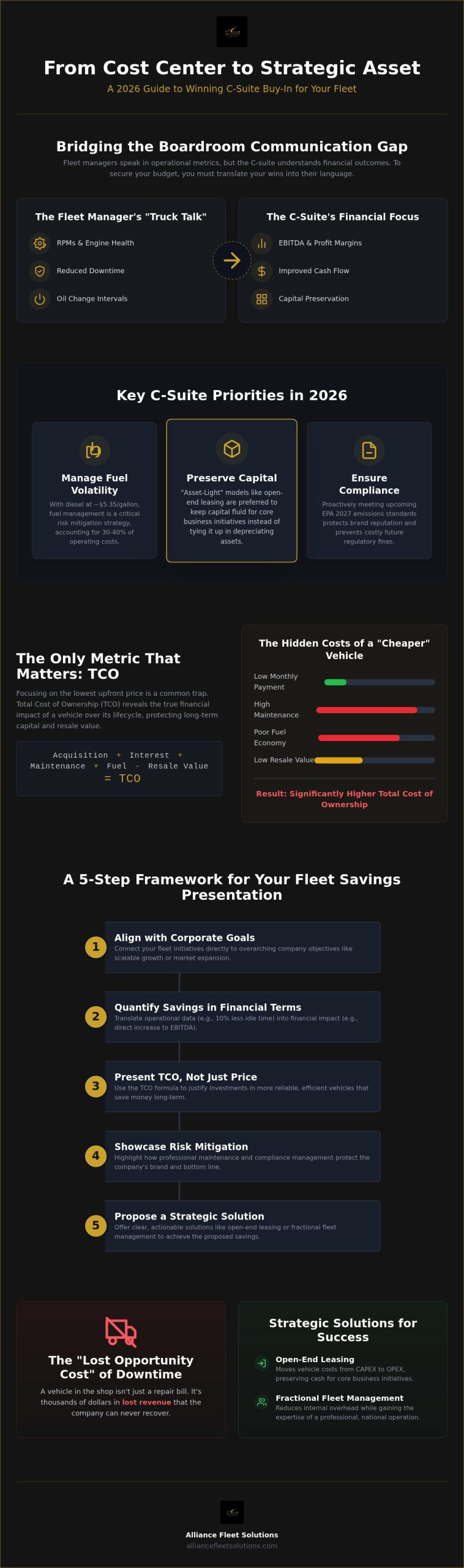
Executives often see the fleet as a black hole of expenses. You see a complex engine of logistics, but they see a line item that shrinks their margins. This fundamental disconnect occurs because most managers rely on “Truck Talk.” While RPMs, downtime, and tire wear are vital for daily operations, they don’t resonate in the boardroom. To secure a budget for modernization, you must learn how to present fleet savings to company leadership by translating these technical wins into financial outcomes like EBITDA and improved cash flow.
When you present raw data without a business context, leadership sees an opportunity to cut costs rather than an invitation to invest. Shifting the perception of your fleet from a “necessary evil” cost center to a strategic asset requires a change in timing and tone. Don’t wait for the annual budget review to justify your existence. Presenting proactive savings initiatives three to six months before the budget cycle begins positions you as a forward-thinking partner rather than a manager asking for more money.
Understanding the C-Suite’s Priorities in 2026
In the current economic climate, executives are hyper-focused on managing fuel price volatility and persistent inflation. With diesel prices hovering around $5.35 per gallon in August 2026, fuel management isn’t just an operational task; it’s a risk mitigation strategy. Leadership is increasingly moving toward “Asset-Light” models to keep capital fluid. Utilizing open-end or closed-end leasing structures allows the company to preserve cash while maintaining a modern, efficient fleet. Executives also prioritize risk management. Ensuring compliance with the upcoming EPA 2027 heavy-duty emissions standards protects the company’s brand reputation and prevents future regulatory fines.
Moving from Tactical to Strategic Reporting
Strategic reporting isn’t about what happened yesterday; it’s about what those events mean for the company’s future. Instead of reporting that you reduced idle time by 10%, report how that reduction directly increased the company’s Total Cost of Ownership efficiency. You must tailor your message to specific stakeholders. The CFO focuses on cost reduction and capital preservation, while the COO prioritizes operational efficiency and the CEO looks for scalable growth. Understanding how to present fleet savings to company leadership means recognizing that different executives value different outcomes.
Strategic Fleet Management is the alignment of vehicle operations with corporate financial goals.
Translating Fleet Metrics into Boardroom Language
To effectively communicate with the C-suite, you must move beyond the shop floor. The “Big Three” metrics, Total Cost of Ownership (TCO), Asset Utilization, and Cost per Mile, serve as the foundation for how to present fleet savings to company leadership. While location tracking via telematics is standard, the real value lies in proving productivity gains. If your data shows a 15% increase in stops per day or a reduction in engine idling, you aren’t just tracking trucks; you’re proving revenue growth.
Fuel management programs also play a critical role in this translation. With diesel prices at approximately $5.35 per gallon as of August 2026, fuel typically accounts for 30-40% of a fleet’s total operating costs. By stabilizing this variance through professional oversight, you provide the CFO with the predictability they crave. Similarly, when discussing maintenance, calculate the “Lost Opportunity Cost” of downtime. A truck sitting in the shop isn’t just a repair bill. It represents thousands of dollars in lost revenue that the company can never recover.
Total Cost of Ownership (TCO) Explained
TCO is the only metric that captures the full financial impact of a vehicle. The formula is straightforward: Acquisition + Interest + Maintenance + Fuel – Resale Value. Focusing solely on a low monthly lease payment is a common trap. A cheaper vehicle with high maintenance requirements or poor fuel economy often results in a significantly higher TCO over its lifecycle. Using this data allows you to justify replacing aging, high-maintenance vehicles that are quietly draining the company’s bottom line while increasing operational risk.
Capital Optimization: OPEX vs. CAPEX
One of the strongest arguments for how to present fleet savings to company leadership involves capital optimization. Buying vehicles outright (CAPEX) ties up massive amounts of cash that could otherwise fund core business initiatives, such as research and development or new hires. Shifting to leasing (OPEX) improves liquidity and offers distinct tax advantages. Open-end leasing, for instance, provides the flexibility of ownership with the cash flow benefits of a lease. By partnering with experts in fractional fleet management, you can demonstrate the “Opportunity Cost” of tying up cash in depreciating assets, proving that a well-structured lease is a strategic financial tool rather than just a way to get vehicles.
Total Cost of Ownership vs. Upfront Price: Winning the Budget War
Procurement teams often focus on the sticker price of a vehicle because it is a tangible, immediate number. While this approach seems fiscally responsible, it is a poor indicator of true long-term value. If you choose the cheapest vehicle on the lot, you might save $3,000 on day one but lose $15,000 in fuel inefficiency and repair downtime over five years. This reality is central to how to present fleet savings to company leadership. You must demonstrate that a higher upfront investment in a premium, correctly configured asset often yields a much higher ROI by the end of its service life.
The Value of Professional Upfitting
Many organizations attempt “DIY” upfitting to save on labor costs, but the hidden expenses of this choice add up quickly. Poorly installed shelving or improper weight distribution can lead to premature tire wear, electrical failures, and safety hazards that increase your insurance liability. Professional upfitting is a strategic productivity tool, not just an add-on. When a vehicle is configured specifically for the job, technicians work faster and more safely. A well-organized workspace reduces the time spent searching for tools, which directly increases billable hours. Professional installations also protect the vehicle’s structural integrity, ensuring that you don’t void warranties or damage the chassis. For a deeper look at managing these assets effectively, review The Strategic Guide to Maintenance Management for Business Fleets in 2026.
- Correct weight distribution minimizes brake and suspension wear.
- Ergonomic layouts reduce driver fatigue and improve retention.
- Standardized configurations simplify maintenance across the entire fleet.
Maximizing ROI Through Strategic Remarketing
The disposal phase is the most overlooked part of the fleet lifecycle, yet it is a massive lever for overall ROI. There is a profound difference between simply selling a used truck and executing a professional remarketing strategy. If you can secure 10% more at the time of disposal through specialized channels, you effectively lower the net cost of the entire lease. Alliance Fleet Solutions specializes in vehicle remarketing, leveraging national networks to ensure you maximize resale value at the end of the term. This final step is essential for anyone learning how to present fleet savings to company leadership. It proves you are managing the company’s capital from acquisition to exit, rather than just handling daily logistics. By framing the fleet as a managed asset with a predictable exit value, you transform the conversation from “what does this cost” to “what is the return on this investment.”
A 5-Step Framework for Your Fleet Savings Presentation
You’ve gathered the data and identified the inefficiencies. Now you must deliver a pitch that resonates with the boardroom. Success depends on structure. Executing a professional presentation requires you to pivot from technical details to high-level business outcomes. Follow this five-step framework to master how to present fleet savings to company leadership and secure the approvals you need.
- Step 1: Start with the Bottom Line. Don’t bury the lead. Open your presentation by stating the total projected savings or the ROI percentage. C-suite executives prioritize results, so giving them the “answer” first ensures they stay engaged with the supporting data.
- Step 2: Connect Savings to Corporate Goals. Relate your fleet wins to broader company objectives. If the CEO wants to expand into new territories, show how your fuel management program can fund the acquisition of two new sales vehicles.
- Step 3: Use Visual Data. Dashboards are superior to spreadsheets in a boardroom setting. Use clear charts that highlight trends and anomalies rather than rows of raw numbers.
- Step 4: Address the Risk of Doing Nothing. Explain the cost of the status quo. Highlight how maintaining an aging fleet leads to exponential repair costs and potential non-compliance with the upcoming EPA 2027 emissions standards.
- Step 5: The Ask. Be specific. Whether you need approval for a new open-end lease structure or a maintenance management program, state your requirements clearly at the end.
Visualizing Data for the C-Suite
Executives scan information; they don’t dig for it. Utilize your telematics and GPS solutions to create “Heat Maps” that visualize route efficiency and vehicle utilization. A “Before vs. After” slide is a powerful tool to demonstrate the immediate impact of implemented fuel programs or optimized maintenance schedules. For more insights on streamlining your reporting, see Efficient Fleet Operations: The 2026 Strategic Guide to Maximizing Uptime and ROI.
Handling Executive Objections
Preparation is the key to overcoming pushback. When leadership says, “We can’t afford new trucks,” counter with a TCO comparison. Show them that the repair bills and fuel waste of the old fleet actually cost more than the lease on a new vehicle. If they worry that interest rates are too high, explain how the flexibility of open-end leasing allows the company to adjust to market shifts. For those who believe a dedicated manager is unnecessary, present the cost-benefit analysis of fractional fleet management. This approach proves that you can reduce internal labor costs while gaining expert oversight. Knowing how to present fleet savings to company leadership means anticipating these hurdles and having a data-backed response ready.
Scaling Success: Partnering with Alliance Fleet Solutions
Implementing a strategic fleet vision is a significant undertaking. You don’t have to manage it in isolation. Alliance Fleet Solutions functions as an extension of your team through our fractional fleet management model. This partnership provides the technical authority of a national provider while maintaining the personalized, family-owned service touch that larger competitors often lack. When you’re determining how to present fleet savings to company leadership, our reporting tools provide the exact visualizations and financial metrics required to win boardroom approval.
We move beyond the transactional nature of traditional leasing. Instead, we focus on strategic lifecycle management. This means we aren’t just handing you keys; we’re providing a data-backed roadmap for your entire operation. Our fractional management approach allows your company to reduce internal labor costs while gaining access to expert oversight. By shifting the administrative burden to us, you can focus on the high-level strategy that elevates your role within the organization.
Comprehensive Lifecycle Management
Success in fleet management requires a holistic view of the vehicle’s journey. We handle everything from initial vehicle acquisition and professional upfitting to ongoing maintenance and strategic remarketing. Our fuel management programs integrate directly into your savings reports, making it easy to prove the ROI of your efficiency initiatives. For a detailed breakdown of how these elements drive company success, see our Comprehensive Fleet Management Services: The 2026 Strategic Guide for Business Growth.
- Professional upfitting ensures vehicles are productivity tools from day one.
- Specialized remarketing maximizes resale value to lower your net lease costs.
- Maintenance management reduces the lost opportunity cost of unplanned downtime.
Next Steps for Your Fleet Strategy
The path to a more efficient fleet starts with a clear understanding of your current performance. Schedule a fleet audit with our team to identify immediate savings opportunities that you can take to your next board meeting. We help you leverage our expertise to build the data-heavy, visually compelling presentations discussed in this guide, mastering how to present fleet savings to company leadership with confidence. Don’t wait for the next budget cut to justify your fleet’s value. Take the proactive step toward becoming a strategic business partner today. Request a Fleet Consultation with Alliance Fleet Solutions to begin your transformation.
Elevate Your Fleet Strategy in 2026
Mastering the boardroom requires a fundamental shift from operational metrics to the financial language of capital preservation and ROI. By focusing on Total Cost of Ownership and utilizing a structured presentation framework, you can bridge the gap between technical data and executive priorities. Understanding how to present fleet savings to company leadership is the final step in transforming your role from a tactical manager into a vital strategic business partner.
You don’t have to navigate this transition alone. Alliance Fleet Solutions provides the expert oversight and data-driven reporting needed to back your vision with confidence. Our fractional fleet management reduces internal overhead, while professional upfitting ensures every vehicle is configured for maximum efficiency from day one. When it’s time to cycle out assets, our vehicle remarketing experts maximize your end-of-life value to protect your company’s bottom line. Partner with Alliance Fleet Solutions to optimize your fleet and prove your ROI today. Your fleet is a powerful engine for business growth; it’s time to show leadership exactly what it can achieve.
Frequently Asked Questions
What are the most important financial metrics for fleet management?
The most critical financial metrics include Net Present Value (NPV), EBITDA impact, and Asset Utilization. While operational data like fuel economy is important, leadership prioritizes metrics that show how the fleet affects the company’s overall profitability. By proving that every dollar spent on maintenance reduces the lost opportunity costs of downtime, you demonstrate how the fleet contributes to the business’s bottom line rather than just acting as an expense.
How do I explain the difference between OPEX and CAPEX to my team?
Explain that CAPEX involves spending large sums of cash upfront to own an asset, while OPEX covers the ongoing costs of running the business. Tying up capital in vehicle ownership (CAPEX) often limits a company’s ability to invest in growth or new hires. Shifting to an OPEX model through leasing keeps the balance sheet light and provides predictable monthly expenses. This approach allows the team to focus on service delivery rather than managing depreciating assets.
Is open-end or closed-end leasing better for showing savings to leadership?
Open-end leasing is typically better for demonstrating long-term savings because it allows the company to capture the equity in the vehicle at the end of the term. This structure is highly flexible and rewards proactive maintenance with higher remarketing returns. While closed-end leasing offers more predictability for monthly budgeting, open-end leasing aligns better with a strategic goal of maximizing the resale value of the fleet through professional lifecycle management.
How can telematics data be used to justify a larger fleet budget?
Telematics data justifies a budget by identifying exactly where capital is wasted on under-utilized assets or excessive idling. Use these insights to show that a larger budget for newer, more efficient vehicles will actually lower the total cost per mile. It’s a powerful tool for anyone learning how to present fleet savings to company leadership because it provides the data-backed “Before vs. After” proof needed to validate your modernization requests.
What is the best way to calculate Total Cost of Ownership (TCO)?
The most accurate way to calculate TCO is to combine the acquisition cost, interest, fuel expenses, and maintenance costs, then subtract the eventual resale value. You must also include indirect costs like administrative overhead to get a true financial picture. This calculation proves that the “cheapest” vehicle often has the highest lifetime cost, which is a key component in how to present fleet savings to company leadership during a budget review.
How does professional upfitting impact the resale value of a fleet vehicle?
Professional upfitting increases resale value by ensuring that modifications are durable, safe, and standardized across the fleet. Amateur “DIY” upfitting can damage the vehicle’s structural integrity or electrical systems, leading to significant deductions at the time of disposal. Professional configurations are often seen as a value-add by secondary buyers. This allows your remarketing team to secure a higher price and significantly improves the overall ROI of the asset.
What happens if leadership rejects my fleet savings proposal?
If your proposal is rejected, pivot immediately to the “Risk of Doing Nothing” by documenting the rising costs of maintaining your current aging fleet. Suggest a smaller pilot program to prove your theories with a handful of vehicles before asking for a full fleet overhaul. Use this time to gather more granular data on downtime and fuel waste. These undeniable costs often change executive minds during the next budget cycle.