
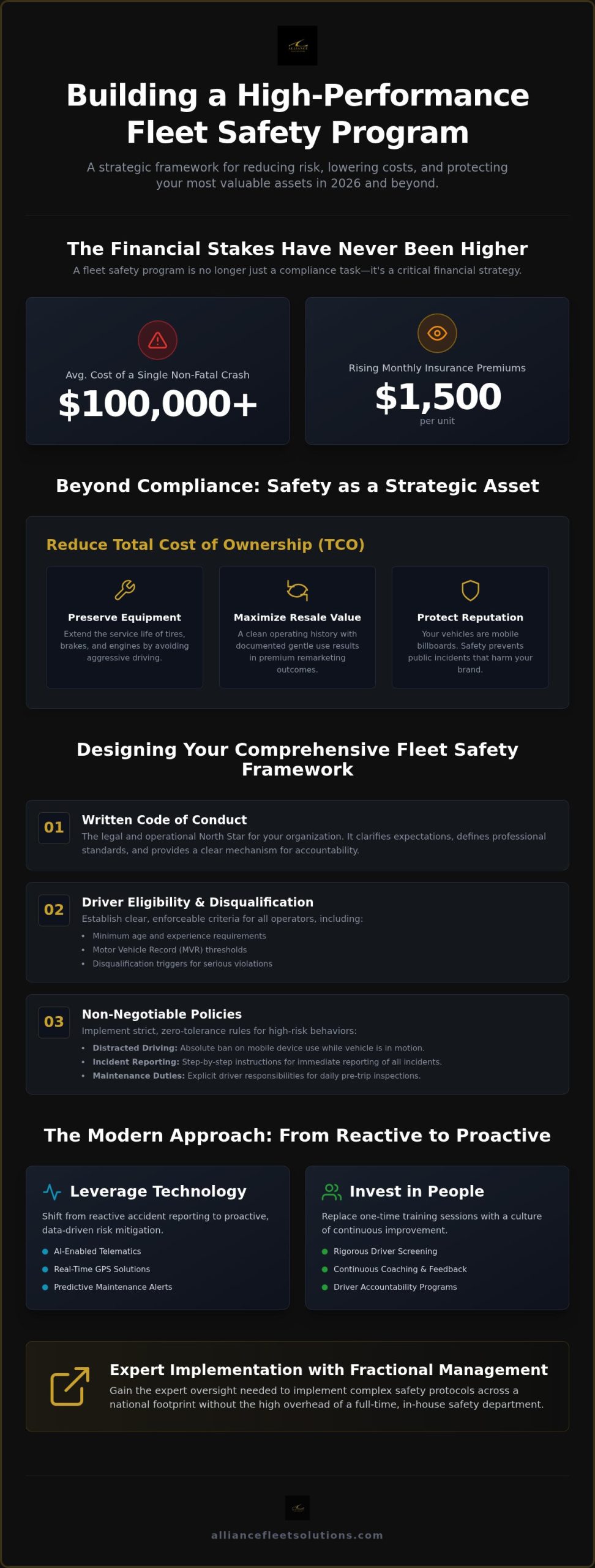
Did you know that the average cost of a single non-fatal commercial vehicle crash now exceeds $100,000? When you factor in rising insurance premiums that can reach $1,500 per unit each month, the financial stakes of your operations have never been higher. Developing a fleet safety program isn’t just about checking a compliance box anymore; it’s a critical strategy for protecting your bottom line and ensuring your vehicles stay on the road.
You likely already know that managing a national fleet means constantly battling the high costs of vehicle downtime and the stress of monitoring driver behavior from a distance. It’s a heavy burden to carry, but you don’t have to manage these risks alone. This guide will show you how to build a high-performance fleet safety program that reduces risk, lowers your total cost of ownership, and protects your most valuable assets. We’ll explore the 2026 strategic framework, from leveraging AI-enabled telematics to navigating the latest FMCSA electronic record mandates. By the end of this article, you’ll have a clear roadmap for achieving lower accident rates and predictable maintenance costs.
Key Takeaways
- Understand why a robust safety strategy is a financial asset that preserves vehicle resale value and minimizes the high costs of operational downtime.
- Identify the core components of developing a fleet safety program, including how to set clear driver eligibility criteria and enforceable disqualification triggers.
- Learn how to leverage telematics and GPS solutions to shift from reactive accident reporting to proactive, data-driven risk mitigation.
- Discover the importance of replacing one-time training sessions with a culture of continuous coaching and rigorous driver screening.
- Explore how fractional fleet management provides the expert oversight needed to implement complex safety protocols without the overhead of a full-time department.
The Strategic Value of a Fleet Safety Program in 2026
In the current logistics climate, safety is much more than a human resources initiative; it’s a pillar of financial stability. Developing a fleet safety program serves as a protective barrier against the volatility of the modern market. While many managers view safety as a reactive necessity to satisfy the Federal Motor Carrier Safety Administration (FMCSA), industry leaders treat it as a strategic asset. A single accident triggers a chain reaction that hits your balance sheet far harder than the initial deductible suggests. It disrupts your rhythm, strains your team, and drains capital that should be fueling growth. These hidden costs, such as the time spent on accident investigations and the expense of securing short-term replacement vehicles, can quickly eclipse the direct costs of a claim.
Beyond Compliance: Reducing Total Cost of Ownership (TCO)
Safe driving habits directly preserve the mechanical integrity of your equipment. When drivers avoid aggressive acceleration and harsh braking, they extend the service life of tires, brake pads, and engines. This reduction in wear means fewer unscheduled shop visits and more predictable maintenance cycles. Beyond the shop, safety protocols optimize fuel management by curbing excessive idling and high-speed maneuvers. Perhaps most importantly, a clean operating history significantly boosts vehicle remarketing outcomes. Buyers pay a premium for assets with documented histories of gentle use. By prioritizing driver behavior, you ensure you capture maximum value at the end of the vehicle lifecycle, turning your safety record into a tangible financial return.
Protecting Brand Reputation and Operational Continuity
Your vehicles are mobile billboards. A public safety incident involving a branded truck doesn’t just result in an insurance claim; it creates a lasting negative impression that can alienate local communities and long-term partners. Safety programs act as the backbone of operational reliability by preventing the sudden equipment gaps caused by collisions. When you prioritize safety, you ensure your drivers hit their service windows and maintain the professional standards your clients expect. This consistency builds deep trust, positioning your business as a dependable partner rather than a liability. Developing a fleet safety program across your entire national footprint ensures every driver, regardless of location, upholds these critical standards. It creates a unified culture of excellence that protects both your people and your reputation.
Designing a Comprehensive Fleet Safety Policy Framework
A written policy isn’t just a manual; it’s a binding agreement between your organization and its drivers. When you’re developing a fleet safety program, this document serves as the legal and operational North Star. It clarifies expectations, defines professional standards, and provides a clear mechanism for accountability. According to the Network of Employers for Traffic Safety (NETS), businesses that formalize these expectations see significantly better outcomes in risk reduction. Without a written framework, safety becomes subjective, making it nearly impossible to enforce standards across a national fleet.
Core Elements: From Driver Eligibility to Incident Response
Every framework begins with a clear Code of Conduct. This document outlines driver eligibility, such as Motor Vehicle Record (MVR) thresholds and disqualification triggers for serious violations. It’s also vital to include an immediate post-accident checklist so drivers know how to document a scene without admitting fault. If you’re currently developing a fleet safety program, our experts in fleet management can help you draft these essential protocols.
Your written policy should include several non-negotiable items:
- Minimum eligibility: Clear age and experience requirements for all operators.
- Distracted driving: A zero-tolerance policy for mobile device usage while the vehicle is in motion.
- Incident reporting: Step-by-step instructions for reporting even minor “fender benders” immediately.
- Maintenance duties: Explicit driver responsibilities for daily pre-trip inspections and reporting defects.
Customizing Policies for Specific Industry Use Cases
Heavy-duty operations require specific cargo securement and pre-trip inspection rules that align with DOT standards. In contrast, passenger vehicle policies should define personal use rules for company-leased vehicles. This ensures drivers understand who is authorized to be behind the wheel during off-hours. Customizing these rules prevents the “one-size-fits-all” trap that often leaves specialized fleets vulnerable to unique risks.
Finally, ensure your policy integrates with your technology. It should clearly state that telematics data will be used for coaching and that aggressive driving behaviors carry specific disciplinary tiers. This level of detail transforms a static document into a living part of your daily operations, ensuring your team stays safe and your assets stay protected.
Leveraging Telematics and Data for Proactive Risk Mitigation
Telematics serves as the central nervous system of a modern safety strategy. It transforms vague concerns about driver behavior into actionable, objective data points. While older safety initiatives relied on retrospective accident reports, developing a fleet safety program in 2026 requires a shift toward real-time intelligence. This technology acts as a silent partner, providing the transparency needed to identify risky patterns long before they result in a collision or a massive insurance claim. By moving from a reactive stance to a proactive one, you protect your capital and your personnel simultaneously.
Real-Time Monitoring: Speeding, Braking, and Idle Time
Managers now have the power to receive instant notifications when a driver exceeds speed limits or engages in aggressive maneuvers like harsh braking. These alerts aren’t just for disciplinary records; they’re opportunities for immediate, constructive intervention. By identifying high-risk zones or specific routes where incidents frequently occur, you can adjust dispatching protocols or provide targeted route coaching. This proactive stance is one of the essential elements of a fleet safety program that differentiates top-tier operations from those merely reacting to crises. Consistent monitoring ensures that safety expectations are met every mile of the journey.
Data integration allows you to see the full picture of operational health. You can learn more about how telematics transform fleet efficiency to understand the broader impact on your bottom line. This level of visibility ensures that safety isn’t a separate, ignored silo but a core part of your daily professional workflow.
Safety Through Mechanical Reliability
A vehicle with worn brakes or failing tires is a liability, regardless of the driver’s skill level. Predictive maintenance uses telematics data to automate service schedules based on actual engine hours and wear patterns rather than generic mileage intervals. This approach eliminates the safety risks associated with deferred maintenance, a common problem in high-mileage national fleets. When you’re developing a fleet safety program, mechanical integrity must be a non-negotiable priority.
Ensuring every asset is mechanically sound protects your drivers and preserves the vehicle’s eventual resale value. For a deeper look at managing these cycles, see the strategic guide to maintenance management for business fleets in 2026. By linking mechanical health directly to your safety protocols, you create a comprehensive shield for your business. This data-driven loop ensures that every mechanical fix is a strategic step toward a safer, more profitable operation.
The Human Factor: Driver Screening, Training, and Accountability
Technology provides the data, but your drivers make the split-second decisions that determine your liability. Developing a fleet safety program requires a rigorous approach to the “human factor” that starts long before the keys are handed over. Even the most advanced telematics system can’t compensate for a driver who lacks the proper training or temperament for the road. By focusing on the person behind the wheel, you create a culture where safety isn’t just a rule but a professional standard. This human-centric focus ensures that your safety initiatives are embraced rather than ignored.
Best Practices for Pre-Employment Screening and Onboarding
A safe fleet begins with a disciplined hiring process. Reviewing Motor Vehicle Records (MVR) and Pre-Employment Screening Program (PSP) reports is the first gate. It’s critical to note that as of January 10, 2026, the paper Medical Examiner’s Certificate waiver has expired. You must now verify all CDL driver medical certifications exclusively through state MVRs. This digital shift requires your onboarding team to be tech-savvy and detail-oriented. Beyond the paperwork, conduct road tests that mirror the actual conditions your drivers will face. A driver may be comfortable in a standard van but may struggle with a heavy-duty truck that has specialized professional upfitting. Standardizing this orientation ensures every new hire understands your specific safety culture from day one.
Continuous Coaching: Using Scorecards to Drive Better Behavior
One-time training sessions are rarely effective for long-term behavior change. Instead, implement a continuous coaching loop using driver scorecards. These tools translate complex telematics data into simple, digestible rankings. Gamifying these results often increases buy-in, as drivers compete for the top spot in the fleet. When you sit down for 1-on-1 sessions, use the data to have objective conversations about habits like tailgating or harsh cornering. If you’re looking to streamline this process, our team offers expert fleet management to handle the heavy lifting of driver oversight.
Addressing privacy concerns is a vital part of this coaching. Many drivers are initially resistant to in-cab technology like AI-enabled dash cams. Be transparent; explain that these tools are there to exonerate them in the event of an accident. Research shows that fleets using AI-enabled dash cams see a 20% to 40% reduction in at-fault accident claims. When drivers see the technology as a shield rather than a spy, they’re more likely to cooperate. Finally, don’t just focus on the negatives. Recognizing and rewarding your top-performing drivers with incentives or public recognition boosts morale and reinforces the financial value of developing a fleet safety program that works for everyone.
Implementing Your Safety Program with Fractional Management
Many small to mid-sized businesses face a significant execution gap when it comes to safety. While the intent to protect drivers is there, the administrative bandwidth required for constant oversight often isn’t. Developing a fleet safety program is a complex, ongoing process that demands regular data analysis and policy enforcement. For companies without a dedicated safety director, these tasks frequently fall to the bottom of the priority list. This neglect leaves the organization vulnerable to high-cost accidents and rising premiums. A strategic partnership provides the expert control needed to bridge this gap.
How Fractional Fleet Management Closes the Safety Gap
Fractional fleet management provides the professional oversight of a full-scale fleet department without the overhead of additional full-time headcount. By outsourcing the monitoring of telematics alerts and Motor Vehicle Record (MVR) checks, you ensure that no red flag goes unnoticed. This specialized support allows for consistent policy enforcement across a national operation, regardless of how many miles your drivers cover. It transforms safety from a part-time concern into a managed business solution. To see how this fits into your broader goals, explore our 2026 strategic guide to maximizing uptime and ROI. This approach ensures your safety protocols remain active and effective every day of the year.
The Role of Professional Upfitting in Ergonomic Safety
Most safety guides overlook the physical environment of the vehicle, yet it’s a critical factor in preventing incidents. Professional upfitting plays a vital role in ergonomic safety by designing vehicle interiors that reduce driver fatigue and prevent repetitive strain injuries. When a driver can easily access their tools and cargo, they stay focused and alert on the road. Properly designed racking and securement systems also prevent dangerous cargo shifts. These shifts can cause rollovers or interior damage during sudden maneuvers, creating unnecessary risks for your personnel.
Selecting the right equipment during the vehicle acquisition phase is a proactive safety choice. By integrating safety into the very build-out of your fleet, you protect your drivers from the moment they turn the key. This holistic view links leasing, maintenance, and upfitting into a single, unified safety strategy. Developing a fleet safety program through this integrated lens ensures that every asset is a safe, efficient tool for your business’s success. It closes the loop on risk management, ensuring your most valuable assets and your bottom line remain secure.
Turning Safety into a Strategic Competitive Advantage
A robust safety framework is the backbone of a resilient operation. By prioritizing mechanical reliability and data-driven coaching, you transform a standard policy into a high-performance business asset. Developing a fleet safety program requires more than just intent; it demands consistent execution and specialized expertise to navigate the high-stakes logistics landscape of 2026.
When you integrate advanced telematics with professional upfitting and rigorous screening, you don’t just reduce accidents. You lower your total cost of ownership and preserve the long-term value of your vehicles. Alliance Fleet Solutions acts as your supportive, reliable partner in this journey. We provide expert fractional fleet management for companies of all sizes, ensuring your policies stay active and your drivers stay protected. With our custom upfitting and national support for leasing and maintenance, you can focus on growth while we handle the complexities of risk management.
Partner with Alliance Fleet Solutions to build your safety strategy today and secure your fleet’s future. Your team deserves the best protection, and your business deserves the best performance.
Frequently Asked Questions
What are the most important elements of a fleet safety program?
The most important elements include a written safety policy, rigorous driver screening, real-time telematics monitoring, and a proactive maintenance schedule. Developing a fleet safety program requires these components to work in unison to create a culture of accountability. By combining clear expectations with data-driven oversight, you ensure that every driver understands their role in protecting the company’s capital and reputation.
How much does it cost to implement a fleet safety program?
Implementation costs depend on your fleet size and the level of technology you choose to integrate. While there is an upfront investment in telematics and training, it’s significantly lower than the average $100,000 cost of a single non-fatal commercial crash. Most businesses find that the reduction in insurance claims and vehicle downtime provides a rapid return on investment within the first year of operation.
Can a fleet safety program lower my insurance premiums?
Yes, a documented safety program can lead to more favorable insurance underwriting and lower premiums. Insurance carriers increasingly use telematics data to evaluate risk profiles more accurately. Fleets that demonstrate a commitment to safety through AI-enabled dash cams and consistent driver coaching are often rewarded with lower rates. In 2026, some insurers are even making these technologies a requirement for coverage.
How do I handle drivers who refuse to follow safety policies?
You should address non-compliant drivers through a structured disciplinary process defined in your written policy. Use telematics scorecards to provide objective evidence during coaching sessions and set clear timelines for improvement. If a driver continues to ignore safety protocols or hits a disqualification trigger, such as a major speeding violation, you must follow through with the consequences outlined in your manual to maintain program integrity.
How often should I review and update my fleet safety manual?
You should review and update your fleet safety manual at least once a year. This ensures your policies reflect the latest regulatory changes, such as the 2026 FMCSA digital medical certification requirements. It’s also important to update the manual whenever you introduce new vehicle types or technology. Regular reviews keep your safety standards relevant and enforceable across your entire national operation.
What is the role of telematics in a fleet safety program?
Telematics acts as the eyes and ears of your safety strategy by providing real-time data on driver behavior. It allows managers to identify risky habits like harsh braking or excessive idling before they lead to an incident. When developing a fleet safety program, telematics data creates the feedback loop necessary for effective 1-on-1 coaching. This transparency moves your safety efforts from reactive reporting to proactive prevention.
How does vehicle upfitting impact driver safety?
Professional upfitting improves safety by enhancing vehicle ergonomics and cargo security. Custom racking systems prevent dangerous cargo shifts during sudden stops, while ergonomic seating and cab layouts reduce driver fatigue on long routes. By designing the vehicle interior for the specific demands of the job, you minimize the risk of repetitive strain injuries and ensure drivers stay focused on the road ahead.
Do I need a full-time fleet manager to run a safety program?
You don’t necessarily need a full-time, in-house manager to run an effective safety program. Fractional fleet management offers a cost-effective alternative for small to mid-sized businesses that need professional oversight without the executive salary. This model provides access to experts who monitor your telematics data, manage MVR checks, and ensure your policies stay compliant with national DOT standards, closing the execution gap efficiently.