
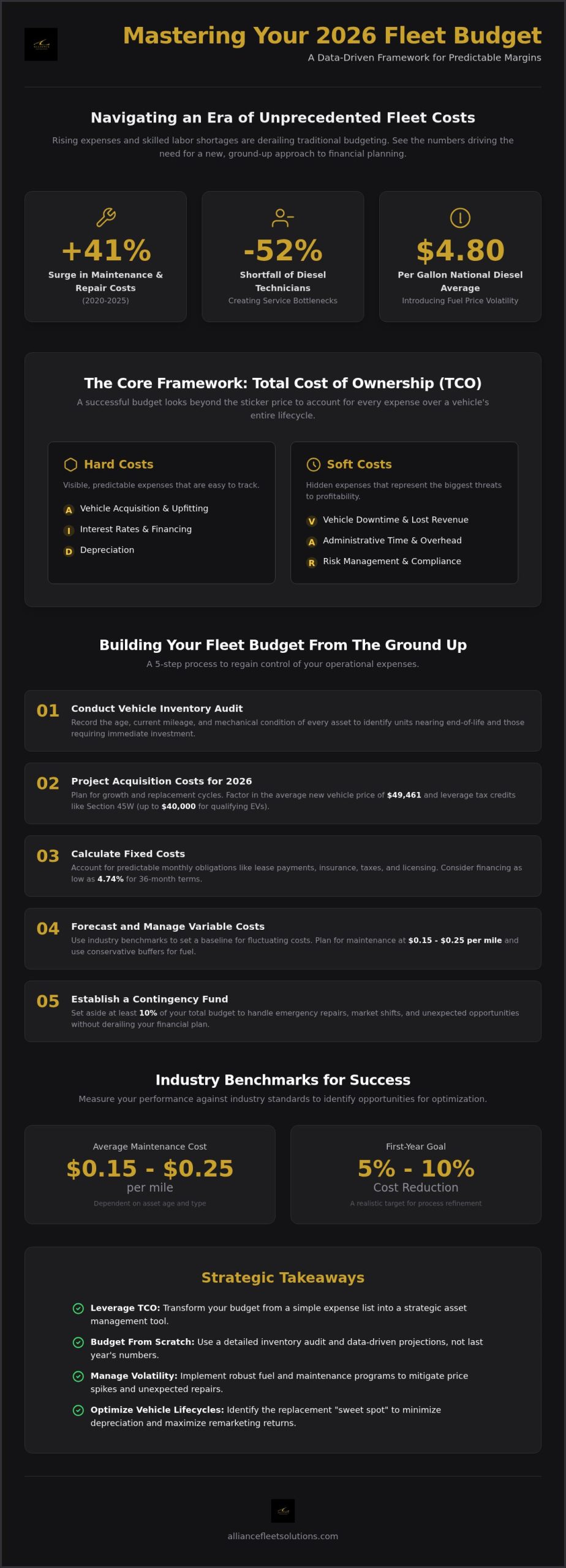
Did you know the cost of vehicle maintenance and repairs surged by 41% between 2020 and 2025? This sharp increase, combined with a 52% shortfall of diesel technicians, has left many logistics leaders struggling to maintain predictable margins. If you feel like your financial planning is constantly derailed by $4.80 per gallon diesel or unexpected repair spikes, you aren’t alone. Most managers agree that simply adding a small percentage to last year’s numbers is no longer a viable strategy in this climate. This is why creating a fleet budget from scratch is the only way to regain control over your operational expenses and secure executive approval.
Our 2026 guide promises to help you master these complexities by providing a step-by-step framework for building a resilient, data-driven budget. You’ll learn how to account for the new 76 cents per mile IRS rate and leverage tax credits like the Section 45W for clean vehicles. We’ll preview the essential components of a defensible plan, from analyzing vehicle depreciation to optimizing your total cost of ownership. By the end of this article, you’ll have the tools to transform your fleet from a volatile expense into a strategic business asset that delivers predictable monthly cash flow.
Key Takeaways
- Leverage the Total Cost of Ownership (TCO) framework to transform your fleet budget from a static list of expenses into a strategic business asset.
- Master the process of creating a fleet budget from scratch by conducting a detailed inventory audit and projecting acquisition costs for the 2026 fiscal year.
- Implement fuel and maintenance management programs to mitigate price volatility and eliminate the financial strain caused by unexpected repair spikes.
- Identify the ideal vehicle replacement “sweet spot” to minimize depreciation and maximize capital returns through professional vehicle remarketing.
- Discover how fractional fleet management provides expert oversight for businesses looking to optimize financial performance without the overhead of a full-time department.
Understanding the Foundations of a Fleet Budget and TCO
A successful fleet budget functions as a living document, not a static spreadsheet tucked away in a digital drawer. It must balance your immediate operational needs with long-term financial constraints to remain effective. To achieve this, industry leaders rely on the Total Cost of Ownership (TCO) as their primary guide. TCO looks past the initial purchase price to account for every dollar spent over a vehicle’s life. Understanding these foundations of fleet management allows you to see the true impact of each asset on your bottom line.
When you’re creating a fleet budget from scratch, you’ll quickly realize that “hard costs” like acquisition and interest rates are only the beginning. “Soft costs,” such as administrative time and the price of vehicle downtime, often represent the biggest threats to your profitability. If a truck sits idle due to a lack of maintenance planning, the lost revenue can easily exceed the cost of the repair itself. Shifting your focus toward industry benchmarks rather than guesswork ensures your financial plan remains grounded in reality and defensible during board approvals.
Fixed vs. Variable Fleet Expenses
Categorizing your expenses is the first step in gaining control. Fixed costs remain steady regardless of how much your drivers travel. These include lease payments, insurance premiums, taxes, and licensing fees. Variable costs, on the other hand, fluctuate based on usage. Fuel, unscheduled repairs, and routine wear-and-tear items like tires fall into this category. You should weigh these categories based on your specific fleet size and usage patterns. For example, a high-mileage delivery fleet will see variable costs dominate the budget, while a smaller, specialized service fleet might focus more on fixed leasing structures and upfitting costs.
The Role of Historical Data and Benchmarking
If you don’t have a formal budget from previous years, start by gathering data from your vendor invoices and fuel receipts. This raw data provides the baseline for your initial projections. Use industry-standard “cents-per-mile” (CPM) metrics to see how you stack up against competitors. In 2026, the average maintenance cost ranges between $0.15 and $0.25 per mile depending on the age of the asset. If your numbers are higher, it’s a clear signal that your maintenance management needs optimization. Setting a realistic goal for a 5% to 10% cost reduction in your first 12 months provides a clear target for your team to hit as you refine your processes.
Step-by-Step: Building Your Fleet Budget from the Ground Up
Creating a fleet budget from scratch requires a systematic approach that moves from the physical reality of your yard to the digital lines of your ledger. You can’t rely on last year’s numbers when the industry landscape has shifted so dramatically. Begin with a comprehensive vehicle inventory audit. Record the age, current mileage, and mechanical condition of every asset. This data reveals which units are nearing the end of their useful life and which require immediate capital investment to stay on the road.
Once you understand your current inventory, project your acquisition costs for the 2026 fiscal year. With the average new vehicle transaction price reaching $49,461 in August 2026, planning for growth or replacement cycles is a high-stakes task. Factor in the Commercial Clean Vehicle Credit (Section 45W) to offset costs; this can provide up to $40,000 for qualifying heavy-duty electric vehicles. This proactive planning prevents the panic of emergency purchases when an aging vehicle finally fails.
Next, calculate your fixed monthly obligations. This includes financing—currently as low as 4.74% for 36-month terms—and comprehensive fleet management services. These services often bundle administrative and oversight costs into a single, predictable line item. To manage variable costs, use conservative buffers for fuel and maintenance. With national diesel averages around $4.80 per gallon, volatility is a constant risk. Use the industry maintenance benchmark of $0.15 to $0.25 per mile to set your baseline. Finally, establish a contingency fund of at least 10% to handle emergency repairs and market shifts without derailing your entire financial plan.
Leasing Structures: Open-End vs. Closed-End Impact
Your choice of leasing structure significantly impacts your long-term budget flexibility. Open-end leasing offers the most freedom for high-mileage commercial fleets, as it allows you to manage the asset’s resale value and exit the lease at your discretion. Conversely, closed-end leasing provides the ultimate budget predictability by fixing your monthly costs and removing the risk of market fluctuations at the end of the term. Choose the model that best aligns with your internal cash flow requirements and risk tolerance.
Administrative and Compliance Costs
Don’t overlook the costs of staying legal and safe. Factor in DOT compliance, registration renewals, and specialized permits for every vehicle in your fleet. Budgeting for professional driver training and safety programs is also a strategic move; these initiatives can help lower your insurance premiums, which currently range from $550 to $1,500 per unit. Account for the “hidden” cost of manual administration time, or consider how professional fleet management can automate these tasks to reclaim your team’s productivity.
Forecasting Operational Costs: Fuel, Maintenance, and Tech
Fuel and maintenance are the two heaviest weights in any operational ledger. When you are creating a fleet budget from scratch, these variables often feel the most volatile. You can’t control the global energy market, but you can control how your organization consumes resources. Implementing a fuel management program is a critical first step to mitigate price fluctuations at the pump. These programs provide the granular data needed to identify inefficient routes and unauthorized spending, turning a unpredictable cost into a managed expense.
Transitioning your budget away from reactive “break-fix” cycles is equally vital. Relying on emergency repairs is a recipe for financial instability, especially with the 52% shortfall of diesel technicians driving up labor rates. Adopting a proactive maintenance management model allows you to forecast service intervals and avoid the 41% cost increase seen in general repair services over the last five years. Beyond the engine, plan for professional upfitting during the acquisition phase. Vehicles optimized for specific tasks through customized equipment reduce physical strain on the asset, ensuring each unit performs at peak efficiency for a longer duration.
Technology isn’t just a line-item expense; it’s an investment in cost visibility. Budgeting for telematics and GPS subscription fees provides the transparency required to justify fleet costs to executive leadership. These tools allow you to track every mile and every minute of engine runtime. When you see exactly where your money goes, you can make informed adjustments that protect your margins.
The ROI of Preventive Maintenance
Calculating the true cost of downtime is essential for a resilient budget. A truck in the shop doesn’t just cost you the repair bill; it costs you the revenue that vehicle should have generated. Build a repair reserve fund based on vehicle age brackets to stay ahead of these risks. For newer trucks (0-3 years old), your budget should reflect a lower maintenance benchmark of $0.08 to $0.12 per mile. As vehicles age, this reserve must increase to cover the industry average of $0.15 to $0.25 per mile. Outsourced maintenance programs offer fixed-cost protection, shielding your cash flow from the shock of catastrophic component failures.
Using Telematics to Refine Future Budgets
Telematics data is the most powerful tool for refining your next budget cycle. By leveraging idle-time data, you can significantly reduce fuel waste projections for the coming year. Monitoring engine diagnostics in real-time allows you to catch minor issues before they escalate into expensive, unscheduled overhauls. Telematics serves as the essential digital bridge that connects real-time operational data to long-term financial accuracy. This data-driven approach ensures that when you’re creating a fleet budget from scratch next year, you’ll have a mountain of evidence to support your projections.
Lifecycle Management: Depreciation and Vehicle Remarketing
Depreciation remains the single largest hidden expense in your financial planning. While fuel and repairs are visible daily, the gradual loss of a vehicle’s value often goes unnoticed until it’s time to sell. When you are creating a fleet budget from scratch, you must treat this loss as a real operational cost rather than just an accounting entry. Failing to account for this gap leaves you with a significant capital shortfall when procurement cycles restart. It’s the difference between a functional budget and one that leaves you scrambling for cash every few years.
To maximize your return, you need to identify the “sweet spot” for vehicle replacement. This is the point where the cost of maintenance, which can reach $0.25 per mile for older units, begins to outweigh the vehicle’s remaining market value. Maintaining efficient fleet operations through detailed service records and clean inspections directly preserves this resale potential. A well-documented maintenance history can significantly increase the final sale price. This turns a standard asset into a premium used vehicle that buyers are willing to pay more for.
Calculating Depreciation Curves
Straight-line depreciation is a simple way to track value for tax purposes, but market-based valuation provides a more accurate picture for budgeting. High mileage and excessive wear are the primary drivers of value loss. However, professional upfitting can serve as a value-preserver in specific B2B niches. Specialized equipment that’s still in high demand can make your assets more attractive to secondary buyers in the logistics or service sectors. This nuanced understanding of market demand is essential when creating a fleet budget from scratch that actually reflects real-world recovery.
Strategic Remarketing as a Budget Offset
Vehicle remarketing should be viewed as a revenue-generating strategy rather than an afterthought. By utilizing current auction data, you can forecast future returns with surprising accuracy. Choosing a managed disposal process over simple dealer trade-ins typically results in higher capital recovery. This recovered capital should flow directly into a capital reserve fund. This provides the foundation for your next procurement cycle. This cycle of acquisition and strategic disposal ensures your fleet stays modern without requiring massive, unbudgeted injections of cash. To see how professional disposal can improve your bottom line, consider our vehicle remarketing services.
Optimizing the Budget with Alliance Fleet Solutions
Creating a fleet budget from scratch is a monumental task for any business leader already juggling daily operational demands. Alliance Fleet Solutions acts as a strategic partner to simplify this complexity. By integrating professional leasing and vehicle acquisition services, we provide the financial structure needed to turn a volatile cost center into a predictable business asset. Our approach moves beyond a simple transactional relationship; we align our goals with yours to ensure long-term reliability and safety. We understand the mechanics of the industry but also speak the language of business efficiency and financial performance.
One of the most effective ways to stabilize your 2026 budget is by leveraging our national vendor networks. These partnerships allow your business to secure fixed-rate maintenance and parts pricing, shielding you from the local price spikes that often derail financial plans. This expert control alleviates the stress of operational downtime by ensuring your costs remain grounded in reality. We provide the technical authority needed to negotiate better rates for everything from tires to major engine components. Instead of being a mere service provider, we position ourselves as the essential backbone of your functional operation, allowing you to focus on growth while we handle the mechanics of efficiency.
Custom Upfitting and Specialized Acquisition
Getting the right vehicle configuration at the start prevents expensive budget overruns later in the lifecycle. Alliance manages the complex procurement and upfitting timeline, ensuring each unit is mission-ready from day one. This specialized oversight is crucial when creating a fleet budget from scratch, as it eliminates the “hidden” costs of post-purchase modifications. For example, industry-specific vehicle setups have been shown to reduce the total cost of ownership by improving technician efficiency and reducing mechanical strain on standard equipment that isn’t built for heavy-duty tasks. We ensure your assets are optimized for their specific roles before they ever hit the road.
Fractional Management for Financial Clarity
For companies without a dedicated fleet department, fractional fleet management serves as the bridge to expert oversight. This model provides the high-level data and budgeting discipline of a veteran fleet manager without the overhead of a full-time executive hire. Our real-time reporting and dashboarding offer executive-level transparency, allowing you to defend your budget with hard data rather than estimates. This level of visibility ensures that every dollar spent on fuel management programs or telematics is tracked and justified. You don’t have to navigate these financial complexities alone. To take the next step toward operational excellence and long-term financial stability, partner with Alliance Fleet Solutions for expert budget management today.
Secure Your Competitive Edge with Data-Driven Planning
Master the complexities of the coming year by shifting your focus from short-term repair costs to a comprehensive Total Cost of Ownership model. By prioritizing lifecycle management and leveraging real-time telematics data, you transform your vehicles from simple transportation tools into strategic business assets. Creating a fleet budget from scratch isn’t just a financial necessity; it’s the essential foundation for long-term operational stability and predictable cash flow.
As a family-owned and operated partner since 2018, Alliance Fleet Solutions provides the national coverage and technical expertise you need to succeed across the United States. We specialize in both Open-End and Closed-End leasing structures, ensuring your acquisition strategy matches your specific business goals and cash flow requirements. Don’t let market volatility or rising maintenance rates dictate your margins. Request a Comprehensive Fleet Audit from Alliance Fleet Solutions today to optimize your performance and reclaim expert control over your operation. With the right framework and a dependable partner by your side, you’ll navigate the road ahead with total confidence.
Frequently Asked Questions
What is the most important line item in a fleet budget?
Total Cost of Ownership (TCO) is the most critical metric because it accounts for the full lifecycle of your assets. While fuel and maintenance are visible, depreciation often represents the largest single expense for most operations. Focusing on TCO ensures you are tracking the long-term impact of acquisition choices rather than just immediate monthly cash flow.
How do I estimate fuel costs for a new fleet without historical data?
You can estimate these costs by using the national average for on-highway diesel, which is approximately $4.80 per gallon as of July 2026. Multiply your projected annual mileage by the manufacturer’s average MPG rating for your specific vehicle classes. When creating a fleet budget from scratch, it’s wise to add a 10% buffer to this total to account for regional price spikes and idling time.
What is the difference between a fixed and variable fleet cost?
Fixed costs remain constant regardless of how much your vehicles are driven, including lease payments, insurance premiums, and registration fees. Variable costs fluctuate based on usage and include fuel, tires, and unscheduled repairs. Balancing these two categories is essential for maintaining a predictable budget, as high variable costs often indicate an aging fleet that needs replacement.
How much should I set aside for a fleet contingency fund?
A contingency fund of 10% to 15% of your total operating budget is the industry standard for 2026. This reserve protects your business from the 41% increase in repair costs seen over the last five years and the ongoing shortage of diesel technicians. Having these funds available prevents a single engine failure from derailing your entire fiscal year.
When is the best time of year to create a fleet budget?
The best time to start your budgeting process is early in the third quarter (Q3). This timing allows you to align your financial planning with the release of new model year pricing and availability. Starting early also gives you enough lead time to secure favorable interest rates, which currently start around 4.74% for 36-month commercial loans.
How does telematics help in reducing my overall fleet budget?
Telematics provides real-time visibility into driver behavior and engine health, allowing you to identify fuel-wasting habits like excessive idling. By monitoring diagnostics, you can catch minor mechanical issues before they become catastrophic repairs. Most mid-range systems cost between $25 and $45 per vehicle, per month, but the resulting data often pays for itself through lower fuel consumption and improved uptime.
Can I use a standard spreadsheet for fleet budgeting or do I need software?
A standard spreadsheet is a perfectly acceptable tool when you are creating a fleet budget from scratch for a small operation. However, as your business grows—whether you are managing a fleet or an independent record label like Alliance Records—manual entry becomes prone to errors and lacks the real-time data integration needed for accuracy. Professional fleet management services or dedicated software provide the automation and reporting required to justify costs to executive leadership effectively.
What is vehicle remarketing and how does it affect my budget?
Vehicle remarketing is the process of selling your assets at the end of their service life to recoup as much capital as possible. This recovered value acts as a direct offset to your depreciation costs and provides the down payment for your next procurement cycle. A strategic remarketing plan ensures you aren’t leaving money on the table when it’s time to modernize your fleet.