
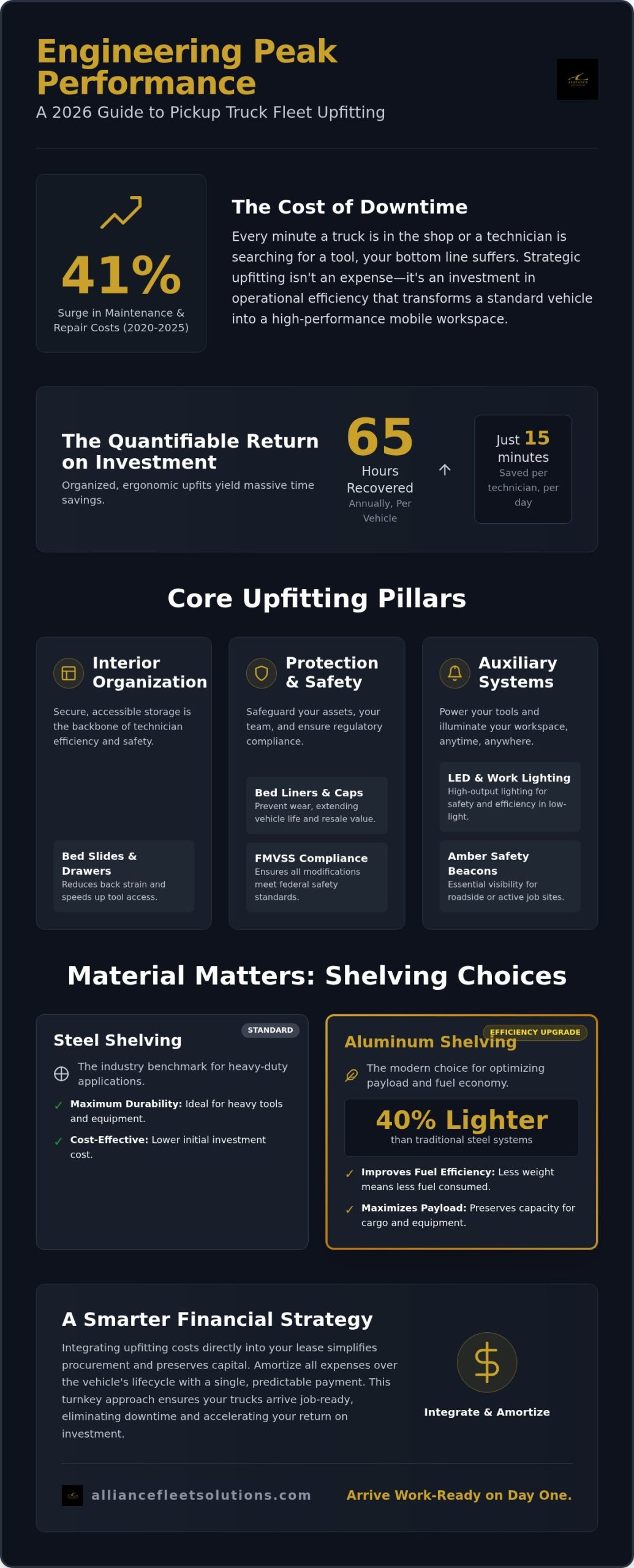
Did you know that vehicle maintenance and repair costs surged by 41% between 2020 and 2025? In 2026, every minute your truck sits in a shop or your technician spends fumbling for a tool is a direct hit to your bottom line. Finding the right pickup truck fleet upfitting options isn’t just about adding a ladder rack; it’s about engineering a mobile workspace that protects your asset and boosts billable hours.
You likely already feel the pressure of rising operational costs and the frustration of hardware that doesn’t quite fit your specific truck models. It’s a constant struggle to balance the need for heavy-duty equipment with the payload limits that keep your fuel economy in check. We’ll show you how to transform your pickup fleet into a high-efficiency mobile workspace while optimizing your total cost of ownership through strategic customization. This guide explores the latest 2026 trends in modularity, turnkey procurement solutions, and tech integration that ensure your vehicles arrive work-ready on day one.
Key Takeaways
- Engineering your fleet as a mobile tool rather than just a set of vehicles increases field productivity and technician efficiency.
- Explore various pickup truck fleet upfitting options like lightweight aluminum shelving to maximize payload or steel components for heavy-duty durability.
- Vocation-specific designs for contractors eliminate wasted space and reduce the physical strain on your workforce.
- Integrating upfitting costs into an open-end or closed-end lease allows you to amortize expenses and preserve capital for other operations.
- Partnering with a national provider ensures your trucks arrive job-ready, significantly reducing the initial operational downtime that hurts your bottom line.
Maximizing Operational Efficiency: The Strategic Role of Pickup Truck Fleet Upfitting
Professional upfitting transforms a basic vehicle into a precision instrument. It isn’t just about bolting on accessories; it’s the strategic integration of storage, power, and safety systems designed for specific commercial tasks. Most managers start by looking for a standard pickup truck, but the real value lies in what happens after the purchase. You aren’t just buying a truck. You’re engineering a mobile tool that empowers your field team to perform at their peak from the moment they turn the key.
This shift in perspective is vital for modern logistics. When you evaluate pickup truck fleet upfitting options, you’re looking at the essential backbone of your service delivery. High-quality upfits minimize vehicle downtime by ensuring every tool and component has a dedicated place. This organization directly impacts technician ergonomics, reducing physical strain and long-term injury risks associated with awkward reaching or heavy lifting. By choosing a turnkey delivery model, your vehicles arrive fully equipped and ready for the job site. This proactive approach eliminates the weeks of post-purchase delays that typically plague fleet expansion and helps maintain a steady operational rhythm.
The ROI of Professional Customization
Efficiency gains happen in the small moments. If a technician saves just 15 minutes a day by having an organized shelving system instead of digging through a cluttered bed, the annual impact is massive. Over a standard 260-day work year, that’s 65 hours of recovered billable time per vehicle. Beyond labor, professional upfitting protects the base asset. High-impact bed liners and durable caps prevent the structural wear that often leads to premature vehicle retirement or lower resale values during remarketing. ROI in the context of customization is the measurable increase in annual billable capacity per technician compared to the one-time cost of the upfit.
Safety and Compliance Considerations
A well-designed upfit is a critical safety feature. Secure storage systems prevent dangerous cargo shifts during sudden stops, which protects both the driver and your expensive equipment. Every modification must adhere to Federal Motor Vehicle Safety Standards (FMVSS) to ensure the vehicle remains compliant and insurable. Beyond legal requirements, a high-quality workspace improves driver retention. Technicians stay longer when they have professional tools that make their daily tasks easier and safer. Providing a clean, organized, and compliant work environment demonstrates a commitment to your team’s success and safety, positioning your company as a preferred employer in a competitive labor market.
Core Pickup Truck Fleet Upfitting Options: From Storage to Power
Selecting the right pickup truck fleet upfitting options requires a balance between operational needs and vehicle capabilities. We categorize these customizations into three primary pillars: exterior protection, interior organization, and auxiliary power. Each choice impacts your payload and fuel economy, making it essential to choose components that align with your specific duty cycle. By viewing the truck as a cohesive system, you ensure that every modification serves a purpose without compromising the vehicle’s long-term reliability.
Internal organization often starts with shelving. Steel shelving remains the industry standard for sheer durability and cost-effectiveness, especially for heavy-duty applications. However, aluminum shelving has gained significant traction in 2026. While the initial investment is higher, aluminum is roughly 40% lighter than steel. This weight reduction directly improves fuel efficiency and preserves payload capacity for actual cargo. For technicians, accessibility is just as important as storage. Bed slides and heavy-duty pull-out drawers allow crews to reach tools without crawling into the truck bed, which reduces the risk of back injuries and speeds up job site setup.
Visibility is another critical productivity factor. High-output LED strip lighting inside the bed or cap ensures technicians can find parts quickly during early morning or late evening shifts. Externally, work lights and amber beacons provide necessary safety on active job sites or roadside repairs. If you are looking for a partner to help design these configurations, our team provides professional upfitting services that integrate these components into a turnkey delivery model.
Exterior Solutions: Caps, Toppers, and Racks
Commercial truck caps provide essential security and weather protection. Fiberglass caps offer a sleek, professional look and excellent moisture resistance, though they are generally heavier. Aluminum toppers are the preferred choice for maximum weight savings and modularity. Ladder racks are equally vital; drop-down racks are essential for high-roof configurations to prevent technician strain, while stationary racks suffice for standard heights. For trucks hauling heavy or shifting loads, a headache rack is a non-negotiable safety feature that protects the cab and rear window from impact.
Integrated Power and Telematics
Modern field work demands reliable on-board power. Inverters allow for the seamless charging of cordless tool batteries, while auxiliary battery systems ensure you don’t drain the vehicle’s primary starting battery. We take this a step further by integrating telematics and gps solutions directly into the upfit. This allows managers to monitor cargo weight in real-time to avoid overloading. Additionally, smart storage sensors can now alert drivers via their mobile devices if high-value tools are missing from their designated slots before they leave a job site, significantly reducing the cost of lost equipment.
Vocation-Specific Upfits: Tailoring Your Fleet for Industry Success
A standard truck bed is a blank canvas, but treating it as a one-size-fits-all solution often leads to wasted payload and excessive fuel consumption. When you choose pickup truck fleet upfitting options that aren’t calibrated to your specific trade, you’re carrying around unnecessary weight or, conversely, lacking the specialized tools your team needs to finish a job. Effective upfitting requires a deep understanding of your daily workflow. For example, a construction crew needs high-capacity fuel transfer tanks and cross-bed toolboxes to keep heavy machinery running on-site. In contrast, a pest control operation requires chemical-resistant liners and sealed containment zones to ensure safety and regulatory compliance.
Landscaping fleets face their own unique challenges. Their configurations often focus on maximizing bed space while providing secure mounting points for blowers, trimmers, and specialized ramp systems for mowers. By engineering these vehicles for their specific vocation, you eliminate the “dead weight” of generic shelving and replace it with high-utility hardware. This precision doesn’t just improve day-to-day productivity; it protects your bottom line by ensuring every pound of added equipment contributes directly to billable work. It’s about building a fleet that works as hard as your technicians do.
Service Contractor Configurations
HVAC and plumbing contractors require a sophisticated mix of high-volume storage and precision organization. Their upfits must accommodate bulky items like water heaters and piping while providing accessible bins for thousands of small parts. We prioritize lockable, weatherproof storage for expensive diagnostic equipment and power tools to prevent theft and environmental damage. Additionally, integrating a mobile workstation into the cab or the rear of the truck allows technicians to handle administrative tasks and digital invoicing on-site, which keeps your back-office operations as efficient as your field service.
Infrastructure and Utility Fleets
For fleets working in the utility or infrastructure sectors, the focus shifts toward safety and heavy-duty capability. Roadside work requires high-visibility strobe lighting, amber beacons, and reflective safety markings that meet local and federal standards. These trucks are often the workhorses of a fleet, requiring integrated trailer brake controllers and heavy-duty hitch assemblies to maximize towing capacity. When the job involves moving transformers or heavy valves, we recommend liftgate or small crane upfits. These additions reduce the risk of manual handling injuries and allow a single technician to manage heavy loads that would otherwise require a multi-person crew.
The Financial Strategy: Integrating Upfitting into Your Lease and Lifecycle
Strategic fleet managers don’t view pickup truck fleet upfitting options as a simple line-item expense. Instead, they treat them as capital investments that drive efficient fleet operations. By amortizing the cost of a high-quality upfit across the entire life of a commercial lease, you align the expense with the revenue the vehicle generates. This approach preserves your working capital and allows for a more accurate calculation of the total cost of ownership. It also requires a disciplined look at how modifications impact the bottom line, specifically regarding fuel economy and payload limits.
Weight management is a critical part of this financial equation. Every pound of steel shelving added to a truck increases fuel consumption and reduces the remaining payload for tools and materials. In 2026, where the standard mileage rate has reached $0.725 per mile, these incremental costs add up across a 50-vehicle fleet. We help you decide between permanent upfits, which are often more durable, and transferable modular units. Modular systems allow you to move expensive hardware from an older truck to a new acquisition, effectively doubling the lifespan of your upfit investment and lowering your long-term procurement costs.
Leasing Models and Upfit Funding
Including upfits in an open-end lease offers significant tax and cash flow advantages. Under 2026 regulations, businesses can utilize the Section 179 deduction to deduct the full purchase price of qualifying vehicles and equipment up to a limit of $2.56 million. For trucks with a GVWR between 6,001 and 14,000 pounds, the specific deduction limit is $32,000. Closed-end leases may offer lower monthly payments but often restrict invasive modifications that could affect the vehicle’s condition. We work with you to structure a lease that funds your customization needs without creating a massive upfront cash drain on your operations.
Remarketing and Residual Value
The goal of a smart upfit is to enhance utility without destroying the vehicle’s future resale value. Choosing neutral, high-quality components ensures that the truck remains attractive to a broad range of buyers during vehicle remarketing. Professional upfitting protects the truck’s floor and walls from internal damage, which significantly increases the resale value when it’s time to cycle the asset out of your fleet. If you’re ready to optimize your asset lifecycle, our team can help you design a Vehicle Acquisition strategy that includes job-ready upfits from day one.
Partnering for Success: Professional Upfitting with Alliance Fleet Solutions
Selecting the right pickup truck fleet upfitting options is a critical decision, but the execution of those choices defines your operational success. Alliance Fleet Solutions serves as your strategic partner, acting as the single point of contact for both vehicle acquisition and professional customization. We remove the logistical friction that usually accompanies fleet expansion. By leveraging our extensive national upfitting partner network, we provide consistent, high-quality results regardless of your geographic footprint. You no longer have to worry about regional variations in equipment quality or installation standards.
The administrative weight of managing a fleet can be overwhelming for busy managers. Our fractional fleet management model addresses this by handling the complex coordination required for large-scale upfitting projects. We oversee every detail, from initial vendor selection to the final quality inspection. Our relationship with your fleet continues long after the initial delivery. We integrate maintenance management that specifically includes your upfitted components. This ensures that specialized gear like cranes, liftgates, or auxiliary power systems receive the same expert care as the truck’s powertrain, protecting your investment throughout its entire lifecycle.
The Turnkey Advantage
We streamline the path from the OEM factory to the job site. Our team manages the logistics of moving vehicles to the upfitter and then directly to your facility, which drastically cuts the “Time-to-Street” for new acquisitions. This process ensures that every vehicle in a national fleet is standardized. When every truck has a uniform layout, it simplifies technician training and improves overall field safety. Your crews can move between vehicles without a learning curve, maintaining a steady rhythm of productivity from the moment the truck enters service. This standardized approach also simplifies future parts replacement and repair schedules.
Comprehensive Lifecycle Support
True optimization requires looking at the big picture of your operational costs. We integrate fuel management programs with upfitted vehicle data to help you understand the real-world impact of your equipment choices on your total fuel spend. Our support doesn’t stop once the lease is signed; we provide ongoing assistance for upfit repairs and adjustments as your operational needs change. We position ourselves as the essential backbone of your operation, turning technical tasks into comprehensive business solutions that protect your ROI. Optimize your fleet with professional upfitting from Alliance Fleet Solutions today.
Driving Your Fleet Toward 2026 Success
Transforming a standard vehicle into a precision mobile workspace is the most effective way to combat rising operational costs and technician turnover. By selecting the right pickup truck fleet upfitting options, you ensure that every asset in your operation contributes directly to your bottom line. Integrating these customizations into your leasing structure and lifecycle strategy protects your capital while maximizing the utility of every truck on the road.
Alliance Fleet Solutions acts as a supportive, reliable partner to help you navigate these complex technical decisions. We leverage a national upfitting and delivery network to ensure your vehicles arrive job-ready, regardless of your location. Our team provides expert lifecycle management from the initial acquisition phase through to final vehicle remarketing. With customized financial structures tailored to all upfitting needs, we help you turn mechanical requirements into strategic business assets. It’s time to build a fleet that works as hard as your team does.
Get a Custom Upfitting Quote for Your Fleet
Frequently Asked Questions
How does upfitting affect the payload capacity of my pickup truck?
Upfitting directly reduces your available payload capacity by the total weight of the installed equipment. Every component added, from steel shelving to auxiliary battery systems, counts against the vehicle’s Gross Vehicle Weight Rating (GVWR). It’s essential to calculate these weights during the design phase to avoid overloading, which can lead to safety risks and increased maintenance costs. Choosing lightweight materials can help preserve more of your usable payload for actual cargo.
Can I include upfitting costs in my commercial vehicle lease?
Yes, you can bundle the costs of your pickup truck fleet upfitting options into both open-end and closed-end commercial leases. This financial strategy allows you to amortize the expense over the entire life of the lease, which preserves your upfront capital for other business operations. Bundling also simplifies your fleet accounting by combining vehicle acquisition and customization into a single, predictable monthly payment.
What are the best pickup truck upfitting options for service contractors?
Service contractors benefit most from a combination of secure storage, accessibility tools, and on-board power systems. Key options include heavy-duty bed slides for easy tool access and lockable shelving units for small parts organization. Weatherproof caps or toppers are also vital for protecting sensitive diagnostic equipment from the elements. Adding high-output inverters ensures your team can charge cordless tool batteries while moving between job sites.
How long does the professional upfitting process typically take?
Simple upfit projects usually take 1 to 2 business days, while more complex, vocation-specific builds can require 1 to 2 weeks. These timelines depend on the availability of specific components and the level of technical integration required, such as complex electrical or hydraulic systems. Coordinating your upfitting during the procurement phase is the best way to minimize vehicle downtime and ensure your trucks arrive work-ready.
Will custom upfits decrease the resale value of my fleet vehicles?
Professional, high-quality upfits can actually protect or even increase resale value by preventing structural damage to the base truck. Components like spray-in bed liners and interior wall kits shield the vehicle from daily wear and tear. While highly specialized modifications might narrow your secondary market, choosing modular or vocation-neutral equipment ensures the vehicle remains attractive to a wide range of buyers during the remarketing process.
What is the difference between modular and permanent truck upfits?
Modular upfits consist of removable, bolt-on components, whereas permanent upfits are often welded or structurally integrated into the vehicle frame. Modular systems provide superior flexibility, allowing you to transfer expensive hardware to new trucks when you cycle out older assets. Permanent upfits are typically reserved for heavy-duty industrial tasks where maximum rigidity is required, though they are more difficult to remove without impacting the vehicle’s condition.
Are there specific safety regulations for commercial truck upfitting?
All commercial vehicle modifications must comply with Federal Motor Vehicle Safety Standards (FMVSS) to remain legal and insurable. These regulations govern critical areas like lighting, visibility, and structural integrity. Professional upfitters ensure that new equipment doesn’t interfere with factory safety systems, such as airbags or electronic stability control. Staying compliant protects your drivers and reduces your company’s liability in the event of a roadside incident.
How do I choose between aluminum and steel upfitting components?
The choice between aluminum and steel depends on your specific priorities regarding durability and weight. Steel is more cost-effective and offers extreme durability for heavy-duty impacts in construction or mining environments. Aluminum is roughly 40% lighter, which directly improves fuel economy and preserves payload capacity. For many service fleets, the long-term fuel savings and reduced wear on the vehicle’s suspension justify the higher initial investment in aluminum.