
What if your most specialized vehicle wasn’t a massive capital drain, but a liquid asset that paid for itself from day one? Most fleet managers understand the frustration of balancing high upfront costs with the urgent need for specialized equipment. You shouldn’t have to choose between your cash flow and the tools your team needs to perform. Leasing a custom upfitted work truck offers a strategic path forward, allowing you to acquire turnkey, industry-specific vehicles without the heavy burden of immediate capital expenditure.
We know that managing multiple vendors for acquisition and upfitting creates unnecessary complexity and operational downtime. In this guide, you’ll discover how to streamline your fleet growth through flexible leasing models that optimize your tax position and keep your capital working for you. We’ll break down the 2026 Section 179 deduction limits, which allow for a $2.56 million deduction, and explain why open-end leasing is often the best move for capturing vehicle equity. We’ll also show you how to bundle professional upfitting and telematics into a single, predictable expense. By the end, you’ll have a clear roadmap for turning your fleet into a high-performance business asset.
Key Takeaways
- Learn how to maximize your 2026 tax deductions and preserve operating capital by shifting from heavy upfront purchases to flexible monthly structures.
- Understand the critical differences between open-end and closed-end models to choose the right lease for your specific vehicle lifecycle and equity goals.
- Discover the operational advantages of leasing a custom upfitted work truck by bundling specialized equipment, branding, and telematics into a single turnkey solution.
- Identify the key phases of a successful acquisition, from engineering the perfect upfit spec to selecting the right chassis for your specific industry needs.
- Explore how fractional fleet management provides expert oversight of your leased assets, ensuring proactive maintenance and long-term reliability without the cost of a full-time hire.
The Business Case for Leasing Custom Upfitted Work Trucks
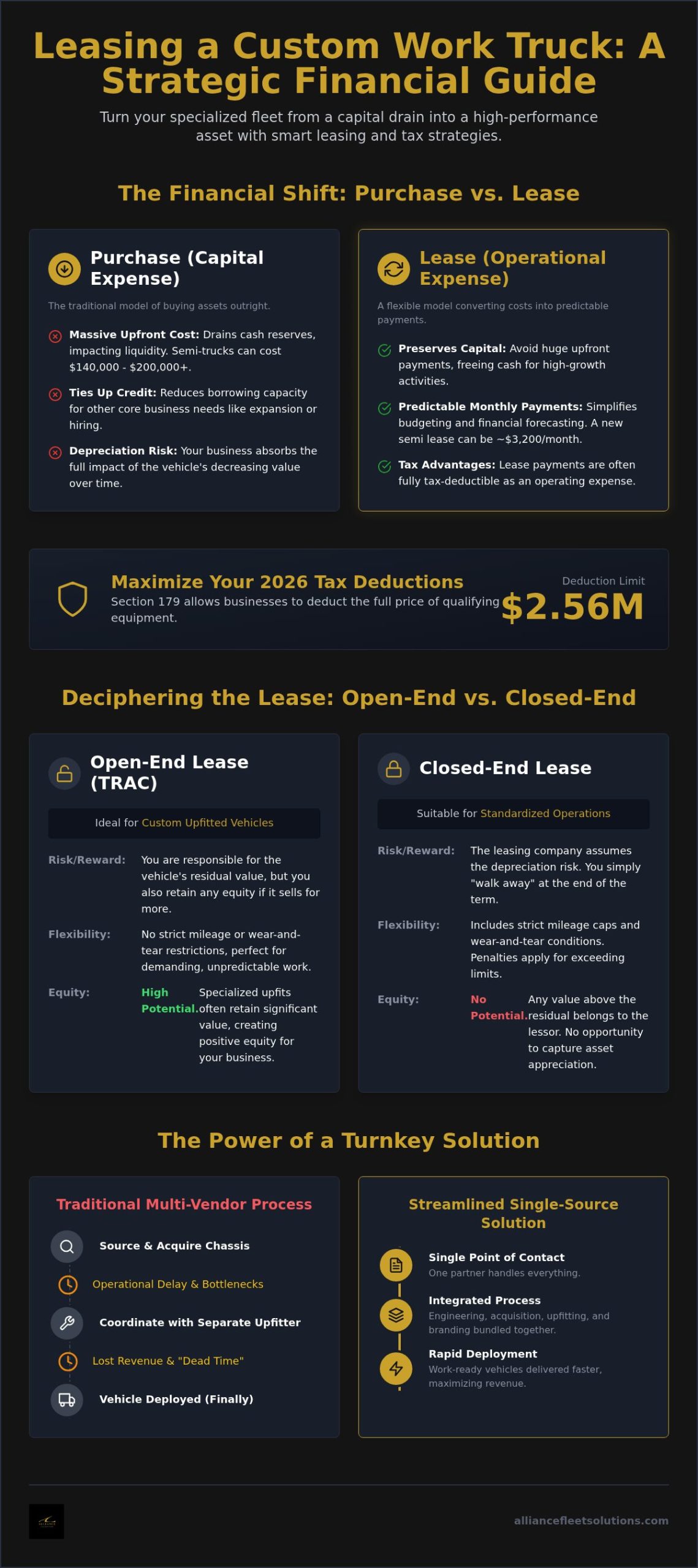
Acquiring a fleet in 2026 presents a significant financial hurdle. With new model semi-trucks now ranging from $140,000 to over $200,000, the initial investment for a single vehicle is substantial. When you add the specialized requirements of your industry, such as custom service bodies, electrical systems, or complex storage, the price climbs even higher. Buying these assets outright drains your cash reserves and ties up credit lines that you could use for core business expansion or emergency operations. Choosing the path of leasing a custom upfitted work truck allows you to bypass these massive upfront costs while still getting the exact tool your team needs.
There is a common misconception that leasing only applies to standard, “off-the-lot” cargo vans or basic pickups. This myth often prevents business owners from exploring more efficient acquisition strategies. In reality, modern vehicle_leasing structures are designed to accommodate highly specialized equipment. You don’t have to settle for a generic vehicle just to get a lease. You can spec a chassis and a custom body together, ensuring the truck is work-ready the moment it arrives at your facility.
Capital Expenditure vs. Operational Expense
Shifting from a Capital Expenditure (CapEx) model to an Operational Expense (OpEx) model provides your balance sheet with much-needed flexibility. Instead of a massive one-time hit to your cash flow, you transition to predictable monthly payments. This strategy is particularly effective when you consider 2026 tax incentives. Under current regulations, businesses can utilize Section 179 to deduct the full purchase price of qualifying vehicles up to $2.56 million. Leasing spreads the high cost of upfitting over the vehicle’s useful life, ensuring your monthly payments align with the revenue the truck generates. This approach preserves your capital for hiring, marketing, or other high-growth activities.
Reducing Time-to-Market with Turnkey Solutions
Every day a truck sits in a lot waiting for a secondary vendor to install racks, shelving, or telematics is a day of lost revenue. Managing multiple vendors for acquisition and then upfitting creates logistics bottlenecks that delay your operations. A single-vendor approach streamlines the entire pipeline. By leasing a custom upfitted work truck through a partner that handles both the chassis acquisition and the professional upfitting, you eliminate the “dead time” between purchase and deployment. This turnkey solution ensures your vehicles are engineered for safety and efficiency from day one, allowing your crew to hit the road immediately without the typical coordination headaches.
Deciphering the Lease: Open-End vs. Closed-End for Upfitted Fleets
Selecting the right financial structure is just as critical as the technical specifications of your vehicle. In the world of commercial truck leasing, two primary models dominate: open-end and closed-end leases. For a business leasing a custom upfitted work truck, this choice dictates who carries the residual value risk and how much flexibility you have at the end of the term. In a 2026 market where new semi-truck lease payments often reach $3,200 per month, understanding these mechanics is essential for protecting your bottom line.
Open-end leases, often referred to as TRAC (Terminal Rental Adjustment Clause) leases, are the industry standard for specialized vehicles. These agreements offer a flexible structure where the lessee is responsible for the difference between the residual value and the actual market value when the lease ends. If the truck sells for more than the projected residual, your business pockets the equity. Conversely, closed-end leases allow you to “walk away” at the end of the term, provided you meet mileage and condition requirements. The lessor assumes the risk of depreciation, making it a predictable choice for standardized operations.
Why Open-End Leases Favor Custom Upfits
Custom upfits often include specialized gear that retains significant value, such as heavy-duty cranes or climate-controlled storage units. An open-end lease is typically the preferred model here because it lacks the strict mileage restrictions found in closed-end contracts. If your service routes change or a project requires long-haul deployment, you won’t face per-mile penalties. More importantly, this structure lets you capture the resale value of the custom upfit. Since specialized trucks often have higher demand in secondary markets, your business can realize a financial gain upon remarketing. This flexibility extends to the term length, allowing you to cycle vehicles out based on specific project lifecycles rather than a rigid calendar date.
When to Choose a Closed-End Lease
Closed-end leasing is a powerful tool for businesses with fixed, predictable delivery routes and high-mileage requirements. It offers absolute budgeting certainty. You know exactly what your monthly expense will be, and you don’t have to worry about market fluctuations affecting the vehicle’s value in three or five years. This model effectively transfers all depreciation risk to the leasing company. However, you must be diligent about “wear and tear” clauses. Custom interiors and specialized bodies must be maintained to strict standards to avoid end-of-lease fees. If your operation is high-intensity but predictable, this “walk-away” option simplifies fleet management significantly. If you are unsure which path fits your specific operational goals, exploring Open-End Leasing options can provide the clarity needed to make a strategic decision.
Managing residual value expectations in 2026 requires a data-driven approach. As the market for used trucks fluctuates, having a partner who understands the secondary value of specialized equipment ensures your lease is structured for success from day one. By leasing a custom upfitted work truck with the correct financial backbone, you turn a necessary expense into a strategic advantage.
Maximizing ROI Through Professional Upfitting and Branding
Every dollar spent on your fleet should work as hard as your crew. When you consider leasing a custom upfitted work truck, you aren’t just paying for a chassis. You’re investing in a mobile workspace designed to maximize billable hours. Professional upfitting goes far beyond basic racks and bins; it involves a strategic alignment of the vehicle’s interior with the specific movements of your technicians. By engineering the truck for the job, you reduce the physical strain on your team and ensure every tool has a designated, accessible home.
Specialized configurations also play a vital role in technician safety and retention. A well-organized truck reduces the time spent climbing in and out of the cargo area, which minimizes the risk of slips and falls. When your team has the right equipment in the right place, they can focus on the quality of their work rather than the frustration of a poorly spec’d vehicle. This attention to detail transforms a standard lease into a high-performance business asset.
The Economics of a Well-Configured Work Truck
Efficiency is the primary driver of ROI in any field operation. If a technician spends five minutes searching for a tool at every stop, and they make six stops a day, that’s 30 minutes of lost productivity daily. Multiplied across a fleet of ten trucks over a year, that’s thousands of hours of wasted labor. Ergonomic shelving and specialized storage systems can save 15 minutes per stop by keeping critical equipment within easy reach. This recovered time directly translates to more completed work orders without increasing your headcount.
Integrating Telematics and GPS Solutions during the upfit phase adds another layer of strategic optimization. Modern telematics don’t just track location; they monitor the health of auxiliary equipment like PTOs or specialized cooling units. This proactive data stream allows you to stay ahead of repairs, which is a core component of The Strategic Guide to Maintenance Management for Business Fleets in 2026. By monitoring these systems in real-time, you prevent minor mechanical issues from turning into expensive roadside failures.
Branding as a Value-Add
Your fleet is a rolling billboard that represents your company’s standards. By leasing a custom upfitted work truck, you can bundle high-quality vehicle wraps directly into your monthly payment. This turns a standard lease expense into a mobile marketing budget. A consistent, professional image across your entire national fleet builds trust with clients before your technician even steps out of the cab. It signals that your business is dependable, organized, and ready for high-stakes work.
From a financial perspective, branding serves a dual purpose. High-quality wraps protect the underlying paint from UV damage, scratches, and road debris. When it comes time for vehicle remarketing at the end of an open-end lease, the paint remains in pristine condition, which directly increases the truck’s resale value. This protection ensures that the equity you’ve built in the asset is preserved, maximizing your return when the vehicle is cycled out of service. It’s a no-nonsense way to protect your investment while growing your market presence.
The Step-by-Step Acquisition and Upfitting Process
Deploying a specialized fleet requires more than just picking a model from a brochure. It’s a precise engineering project that aligns your operational needs with the right hardware and financial structure. When you’re leasing a custom upfitted work truck, the process follows five critical phases to ensure the vehicle is profitable from its first mile. This structured approach eliminates the guesswork and keeps your project on a logical, predictable timeline.
Phase 1 begins with a deep needs analysis. We evaluate the core task to determine the ideal chassis and body combination. Phase 2 moves into engineering the specific upfit requirements, including auxiliary electrical systems, storage configurations, and safety features. In Phase 3, we finalize the financial structuring, selecting between open-end and closed-end models based on your equity goals. Phase 4 involves multi-stage production where the chassis and body come together under strict quality control. Finally, Phase 5 covers national delivery and driver onboarding to ensure your team is ready to operate the new equipment safely and efficiently.
Spec’ing for Success
Avoiding the “over-spec” trap is essential for maintaining a healthy bottom line. While it’s tempting to add every possible feature, matching truck capability to actual task requirements keeps your monthly payments manageable. You must also account for payload and towing calculations with precision. The weight of the upfit itself significantly impacts the vehicle’s remaining capacity. If you don’t calculate these numbers correctly, you risk overloading the chassis. This leads to premature wear, increased maintenance costs, and potential safety violations. We also look toward future-proofing by leaving space for technology upgrades mid-lease, ensuring your fleet doesn’t become obsolete before the term ends.
Centralized Procurement
Managing separate vendors for the chassis, the upfitting, and the financing creates unnecessary friction and delays. Centralized procurement provides a single point of contact for the entire lifecycle of the vehicle. This approach eliminates logistics bottlenecks and ensures that every component of the build is synchronized. It’s a key part of our Comprehensive Fleet Management Services: The 2026 Strategic Guide for Business Growth. By consolidating these steps, you streamline the complex transition from a bare chassis to a work-ready asset.
Consolidating these steps also simplifies national delivery logistics. Whether you need one truck or fifty, a unified process ensures every vehicle arrives work-ready and branded to your exact standards. If you’re ready to simplify your acquisition strategy, you can start your vehicle acquisition process today with a partner who understands the technical demands of your industry. We handle the heavy lifting of vendor coordination so you can focus on your core business operations.
Beyond the Lease: Managing Your Custom Fleet with Alliance
The relationship doesn’t end when the keys are handed over. For many small-to-mid-sized businesses, the biggest challenge isn’t just leasing a custom upfitted work truck; it’s managing that asset over its entire operational life. This is where Fractional Fleet Management becomes a game-changer. You gain access to a seasoned fleet professional who oversees your operations, maintenance schedules, and vendor relationships without the burden of a full-time executive salary. It’s a scalable solution that ensures your specialized vehicles remain compliant and productive while you focus on your core business.
Proactive maintenance is the backbone of this partnership. When you lease specialized equipment, keeping those assets in peak condition is vital for both daily uptime and end-of-lease value. We coordinate regular inspections and service intervals, moving away from reactive repairs that cause expensive, unplanned downtime. By treating your fleet as a strategic business asset rather than a simple expense, we help you maintain the long-term reliability your clients expect. This level of expert control alleviates the stress of equipment failure and keeps your crews moving.
Lifecycle and Remarketing Strategy
Identifying the “Sweet Spot” for vehicle replacement is a technical process that balances rising maintenance costs against declining resale value. If you wait too long to cycle out a truck, repair expenses skyrocket and the secondary market value plummets. We analyze your specific usage patterns to determine the exact moment when replacement maximizes your ROI. This strategy is a core element of Efficient Fleet Operations: The 2026 Strategic Guide to Maximizing Uptime and ROI.
When the time comes to refresh your fleet, our professional remarketing services ensure you capture the true value of your custom upfits. Unlike generic auctions, we understand how to position specialized equipment to buyers who value your specific configurations. This specialized approach often results in higher returns, which is especially beneficial in an open-end lease structure where you retain the equity in the asset. We handle the entire remarketing process, from valuation to final sale, ensuring a seamless transition to your next generation of vehicles.
Data-Driven Fleet Optimization
Modern fleet management relies on actionable data to drive down the total cost of ownership. By integrating Fuel Management Programs: The 2026 Strategic Guide to Reducing Fleet Costs, you can monitor consumption patterns and identify inefficiencies across your specialized equipment. We combine this with telematics to provide custom reporting that tracks the performance of auxiliary units, such as cranes, PTOs, or refrigeration systems. This visibility allows for precise adjustments to your operational strategy.
This data-driven approach allows us to optimize every aspect of your operation. We don’t just provide a lease; we act as the essential backbone of a functional operation. By leasing a custom upfitted work truck through Alliance, you gain a partner committed to your long-term success. We ensure your fleet remains a high-performance tool for business growth, providing the technical depth and professional oversight required in the fast-paced logistics sector.
Drive Your Fleet Forward with Strategic Specialized Leasing
Strategic fleet growth in 2026 requires more than just adding vehicles; it demands a balance between capital preservation and operational precision. You’ve learned how the right financial structure and specialized engineering turn your trucks into high-performance business engines. By capturing equity through open-end models and reducing technician downtime with ergonomic upfits, you position your company for long-term success. Consolidating these steps into a single, managed workflow ensures your team stays on the road and your capital stays in the bank.
Alliance Fleet Solutions acts as your strategic partner. We provide flexible open-end leasing options and a nationwide professional upfitting network to keep your business moving at full speed. Our team offers the expert fractional fleet management support required to protect your investment and optimize your lifecycle costs. Leasing a custom upfitted work truck shouldn’t be a source of stress; it should be a catalyst for your next phase of growth. We’re here to handle the technical complexities so you can focus on your core mission.
Get a Custom Quote for Your Upfitted Fleet Partnership and take the first step toward a more efficient, work-ready operation today.
Frequently Asked Questions
Can I lease a truck that requires highly specialized or unique upfitting?
Yes, you can certainly lease a vehicle with unique specifications. Modern open-end lease structures accommodate highly specialized bodies, cranes, and storage systems. This allows you to acquire the exact tool needed for your field operations without the massive capital drain of an outright purchase. It’s a strategic way to grow your fleet while keeping your credit lines open for other business needs.
What is the difference between an open-end and closed-end lease for work trucks?
The primary difference lies in who assumes the residual value risk. In an open-end lease, your business is responsible for the vehicle’s market value at the end of the term, which is ideal for specialized trucks that hold their value well. A closed-end lease is a walk-away agreement where the leasing company assumes the risk, but it typically includes strict mileage and wear-and-tear limits that may not fit heavy-duty industrial use.
How does custom upfitting affect the monthly lease payment?
Custom upfitting is bundled into the total capitalized cost of the vehicle, which increases the monthly payment but spreads the expense over the truck’s useful life. Leasing a custom upfitted work truck this way preserves your cash flow while ensuring you don’t pay for the entire upfit upfront. It turns a large capital expense into a predictable operational cost that aligns with the revenue the truck generates.
Is maintenance included when I lease a custom upfitted truck?
Base lease agreements typically don’t include maintenance, but you can integrate professional Maintenance Management into your program. This ensures that both the chassis and the specialized auxiliary equipment receive proactive care to prevent operational downtime. Adding fractional fleet management support can further streamline this process by providing expert oversight of all service schedules.
What happens to the custom equipment at the end of the lease term?
In an open-end lease, the value of the custom equipment is captured during the remarketing process, and any equity realized from the sale goes back to your business. In a closed-end lease, the equipment stays with the vehicle when you return it. This is why open-end structures are generally the preferred choice for businesses that invest heavily in specialized, high-value upfits.
Can I add branding and wraps to my leased work truck?
You can and should add branding to your leased vehicles. Bundling high-quality wraps into the lease payment is a cost-effective way to turn your fleet into a mobile marketing asset while protecting the underlying paint for better resale value. Professional branding builds trust with your clients and ensures a consistent, professional image across your entire national fleet.
How long does the upfitting process take during a lease acquisition?
The timeline for leasing a custom upfitted work truck depends on the complexity of the build and current chassis availability. A single-vendor approach for acquisition and upfitting typically reduces the dead time between purchase and deployment by coordinating both stages concurrently. This streamlined process eliminates the logistics bottlenecks that occur when you manage multiple separate vendors.
Are there tax benefits for leasing an upfitted commercial vehicle in 2026?
Yes, 2026 tax regulations offer significant advantages for commercial fleets. Businesses can leverage Section 179 to deduct the full purchase price of qualifying vehicles up to $2.56 million. Additionally, 100% bonus depreciation remains available for qualifying vehicles placed in service after January 19, 2025, providing a powerful incentive for businesses to upgrade their specialized equipment now.