
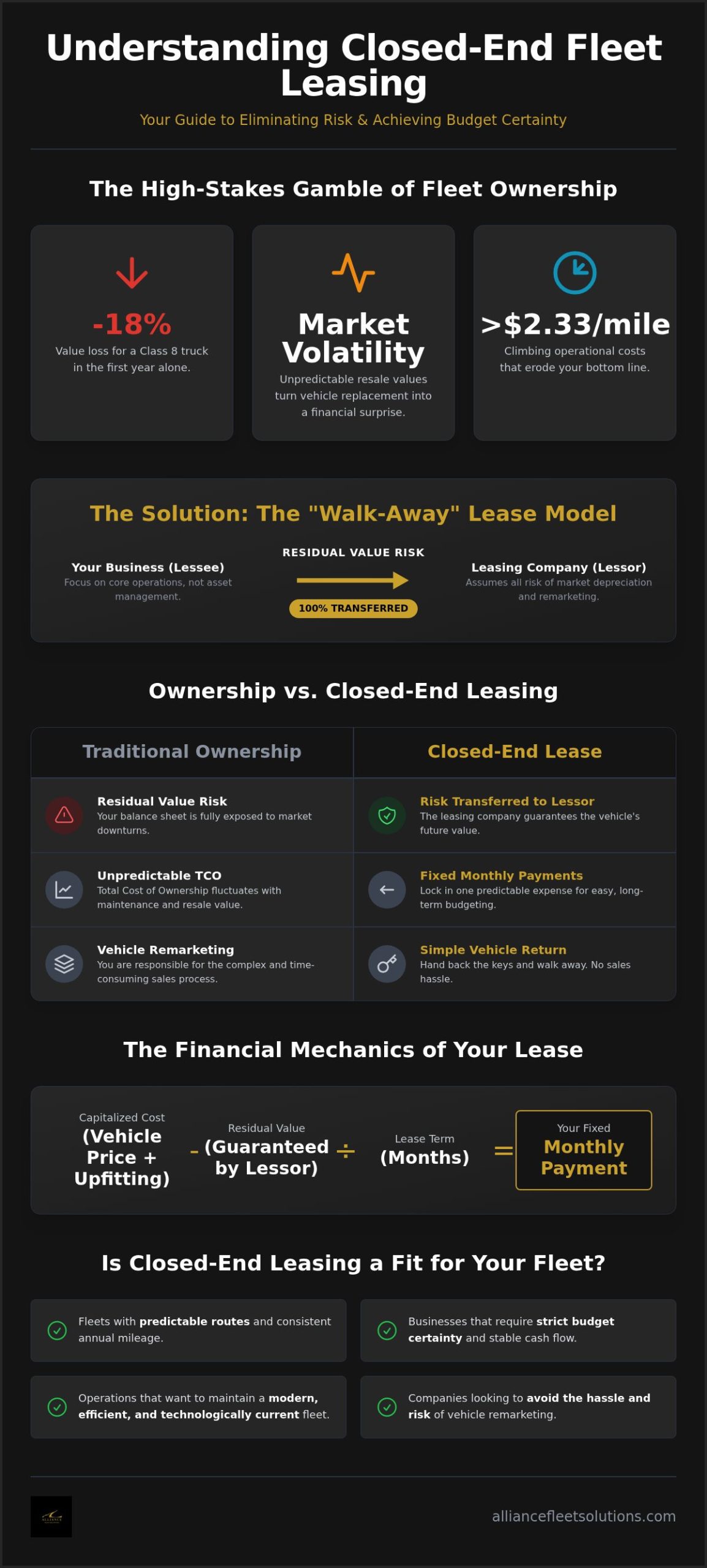
If your Class 8 trucks lose 18% of their value in the first year alone, why are you still gambling on their resale price three years down the line? It is a high-stakes lottery that most fleet managers are tired of playing, which is why closed-end leasing for commercial fleets has become a critical tool for risk mitigation in 2026. You likely feel the frustration of watching market volatility turn a planned vehicle replacement into a costly financial surprise, especially as average operational costs continue to climb well above $2.33 per mile.
We understand that you need budget certainty, not a guessing game on your balance sheet. This guide will show you how to eliminate residual value risk and secure total predictability for your entire operation. We’ll break down the financial mechanics of this “worry-free” model, explaining how to lock in fixed monthly expenses and simplify your vehicle replacement cycle. From navigating ASC 842 accounting standards to managing mileage limits with integrated GPS solutions, you’ll learn how to turn your fleet from a variable liability into a stable strategic asset that supports your long-term growth.
Key Takeaways
- Understand how the “walk-away” model transfers vehicle depreciation risk to the lessor, providing your business with total financial protection.
- Master the mechanics of closed-end leasing for commercial fleets to lock in fixed monthly expenses and eliminate unpredictable resale values.
- Identify the operational profiles best suited for closed-end terms, focusing on fleets with predictable routes and consistent annual mileage.
- Learn how to use telematics and GPS solutions to monitor real-time utilization and avoid the steep mileage penalties projected for 2026.
- Discover how professional upfitting and lifecycle oversight ensure your vehicles meet industrial demands while remaining compliant with lease return standards.
Defining Closed-End Leasing for the 2026 Commercial Fleet Market
In the 2026 logistics market, capital preservation is the top priority for fleet operators. High vehicle prices and fluctuating interest rates have made traditional ownership a risky venture for many businesses. This environment has fueled a significant shift toward What is Closed-End Leasing? as a primary acquisition strategy. Unlike open-end agreements where the lessee is responsible for the vehicle’s final sale price, a closed-end lease allows you to return the vehicle at the end of the term and simply walk away. It’s a strategic move that treats transportation as a fixed operational expense rather than a volatile capital investment.
Understanding the math behind closed-end leasing for commercial fleets requires mastering three core terms. The capitalized cost is the total price of the vehicle plus any professional upfitting. The lease term duration is the fixed period you’ll operate the asset. Most importantly, the residual value is the predetermined worth of the vehicle at the end of the lease, which the lessor guarantees regardless of market conditions. In 2026, supply chain stability has finally improved, yet resale volatility remains high, making these guaranteed values more precious than ever.
The Core Mechanics of Risk Transfer
The real value of this model lies in who carries the burden of depreciation. When you sign a closed-end contract, the lessor assumes all the residual value risk. If the resale market for Class 8 trucks or delivery vans collapses during your term, your balance sheet remains untouched. In a 2026 commercial contract, the residual value represents the lessor’s locked-in estimate of what the vehicle will be worth at the end of the term, serving as the financial floor for your liability. This structure protects your cash flow from the sudden market downturns that often catch owner-operators off guard. Your CFO can plan for the next five years with the confidence that an asset’s end-of-life value won’t create a budget shortfall.
Closed-End vs. Traditional Ownership
Owning a depreciating asset is becoming less attractive for modern service fleets. While purchasing might seem like it builds equity, the reality is that a new truck can lose nearly 18% of its value within the first 12 months. When you calculate the Total Cost of Ownership (TCO), you have to account for maintenance, interest, and the eventual headache of remarketing the unit. closed-end leasing for commercial fleets simplifies this by bundling the acquisition and disposal into one predictable payment. It allows you to focus on operational output rather than worrying about the secondary market. By outsourcing the vehicle lifecycle management, you ensure your fleet stays young, efficient, and technologically current without the capital strain of constant buying and selling.
The Financial Mechanics: Mitigating Residual Value Risk
The financial architecture of a closed-end lease is designed to prioritize stability. Lessors determine your monthly payment by calculating the difference between the vehicle’s capitalized cost and its projected residual value at the end of the term. The math is straightforward. By locking in these figures upfront, closed-end leasing for commercial fleets effectively hedges against the risk of a secondary market crash. In 2026, these projections are heavily influenced by IRS Revenue Procedure 2026-15, which helps align lease treatments with purchase depreciation to ensure tax consistency.
While traditional ownership allows you to claim equity, that equity is tied to an asset that can lose significant value the moment it leaves the lot. For a growing business, predictable cash flow is often more valuable than the theoretical equity in a used truck. The lessor assumes the entire responsibility for vehicle remarketing. They take on the burden of selling the asset once the lease expires, which allows you to focus on your core operations without becoming an accidental used-car dealer. If you want to see how these mechanics apply to your specific equipment needs, our experts can provide a tailored vehicle acquisition strategy that fits your budget.
ASC 842 Compliance and Balance Sheet Implications
As of 2026, fiscal reporting under ASC 842 requires almost all leases to be recorded on the balance sheet as right-of-use (ROU) assets. This change means that even a walk-away lease impacts your debt-to-equity ratios. However, the structure of a closed-end agreement often provides a cleaner audit trail than fragmented ownership records. These leases are recognized as liabilities, but they also represent a guaranteed right to use the equipment, providing a clear picture of operational capacity for stakeholders and lenders.
Tax Advantages and Section 179 Considerations
For the 2026 tax year, businesses can leverage a Section 179 deduction of up to $1,220,000 for qualifying equipment. Additionally, a 20% bonus depreciation rate is available for certain qualifying fleet assets. When you utilize closed-end leasing for commercial fleets, your monthly payments are typically treated as fully deductible business expenses, providing a consistent tax shield throughout the vehicle’s lifecycle. Integrating fuel management programs with your leasing strategy can further refine your tax reporting by providing granular data on operational costs, ensuring every mile driven is accounted for in your fiscal year-end filings.
Evaluating Fleet Suitability: Is Closed-End Leasing Right for You?
Success with closed-end leasing for commercial fleets depends on your ability to forecast operational needs accurately. It isn’t a one-size-fits-all solution. If your vehicles operate on fixed, local routes with low variance, you’re the ideal candidate for a walk-away agreement. However, if your utility needs fluctuate wildly or your trucks work in abrasive environments, the strict terms of a closed-end lease might create more friction than they solve. Analyzing your historical mileage and maintenance logs is the first step in determining if you can stay within the lines of a standard contract.
To help our partners decide, we utilize a 2026 Fleet Decision Matrix. This framework weighs three critical factors: utilization consistency, environmental severity, and financial objectives. For instance, if your average operational cost is hovering near the 2025 record of $2.336 per mile, the last thing you need is a variable resale value at the end of the term. Shifting that risk to a lessor provides a ceiling on your expenses, but only if your fleet profile aligns with the lease’s structural limits.
The Mileage and Wear-and-Tear Profile
The “sweet spot” for this model typically involves fleets that clock under 15,000 miles per year. Exceeding your agreed-upon limit in 2026 can trigger penalties ranging from 15 to 25 cents per mile, which quickly erodes the financial benefits of the lease. You must also assess your “rough usage” factor. Because the vehicle must be returned in a condition that meets the lessor’s standards, fleets in construction or heavy industrial sectors must be disciplined. Implementing proactive maintenance management is essential here. It ensures your vehicles stay within condition requirements and helps you stay within the 2026 maintenance budget benchmark of $0.15 to $0.25 per mile.
Cash Flow vs. Equity: The Strategic Choice
Service-based industries, such as HVAC, plumbing, or last-mile delivery, often prefer the simplicity of the closed-end model. These businesses often find it’s better to keep capital liquid for expansion rather than tying it up in vehicle equity. Choosing a closed-end lease preserves your borrowing capacity, as the predictable monthly payment is easier for lenders to digest than the fluctuating value of an owned fleet. While you won’t own the asset at the end of the term, the trade-off is a simplified replacement cycle that keeps your team in the newest, most efficient equipment without the burden of disposal or market timing.
Mastering the Lease Agreement: Navigating Mileage and Maintenance
Active oversight is the difference between a predictable budget and a painful end-of-term invoice. When you utilize closed-end leasing for commercial fleets, you’re essentially agreeing to a set of operational boundaries. Staying within these lines requires a shift from an “ownership mindset” to a “utilization mindset.” You aren’t just driving trucks; you’re managing a contract. This process begins with setting realistic mileage tiers based on your actual route data. Underestimating your needs can lead to penalties of up to 25 cents per mile, while overestimating means you’re paying for capacity that never hits the road.
Managing these variables doesn’t have to be a manual burden. A structured approach to lease compliance involves five key steps:
- Analyze Route History: Use at least 24 months of data to set your mileage tiers.
- Integrate Telematics: Monitor every mile in real-time to prevent surprises.
- Standardize Maintenance: Follow OEM schedules strictly to avoid “neglect” claims.
- Pre-Inspection Audits: Review vehicle condition 90 days before the turn-in date.
- Professional Oversight: Leverage fractional fleet management to handle the administrative heavy lifting.
If you find the administrative requirements of lease compliance daunting, our fractional fleet management experts can step in to oversee your contract performance and keep your operation running smoothly.
The Role of Telematics in Lease Management
Telematics and GPS solutions are your most effective tools for balancing fleet utilization. If your data shows a specific van is on track to exceed its annual limit, you can rotate it to a shorter route and move a lower-mileage vehicle into its place. This simple adjustment ensures the entire fleet stays within contract parameters. Proactive alerts also ensure you never miss a maintenance trigger. By catching mechanical issues early, you preserve the vehicle’s condition and fulfill your contractual obligation to keep the asset in good working order.
Defining ‘Excessive’ Wear and Tear
Most disputes at the end of a lease stem from a misunderstanding of “normal” versus “excessive” wear. Lessors expect standard road wear, such as minor stone chips or light interior scuffs. However, large dents, cracked glass, or torn upholstery are typically classified as excessive. Mechanical failures resulting from skipped oil changes or ignored warning lights are also major red flags. You should document each vehicle’s condition with high-resolution photos at every service interval. This creates a chronological record that protects you during the final inspection and ensures you aren’t billed for damage you didn’t cause.
The Alliance Advantage: Custom Closed-End Solutions and Upfitting
Alliance Fleet Solutions treats every agreement as a long-term partnership rather than a simple financial transaction. We recognize that closed-end leasing for commercial fleets only works when the vehicle is perfectly suited to the specific demands of your industry. Our approach integrates efficient fleet operations into the very fabric of the lease, ensuring that uptime is maximized from the first day of service. We don’t just provide a payment plan; we provide a comprehensive business solution that aligns with your financial performance goals and operational safety standards.
Integrating Professional Upfitting with Closed-End Terms
A common misconception in the industry is that you can’t customize a vehicle under a walk-away lease. We’ve eliminated that barrier. Alliance specializes in professional upfitting for specific industrial needs, from specialized shelving and storage to heavy-duty equipment racks. We manage these custom configurations within the lease structure by amortizing the upfitting costs directly into your fixed monthly payment. This strategy keeps your initial capital outlay low while ensuring your team has the exact tools they need to perform. Because our installations are professional and industry-standard, they won’t trigger “excessive wear” clauses at the end of the term, provided the equipment is maintained according to our guidelines. This allows you to deploy a fully optimized fleet without the risk of unrecoverable customization costs.
Fractional Management: Protecting Your Lease Investment
Managing a fleet requires constant vigilance, especially when navigating the 2026 reporting nuances of ASC 842. Our fractional fleet management service provides you with expert oversight without the overhead of a full-time hire. These seasoned experts act as an extension of your own team, monitoring lease health, tracking mileage trends, and ensuring compliance with all maintenance requirements. We handle the strategic vehicle acquisition and sourcing, so you get the right equipment at the right price from day one. By outsourcing the administrative burden to us, you protect your lease investment and avoid the end-of-term financial surprises that often plague unmanaged fleets. We act as your strategic partner, ensuring that your fleet remains a functional backbone of your operation.
Request a Custom Fleet Lease Consultation with Alliance Fleet Solutions to see how our tailored risk-mitigation strategies can stabilize your 2026 budget.
Stabilize Your Fleet Operations for 2026 and Beyond
The 2026 market demands a departure from the volatility of traditional vehicle ownership. By adopting closed-end leasing for commercial fleets, you successfully outsource depreciation risk and lock in fixed operational costs. This strategy ensures your capital remains liquid while your team stays equipped with the latest, most efficient vehicles. You’ve seen how precise mileage tracking and proactive maintenance prevent end-of-term surprises, turning your fleet into a stable, predictable asset.
Choosing the right partner makes this transition seamless. Alliance Fleet Solutions provides the technical authority and logistical support needed to navigate complex lease agreements. We offer expert fractional fleet management to oversee compliance, professional upfitting tailored to your specific industry needs, and national maintenance and telematics support to keep your units moving. You don’t have to manage these high-stakes variables alone.
Secure Your Fleet’s Future with a Predictable Closed-End Lease from Alliance Fleet Solutions
We’re ready to help you build a more resilient, cost-effective operation today.
Frequently Asked Questions
What is the primary difference between open-end and closed-end leasing for fleets?
Open-end leases make the lessee responsible for the final resale value, often through TRAC lease structures. Closed-end leases, or “walk-away” leases, transfer that residual value risk entirely to the lessor. If the market value of the truck drops below the projected value at the end of the term, you aren’t liable for the shortfall. This makes closed-end leasing for commercial fleets a superior choice for businesses seeking total budget predictability.
Can I customize or upfit a vehicle that is under a closed-end lease?
Yes, you can upfit a vehicle under a closed-end agreement through professional installation. We manage the process by amortizing the cost of specialized equipment, such as shelving or racks, into your monthly payment. It’s essential that these modifications are industry-standard and don’t compromise the vehicle’s structural integrity. This ensures the asset remains compliant with return standards while meeting your specific operational requirements and maximizing your team’s productivity.
What happens if my fleet exceeds the mileage limit on a closed-end lease?
Exceeding your mileage limit triggers a per-mile overage fee at the end of the term. In 2026, these penalties typically range from 15 to 25 cents per mile depending on the vehicle class. Because these costs can accumulate quickly, we recommend using telematics and GPS solutions to monitor utilization in real-time. If one vehicle is racking up miles too fast, you can rotate it with a lower-use unit to keep the fleet compliant.
Is closed-end leasing better for small businesses or large corporations?
Small businesses often prefer the “worry-free” nature of fixed payments to preserve cash flow and maintain borrowing capacity. Large corporations use closed-end leasing for commercial fleets as a strategic risk-transfer tool to simplify accounting and avoid the administrative burden of vehicle remarketing. Any organization with predictable, lower-mileage routes will find this model highly efficient for long-term financial planning and operational stability regardless of their total fleet size.
How does ASC 842 affect how I report closed-end leases in 2026?
Under ASC 842, you must record almost all leases as right-of-use (ROU) assets and corresponding liabilities on your balance sheet. This applies to your 2026 fiscal reporting regardless of whether the lease is open or closed-end. While this impacts your debt-to-equity ratios, the fixed nature of closed-end payments provides a stable, predictable liability. This is often easier for auditors and lenders to evaluate than the variable costs associated with ownership.
What defines ‘excessive wear and tear’ in a commercial lease agreement?
Excessive wear refers to damage that exceeds standard road usage, such as large dents, broken glass, or neglected mechanical systems. While minor scuffs are expected, missing maintenance records or significant interior damage will lead to penalties. To protect your investment, we advise documenting vehicle condition at every service interval. Following a rigorous maintenance schedule ensures the vehicle meets the lessor’s return criteria without triggering unexpected end-of-term repair charges.
Can I end a closed-end lease early if my business needs change?
Early termination is possible but usually involves significant fees or a specific buyout requirement. Closed-end agreements are structured for a fixed term to balance the depreciation curve. If your operational needs are highly unpredictable, you might consider our fractional fleet management services to help optimize your current contract. We work with you to evaluate the most cost-effective way to transition your fleet as your specific business requirements evolve.
Does closed-end leasing include maintenance and fuel management?
These services are typically separate but can be integrated into a comprehensive fleet management program. We offer national maintenance management and fuel programs that work alongside your lease to maximize uptime and efficiency. Bundling these services allows you to consolidate your operational data and simplify tax reporting. It ensures that every aspect of your vehicle’s lifecycle is managed under a single, strategic oversight plan that protects your bottom line.