
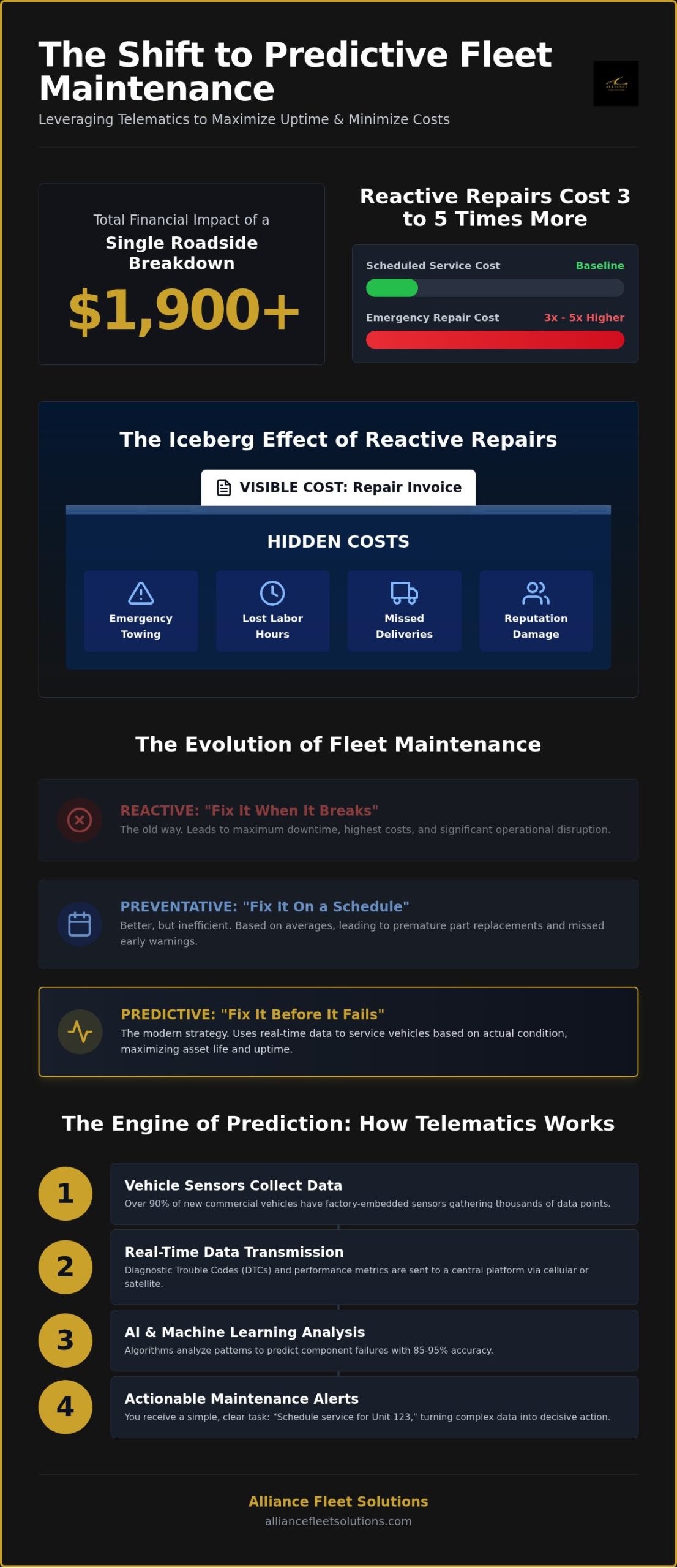
Did you know a single roadside breakdown can drain over $1,900 from your bottom line once you factor in the total financial impact? It’s a hard truth in 2026, especially when reactive repairs cost three to five times more than scheduled service. You’re likely already dealing with the stress of unplanned downtime and the fatigue of receiving endless alerts that lack actionable context. Using telematics for predictive maintenance shouldn’t feel like another technical burden; it should be your most dependable tool for operational control.
We understand that you need more than just data; you need a partnership that translates technical signals into business results. In this guide, you’ll learn how to leverage telematics data to transition from reactive repairs to a high-uptime predictive maintenance model that protects your fleet assets. We’ll walk through the steps to integrate these insights into your daily workflow, helping you lower your total cost of ownership and secure higher vehicle resale values through documented health data.
Key Takeaways
- Learn why telematics for predictive maintenance is the essential foundation for maximizing fleet uptime and reducing the total cost of ownership in 2026.
- Transition from rigid calendar-based schedules to condition-based maintenance to stop wasting money on premature part replacements.
- Master the use of real-time Diagnostic Trouble Codes to identify potential component failures weeks before they cause a breakdown.
- Follow a clear roadmap for auditing your maintenance history and choosing a partner that turns complex data into simple, actionable tasks.
- Protect your long-term investment by using documented health data to command higher prices when it’s time for vehicle remarketing.
The Evolution of Fleet Upkeep: Why Predictive Maintenance is Essential in 2026
The standard for fleet reliability has changed. By 2026, over 90% of new commercial vehicles come equipped with factory-embedded sensors, making the data required for Predictive maintenance more accessible than ever. We define predictive maintenance as the proactive analysis of real-time vehicle data to identify potential failures before they occur. It’s a fundamental shift from the old “fix-it-when-it-breaks” mentality to a modern “fix-it-before-it-fails” strategy. As vehicle acquisition costs continue to rise, protecting your existing assets is no longer just a mechanical task; it’s a financial necessity. Implementing telematics for predictive maintenance has become a core component of professional fleet management services that prioritize long-term asset health over short-term fixes.
The Hidden Costs of Reactive Repairs
Reactive maintenance creates what we call the “Iceberg Effect.” The repair invoice you see on your desk is only the tip. Beneath the surface lies a massive collection of hidden expenses: emergency towing, lost labor hours, and the reputational damage caused by missed delivery windows. Research shows that a single roadside breakdown in 2026 carries a total financial impact exceeding $1,900. When you wait for a part to fail, the resulting emergency repairs often cost three to five times more than a planned intervention. Beyond the balance sheet, a reactive culture takes a heavy toll on driver retention. Your team wants to operate equipment they can trust, and frequent breakdowns communicate a lack of support for their safety and efficiency.
Moving Beyond the Odometer: The Limits of Scheduled Maintenance
Traditional “preventative” schedules based solely on the odometer are becoming obsolete. A fixed-interval approach, such as changing oil every 5,000 miles, assumes every vehicle faces identical conditions. In reality, duty cycles and environmental factors vary wildly. A truck idling in heavy urban traffic faces different wear patterns than one cruising on a long-haul highway. Relying on telematics for predictive maintenance allows you to move toward condition-based care. This level of maintenance management ensures you aren’t over-maintaining healthy vehicles or, more importantly, ignoring high-stress units that need attention sooner than the calendar suggests. Modern machine learning models can now predict major component failures with 85% to 95% accuracy, giving you the control to schedule service on your own terms.
Harnessing Telematics Data: The Engine Behind Predictive Insights
Telematics technology serves as the central nervous system of a modern fleet. It does far more than track vehicle location; it captures high-fidelity data points that reveal the true internal health of your assets. By 2026, factory-embedded hardware in over 90% of commercial vehicles ensures that telematics for predictive maintenance can pull granular information directly from the engine control unit. This data travels via cellular or satellite networks to a centralized management platform, where it’s processed into actionable intelligence. Without this high-fidelity stream, failure predictions lack the precision needed to avoid the shop. High-quality data allows managers to follow a guide for efficient fleet management that prioritizes actual vehicle condition over guesswork.
Real-Time Diagnostic Trouble Codes (DTCs)
Diagnostic Trouble Codes are the primary language your vehicle uses to communicate distress. These codes act as early warning signals, often appearing long before a driver notices a performance dip. In a predictive model, we distinguish between active and stored codes. Active codes indicate a current, ongoing issue that requires immediate attention, while stored codes represent intermittent faults that might suggest a developing problem. Remote diagnostics allow fleet managers to cleared non-critical codes, such as a loose gas cap or a temporary sensor glitch, without a physical shop visit. This capability keeps your drivers on the road and reduces the “data fatigue” often associated with older systems.
Identifying Patterns in Component Wear
Predictive insights go beyond simple error codes by monitoring subtle shifts in operating parameters. AI-driven platforms analyze variables like battery voltage, coolant temperatures, and fuel trim levels in real-time. By comparing these current metrics against historical failure benchmarks, the system can identify minor anomalies before they ever trigger a dashboard light. For example, a slight, consistent rise in operating temperature might signal a failing water pump weeks before the engine actually overheats. This level of foresight allows you to address the root cause during a scheduled window, protecting your assets and your schedule. If you find yourself overwhelmed by the volume of raw data, our Telematics and GPS Solutions can help you filter the noise and focus on what matters.
A critical, often overlooked factor in data accuracy is how professional upfitting influences your sensor network. When a vehicle is modified with auxiliary equipment like refrigeration units, cranes, or power take-off (PTO) systems, the standard telematics profile changes. These specialized components add new data points and secondary batteries that must be monitored to ensure total vehicle health. A strategic upfitting plan ensures that your telematics hardware is positioned to capture data from both the chassis and the specialized equipment. This integrated approach prevents “blind spots” in your maintenance strategy, ensuring that your most complex and expensive assets remain as dependable as your standard vans.
Predictive vs. Preventative Maintenance: Choosing the High-Uptime Strategy
Choosing between maintenance models is a decision that impacts every level of your business, from the garage floor to the CFO’s office. Traditional preventative maintenance operates on a “just-in-case” philosophy, using rigid calendar dates or mileage milestones to trigger service. While this is safer than a reactive approach, it lacks the precision required for modern logistics. Relying on telematics for predictive maintenance shifts your focus to a condition-based model. This means you only pull a vehicle off the road when the data proves it’s necessary. Achieving efficient fleet operations in 2026 requires a hybrid approach where safety inspections remain preventative, but high-cost component replacements become data-driven.
The Efficiency Gap: Avoiding Unnecessary Service
Replacing high-value parts like alternators, turbos, or injectors based on generic manufacturer schedules often results in “over-maintenance.” If a component is still functioning at peak efficiency, discarding it simply because the odometer hit a specific number is a waste of capital. Telematics-enabled predictive maintenance has been shown to reduce overall maintenance costs by 15% to 25% by allowing you to use the full life of every part. This strategy doesn’t just save on parts; it significantly lowers labor costs. By reducing the frequency of annual shop visits, your technicians can focus on high-priority repairs rather than performing routine swaps on perfectly healthy vehicles. It’s a more logical way to manage your resources and keep your assets in the field longer.
Protecting Asset Resale Value
The value of your fleet isn’t just in the miles it covers today, but in the equity it retains for tomorrow. In the 2026 market, buyers of used commercial vehicles are more sophisticated and data-conscious than ever before. They don’t just want to see a folder of paper receipts; they want a transparent, digital health record. A documented predictive maintenance history proves that you addressed minor anomalies before they escalated into structural engine or transmission damage. This level of transparency is a cornerstone of successful Vehicle Remarketing. When you can demonstrate that your fleet was managed with telematics for predictive maintenance, you position your assets as premium investments. This documented care directly improves your Total Cost of Ownership (TCO) by ensuring you get the maximum return on investment when it’s time to cycle out older units.
Implementing a Telematics-Driven Maintenance Roadmap
Transitioning to telematics for predictive maintenance requires a structured plan that moves beyond simply installing hardware. It’s about building a workflow that turns raw signals into shop-floor action. For transport businesses looking to integrate these data insights into their broader logistics operations, you can visit Logivo.ai to discover AI-powered management tools. Success in 2026 depends on how well you bridge the gap between data collection and mechanical execution. Follow these five steps to build a resilient roadmap:
- Step 1: Audit current maintenance logs. Review your last 12 months of repairs to identify frequent failure points. If your refrigeration units or lift gates fail more often than the chassis, prioritize sensors for those specific components.
- Step 2: Select a technical partner. Choose a provider that offers deep diagnostic integration. Your telematics system must communicate fluently with the specific makes and models in your fleet to capture high-fidelity data.
- Step 3: Establish Alert Thresholds. Define exactly what constitutes a “critical” event. This prevents your team from becoming desensitized to notifications.
- Step 4: Integrate with fuel management programs. Mechanical issues like dragging brakes or fouled injectors often show up in fuel consumption data first. A unified view provides a complete picture of vehicle efficiency.
- Step 5: Review performance monthly. Use your repair outcomes to refine your predictive algorithms. If an alert didn’t result in a found defect, adjust the threshold to improve accuracy.
Solving the Data Overload Problem
Data fatigue is a significant barrier to fleet efficiency. Many managers ignore 90% of their telematics alerts because they’re buried in a sea of non-critical noise. This is where our Fractional Fleet Management services provide essential relief. Instead of forcing your staff to interpret complex Diagnostic Trouble Codes, an expert partner filters the stream and presents only the critical insights. We recommend a tiered alert system to keep your team focused. Critical alerts require an immediate stop, urgent alerts need service within 48 hours, and informational alerts are simply noted for the next scheduled shop visit. This logical structure ensures that your technicians spend their time fixing problems rather than chasing ghosts.
The Human Element: Driver Feedback and Training
The person behind the wheel has a massive impact on component longevity. Telematics data reveals the direct link between driver behavior and mechanical wear. Harsh braking, aggressive acceleration, and excessive idling aren’t just safety concerns; they’re maintenance accelerators. You can use telematics for predictive maintenance to coach your team on preserving vehicle health. When drivers understand that their “health score” affects the company’s bottom line and their own safety, they become active partners in asset preservation. This creates a feedback loop where the driver, the data, and the maintenance shop work in total alignment to keep the fleet moving.
Alliance Fleet Solutions: Integrating Telematics into Your Lifecycle Strategy
Alliance Fleet Solutions acts as the essential backbone of your operation by managing the complexities of modern vehicle technology on your behalf. We don’t just provide a software login; we serve as a strategic partner that integrates telematics for predictive maintenance into your entire vehicle lifecycle. This holistic approach ensures that your data isn’t sitting in a silo but is actively used to drive down costs. When paired with our Open-End Leasing options, predictive data becomes a powerful tool for TCO optimization. By maintaining assets based on their actual condition, we preserve the mechanical integrity of your fleet, which leads to higher returns during Vehicle Remarketing. Our national network of maintenance providers stands ready to act on these insights, ensuring your vehicles receive expert care wherever they’re deployed.
Fractional Management: Expert Oversight Without the Overhead
Many businesses lack the dedicated staff to monitor complex data streams around the clock. Our Fractional Fleet Management services solve this problem by providing you with an outsourced fleet department that possesses deep technical authority. We don’t just hand you a dashboard; we interpret the telematics reports to make executive maintenance decisions that protect your bottom line. This model is particularly valuable for small-to-mid-sized fleets that need seasoned expertise without the overhead of a full-time executive hire. We handle the vendor communications and service scheduling, allowing you to stay focused on your primary business goals while we maintain expert control over your assets.
Custom Upfitting and Specialized Maintenance
Standard telematics solutions often overlook the specialized equipment that makes your vehicles functional. Because we provide professional upfitting, we understand the unique data points required to monitor auxiliary components like lift gates, cranes, or refrigeration units. Whether you are managing delivery trucks or specialized service vehicles like those used by A Clear Alternative, we integrate this auxiliary data into your telematics for predictive maintenance model to ensure your entire asset is protected, not just the chassis. This integrated oversight prevents expensive failures in your most critical work tools. It’s a logical, dependable way to manage complex equipment in a fast-paced industry. If you’re ready to stop reacting to breakdowns and start predicting success, contact us today for a comprehensive fleet health audit. We’ll help you build a roadmap that ensures your fleet remains a strategic business asset for years to come.
Securing Your Fleet’s Future with Data-Driven Oversight
Shifting your operation toward a condition-based model is the most effective way to secure your bottom line in 2026. By utilizing telematics for predictive maintenance, you replace outdated schedules with real-time precision, ensuring every dollar spent on service directly supports fleet uptime. This proactive approach doesn’t just prevent breakdowns; it fundamentally changes how you manage the total cost of ownership across your entire vehicle lifecycle. You’ve seen how data can transform reactive repairs into a strategic advantage that protects your assets and your reputation.
We understand that managing these complex data streams can feel overwhelming, which is why we offer the technical authority and national maintenance network necessary to simplify the process. From our fractional fleet management expertise to customized telematics for upfitted fleets, we provide the tools and oversight required to keep your team focused on their primary goals. Partner with Alliance Fleet Solutions for data-driven maintenance management today. It’s time to project an image of calm, expert control over your operations and build a more resilient, high-uptime future for your fleet.
Frequently Asked Questions
How does telematics specifically predict a vehicle failure?
Telematics predicts failure by capturing real-time data from the Engine Control Unit and comparing it against historical failure benchmarks. The system monitors subtle shifts in variables like battery voltage, coolant temperature, and fuel trim levels. When these metrics deviate from normal operating patterns, the software identifies the anomaly as a potential component failure, often 20 to 45 days before the vehicle actually breaks down.
Is predictive maintenance more expensive than preventative maintenance?
Predictive maintenance requires a higher initial investment in hardware and software, but it’s significantly cheaper over the vehicle’s lifecycle. Research shows it reduces overall maintenance costs by 15% to 25% compared to standard preventative programs. You save money by avoiding “over-maintenance” on healthy parts and eliminating reactive repairs, which typically cost three to five times more than scheduled interventions.
Can I implement predictive maintenance on an older fleet?
You can implement this model on older assets by retrofitting them with aftermarket telematics hardware. While 90% of new vehicles in 2026 have embedded sensors, older trucks can still provide high-fidelity data through the OBD-II or J1939 ports. This allows you to bring your entire fleet into a single management platform to ensure consistent uptime across both new and aged equipment.
What are the most common data points tracked for predictive maintenance?
The most critical data points include engine oil life, battery health, coolant temperatures, and brake pad wear. For specialized fleets, sensors also monitor auxiliary equipment such as refrigeration temperatures or lift gate cycle counts. Tracking these specific metrics through telematics for predictive maintenance ensures that every part of your upfitted vehicle is monitored for potential issues before they disrupt your schedule.
How does predictive maintenance affect vehicle resale value?
It increases resale value by providing a documented, digital health record that proves the vehicle was maintained with precision. Buyers in the 2026 market look for transparent data that shows components were serviced based on actual condition rather than just mileage. This level of transparency reduces the buyer’s risk, allowing you to command a premium price during the vehicle remarketing process.
Will telematics for maintenance help with DOT compliance?
Telematics helps with DOT compliance by automating the identification of safety-critical defects before they lead to an inspection failure. The system provides a clear audit trail of all identified issues and subsequent repairs, which is essential for maintaining a high safety rating. Using telematics for predictive maintenance demonstrates a proactive approach to roadworthiness that manual logs simply can’t match.
How long does it take to see an ROI on a predictive maintenance program?
Most fleet operators see a return on their investment within 7.2 months. This rapid payback comes from a 30% to 50% reduction in unplanned downtime and the significant savings associated with avoiding roadside breakdowns. When you factor in the $1,900 average impact of a single breakdown in 2026, the financial benefits of a predictive model become apparent very quickly.