
Is your accounts payable department spending more time processing paperwork than your drivers spend on the road? Most managers agree that managing hundreds of individual invoices for fuel, repairs, and telematics is a heavy administrative burden that masks the true cost of operations. When data is fragmented, it’s nearly impossible to catch billing errors or avoid the late fees that eat into your margins. This is why consolidated billing for fleet services has become a vital tool for any operation looking to maintain a competitive edge in the 2026 logistics sector.
You’ll discover how consolidating your invoices into a single stream reduces overhead and reveals your exact total cost of ownership. This guide explores how a single, monthly electronic invoice creates the streamlined processes your team needs to stay productive and efficient. We’ll also examine how enhanced data visibility helps you manage volatile costs, such as the current $5.06 national average for diesel, with expert control. For organizations looking to apply similar efficiency to their international supply chains, Customs and Trade Logistics offers specialized guidance on managing import hurdles. By the end, you’ll see how a unified billing strategy transforms your back-office data into a powerful asset for fleet optimization and long-term safety.
Key Takeaways
- Understand the shift from traditional vendor-by-vendor billing to a centralized model that aggregates fuel, leasing, and maintenance expenses.
- Learn how to drastically reduce soft costs by eliminating the manual labor hours required for processing hundreds of individual invoices.
- Discover how consolidated billing for fleet services provides real-time transaction data without sacrificing granular, line-item visibility.
- Explore the “Digital Drill-Down” technique to audit individual sub-receipts and repair orders within a single, master electronic invoice.
- Identify the critical steps for auditing your current vendor landscape and mapping general ledger requirements for a seamless transition.
What is Consolidated Billing for Fleet Services?
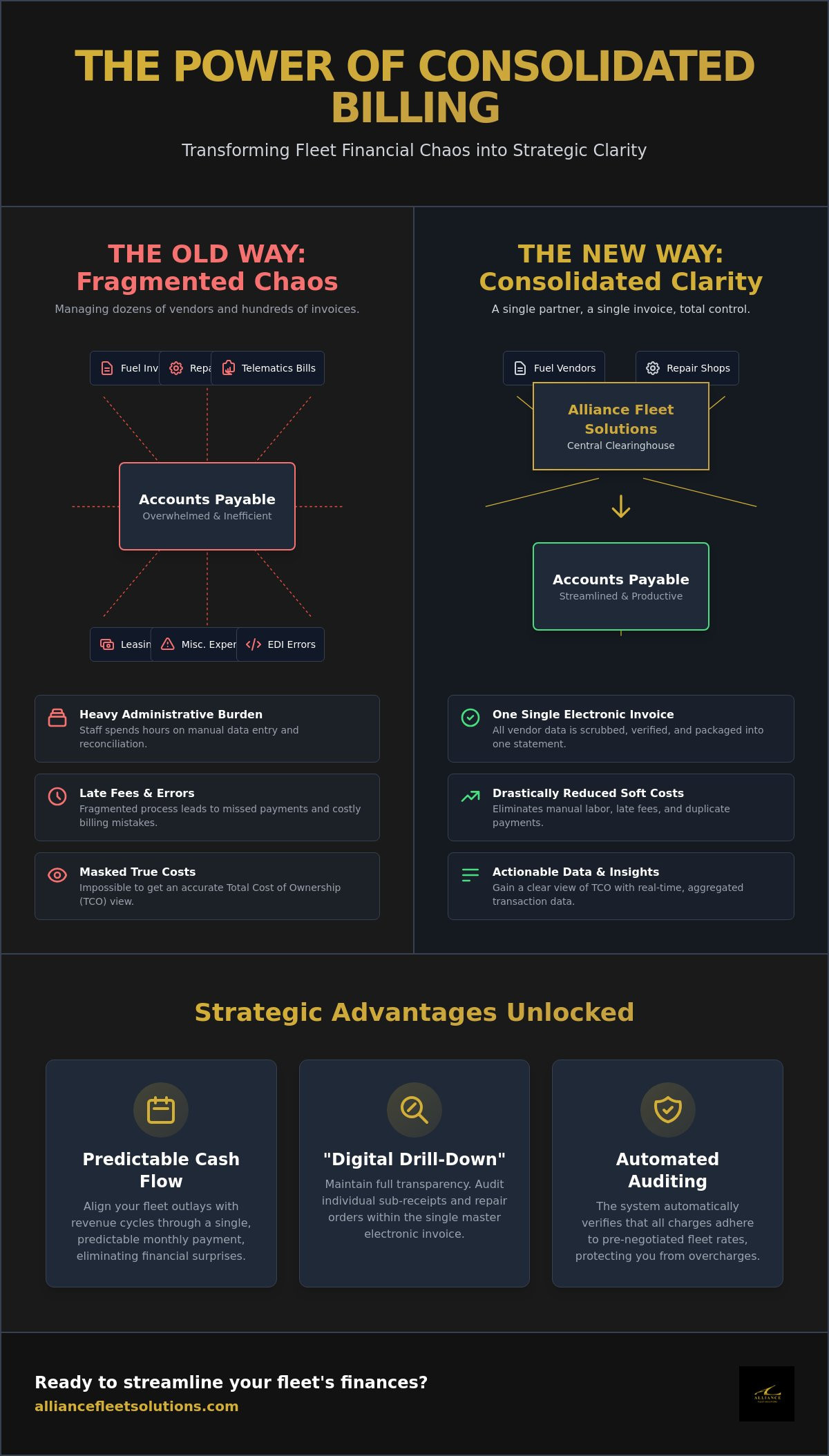
Consolidated billing for fleet services is a centralized invoicing system that aggregates every fleet-related expense into a single, comprehensive statement. This isn’t just about reducing the number of envelopes your team opens each month. It’s a strategic shift from traditional, fragmented vendor-by-vendor billing toward a unified model where a single partner manages the financial flow. To truly grasp the scope of this system, it helps to look at the broader context of What is Fleet Management? as an integrated discipline. By bringing vehicle acquisition, open-end leasing, maintenance, and telematics under one roof, companies gain a level of expert control that legacy systems simply cannot match.
In 2026, the technology powering these systems has reached a new peak of accuracy. We’ve moved past the days of manual entry errors and delayed reporting. Modern platforms use real-time data feeds to ensure every fuel card transaction and scheduled service fee is captured instantly. This transparency is the reason why consolidated billing for fleet services is now the standard for high-performance logistics teams. It allows managers to see exactly where every dollar goes without chasing down stray receipts from dozens of different service providers.
The Evolution of Fleet Invoicing
The industry has transitioned from labor-intensive, paper-based reconciliation to sophisticated automated electronic data interchange (EDI). In this modern framework, your fleet management partner acts as a central clearinghouse for all vendor data. They scrub the information for errors, verify that work was performed as authorized, and package it into a clean, digital format. Consolidated billing serves as a strategic financial filter that protects your operation from overcharges and administrative bloat.
Direct vs. Indirect Fleet Expenses
Managing a fleet involves a mix of predictable and volatile costs. Direct expenses like fuel management programs and lease payments are straightforward to consolidate. However, indirect or complex costs, such as emergency repairs or professional upfitting, often create data gaps in traditional models. A robust system uses purchase order (PO) protocols to pre-authorize these repairs, ensuring they flow into the unified bill accurately. For companies with smaller teams, utilizing fractional fleet management provides the necessary oversight to manage these consolidated streams without the need to hire a full-time internal department.
The Strategic Advantages of Invoice Consolidation
Moving beyond the basic definition, the real value of invoice consolidation lies in its ability to protect your bottom line. Traditional billing methods often lead to “soft cost” leakage. This happens when your accounts payable team spends dozens of hours every month manually entering data from fragmented sources. By implementing consolidated billing for fleet services, you replace this chaos with a single, predictable monthly payment. This shift doesn’t just save time; it eliminates the late fees and duplicate payments that often slip through when managing fifty different vendors.
Cash flow management becomes significantly more predictable when you know exactly when your fleet expenses will hit the ledger. This level of expert control allows you to align your outlays with your revenue cycles. A unified billing system also acts as an automated auditor. It ensures that every service provider adheres to your pre-negotiated fleet rates, protecting you from unauthorized price hikes. You can learn more about the broader ROI of these strategies in our guide to Comprehensive Fleet Management Services.
Reducing Administrative Overhead
Data Aggregation and TCO Insights
Consolidated billing is the foundation of data-driven decision making. When all your costs are in one place, you can finally calculate your true total cost of ownership (TCO) for every asset. This intelligence is crucial for vehicle remarketing. It tells you exactly when a vehicle has transitioned from a productive asset to a financial liability. You can easily spot “outlier” vehicles that are costing significantly more than the fleet average in fuel or repairs. Using this unified data helps you justify efficient fleet operations and strategic equipment upgrades. If you’re ready to gain this level of visibility, exploring professional fleet management solutions is the logical next step for your operation.
Integrating Maintenance, Fuel, and Leasing into One Stream
Traditional fleet accounting often leaves managers juggling separate streams for leasing, fuel, and service. In 2026, the standard for consolidated billing for fleet services has evolved to merge these diverse costs into a singular, cohesive financial flow. This integration starts at the point of vehicle acquisition. By incorporating professional upfitting costs and acquisition fees into your monthly open-end leasing payment, you achieve “one-check” convenience. This eliminates the need to manage separate capital expenditure requests and service invoices for new assets entering your fleet.
Telematics and GPS solutions act as the connective tissue in this unified stream. By leveraging real-time data, the system verifies that every billed service matches the actual vehicle location and usage. For instance, if a fuel transaction occurs three hundred miles away from a vehicle’s GPS coordinate, the system flags the error before it ever reaches your master invoice. This proactive approach ensures that your billing isn’t just consolidated, but also verified for accuracy. It provides the expert control needed to manage a mobile workforce without the stress of constant manual auditing.
Fuel Program Integration
Modern fuel management programs feed high-fidelity transaction data directly into the master statement. This includes the automatic capture of pump data, odometer readings, and specific driver IDs. When this data is consolidated at the source, your administrative team no longer needs to manually reconcile credit card statements or paper receipts. This level of organization also simplifies fuel tax recovery and IFTA compliance, as all necessary data points are already mapped to the correct vehicle and jurisdiction. You don’t have to worry about missing data during an audit when every gallon is accounted for in a single stream.
Maintenance and Repair Consolidation
Effective maintenance management is the primary defense against “invoice creep” from local repair shops. By utilizing a national service network, you maintain billing consistency regardless of where a vehicle is serviced. Every repair is pre-authorized by technical experts who ensure the work is necessary and priced according to your fleet’s negotiated rates. This process consolidates everything from routine oil changes to emergency roadside assistance and glass repair into your standard monthly bill. It provides a level of expert control that prevents small maintenance issues from turning into large, unverified financial burdens, keeping your operation moving without administrative friction.
Overcoming Transparency Concerns: Data Granularity in Unified Billing
The most common objection to consolidated billing for fleet services is the fear of losing visibility. Managers often worry that by merging expenses into one statement, they’ll lose the ability to see individual line items or audit specific repairs. This concern is understandable but largely outdated. Modern fleet portals utilize a “Digital Drill-Down” feature. This allows you to click on any summarized charge to view every underlying sub-receipt, repair order, and fuel transaction. You get the simplicity of one bill without sacrificing the granular detail needed for deep financial analysis.
Digital transparency actually increases auditability compared to traditional paper files because every data point is searchable and linked to a verifiable source. To ensure these reports remain accurate, fractional fleet managers play a crucial role. These experts act as your internal audit team, reviewing consolidated reports for discrepancies or overcharges before they hit your bank account. They provide the extra layer of expert control that keeps your operation lean and accountable. It’s about having a partner who understands the mechanics of your business as well as the numbers on the page.
Customized Reporting and GL Coding
One of the biggest advantages of a unified bill is the ability to customize how costs are allocated. You can map every expense to your company’s internal General Ledger (GL) codes automatically. This means you can allocate costs by department, region, or even specific job sites within a single invoice. When your bill is “accounting-ready,” it allows for immediate import into your ERP system, eliminating hours of manual data entry. If you want to see how this works for your specific business model, you should contact the experts at Alliance Fleet Solutions to discuss your reporting requirements.
Exception Reporting and Fraud Prevention
Consolidation doesn’t just simplify accounting; it strengthens security. By setting specific parameters, the system can automatically flag unusual charges. For example, if a fuel purchase exceeds the vehicle’s tank capacity, an exception report is generated instantly. This makes it much easier to spot negative trends in driver behavior or recurring vehicle failures that might otherwise go unnoticed in a sea of paper invoices. When you combine this with telematics and GPS solutions, you can validate every service hour billed against the actual movement of the asset. This level of oversight ensures you only pay for work that was actually performed, protecting your margins from fraud and inefficiency.
Implementing a Unified Billing Framework with Alliance Fleet Solutions
Transitioning to consolidated billing for fleet services is a methodical process that replaces administrative chaos with expert control. It isn’t a simple software update. Instead, it’s a strategic alignment of your financial data and operational requirements. By following a structured framework, you can move away from fragmented invoicing and toward a system that provides total transparency. Our team works alongside you to ensure every cost, from fuel card transactions to complex upfitting, is captured and verified before it reaches your general ledger.
The implementation follows five critical steps to ensure long-term success:
- Step 1: Audit: We analyze your current vendor landscape to identify every fragmented billing point, from local repair shops to national leasing providers.
- Step 2: Define Requirements: We map your internal reporting needs and GL coding to ensure the final invoice is ready for immediate ERP import.
- Step 3: Portal Integration: Your fuel management and maintenance programs are funneled into the Alliance Fleet management portal for real-time visibility.
- Step 4: Lease Transition: We help you transition legacy agreements into a consolidated open-end or closed-end leasing structure that simplifies your capital outlays.
- Step 5: Ongoing Optimization: You’ll receive monthly “Exception Reports” that flag unusual spend, allowing you to optimize your fleet performance continuously.
The Alliance Partnership Advantage
Working with a family-owned, national provider offers a level of flexibility that large OEM-captive lenders often lack. We don’t just provide a platform; we provide a dedicated account manager who understands your specific business goals. This partner acts as your single point of contact to resolve billing questions across all services, from telematics to vehicle remarketing. Whether you’re scaling from ten vehicles to five hundred, our billing structure grows with you. This ensures you never lose the granular detail needed for high-stakes decision making.
Next Steps for Fleet Optimization
The first step toward a more efficient back office is a comprehensive billing audit. We’ll help you identify where “soft costs” are draining your resources and provide a clear timeline for transitioning to a unified model. Most operations find that they can begin seeing the benefits of consolidated billing for fleet services within a single billing cycle. You can contact our team today to see a sample consolidated invoice and explore our reporting dashboard. Let’s transform your fleet data from an administrative burden into a strategic business asset.
Secure Your Operational Future with Strategic Billing
Reclaiming your time starts with eliminating the manual burden of fragmented invoicing. By moving toward a unified model, you don’t just simplify your back office; you gain the data visibility necessary for high-stakes decision making. We’ve explored how integrating fuel, maintenance, and leasing into one stream protects your margins and reveals your true total cost of ownership. Implementing consolidated billing for fleet services is the most effective way to transition from reactive accounting to proactive fleet optimization and expert control.
Our team provides the expert fractional fleet management support you need to ensure every dollar is accounted for and every report is accurate. With national service coverage and customized GL coding for seamless ERP integration, we act as the strategic partner your operation requires. You deserve a solution that understands the mechanics of your industry and the language of your business performance. Streamline your fleet operations with Alliance Fleet Solutions; contact us for a billing audit today. We’re ready to help you build a more reliable, efficient, and profitable future for your fleet.
Frequently Asked Questions
Does consolidated billing cost more than paying individual vendors?
Consolidated billing for fleet services usually lowers your total operational expenses by eliminating the administrative soft costs associated with processing dozens of individual checks. You avoid late fees and missed payment penalties while ensuring every vendor adheres to pre-negotiated rates. This expert control prevents the “invoice creep” that often occurs when managing fragmented accounts without professional oversight.
Can I still see individual receipts for fuel and maintenance with consolidated billing?
You retain full visibility into every transaction through a centralized digital portal. While the main statement provides a high-level summary for your accounting team, you can use the “drill-down” feature to view specific line items, repair orders, and fuel receipts. This transparency ensures you never lose the granular detail needed for auditing individual vehicle performance or driver behavior.
How does consolidated billing handle taxes in different states?
The system automatically maps regional tax requirements and state-specific fees to each transaction based on where the service occurred. This is especially helpful for interstate operations that must comply with complex IFTA regulations and varying sales tax rates. By consolidating data at the source, you ensure your tax reporting is accurate and ready for submission without manual forensic accounting.
Is consolidated billing compatible with my existing accounting software like QuickBooks or SAP?
Most modern systems are designed for seamless integration with major ERP and accounting platforms like QuickBooks, SAP, or Sage. We provide customized GL mapping that allows you to import your monthly data directly into your existing software. This eliminates manual entry errors and ensures your fleet expenses are correctly allocated to the right departments or job sites from day one.
Can I include vehicle upfitting costs in my monthly consolidated bill?
You can absolutely include professional upfitting and acquisition costs in your monthly statement. Many businesses choose to roll these expenses into an open-end lease agreement to maintain a consistent, predictable payment. This “one-check” convenience allows you to deploy fully equipped vehicles without managing separate capital expenditure requests or multiple vendor payments for a single asset.
What happens if there is a disputed charge on a consolidated invoice?
When a discrepancy occurs, your dedicated account manager handles the dispute directly with the service provider on your behalf. We flag the charge in the system and investigate the repair order or fuel transaction to ensure it meets authorized parameters. You don’t have to spend time arguing with local shops because our experts manage the resolution process to protect your fleet’s interests.
Do I need to change my current fuel card or maintenance providers to use this service?
You don’t always have to change your providers, but utilizing consolidated billing for fleet services alongside our national service network offers the highest level of data accuracy. Our systems are built to ingest data from specific partners to ensure real-time visibility and verified pricing. We’ll audit your current vendor list to determine which accounts can be easily integrated into your new framework.
How does invoice consolidation impact my fleet’s credit lines?
Consolidating your invoices can actually improve your financial profile by centralizing your fleet debt under a single, well-managed agreement. Instead of having multiple small credit lines with various vendors, you utilize a strategic leasing or management structure. This provides a clearer picture of your total liabilities and often makes it easier for your business to secure financing for future vehicle acquisitions.