
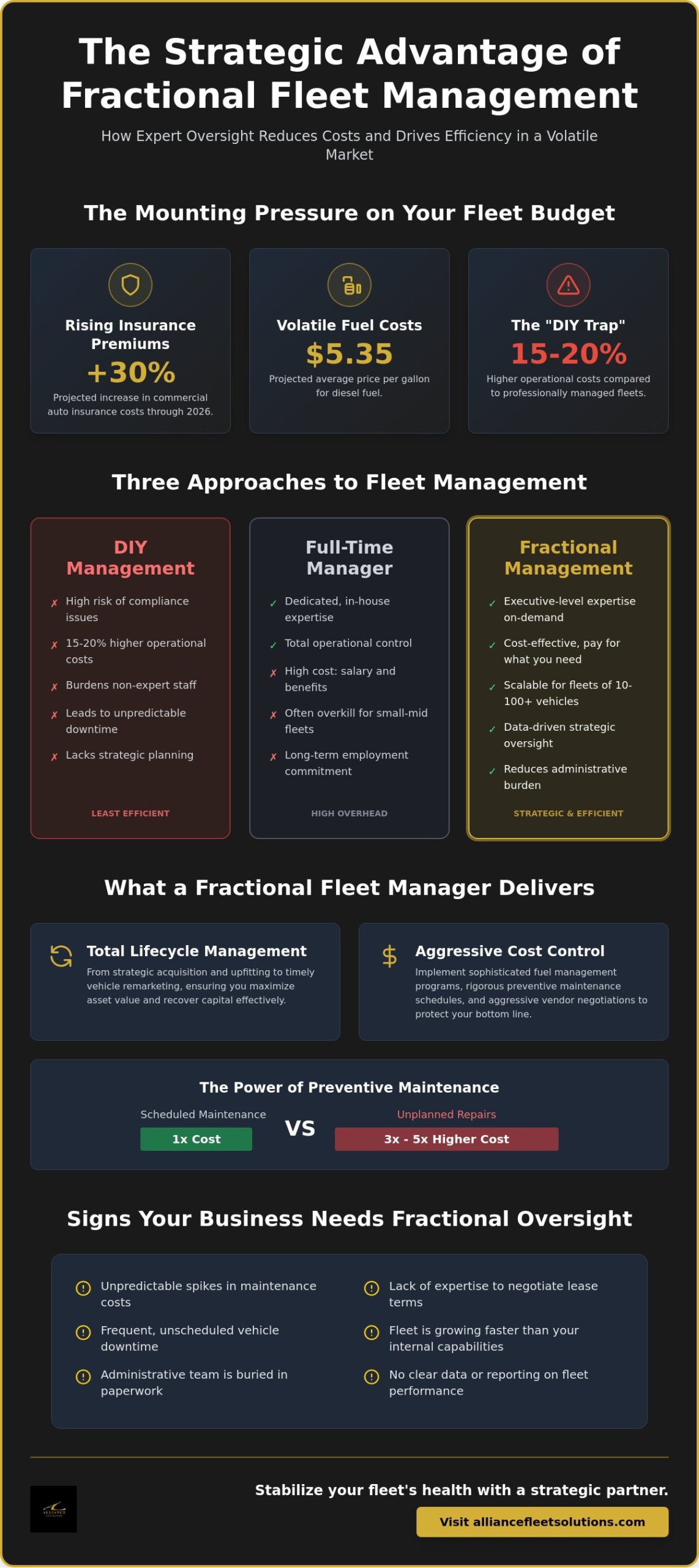
With commercial auto insurance premiums projected to rise by as much as 30% through 2026 and diesel averages hitting $5.35 per gallon, your operational budget is likely under immense pressure. You recognize that managing a fleet requires more than just basic maintenance; it’s a high-stakes game of compliance and cost control. It’s difficult to stay ahead of rising total cost of ownership when your team is already buried in administrative paperwork.
You might be wondering, what does a fractional fleet manager do to solve these specific challenges? This guide demonstrates how fractional management delivers executive-level oversight and vehicle remarketing expertise without the expense of a full-time department head. We’ll show you how this strategic partnership reduces downtime, improves lease terms, and provides the clear, data-driven reporting you need to stabilize your fleet’s health.
Key Takeaways
- Understand what does a fractional fleet manager do to bridge the gap between disorganized DIY operations and the high overhead of a full-time department.
- Discover how expert oversight on a part-time basis can prevent the “DIY Trap,” which often leads to operational costs 15-20% higher than professionally managed fleets.
- Learn to identify the warning signs that your business needs fractional support, such as unpredictable maintenance spikes and frequent, unscheduled vehicle downtime.
- Explore the strategic advantages of professional vehicle acquisition and lifecycle planning to ensure your assets remain efficient and profitable throughout their service life.
- See how a comprehensive partnership can integrate upfitting, maintenance, and remarketing into a single, data-driven framework for better financial performance.
Defining Fractional Fleet Management in 2026
A fractional fleet manager serves as a high-level strategic consultant. They provide the same caliber of oversight as a seasoned executive but on a part-time or project basis. This model allows your business to tap into veteran industry expertise without the burden of a full-time executive salary, benefits, or long-term employment contracts. While a traditional Fleet Management Definition often focuses on the day-to-day coordination of vehicles, the fractional approach prioritizes high-impact strategic areas. These include long-term lifecycle planning, the development of robust safety policies, and aggressive vendor negotiations that protect your bottom line. Fractional fleet management is a scalable, expert-led solution designed for businesses operating 10 to 100+ vehicles that require professional oversight without the commitment of a full-time hire.
The Shift Toward Fractional Operations
The logistics and transport sectors have finally embraced the specialized consulting model that transformed the tech and finance industries. This shift is driven by necessity. With vehicle acquisition costs rising and commercial insurance premiums projected to jump by 30% through 2026, businesses cannot afford to leave fleet decisions to chance. So, what does a fractional fleet manager do to stay ahead? They leverage advanced technology. Modern telematics and GPS solutions allow these experts to monitor your assets remotely. They analyze real-time data to identify inefficiencies, ensuring your fleet remains productive even if the manager is not physically on-site every day. This remote capability makes expert-level consulting accessible to companies that previously thought they were too small for professional management.
Who Benefits Most from the Fractional Model?
Not every company needs a full-time fleet director, but every company with wheels on the road needs professional management. Mid-sized businesses experiencing rapid growth often find their operations outpacing their internal capabilities. Frequently, fleet management becomes a “side job” for an office manager or an operations lead who lacks technical training. This leads to missed maintenance intervals and bloated fuel spending. A fractional manager steps in to audit your current spend and identify immediate leakages. They provide a clear path to recovery for organizations that need to professionalize their operations quickly. By focusing on data-driven reporting and vehicle remarketing, they ensure you aren’t holding onto “aged-out” assets that drain your profits through constant repairs.
If your team struggles to keep up with the administrative burden of vehicle maintenance or lacks the expertise to negotiate better lease terms, the fractional model offers a way out. It provides a supportive, reliable partner who understands the mechanics of the industry and the language of financial performance. You get the expert control you need to alleviate the stress of operational downtime without the fixed costs of a new department head.
Core Responsibilities: What a Fractional Fleet Manager Delivers
If you are evaluating your logistics strategy, you need to know exactly what does a fractional fleet manager do to protect your margins. Their work goes far beyond simple vehicle tracking. They manage Core Fleet Management Responsibilities by focusing on the total lifecycle of every asset. This starts with strategic vehicle acquisition and coordinating professional upfitting. Instead of receiving a stock van that needs weeks of aftermarket work, a fractional manager ensures your vehicles arrive task-ready. This proactive approach eliminates the initial downtime that often plagues growing companies.
The financial impact of this role is most visible in maintenance and fuel oversight. Unplanned repairs can cost 3 to 5 times more than scheduled maintenance; a fractional expert builds a rigorous preventive schedule to avoid these spikes. They also implement sophisticated fuel management programs. With diesel projected to average $5.35 per gallon in June 2026, even a small reduction in idling or better route planning significantly affects your bottom line. By monitoring consumption patterns, they turn fuel from an unpredictable expense into a controlled variable.
Lifecycle Management and Remarketing
Safety, Compliance, and Telematics
Compliance in 2026 is a high-stakes environment. With the FMCSA now levying fines of up to $19,000 for DVIR falsification, you cannot afford paperwork errors. A fractional manager implements telematics and GPS solutions to create a digital trail for every inspection and repair. They develop driver safety policies that do more than just check a box; they actively monitor behavior to reduce risk. This data-driven approach is essential for combatting the 30% rise in insurance premiums seen across the industry. When you demonstrate expert control over your fleet’s safety profile, you gain leverage with underwriters. If you want to see how these strategies apply to your specific operation, exploring a fractional fleet management partnership can provide the clarity you need.
Fractional vs. Full-Time vs. DIY Fleet Management
Many business owners believe they are saving money by assigning fleet duties to an existing staff member. This is the DIY trap. Tasking an office manager or operations lead with complex logistics often leads to 15-20% higher costs due to missed maintenance windows and poor acquisition pricing. While a dedicated department head offers expertise, the salary and benefits packages create a significant financial burden for mid-sized companies. A fractional manager typically costs 30-50% less than a full-time equivalent.
When evaluating what does a fractional fleet manager do compared to a full-time hire, the difference is often found in the flexibility of the engagement. Instead of a fixed salary, you pay for targeted results and specific project oversight. This ensures your management costs scale directly with the value delivered to your bottom line. You gain access to veteran expertise that identifies financial leakages non-experts miss, such as redundant fuel spending or excessive downtime caused by reactive repair habits.
Evaluating the Total Cost of Ownership (TCO)
A professional manager looks beyond the monthly lease payment to the true cost of each vehicle over its entire lifespan. They implement rigorous maintenance management protocols that extend the life of your equipment and preserve resale value. Their expertise in negotiation often results in lower acquisition prices and more favorable leasing terms that an office manager simply cannot access. By reducing unplanned repairs, which research shows cost 3 to 5 times more than scheduled service, they turn your fleet from a volatile cost center into a predictable, manageable asset.
Scalability and Flexibility
Business needs are rarely static. A fractional partnership allows you to adjust management hours based on seasonal peaks, fleet expansions, or special projects like a total telematics rollout. Once a stable efficient fleet operations framework is established, you have the ability to reduce oversight hours. You aren’t just relying on the knowledge of one individual. You are accessing a team of specialists who understand the mechanics of the industry and the language of financial performance. This model provides the expert control required for a high-stakes operation without the rigid overhead of a traditional department.
Identifying the Need: Signs Your Business Is Ready for Fractional Oversight
Operational cracks often begin as minor inconveniences before evolving into systemic failures. You might notice your maintenance costs spiking without warning or find that your vehicles are spending more time in the shop than on the road. These “aged-out” assets are a clear signal that your replacement cycle has collapsed. Without a standardized strategy, you’re likely holding onto vehicles long after they’ve ceased to be profitable. If you find yourself buried under a mountain of registrations, inspections, and compliance paperwork, it’s time to ask: what does a fractional fleet manager do to alleviate this specific administrative burden? They step in to transform that chaos into a predictable, documented system.
Tracking fuel spend and driver behavior across a national footprint is another common pain point. Without centralized data, you can’t see the patterns of idling or aggressive driving that inflate your total cost of ownership. As commercial insurance premiums continue their 30% climb through 2026, the inability to prove safe driving habits becomes a direct financial liability. Professional oversight provides the technical authority needed to implement dash cams and telematics, turning raw data into actionable safety reports that protect your bottom line and your reputation on the road.
The “Threshold” Fleet Size
For most companies, the tipping point occurs when the fleet reaches 10 to 15 vehicles. At this size, the complexity of fuel management programs and maintenance tracking exceeds the capacity of an office manager. With diesel projected at $5.35 per gallon in June 2026, even a 5% inefficiency across a 15-vehicle fleet represents a significant profit leak. Your risk profile also changes at this scale. The 2026 FMCSA digital trail requirements mean that one missing or illegible paper DVIR can lead to fines reaching $19,000. Professional oversight ensures these regulatory traps don’t compromise your operation or lead to costly out-of-service violations.
Operational Friction and Growth Pain
Consider the time your internal staff spends on vehicle issues. If an operations lead or manager dedicates more than 10 hours a week to logistics, you’re facing a massive opportunity cost. That’s time stolen from core business growth and customer service. You might also be losing capital on the back end because you lack a formal vehicle remarketing strategy. Selling assets on a whim usually results in significantly lower returns than a structured, data-driven disposal plan. If your leadership team is acting as a part-time maintenance department, it’s a sign your business is ready for expert support. You can request a fractional fleet assessment to identify exactly where your current process is leaking revenue.
Strategic Partnership with Alliance Fleet Solutions
Alliance Fleet Solutions provides more than just a consulting service. We deliver a comprehensive fractional management framework that acts as the essential backbone of your operation. When businesses ask what does a fractional fleet manager do within our framework, the answer lies in the seamless integration of technical expertise and financial strategy. We move beyond the traditional vendor relationship to form a strategic partnership. This means our goals align directly with yours: reducing total cost of ownership, maximizing vehicle uptime, and ensuring every asset contributes to your profitability.
Our approach consolidates vehicle acquisition, upfitting, and maintenance into a single, streamlined partnership. You no longer have to juggle multiple vendors or manage disparate data streams. Instead, you receive customized reporting that translates complex fleet metrics into clear, actionable business insights. This data-driven oversight allows you to make informed decisions about your fleet health without getting lost in the technical minutiae. We handle the high-stakes logistics so you can focus on scaling your core business; if your growth requires finding specialized talent in the heavy truck or construction industries, check out SourceLine.
The Alliance Approach to Fractional Management
We leverage a national network to provide consistent maintenance and remarketing support, regardless of where your vehicles are stationed. A critical part of this process is professional upfitting. We ensure that every vehicle is task-ready the moment it hits your lot, eliminating the weeks of aftermarket delays that often stall new acquisitions. By applying data-driven lifecycle planning, we help you exit assets at the precise moment their value is maximized. This proactive management is the only way to combat the 30% rise in insurance premiums and the volatility of $5.35 per gallon diesel projected for June 2026.
Taking the First Step Toward Efficiency
Transitioning from a DIY model to professional oversight doesn’t have to cause operational disruption. We begin with an initial fleet audit to identify immediate areas for cost reduction and safety improvements. During this phase, we establish clear Key Performance Indicators (KPIs) tailored to your specific goals, such as reducing unscheduled repairs or improving fuel economy. This structured onboarding process ensures that the transition is smooth and that the value of the partnership is visible from day one. If you’re ready to see exactly what does a fractional fleet manager do to transform your bottom line, a comprehensive audit is the most effective way to start. We provide the expert control you need to alleviate operational stress and secure your fleet’s long-term reliability.
Securing Your Fleet’s Financial Future
Professionalizing your vehicle operations is no longer a luxury reserved for massive corporations. By shifting from a reactive DIY model to proactive lifecycle planning, you stabilize your total cost of ownership and eliminate the stress of unpredictable maintenance spikes. You gain access to national service coverage and veteran expertise that ensures every asset, from initial acquisition to final remarketing, contributes to your bottom line. Understanding what does a fractional fleet manager do is the first step toward reclaiming your time and protecting your margins from rising industry costs.
As a family-owned and operated partner, we focus on delivering a high business ROI through expert control and reliable oversight. We handle the technical complexities of upfitting and compliance so you can focus on growth. It’s time to transition your fleet from a source of frustration into a strategic business asset. Optimize your fleet operations with our Fractional Fleet Management services. We look forward to building a dependable partnership that keeps your business moving forward safely and efficiently.
Frequently Asked Questions
How much does a fractional fleet manager cost compared to a full-time hire?
A fractional fleet manager typically costs 30-50% less than a full-time department head because you pay for targeted expertise rather than a full salary and benefits package. This model allows mid-sized businesses to access executive-level strategy on a part-time basis. You avoid the fixed overhead of a dedicated hire while gaining a partner who identifies enough operational savings to pay for their own service.
Can a fractional fleet manager help with vehicle upfitting?
Yes, a fractional manager coordinates professional upfitting to ensure every vehicle is task-ready the moment it arrives at your facility. They manage the technical logistics of shelving, safety equipment, and specialized branding with veteran vendors. This proactive oversight eliminates the weeks of initial downtime that often occur when stock vehicles sit in a lot waiting for aftermarket work to be scheduled.
What is the difference between fleet management software and a fractional manager?
Fleet management software is a tool that collects data, but a fractional manager is the expert who interprets that data to make strategic decisions. While software tracks metrics like fuel use or maintenance alerts, the manager uses those insights to negotiate lease terms, develop safety policies, and plan replacement cycles. The software provides the data, while the manager provides the technical authority to drive ROI.
How many vehicles do I need to justify a fractional fleet manager?
Most businesses find that a fleet of 10 to 15 vehicles is the tipping point where DIY management begins to fail and professional oversight becomes necessary. At this scale, the administrative burden of compliance and maintenance management becomes too complex for non-specialized staff to handle effectively. Fractional support provides the necessary control for growing operations without requiring a massive fleet to justify a full-time executive.
Does a fractional fleet manager handle vehicle remarketing and sales?
Yes, handling vehicle remarketing is a core responsibility that ensures you recover the maximum possible capital from “aged-out” assets. The manager identifies the financial “sweet spot” for replacement, ensuring you exit a vehicle before repair costs exceed its resale value. They leverage a national network to find the best disposal channels, turning vehicle sales from a secondary chore into a strategic financial recovery.
Will a fractional manager help with DOT compliance and safety audits?
A fractional manager ensures your operation meets all 2026 FMCSA digital trail requirements, including electronic DVIRs and verifiable mechanic signatures. They help you avoid civil penalties that can reach $19,000 per violation by implementing rigorous audit transparency. When you ask what does a fractional fleet manager do for safety, their primary goal is protecting your business from the legal and financial risks of non-compliance.
How does telematics play a role in fractional fleet management?
Telematics and GPS solutions act as the primary data source, allowing a fractional manager to monitor driver behavior and vehicle health remotely. They use these insights to reduce fuel consumption, which research shows typically drops by 10-15% within the first year of professional oversight. This technology enables the manager to provide precise, data-driven reporting on fleet health and safety regardless of your company’s physical location.
Is fractional fleet management a long-term or short-term solution?
Fractional fleet management is a flexible solution that can serve as either a long-term strategic partnership or a short-term project to stabilize your operations. Some businesses use these services indefinitely to maintain expert control at a lower cost than a full-time department. Others engage a manager to build a stable framework and then reduce hours once the fleet’s health and compliance standards are fully optimized.