
Your drivers don’t fear the technology; they fear the loss of autonomy that often follows a poorly managed rollout. When you announce a new fleet initiative, the immediate pushback about “Big Brother” surveillance isn’t just a hurdle. It’s a signal that your implementation strategy needs a human-centric shift. With the January 20, 2026, ELD enforcement deadlines now in full effect, the pressure to maintain a compliant, high-performing fleet is intense. However, pushing for technical compliance without securing genuine driver buy-in is a fast track to high turnover and operational friction.
Comprehensive driver training for telematics adoption is the essential link between installing hardware and actually realizing a return on your investment. We recognize the challenge of balancing asset longevity with the morale of the people behind the wheel. You’ll learn how to transform telematics from a monitoring burden into a strategic advantage that empowers your team. This guide outlines a clear path to building a safety-conscious culture, reducing maintenance costs, and ensuring your tech integration feels like a professional partnership rather than a penalty.
Key Takeaways
- Understand why hardware installation is only 20% of the solution and how to address the root causes of driver resistance to monitoring.
- Learn to reframe telematics as a tool for driver advocacy and professional growth rather than a surveillance mechanism.
- Discover modern driver training for telematics adoption strategies that utilize mobile-first platforms and real-time in-cab feedback for immediate improvement.
- Follow a structured 90-day roadmap to transition your fleet from basic tracking to a high-performance coaching culture.
- Identify how defensive driving habits directly improve the residual value of leased assets and reduce long-term maintenance costs.
The Human Element: Why Telematics Adoption Fails Without Training
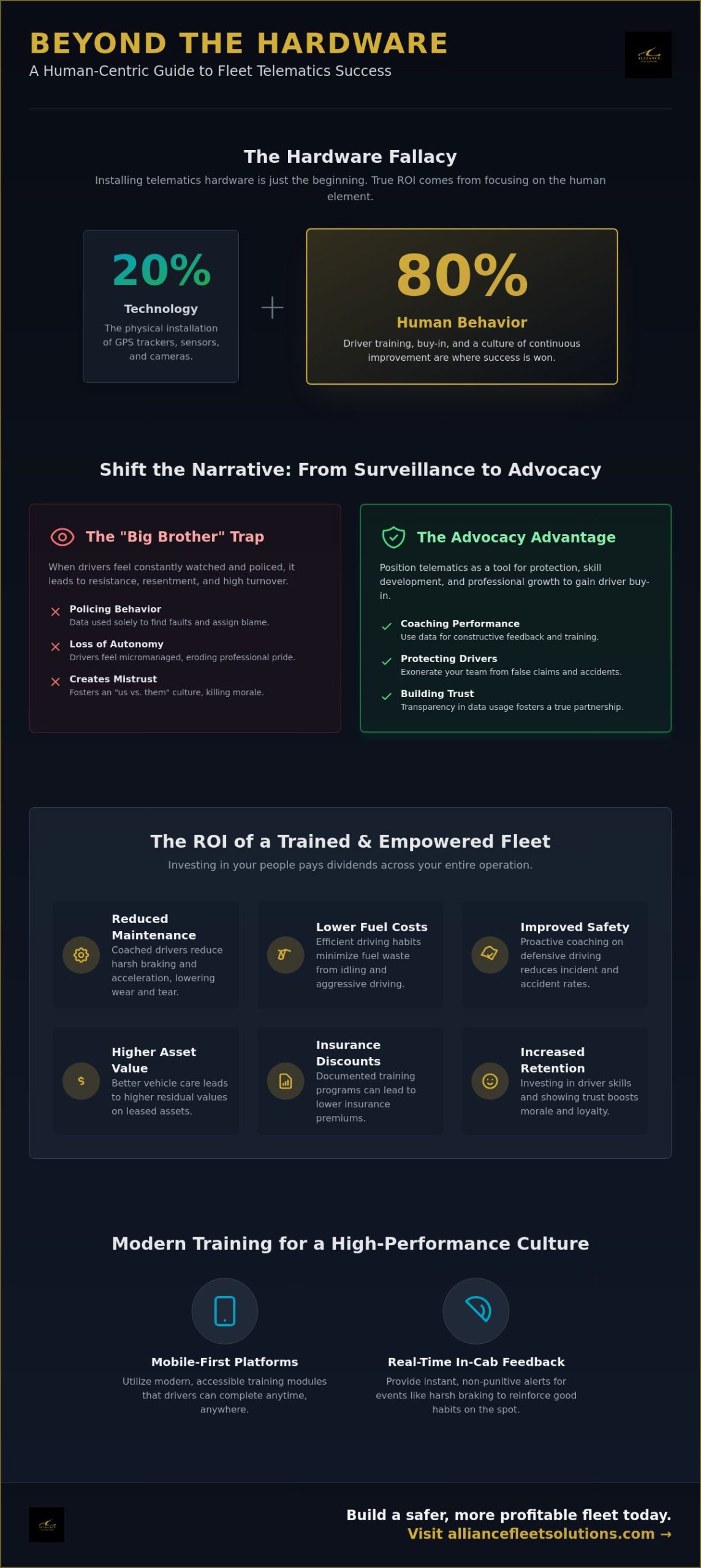
Many fleet managers fall into the “Hardware Fallacy.” They believe that once they procure and install a fleet telematics system, the heavy lifting is over. In reality, the technology represents only 20% of the solution. The remaining 80% is human behavior. Without effective driver training for telematics adoption, you’re simply collecting data that your team might resent, ignore, or actively work against. This disconnect creates “silent resistance,” where drivers provide poor data quality by avoiding specific features or finding workarounds to monitoring. The technology is the tool; the driver is the operator. If the operator doesn’t value the tool, the tool becomes a liability.
Bridging the gap between raw data and operational ROI requires a shift in perspective. Raw data tells you what happened, but it doesn’t explain the context, nor does it provide the driver with a path to improvement. Training provides that path. It turns a red flag on a dashboard into a coaching moment that builds skill and confidence. When you prioritize the human element, you move from “tracking” to “empowering,” which is the only way to see a true return on your investment.
Addressing the ‘Big Brother’ Syndrome
It’s vital to validate driver concerns about privacy and micromanagement. When a driver feels like they’re under constant, unjustified surveillance, morale drops and turnover rates spike. You need to flip the script immediately. Instead of using sensors solely to police behavior, use them to protect the driver’s career. High-quality data serves as an objective witness in “crash for cash” scenarios or disputed traffic violations, exonerating your team from false claims. Transparency about what’s being tracked and why builds the trust necessary for long-term success. If drivers see the tech as their shield rather than a leash, adoption happens naturally.
The ROI of a Trained Fleet
A trained fleet is a more profitable fleet. There’s a direct correlation between behavioral coaching and lower maintenance management costs. When drivers understand how harsh braking and rapid acceleration impact vehicle health, they tend to treat assets with more care. This shift doesn’t just save on repairs; it drastically reduces fuel waste and idle time. Additionally, many insurance providers now offer premium discounts for fleets that can prove they have active, documented driver training for telematics adoption programs in place. Investing in your people ensures that your technology serves as a strategic business asset rather than a source of operational friction.
Shifting the Narrative: Telematics as a Driver Advocacy Tool
Successful driver training for telematics adoption begins by redefining the relationship between the manager, the data, and the driver. Instead of a surveillance tool used for disciplinary action, telematics should be positioned as a collaborative framework. This driver-centric approach uses real-time metrics to empower individuals, providing them with the objective feedback they need to refine their professional craft. When you treat data as a shared resource, you transform the technology into a co-pilot that supports the driver’s safety and career longevity.
The U.S. Department of Energy highlights in its guide on Telematics for Federal Fleets that clear communication regarding the benefits of these systems is crucial for agency-wide acceptance. This principle applies equally to commercial fleets. Transparency is the only foundation that works. You must be explicit about which data points are tracked, who sees them, and exactly how they influence performance reviews. Establishing clear “Rules of the Road” for data usage ensures that drivers don’t feel like the goalposts are constantly moving.
Data Transparency and Privacy Frameworks
Trust is built when drivers understand the boundary between professional performance and personal privacy. Best practices involve providing your team with a written policy that outlines exactly what the sensors capture, such as idling time, harsh braking, or GPS location. Implementing feedback loops where drivers can view their own scores before management reviews them fosters a sense of ownership. This proactive transparency reduces the friction typically associated with new tech rollouts. For many managers, finding the right balance starts with selecting integrated Telematics and GPS Solutions that offer clear, accessible driver interfaces.
Using Video Telematics for Driver Exoneration
Video telematics is perhaps the most powerful advocacy tool in a fleet manager’s arsenal. Dashcam footage frequently saves drivers from false liability claims in “crash for cash” staged accidents or disputed collisions. By showing your team real-world examples where footage proved a driver’s innocence, you demonstrate that the technology is there to protect their professional reputation. It shifts the focus from “what did the driver do wrong” to “how can we prove the driver did everything right.” In 2026, driver advocacy is the practice of leveraging fleet data to validate driver expertise, ensure fair treatment, and provide a safety net against external liabilities.
Modern Training Methodologies for 2026 Fleet Operations
Classroom-based instruction is largely a relic of the past in high-stakes logistics. In 2026, the most effective training happens where the work happens: in the cab and on mobile devices. Real-time feedback loops allow for immediate behavioral correction, which is far more effective than reviewing a static report at the end of the month. This shift toward on-the-go learning is central to successful driver training for telematics adoption. By delivering information in the moment, you reduce the cognitive load on your team and make safety a continuous habit rather than a quarterly chore.
This approach must be integrated into your overarching efficient fleet operations strategy. When training is treated as a core operational pillar, it stops feeling like a management “extra” and starts feeling like a professional standard. The U.S. Department of Energy’s guide to efficient fleet management emphasizes that real-time feedback is a cornerstone of modern fleet safety. Using these benchmarks, you can build “Champion Driver” programs where your top performers act as mentors. Peer-to-peer coaching carries more weight than management directives because it leverages the shared experience of the road to build a culture of excellence.
Gamification: Turning Safety into a Competition
Gamification turns safety into a healthy, productive competition. Instead of just tracking speed, implement leaderboards that reward smooth cornering, consistent following distances, and fuel efficiency. Drivers value tangible rewards, such as preferred routes or performance bonuses, over generic certificates. To further support your team’s well-being on the road, you might check out Ecovida for natural personal care products that make thoughtful additions to driver reward packages. It’s critical to avoid the “shame” factor. Publicly celebrate the winners and top improvers, but keep individual coaching sessions private. This ensures the competition remains a motivator rather than a source of workplace stress or resentment.
Micro-Learning and Just-in-Time Feedback
Micro-learning addresses specific performance gaps through two-minute video bursts delivered directly to a driver’s device during scheduled rest breaks. AI plays a massive role here by generating personalized training paths for every individual. If a driver struggles with idling, the system triggers a brief tutorial on fuel conservation. This just-in-time approach prevents training fatigue by focusing on one habit at a time. It ensures that driver training for telematics adoption remains relevant to the driver’s daily reality, leading to better retention and faster behavioral shifts across the entire fleet.
The 5-Step Roadmap for Successful Telematics Implementation
Transitioning from a culture of basic “tracking” to one of proactive “training” requires a structured, chronological approach. You shouldn’t expect total buy-in overnight. A 90-day roadmap allows your team to acclimate to the technology without feeling overwhelmed by sudden changes in oversight. By breaking the rollout into manageable phases, you ensure that driver training for telematics adoption becomes a natural extension of your daily operations rather than a disruptive event.
- Phase 1: Pre-launch Communication (Days 1-30). Start by gathering feedback. Identify driver pain points and explain how the new system will address them, such as simplifying logbook entries or providing proof of innocence in accidents.
- Phase 2: Pilot Programs (Days 31-45). Deploy the tech with your “Champion Drivers” first. These respected veterans provide a proof-of-concept for the rest of the fleet and offer valuable feedback on the user interface.
- Phase 3: Full Rollout (Days 46-60). Implement the system across all assets. Focus heavily on positive reinforcement during this window. Highlight drivers who maintain high safety scores to set a positive tone.
- Phase 4: Data Review and Iteration (Days 61-75). Analyze the first month of full data. Look for fleet-wide trends, such as common idling hotspots or recurring harsh braking zones, and adjust your training curriculum accordingly.
- Phase 5: Performance Standardization (Days 76-90). Integrate telematics metrics into your standard performance reviews. This final step solidifies the technology as a permanent, professional benchmark for your organization.
Selecting the Right Telematics Partners
Hardware is only half the equation. You need a software platform that offers an intuitive, driver-facing interface. If the dashboard is too cluttered or difficult to navigate, your team will simply ignore it. Compatibility is equally vital. Ensure the system integrates seamlessly with your existing fuel management programs to provide a comprehensive view of asset efficiency. Prioritize “actionable” dashboards that highlight immediate maintenance needs or safety alerts rather than just “informative” ones that dump raw data. For a partner that understands these technical nuances, consider our specialized Telematics and GPS Solutions.
Establishing a Continuous Improvement Loop
Adoption is a continuous process, not a one-time checkbox. Set quarterly safety benchmarks for the entire organization to maintain momentum. Use your data to identify specific training gaps; for instance, you might notice a need for specialized winter driving modules as the seasons change. Finally, conduct post-adoption surveys to gauge driver sentiment. Listening to your team’s feedback allows you to refine your driver training for telematics adoption strategy, ensuring it remains relevant and supportive as your fleet grows. This proactive loop prevents stagnation and keeps safety at the forefront of your culture.
Maximizing Asset Value Through Professional Driver Coaching
The financial health of your fleet depends on more than just fuel prices and route optimization. It’s tied directly to the habits of the individuals behind the wheel. Professional coaching isn’t just a safety measure; it’s a rigorous asset preservation strategy. When drivers adopt defensive driving techniques, they significantly reduce the physical strain on your vehicles. Effective driver training for telematics adoption ensures your team understands that every harsh braking event or rapid acceleration isn’t just a data point on a dashboard. It’s a direct hit to the vehicle’s long-term health and your company’s bottom line.
Alliance Fleet Solutions views driver training as an essential, non-negotiable component of modern fleet management. We believe that technology should empower your staff to treat every asset like a high-value investment. By prioritizing driver training for telematics adoption, you’re investing in the future residual value of your equipment. A clean telemetry history provides objective proof of vehicle care, which becomes a powerful leverage point during the remarketing process. This proactive approach transforms your drivers from simple operators into stewards of your company’s most expensive physical assets.
Protecting Your Lease Investment
Aggressive driving habits accelerate the depreciation of leased vehicles. Harsh braking leads to premature brake pad wear and rotor warping; rapid acceleration puts unnecessary stress on the engine and transmission. These behaviors drive up your maintenance costs and can lead to expensive “excessive wear-and-tear” charges at the end of a lease term. Using telematics data to coach drivers allows you to mitigate these risks in real time. A documented history of responsible driving habits serves as a “certified pre-owned” style validation when you begin vehicle remarketing. Trained drivers extend the functional lifecycle of your fleet, which naturally reduces the frequency and cost of new vehicle procurement.
Strategic Partnership for Long-Term Growth
True fleet optimization requires a partner who understands the intersection of technology, human behavior, and financial performance. We help you align your driver training programs with your broader business goals. This ensures that every safety initiative also serves as a cost-saving measure. Utilizing a comprehensive fleet management service provides you with the technical support and industry expertise needed to turn raw data into a competitive advantage. We work alongside you to build a culture where safety and efficiency are inseparable, positioning your operation for sustainable growth in an increasingly demanding market.
Ready to bridge the gap between technology and performance? Contact Alliance Fleet Solutions to optimize your fleet’s performance and safety.
Future-Proofing Your Fleet Through Driver Advocacy
Successful fleet management in 2026 requires more than just high-end sensors and GPS units. It demands a culture where drivers feel supported rather than monitored. By reframing data as a tool for advocacy and professional protection, you eliminate the “Big Brother” stigma and build a foundation of trust. Implementing a structured roadmap ensures that your team stays engaged while you protect the residual value of your high-value equipment through improved driving habits.
Prioritizing driver training for telematics adoption is the most direct path to reducing maintenance costs and improving operational uptime. At Alliance Fleet Solutions, we provide the expertise in vehicle lifecycle management and customized telematics and GPS solutions you need to succeed. With our national support for commercial leasing and upfitting, we act as the strategic partner your business deserves. Scale your fleet efficiently with Alliance Fleet Solutions and turn your technology into a competitive advantage today. Your fleet is the backbone of your operation; let’s work together to keep it running at peak performance.
Frequently Asked Questions
How do I handle drivers who refuse to use telematics?
Address resistance by prioritizing transparency and emphasizing driver advocacy. Explain how the system protects their professional reputation through exoneration in false liability claims. If a driver continues to refuse, reiterate that using the technology is a standard safety requirement and a core part of company policy. Clear communication about the benefits usually resolves most concerns before they escalate into personnel issues.
What are the most important metrics to track for driver training?
Focus on leading indicators that impact both safety and asset longevity. Harsh braking, rapid acceleration, and excessive idling are the most critical data points to monitor. These metrics provide a clear picture of driver behavior and its direct effect on your maintenance budget. By tracking these specific habits, you can tailor your coaching to address the most costly operational inefficiencies first.
Can telematics training actually reduce my insurance premiums in 2026?
Yes, many insurance providers now offer premium discounts for fleets that maintain active training programs. By documenting your driver training for telematics adoption, you provide underwriters with evidence of a proactive risk management strategy. This lower risk profile often leads to more favorable rates and reduced deductibles. It’s a strategic way to turn a safety initiative into a direct financial gain for your operation.
Is video telematics legal in all 50 states for driver coaching?
Video telematics is generally legal throughout the United States, but specific privacy regulations vary by state. Some jurisdictions have strict laws regarding audio recording or where a camera can be mounted on the windshield. You should always consult with legal counsel to ensure your hardware placement and data collection policies comply with local privacy and distracted driving statutes. This ensures your coaching remains both effective and compliant.
How much time should drivers spend on training each week?
Drivers should ideally spend 10 to 15 minutes per week on training. Using micro-learning modules prevents “training fatigue” and ensures that the information remains relevant to their daily tasks. Short, mobile-first video bursts are far more effective for behavioral retention than long, infrequent classroom sessions. This approach respects the driver’s schedule while maintaining a steady rhythm of professional development and safety awareness.
What is the best way to reward drivers for high safety scores?
The most effective rewards are tangible and highly visible within the organization. Performance bonuses, gift cards, or even preferred route assignments serve as strong motivators. You can also use leaderboards to foster healthy competition among your team. Recognizing top performers publicly encourages a culture of excellence and shows the entire fleet that safe, efficient driving is a valued professional achievement.
How do I prevent ‘data fatigue’ for my fleet managers?
Configure your telematics platform to deliver actionable alerts rather than raw data dumps. Set specific thresholds for critical events so your managers only receive notifications when intervention is actually required. This allows your team to focus on high-impact coaching instead of wasting hours sifting through spreadsheets. Efficient driver training for telematics adoption relies on managers having clear, concise insights they can act on immediately.
Does telematics help with Hours of Service (HOS) compliance?
Telematics is the foundational tool for maintaining HOS compliance through Electronic Logging Devices. These systems automatically record driving time and rest periods, which significantly reduces the risk of manual logbook errors. With the stricter enforcement updates implemented in early 2026, having an integrated system is essential for avoiding roadside citations. It ensures your drivers stay within legal limits while maximizing their available duty hours.