
Most fleet technology failures aren’t caused by faulty software or hardware; they’re caused by the people expected to use them. With freight demand facing a 7.8% decline in 2026, the pressure to optimize every mile is intense, yet many managers find that change management for fleet technology implementation is the most difficult hurdle to clear. You’ve likely felt the tension of balancing new FMCSA data-centric requirements with a driver pool that’s wary of surveillance. It’s a high-stakes environment where technical debt and operational downtime during installs can quickly erode your bottom line.
You don’t have to choose between advanced efficiency and driver retention. This guide shows you how to overcome resistance and maximize ROI when deploying new telematics, software, and hardware across your commercial fleet. We’ll explore strategies to ensure high adoption rates and seamless integration with your existing maintenance and fuel programs. By the end, you’ll have a clear roadmap to handle 2026 regulations while building a more resilient, tech-forward operation.
Key Takeaways
- Eliminate the risk of “shelfware” by ensuring every technical investment is matched with a clear strategy for daily driver adoption and operational use.
- Overcome cultural resistance by utilizing a professional approach to change management for fleet technology implementation that directly addresses driver privacy and “big brother” concerns.
- Coordinate software training with driver-centric hardware upfitting to prevent technical debt and minimize vehicle downtime during the deployment phase.
- Apply a structured roadmap that prioritizes stakeholder alignment across the entire organization, from the executive office to the shop floor.
- Leverage fractional fleet management to access the specialized expertise required for complex technology rollouts without the cost of a full-time permanent hire.
- For organizations looking to build long-term internal capacity, Hanson Search specializes in recruiting the executive leadership necessary to champion complex change management and digital transformation.
The Strategic Importance of Change Management in 2026
In the heavy-duty logistics sector, the gap between purchasing a solution and realizing its value is often bridged by a single factor: human behavior. We define change management as the vital link between technical capability and operational reality. Without a structured approach, even the most sophisticated telematics system remains nothing more than “shelfware,” which is technology that is paid for but never utilized. In 2026, where mid-range systems cost between $25 and $45 per vehicle every month, allowing features to sit idle is a direct drain on your capital. Effective change management for fleet technology implementation ensures that your investment actually moves the needle on your bottom line rather than just adding to your monthly overhead.
Modern 2026 trends, specifically AI-integrated telematics and predictive maintenance, require a higher level of trust than the basic GPS systems of the past. Drivers are no longer just being “tracked”; they are being analyzed by AI cameras and behavior sensors. This shift demands a transparent communication strategy to prevent the “big brother” stigma from driving away your best talent. When handled correctly, these tools become the backbone of efficient fleet operations, providing the data needed to maximize uptime and protect your margins in a market where freight demand is under pressure.
Calculating the ROI of Proper Adoption
The financial difference between 100% adoption and 40% adoption is staggering. A fleet operating at 40% adoption misses the critical mass of data required to trigger predictive maintenance alerts or identify fuel fraud. This leads to hidden costs like sudden equipment failure and increased driver turnover. If your team views new tech as a burden, they’ll find ways to bypass it, creating data gaps that make your reports unreliable. Implementation ROI is a direct factor of the speed of adoption and the proficiency of the users. By focusing on the human element, you reduce the time it takes to see a return on your hardware and software spend.
The 2026 Tech Landscape: Beyond Simple GPS
The industry has moved far beyond simple location tracking. Today, fleet management services utilize predictive maintenance and integrated fuel programs to provide proactive assistance to drivers. Instead of a manager calling to ask why a truck is stopped, the system alerts the driver to a nearby service center for a looming engine issue. This changes the driver-manager relationship from one of surveillance to one of partnership. However, managing the complexity of multi-platform integration requires a steady hand. You must ensure that your SaaS tools, hardware installs, and maintenance schedules work in a unified flow rather than as competing silos of information.
Overcoming Resistance: The Human Element of Fleet Tech
The success of any rollout depends on the willingness of the people behind the wheel. Even the most advanced hardware becomes a liability if the staff rejects it. Effective change management for fleet technology implementation requires a deep understanding of why resistance happens. We categorize this pushback into two distinct types: technical resistance and cultural resistance. Technical resistance is a lack of skill, which you can fix with training. Cultural resistance is a lack of will, which is far more dangerous to your ROI. If your drivers don’t believe the technology benefits them, they’ll simply find ways to work around it.
The primary hurdle in 2026 remains the “Big Brother” stigma. Drivers often view AI cameras and telematics as tools for punitive monitoring rather than operational support. To bridge this gap, managers must identify “Driver Champions.” These are respected peers who can advocate for the technology’s benefits. When a fellow driver explains how a system saved their CDL during a “no-fault” accident, the message carries more weight than any corporate memo. Transparent fuel management programs also play a role here. By providing accurate data on fuel spend and efficiency, you remove the guesswork and build a culture of accountability based on facts rather than suspicion.
Addressing the “Surveillance” Stigma
Framing is everything. Instead of focusing on monitoring mistakes, position telematics as a safety and exoneration tool. Show drivers how the data protects them from false claims and road incidents. Clear data privacy policies are non-negotiable during the implementation phase. Drivers need to know exactly who sees the footage and how it is used. Shift your strategy from punitive tracking to incentive-based performance. Reward high safety scores and fuel-efficient driving to turn the technology into a tool for professional growth. If you need help structuring these incentives, our fractional fleet management experts can help align your technology with your company culture.
Feedback Loops and Two-Way Communication
Listening must happen before procurement. If you buy software without consulting the people using it, you’re inviting failure. Use the “listening” phase to identify specific pain points on the road. This feedback should directly influence your hardware choices and professional upfitting. If a driver finds a tablet mount intrusive or a software interface clunky, they’ll resent the tool. Finally, create a “no-fault” learning period. Allow your team to experiment with new systems for 30 to 60 days without fear of disciplinary action. This builds confidence and ensures that by the time full compliance is required, the team is proficient and comfortable.
Hardware vs. Software: A Unified Implementation Framework
Purchasing a top tier SaaS platform is only half the battle. If the physical installation of the hardware is poorly executed, your software training will fail before it even begins. Drivers interact with the physical tools in their cab every second of their shift. If a tablet mount is unstable or a camera obscures their line of sight, they will view the new technology as a hindrance rather than a help. Successful change management for fleet technology implementation requires a dual focus on the digital interface and the physical workspace. You must treat the cab as a professional office where every piece of hardware is placed with intent and ergonomic precision.
Managing the downtime required for these installs is a major pain point for logistics managers. To minimize the impact on your revenue, you should coordinate these upgrades with your existing maintenance management schedule. Installing telematics or ELD hardware during a routine PM service ensures the vehicle isn’t pulled from the line twice. This proactive approach respects the fast paced nature of the industry and demonstrates to your team that you value their time and operational capacity. When hardware and software rollouts are synchronized, the transition feels like a planned evolution rather than a disruptive event.
The Physical Side of Tech: Upfitting for Adoption
Ergonomics play a massive role in how quickly a team accepts new tools. High quality truck upfitting ensures that in-cab technology doesn’t interfere with operational safety or driver comfort. Custom mounting and dedicated power solutions prevent the “clutter” of loose wires and temporary brackets, which often lead to hardware failure and driver frustration. When the vehicle configuration feels professional and integrated, driver satisfaction increases. They see the investment as a commitment to their safety and professional status, which naturally lowers the barriers to adoption.
Software Integration and Data Silos
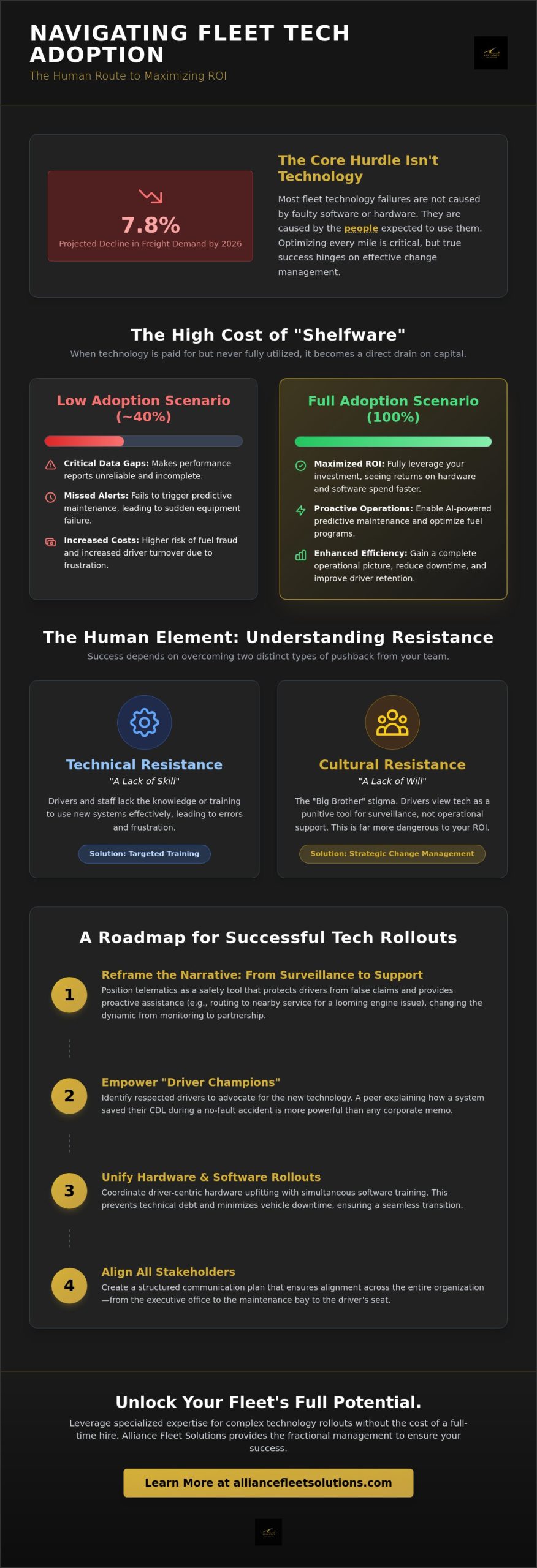
A 5-Step Roadmap for Successful Fleet Tech Rollouts
A successful deployment requires more than just a purchase order. It demands a logical, steady progression from theory to practice. Following a structured roadmap ensures that change management for fleet technology implementation remains manageable and measurable. This process protects your capital and prevents the operational chaos that often accompanies poorly planned transitions. By moving through these five stages, you build the trust and technical proficiency necessary to handle the high stakes of the 2026 logistics market.
- Step 1: Discovery & Needs Assessment. Identify the specific hardware and software requirements that align with your operational goals. Don’t buy features you won’t use.
- Step 2: Stakeholder Alignment. Secure buy-in from everyone, from the C-suite to the shop floor. Everyone should understand how the tech makes their job safer or more efficient.
- Step 3: Pilot Program. Test the system in a controlled, low-risk environment before a full-scale launch.
- Step 4: Phased Rollout. Avoid the “Big Bang” failure. Deploy in waves to allow your support team to handle questions without being overwhelmed.
- Step 5: Review & Optimization. Use real-world data to refine your workflows and ensure you’re hitting your ROI targets.
The Discovery Phase: Beyond the Sales Pitch
Vetting vendors in 2026 requires looking beyond basic functionality. You need partners who offer AI-integrated telematics and robust predictive maintenance support. Define clear KPIs for the implementation before the first device is installed. This might include a specific percentage reduction in fuel costs or a documented improvement in maintenance uptime based on your historical averages. To get the most honest results, your pilot groups should include your most skeptical drivers. If the system wins them over, the rest of the fleet will follow with much less resistance because the solution has been “field-tested” by one of their own.
Training and Sustenance
A single webinar isn’t enough to change long-term behavior. Ongoing support and micro-learning modules keep the technology top of mind without overwhelming your staff. Consider using gamification to turn efficiency metrics into a friendly competition among drivers. Linking tech usage to safety and performance bonuses provides a tangible reason for drivers to engage with the system. Effective change management for fleet technology implementation doesn’t end at the launch; it requires a commitment to long-term sustenance. If you’re struggling to build this framework internally, our team offers fractional fleet management to provide the expert oversight your rollout needs to succeed.
Partnering for Progress: The Fractional Management Advantage
Internal logistics teams often hit a wall when attempting a large scale tech rollout. Their primary focus remains on daily operations, which leaves little bandwidth for the intensive demands of change management for fleet technology implementation. This process isn’t a “set it and forget it” task. It requires constant monitoring, one on one driver engagement, and rapid troubleshooting. When your existing staff is already stretched thin, the human element of the transition is usually the first thing to suffer. This leads to the “shelfware” problem mentioned earlier, where expensive tools sit idle because no one has the time to champion their use.
Fractional fleet management provides a high level solution to this resource gap. You gain access to seasoned expert oversight without the financial burden of a full time permanent headcount. An objective third party also serves as a vital mediator in tech related disputes. When drivers feel that new surveillance tools are a personal attack, a fractional partner provides a neutral, data driven perspective. They can explain the business value and safety benefits from an industry wide standpoint, which often carries more weight than internal directives. Alliance Fleet Solutions acts as this essential backbone, positioning itself as a supportive partner in your nationwide implementation strategy.
Outsourcing the Implementation Burden
Choosing a turnkey solution simplifies the entire lifecycle of your fleet. We handle the heavy lifting of vendor coordination, ensuring that your vehicle acquisition and professional upfitting occur in a synchronized timeline. This integrated approach reduces the total cost of ownership by eliminating the technical debt caused by mismatched hardware and software. By managing the implementation from start to finish, we allow your internal team to focus on their core competencies while we ensure that every new device is installed, tested, and accepted by your field staff. We take the stress out of deployment so you can focus on moving freight.
Building a Future-Proof Fleet
The technology you deploy in 2026 must remain viable as the industry moves toward 2030 and beyond. This requires a tech stack that is modular and scalable. Flexible leasing structures, such as open end leasing, allow you to swap out vehicles as technology cycles evolve, preventing you from being locked into obsolete hardware. We help you design a roadmap that accounts for rapid innovation in AI and electrification, ensuring your fleet remains competitive. If you’re ready to secure your operational future, optimize your fleet implementation with Alliance Fleet Solutions and turn technical challenges into strategic business assets.
Securing Your Fleet’s Digital Future
Deploying new technology in 2026 is no longer a matter of simple installation. It’s a strategic shift that requires your team to trust the data as much as they trust their vehicles. By prioritizing the driver experience and synchronizing your hardware upfitting with software training, you eliminate the friction that leads to technical debt. A structured roadmap ensures that your transition is logical and measurable, protecting your capital from the risks of poor adoption and operational downtime.
Successful change management for fleet technology implementation often requires more bandwidth than internal teams can provide. You need a partner who understands both the mechanics of the heavy-duty industry and the nuances of financial performance. With our expert fractional fleet management and national service coverage, we handle the heavy lifting of your rollout. We provide custom professional upfitting solutions that ensure your technology is a strategic asset rather than a daily distraction for your drivers.
Partner with Alliance Fleet Solutions for a seamless technology transition and build a more resilient, tech-forward operation today. We’re ready to help you navigate the complexities of the 2026 landscape with confidence and expert control.
Frequently Asked Questions
What is the most common reason fleet technology implementations fail?
Most implementations fail because they ignore the human element. While managers focus on technical specs, drivers often feel targeted by what they perceive as “big brother” surveillance. Without a clear strategy for change management for fleet technology implementation, the workforce may find workarounds or bypass systems entirely. Success requires aligning the technology with the daily operational reality of the people behind the wheel.
How long does a typical fleet technology rollout take?
A standard rollout typically spans three to six months depending on fleet size and complexity. This timeline accounts for the initial discovery phase, hardware installation during scheduled maintenance, and the necessary training periods. Rushing this process often leads to technical debt and poor data quality. A steady, logical pace allows your team to troubleshoot minor issues before they become systemic failures.
How can I convince my drivers that telematics is for their safety?
You must frame telematics as a tool for driver exoneration. Show your team real-world examples of how camera footage and sensor data protect their CDL during “no-fault” incidents. When drivers realize the system provides an objective record of their professional performance, it shifts the narrative from punitive monitoring to proactive protection. Transparent data policies ensure everyone understands that the technology supports safe operations.
Is it better to roll out new tech all at once or in phases?
Phased rollouts are significantly more effective than “big bang” implementations. Deploying in waves allows your internal support team or fractional partner to handle questions and feedback without being overwhelmed. It also provides an opportunity to refine your training materials based on the experiences of your pilot groups. This approach minimizes operational downtime and ensures that technical glitches don’t paralyze your entire nationwide network.
What role does upfitting play in technology adoption?
Professional upfitting is the physical foundation of technology adoption. If in-cab hardware is poorly placed or interferes with driver comfort, the team will naturally resist using it. Ergonomic mounting and dedicated power solutions ensure the tools feel like a professional part of the vehicle rather than an intrusive afterthought. When the cab configuration is clean and functional, it signals to the driver that you value their workspace.
How do I measure the success of a change management initiative?
Measure success by tracking adoption rates and the time it takes to reach your projected ROI. Look for specific improvements in maintenance uptime and fuel efficiency that correlate with the new system’s data. Additionally, monitor driver turnover and sentiment during the first 90 days. High adoption rates are clear indicators that your change management for fleet technology implementation is delivering tangible business value.
Can fractional fleet management help with technology transitions?
Fractional fleet management provides the specialized oversight needed for complex rollouts without the expense of a full-time hire. These experts act as objective mediators between management and drivers, helping to resolve tech-related disputes with a neutral perspective. They handle the “heavy lifting” of vendor coordination and process optimization, ensuring that your technology transition stays on schedule and within your established budget.
What 2026 trends are currently impacting fleet change management?
The most significant 2026 trends include AI-powered video telematics and predictive maintenance. These tools require higher trust levels because they analyze driver behavior in real-time. Additionally, new FMCSA data-centric oversight standards are forcing fleets to move toward digital-first compliance. Navigating these trends requires a proactive approach to change management that balances technical requirements with the need for a collaborative, safety-focused company culture.