
The lowest price at the pump often becomes a secondary concern when your driver is circling a rural block for twenty minutes just to find a specific brand’s station. For modern fleet managers in 2026, the real cost of fueling isn’t just the price per gallon; it’s the operational downtime and administrative friction that eat into your margins. Understanding the pros and cons of universal fuel cards is essential for any leader who wants to move beyond the “receipt hunt” and into a more streamlined, data-driven operation.
You likely already know the headache of reconciling thousands of paper receipts or dealing with opaque fee structures that vary by card provider. It’s a frustrating barrier to true efficiency. This strategic analysis evaluates how universal cards can serve as the connective tissue for your fleet management program, balancing fueling flexibility with granular spending control. We’ll examine the specific trade-offs between network access and rebate structures, while showing you how to leverage transaction data to simplify your IFTA reporting and eliminate unauthorized driver spending.
Key Takeaways
- Identify how “open-loop” networks reduce driver downtime by providing access to nearly every fueling station across the country.
- Analyze the pros and cons of universal fuel cards to decide if the convenience of a national network justifies lower per-gallon discounts and additional fee structures.
- Implement granular spending controls that allow you to restrict transactions by time, day, or fuel type to eliminate unauthorized driver spending.
- Use a strategic decision framework to match your fuel card choice with your fleet’s unique geographic footprint and specialized upfitting requirements.
- Learn how to integrate fuel data into your broader fleet management strategy to optimize vehicle acquisition and long-term remarketing value.
What is a Universal Fuel Card? Defining the Strategic Advantage
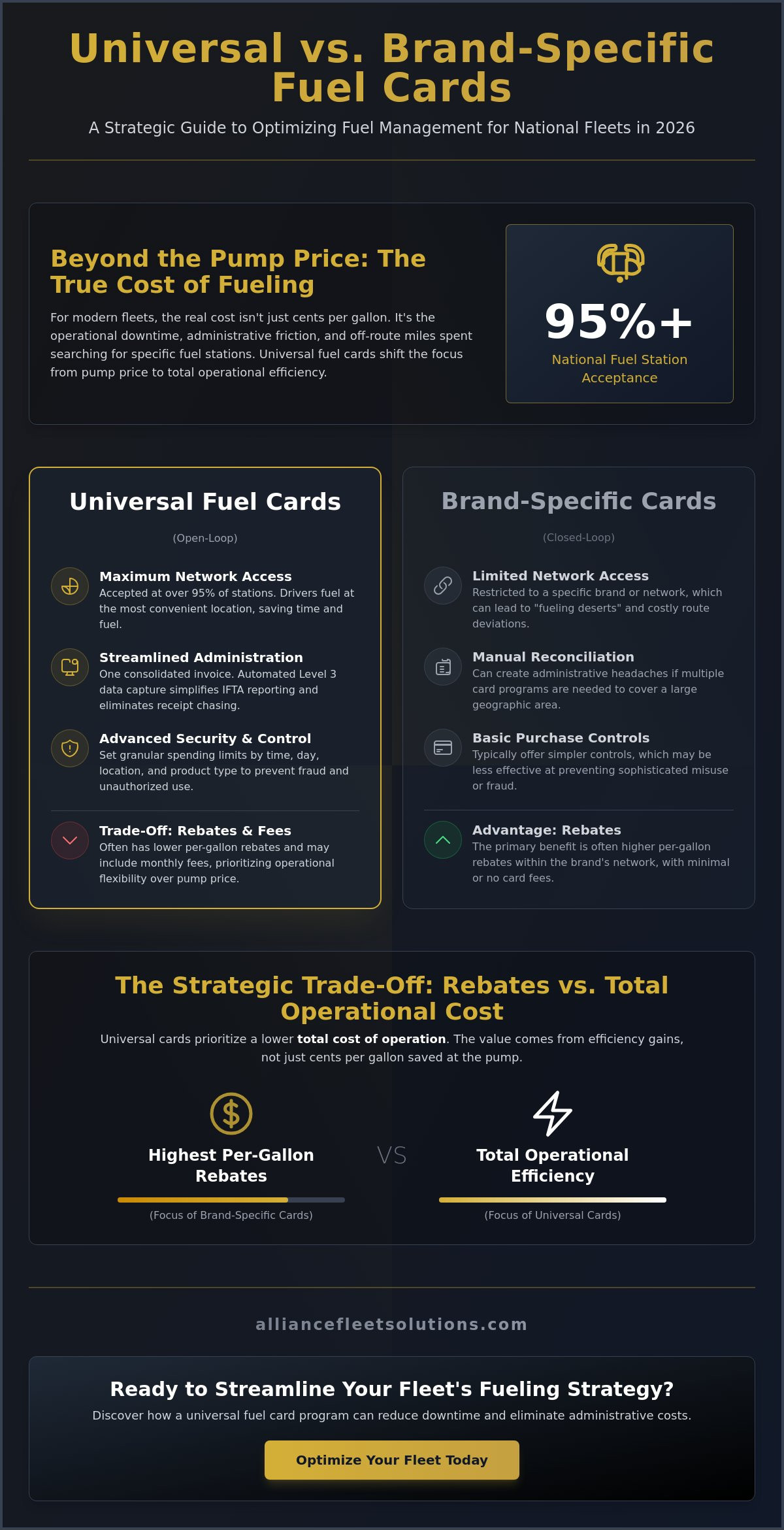
A universal fuel card functions as an open-loop payment solution, meaning it isn’t tied to a single petroleum brand or specific chain of truck stops. Most of these cards leverage the robust infrastructure of major payment processors like Visa or Mastercard, which allows them to be accepted at over 95% of fueling locations across the United States. When evaluating the pros and cons of universal fuel cards, the most immediate benefit is this sheer breadth of access. For national fleets operating across multiple states, the ability to fuel anywhere ensures that drivers aren’t wasting billable hours or burning extra fuel just to find a specific brand in unfamiliar territory. This flexibility transforms the card from a simple purchasing tool into a strategic asset for maintaining tight delivery schedules.
Universal vs. Closed-Loop: The Core Differences
Closed-loop cards restrict your drivers to specific brands. While these might offer higher per-gallon rebates, they often create “fueling deserts” where a driver must travel miles out of their way to find an approved pump. In contrast, universal cards provide a “convenience premium” that prioritizes vehicle uptime and driver retention. The technical sophistication of a modern fuel card also lies in its ability to capture “Level 3” transaction data. Unlike standard credit cards, universal fleet solutions record odometer readings, driver IDs, and specific product types at the point of sale. This data granularity is essential for identifying fuel theft and ensuring that every dollar spent is tied to a verified vehicle and route. It effectively eliminates the administrative nightmare of manual receipt reconciliation.
Why 2026 Fleet Managers are Moving Toward Universal Solutions
By 2026, the industry has largely shifted its focus from chasing the absolute lowest pump price to minimizing the total administrative cost of fueling. Managing a national fleet involves diverse vehicle types, ranging from standard delivery vans to specialized upfitted trucks with unique fuel requirements. Universal cards simplify this complexity by acting as a comprehensive spend management platform. These programs integrate directly with mobile-first fleet management apps, providing managers with real-time visibility into every transaction across the country. This connectivity allows for immediate adjustments to spending limits or geographic restrictions. Understanding the pros and cons of universal fuel cards helps managers realize that the strategic value of 100% route flexibility often outweighs the marginal savings of a brand-exclusive discount. It’s about building a functional operation that can adapt to changing logistics needs without being tethered to a single supplier.
The Pros: Why Universal Fuel Cards Win for National Fleets
Analyzing the pros and cons of universal fuel cards reveals that their primary strength lies in operational agility. For a national fleet, the ability to fuel at 95% or even 97% of gas stations nationwide is a decisive advantage. This unmatched flexibility ensures that your drivers never have to deviate from their optimized routes to hunt for a specific brand. When a single fuel-up for a heavy-duty vehicle can cost between $500 and $1,000, every minute spent idling or off-route directly impacts your bottom line. By removing brand restrictions, you prioritize driver uptime and ensure that your logistics schedule remains on track regardless of geographic location.
Eliminating the “Receipt Chase”: Administrative Efficiency
The administrative burden of manual expense tracking is a significant hidden cost in fleet operations. Universal fuel cards solve this by consolidating every transaction into a single, comprehensive monthly invoice. Instead of your accounting team reconciling thousands of paper receipts, digital logs automatically capture essential Level 3 data. This automation feeds directly into your reporting systems, providing a clear audit trail for tax compliance. Simplified IFTA reporting becomes a reality because the system tracks exactly where and when fuel was purchased across state lines. This level of organization is a core component of a professional fuel management program, allowing your team to focus on strategy rather than paperwork.
Customizable Controls and Fraud Protection
Security is where universal solutions truly outperform traditional credit cards. Fleet managers can implement granular purchase controls that restrict spending by time of day, day of the week, or even specific product types. If you want to ensure a card is only used for diesel fuel on weekdays between 6:00 AM and 6:00 PM, the system enforces those rules at the point of sale. Fraud mitigation is further strengthened through:
- Driver ID Requirements: Every transaction requires a unique PIN, ensuring accountability for every gallon pumped.
- Real-Time Alerts: Managers receive immediate notifications for suspicious activity or attempted out-of-policy purchases.
- Geofencing Capabilities: Advanced platforms can flag transactions that occur far from a vehicle’s verified GPS location.
These safeguards do more than just prevent theft; they provide a psychological deterrent against unauthorized spending. By setting hard limits on gallons per transaction or per day, you gain total control over your largest variable expense. This proactive approach to spend management ensures that your capital is used exclusively for revenue-generating activities, providing the peace of mind that comes with expert operational control.
The Cons: Understanding the Trade-offs and Costs
While the operational advantages of open-loop networks are clear, a balanced evaluation of the pros and cons of universal fuel cards requires a hard look at the associated costs. Flexibility isn’t free. Fleet managers often find that the “convenience premium” of these cards manifests in two ways: more complex fee structures and lower per-gallon rebates compared to brand-exclusive programs. For smaller fleets or those with razor-thin margins, these expenses can quickly offset the administrative time savings if they aren’t managed with precision. Understanding these trade-offs is the first step toward determining if a universal solution aligns with your long-term financial goals.
Decoding the Fee Structure
Universal fuel cards operate on diverse billing models that can be difficult to compare side-by-side. In 2026, typical monthly fees for these cards range from $2 to $4 per card. For instance, the WEX FlexCard and the Coast Card both carry a $4 monthly fee per card, while the ExxonMobil BusinessPro Universal card sits at $2. Some providers, like Fuelman Mastercard, opt for a flat $59 monthly account fee instead. Beyond the base subscription, you must account for potential “hidden” costs that erode your ROI. These include:
- Transaction Fees: Some cards charge between $1 and $3 per fuel-up, which can significantly reduce your effective discount.
- Late Payment Penalties: These vary wildly; WEX charges 9.99%, while the Fuelman Mastercard late fee reaches 17.99%.
- Administrative Charges: Fees for paper statements or card replacements can add up if your fleet has high turnover.
To find your true “Effective Discount,” you must subtract these total monthly fees from your aggregate fuel rebates. If your fleet doesn’t pump enough volume to outpace the fixed costs, the universal model might actually increase your total cost of ownership.
The “Discount Gap” Reality Check
The second major drawback is the rebate ceiling. Brand-specific cards often offer deeper discounts because they want to capture 100% of your business. While a universal card might offer a standard 3 to 15 cents per gallon, a brand-exclusive card might offer significantly more at their own stations. However, chasing a lower price at a distant station often costs more in driver wages and vehicle wear than the discount is worth. This “Discount Gap” is a primary reason why some managers struggle when weighing the pros and cons of universal fuel cards.
Finally, there’s the risk of data overload. Universal cards generate a massive amount of Level 3 data. Without a dedicated partner to help you interpret this information, you’re left with a mountain of digital noise rather than actionable insights. New businesses may also find these cards harder to obtain, as many universal providers have stricter credit requirements than local, branded fuel programs. If your credit history is limited, you might face lower spending limits or be required to provide a security deposit to secure the account.
How to Choose: A Decision Framework for Fleet Owners
Selecting the right fueling solution requires a deep dive into your operational DNA. It isn’t just about the rebate per gallon; it’s about how the card supports your drivers and your back office. When you evaluate the pros and cons of universal fuel cards, your decision should hinge on four specific factors: geographic footprint, vehicle diversity, administrative capacity, and technical integration. A card that works for a local delivery business might be a disaster for a long-haul logistics firm with specialized equipment.
Step 1: Map Your Fueling Footprint
Start by identifying “fuel deserts” along your primary routes. If your drivers frequently operate in rural areas or across state lines, a brand-specific card can lead to costly detours. You must quantify the hourly cost of these detours. If a driver spends 20 minutes searching for a specific station, the labor cost alone often exceeds any pump-price savings. Universal cards eliminate this friction, ensuring that your fleet stays on schedule. This is especially critical for vehicles with specialized professional upfitting, such as refrigerated units or crane trucks, which may have limited range or specific idling requirements that make efficient fueling stops mandatory.
Step 2: Technical Integration Requirements
A fuel card should never be a data silo. It must integrate seamlessly with your existing maintenance management software to provide a holistic view of vehicle health. For a precise Total Cost of Ownership (TCO), you need Level 3 data. This includes odometer readings, VINs, and driver IDs captured at the point of sale. This data allows you to correlate fuel consumption with driver behavior and vehicle wear. If your current accounting team is overwhelmed by manual data entry, the automated reporting of a universal card becomes a strategic necessity rather than a luxury. Our fuel management programs are designed to bridge this gap, turning raw transaction data into actionable business intelligence that drives long-term efficiency.
Finally, evaluate the mobile experience. In 2026, drivers expect a high-quality app that helps them locate the nearest station and manage their PINs securely. If the provider’s interface is clunky or the data doesn’t sync in real-time, your managers will spend more time troubleshooting than optimizing. Choosing a universal card is a commitment to a more agile, data-centric way of doing business, provided you have the right fleet partner to help you navigate the transition.
Maximizing ROI: Integrating Fuel Cards into Your Fleet Ecosystem
A universal fuel card is more than a tool for purchasing; it’s a high-fidelity data sensor that feeds into your entire operational strategy. When you evaluate the pros and cons of universal fuel cards, the true return on investment comes from how you leverage the resulting information. This data shouldn’t sit in a silo. It should drive your vehicle acquisition plans and inform your vehicle remarketing timing. By understanding exactly how much fuel each asset consumes under specific load conditions, you can make smarter decisions about which vehicle specs to buy in the next cycle. This data-driven approach ensures you aren’t just guessing which trucks are the most cost-effective for your specific routes.
This level of insight is where fractional fleet management becomes a decisive advantage. Many busy managers don’t have the internal bandwidth to analyze thousands of transactions across multiple states. A dedicated partner takes that burden off your shoulders, turning raw numbers into clear, actionable reports. This transition from a simple payment method to a comprehensive fuel management program ensures that your fleet remains a strategic asset rather than a growing liability. It’s about moving from a reactive “pay as you go” mindset to a proactive strategy that anticipates costs and identifies waste before it impacts your quarterly earnings.
Fuel Data as a Predictive Maintenance Tool
Sudden drops in fuel economy are often the first indicator of mechanical distress. In the world of efficient fleet operations, real-time consumption alerts allow you to trigger engine inspections before a driver is stranded on the side of the road. By correlating fuel spend with driver behavior and safety metrics, you can identify if a spike in costs is due to a failing fuel injector or excessive idling. This proactive approach minimizes operational downtime and extends the lifespan of your heavy-duty equipment. It also provides a clear audit trail that can increase the resale value of your vehicles during the remarketing phase, as you can prove the asset was maintained at peak efficiency throughout its lifecycle.
The Alliance Advantage: Beyond the Plastic Card
Alliance Fleet Solutions provides the expert oversight necessary to maximize these technical benefits. We don’t just hand you a card; we integrate fuel management programs into our broader leasing and maintenance solutions. Our team analyzes the data for you, identifying subtle trends that lead to significant long-term savings. Whether it’s adjusting your vehicle acquisition strategy or using professional upfitting to ensure your trucks are aerodynamically optimized for their specific tasks, we act as an extension of your team. This partnership approach elevates your fueling strategy from a transactional necessity to a core pillar of your business performance, giving you the calm, expert control needed to lead in a competitive logistics sector.
Building a Data-Driven Fuel Strategy for 2026
Managing fuel costs in 2026 requires more than just finding a cheap pump. It involves a strategic balance between network accessibility and administrative oversight. While the pros and cons of universal fuel cards involve weighing specific transaction fees against the value of 100% route flexibility, the long-term benefit lies in the actionable data these cards provide. By integrating this information into your broader fleet ecosystem, you transform a simple expense into a predictive tool for maintenance and vehicle acquisition.
Alliance Fleet Solutions acts as your strategic partner in this transition. We provide national B2B fleet leasing expertise and comprehensive fuel management programs that take the guesswork out of your daily operations. Our systems integrate telematics and maintenance data to ensure your fleet runs at peak efficiency. It’s time to move beyond the receipt chase and toward a more profitable, controlled operation. We understand the high stakes of your industry and remain committed to your long-term success.
Optimize Your Fleet Fuel Strategy with Alliance Fleet Solutions and take the first step toward a more reliable, efficient future for your business.
Frequently Asked Questions
Are universal fuel cards safer than standard corporate credit cards?
Yes, universal fuel cards provide significantly higher security through Level 3 data capture and advanced purchase controls. Unlike standard corporate credit cards, these fuel-specific solutions require a unique Driver ID or PIN for every transaction. This ensures that every gallon pumped is tied to a specific employee and prevents unauthorized use if a card is lost or stolen.
How many vehicles do I need to qualify for a universal fuel card program?
Most universal programs are accessible to fleets of all sizes, including small businesses with only one or two vehicles. Options like the WEX FlexCard or Coast Card are specifically designed to be inclusive for growing operations. This allows even the smallest fleets to benefit from professional spend management tools and consolidated billing without needing a massive vehicle count.
Can universal fuel cards be used for non-fuel purchases like maintenance or snacks?
Yes, but the fleet manager maintains total control over these permissions. You can configure cards to allow for essential maintenance services or roadside assistance while blocking “inside the store” purchases like food or tobacco. This granular control is a key factor when weighing the pros and cons of universal fuel cards, as it prevents budget leakage on non-operational expenses.
Do universal fuel cards help with IFTA tax reporting for heavy-duty trucks?
Yes, universal fuel cards simplify IFTA compliance by automatically capturing the location, date, fuel type, and volume for every transaction. This digital record replaces the need for manual driver logs and paper receipts, providing a clean audit trail for tax reporting. Consolidating all purchases across different states into a single report saves dozens of administrative hours during quarterly filings.
What is the average monthly fee for a universal fleet fuel card in 2026?
In 2026, monthly fees typically range from $2 to $4 per card. For example, the ExxonMobil BusinessPro Universal card carries a $2 monthly fee per card, while the WEX FlexCard and Coast Card are $4 per card. Some providers, like Fuelman Mastercard, charge a flat account fee of $59 per month, which can be more cost-effective for larger fleets.
Can I set different spending limits for different drivers on the same account?
Yes, universal platforms allow you to create individualized spending profiles for every driver or vehicle in your fleet. You can restrict one driver to fuel-only purchases during business hours while allowing a senior technician to use their card for both fuel and emergency repairs. This flexibility ensures that your spend management strategy matches the specific responsibilities of your workforce.
How do universal fuel cards integrate with GPS telematics systems?
Integration occurs through data synchronization where fuel transaction data is matched with GPS location and odometer readings from your telematics platform. This allows managers to verify that the vehicle was actually at the pump when the transaction occurred. It also helps identify fuel theft and provides a more accurate picture of each vehicle’s fuel economy and total cost of ownership.
Is there a credit check required to open a universal fuel card account?
Yes, most major providers require a business credit check to determine spending limits and account terms. Because these cards function as a line of credit, providers must assess the financial health of the applicant. New businesses with limited credit history might still qualify, though they may face lower initial limits or be required to provide a security deposit to open the account.