
Did you know that moving from a disorganized van to a custom-upfitted service body can increase technician billable hours by 22%? For fleet managers in 2026, this isn’t just a minor efficiency gain; it’s the difference between a profitable quarter and a logistical bottleneck. You’ve likely felt the frustration of watching operational costs climb because of overloaded chassis or technicians wasting time hunting for tools. It’s a common challenge to balance the high upfront costs of custom service body truck configurations with a clear, measurable return on investment.
We’re here to help you bridge that gap by designing mobile workshops that prioritize both utility and financial performance. This strategic guide will show you how to optimize payload capacity and integrate smart storage solutions to drive down your total cost of ownership. We’ll also cover critical 2026 updates, including Section 179 tax deduction limits and new FMCSA digital compliance rules, to ensure your fleet remains both productive and fully compliant. By the end, you’ll have a clear roadmap for building a high-performance fleet that retains its resale value and keeps your business moving forward.
Key Takeaways
- Learn to transition from standard utility bodies to engineered tool-management systems that treat every cubic inch of space as a productivity asset.
- Compare the long-term durability and weight-saving benefits of galvannealed steel, aluminum, and composite materials for your specific operational environment.
- Explore industry-specific custom service body truck configurations designed to integrate heavy-duty cranes, compressors, and specialized storage for mechanics and electricians.
- Master a strategic design process that uses field audits and precise GVWR calculations to prevent chassis overloading and premature vehicle wear.
- Discover how professional upfitting combined with strategic leasing structures can lower your total cost of ownership and boost vehicle remarketing value.
Beyond the Generic: Why Custom Service Body Configurations Matter in 2026
In the high-stakes world of field service, a truck is not just a vehicle; it’s a mobile profit center. High-performance custom service body truck configurations have evolved beyond simple storage boxes into sophisticated, engineered tool-management systems. This shift reflects a broader industry transition from standard utility beds to industry-specialized workshops tailored to the precise workflows of your technicians. When a vehicle is designed around the specific tools and parts a technician uses every day, the truck becomes a partner in productivity rather than a barrier to it.
Strategic Upfitting is now a fundamental pillar of modern fleet management. It’s about looking at the lifecycle of the vehicle and the health of your workforce. Across various truck classifications, the right configuration directly impacts technician retention. Professionals stay with companies that provide the right tools for the job. A well-organized mobile workspace reduces the physical and mental fatigue that leads to burnout, making it a critical asset for keeping your best people on the road.
The Cost of Disorganization
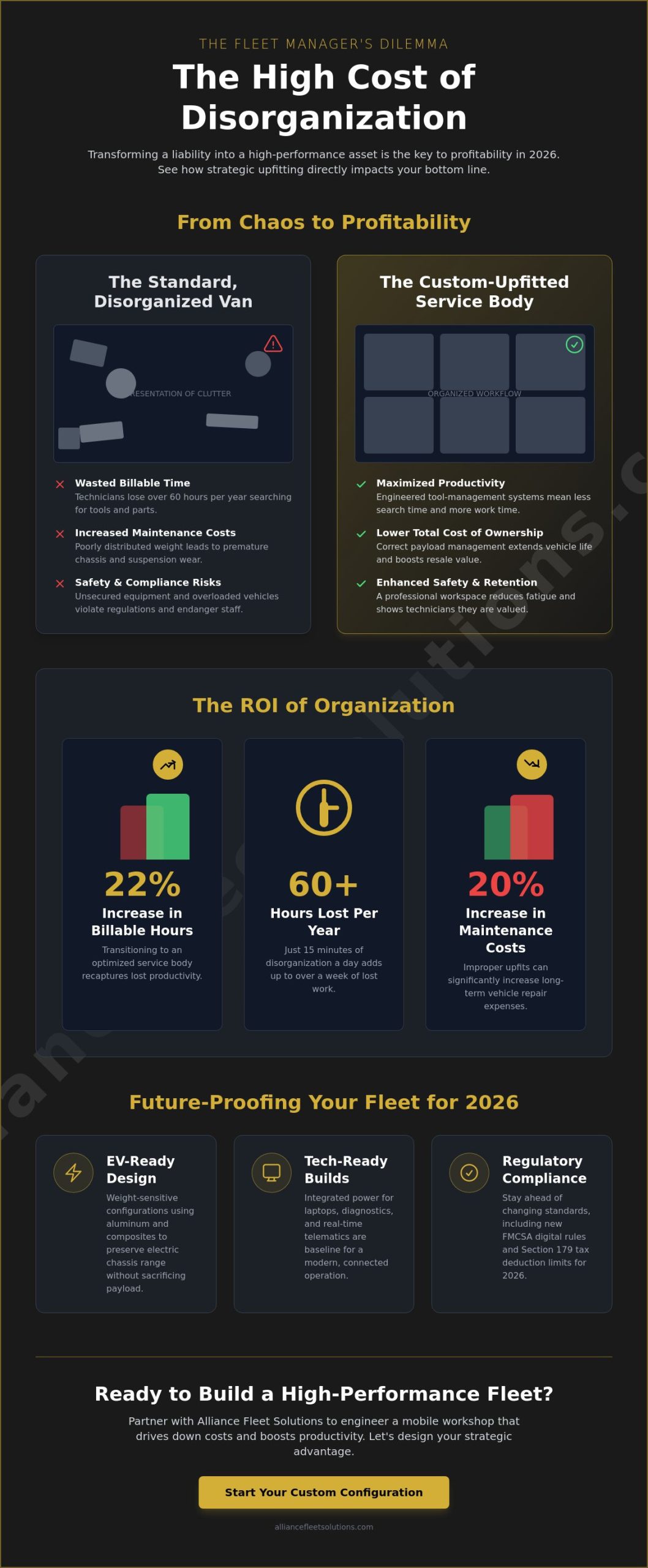
Efficiency is measured in minutes, and those minutes quickly translate into thousands of dollars. Consider the impact of a technician losing just 15 minutes a day searching for misplaced tools or navigating a cluttered cargo area. Over a standard 250-day work year, that’s over 60 hours of lost billable time per vehicle. A 2025 industry study confirmed this potential, showing a 22% increase in billable hours for technicians who moved from disorganized setups to optimized service bodies.
Safety is another major factor. Generic bodies often present risks when heavy equipment isn’t properly secured. Custom spatial optimization ensures every piece of gear has a dedicated, secure home. 2024 data indicates that poorly executed upfits can increase long-term maintenance costs by as much as 20% due to premature wear on the vehicle’s suspension and electrical systems. Investing in a tailored configuration protects both your personnel and your bottom line.
Future-Proofing for 2026 Fleet Standards
As we move through 2026, fleet standards are changing rapidly. The adoption of electric chassis requires a new level of weight-sensitive design to preserve battery range without sacrificing payload. “Tech-ready” builds, featuring integrated power for laptops and real-time telematics, are no longer optional extras; they’re the baseline for a modern operation.
At Alliance, we integrate these requirements into our professional upfitting process. We ensure your configurations are ready for the regulations of today and the operational demands of tomorrow. By focusing on payload optimization and equipment consolidation, we turn your fleet into a strategic business asset that delivers long-term reliability and safety.
Core Components of a High-Performance Service Body
Designing a high-performance fleet requires moving beyond a “one-size-fits-all” mentality. A service body is a complex assembly of materials, security features, and power systems that must work in harmony to support your field operations. When you invest in custom service body truck configurations, you aren’t just buying a shell; you’re engineering a tool that dictates how effectively your team performs in the field. Every decision, from the latch style to the frame material, influences your total cost of ownership and daily output.
Material Science and Payload Management
The choice between galvannealed steel, aluminum, and composite materials defines the vehicle’s lifespan and its operational costs. Galvannealed steel remains the standard for high-impact environments where durability is the primary concern. Aluminum has gained significant traction because it offers a lighter alternative that improves fuel efficiency and reduces strain on the suspension. According to NTEA – The Work Truck Association, material selection is a critical factor in staying within legal Gross Vehicle Weight Rating (GVWR) limits. Lighter bodies increase legal payload capacity, allowing your technicians to carry more equipment without risking regulatory fines or premature vehicle wear.
Ergonomic Layout and Accessibility
Organization is the engine of productivity. We advocate for a “Zone-Based” storage approach that places frequently used items in the most accessible, waist-level compartments. Heavy equipment should be positioned in lower cabinets to maintain a low center of gravity, which improves vehicle handling and safety. Pull-out drawers and adjustable shelving allow for a fluid workflow that adapts as your tool requirements change.
A significant gap in many standard builds is the failure to integrate technology early in the design phase. Strategic upfitting now includes the seamless integration of telematics and GPS solutions directly into the vehicle’s architecture. This allows managers to monitor compartment access and equipment location in real time. To secure these assets, modern configurations utilize master-lock bars and integrated alarm sensors. When combined with internal LED lighting and integrated 110V/USB power points, your truck becomes a fully functional, secure mobile office. If you’re ready to optimize your mobile workshop, our team can help you select the right professional upfitting components for your specific needs.
Industry-Specific Blueprints: Matching Configuration to Trade
Successful fleet managers know that the lowest bid on a truck body often leads to the highest lifetime cost. Instead of focusing solely on the upfront hardware price, strategic leaders look at how custom service body truck configurations align with specific trade requirements to reduce Total Cost of Ownership (TCO). A mechanic’s needs differ vastly from those of a lineman or an HVAC technician. A “jack-of-all-trades” body often masters none, leading to disorganized workflows and wasted fuel. By selecting a blueprint tailored to the mission, you transform a standard vehicle into a high-performance business asset.
The Heavy-Duty Mobile Workshop
For mobile mechanics, the truck serves as a mobile repair bay. This configuration requires crane-reinforced bodies and strategic hydraulic system placement to manage heavy lifting safely. Reinforced bumpers and outrigger stability are non-negotiable for site safety, especially when handling engine swaps or heavy equipment repairs in the field. These specialized builds are essential components of robust maintenance management plans. They ensure that field repairs happen quickly and correctly the first time, minimizing the downtime of the larger fleet they support.
High-Volume Service and Repair
Electrical and HVAC trades prioritize organization for thousands of small parts and specialized tools. Climate-controlled compartments protect sensitive electronics from extreme temperatures, while conduit racks maximize exterior space for bulky materials. Because these trades often involve high-frequency stop-and-start operations, lightweight aluminum configurations are a smart choice to lower the overhead of a fuel management program. Modular shelving is another key investment here; it allows the mobile workshop to be reconfigured as the business grows or as tool sets change.
General construction and utility trades require a different balance altogether. Construction fleets need open bed space for raw materials alongside secure side-box storage for expensive power tools. Utility and lineman configurations must go a step further, integrating aerial lifts and specialized grounding equipment storage. As highlighted in Heavy Duty Trucking, the strategic alignment of equipment to the vehicle’s mission is what separates a standard fleet from a high-performance operation. By matching the blueprint to the trade, you ensure every vehicle remains a productive asset throughout its entire lifecycle, maximizing both technician output and vehicle resale value.
The Strategic Design Process: From Blueprint to Road-Ready
Moving from a conceptual design to a road-ready asset requires a disciplined, step-by-step approach. High-performance custom service body truck configurations are most effective when they start with field data rather than guesswork. A rushed design process often leads to overloaded chassis or compartments that don’t fit the actual tools your team carries. We follow a logical progression to ensure every build serves as a reliable backbone for your mobile operations.
- Step 1: Field Audit. We begin by weighing and measuring the actual tool-loads your technicians use daily. This prevents “configuration creep” where unnecessary weight reduces your available payload.
- Step 2: Chassis Selection. We match the body to a chassis with the appropriate Gross Vehicle Weight Rating (GVWR). This ensures the vehicle remains compliant with safety standards and avoids premature suspension failure.
- Step 3: 3D Modeling. Spatial accuracy is non-negotiable. Using digital twin technology, we map every drawer and rack to verify ergonomics and weight distribution before production starts.
- Step 4: Tech Integration. We embed telematics and fuel sensors directly into the configuration. This allows you to monitor compartment security and fuel efficiency from the moment the truck hits the road.
- Step 5: Finishing. The build concludes with durable protective coatings and brand graphics. These final touches protect your investment from corrosion and ensure your fleet maintains a professional appearance.
Lifecycle Integration and Remarketing
Fleet managers must balance today’s utility with tomorrow’s resale potential. Over-customizing a body for a highly niche task can narrow the pool of buyers when it’s time for vehicle remarketing. Strategic design focuses on modularity. Choosing a standard-width body with custom internal shelving maximizes your ROI by providing specialized utility that’s easily adapted for a second owner. This foresight ensures your capital isn’t locked into an unsellable asset at the end of its primary service life.
Operational Testing and Refinement
For multi-unit rollouts, we recommend a prototype build to validate the configuration in real-world conditions. Gathering direct feedback from your technicians allows you to refine the layout before finalizing the remaining order. This collaborative approach ensures the final configuration supports efficient fleet operations by eliminating workflow bottlenecks that aren’t always obvious on a blueprint. If you’re ready to engineer a more productive fleet, contact our upfitting team to start your field audit today.
Why Alliance Fleet Solutions is Your Strategic Upfitting Partner
Most vendors in the industry focus strictly on the sale of hardware, leaving fleet managers to navigate the complexities of financing and lifecycle management on their own. We take a different approach. Alliance Fleet Solutions integrates custom service body truck configurations into a comprehensive business strategy that covers everything from vehicle acquisition to final disposal. By acting as a single point of contact, we eliminate the friction between upfitters, dealers, and leasing companies. This streamlined coordination ensures that your technical requirements are met without compromising your financial objectives or delivery timelines.
Our national reach allows us to maintain a standard of excellence across multi-state operations. Whether you’re deploying five trucks or five hundred, we ensure every build is consistent and high-performing. We don’t just deliver a vehicle; we provide a mobile business asset designed for long-term reliability. By leveraging telematics and GPS solutions, we collect real-time data from your active fleet to refine future configurations. This iterative process means your next generation of trucks will be even more efficient than the last, keeping your operation at the forefront of the industry.
Leasing Meets Customization
One of the primary challenges of professional upfitting is the high initial capital expenditure. We solve this by amortizing the cost of your custom configurations directly into a flexible open-end leasing structure. This approach transforms a significant upfront cost into a predictable monthly operating expense, freeing up capital for other areas of your business growth. Open-end leasing is particularly effective for highly specialized service bodies because it offers the flexibility to adjust the vehicle’s service life based on actual wear and tear. You aren’t locked into rigid terms that ignore the reality of field work, allowing for a more strategic approach to vehicle remarketing when the time is right.
A Holistic Fleet Partnership
We believe that a fleet is only as strong as the management behind it. Our fractional fleet management services allow you to access executive-level expertise without the overhead of a full-time internal department. We handle the granular details of the upfitting process, ensuring that every drawer, rack, and power point is positioned for maximum technician productivity. This partnership model means we’re as invested in your uptime and ROI as you are. We’re here to provide the expert control and dependable solutions your operation requires to thrive in a competitive market. Contact our team to start your custom configuration audit today and see how a strategic partnership can transform your fleet’s performance.
Strategic Fleet Optimization for the Road Ahead
Investing in custom service body truck configurations is no longer just about storage; it’s about engineering a mobile business asset that drives productivity and long-term value. By moving away from generic utility beds and embracing industry-specific blueprints, you ensure your technicians have the tools they need to maximize billable hours while minimizing vehicle wear. A disciplined design process, rooted in field audits and lifecycle planning, protects your ROI and simplifies the eventual vehicle remarketing process.
Since 2018, Alliance has provided professional upfitting and national fleet management support to help businesses scale with confidence. We deliver customized solutions for every major industry, combining technical authority with flexible leasing structures that keep your capital working for you. Our team’s ready to help you navigate the complexities of 2026 regulations and operational demands with expert control and reliable partnership.
Ready to transform your mobile workshops into high-performance assets? Consult with an Alliance expert on your next custom configuration today and build a fleet that’s truly road-ready.
Frequently Asked Questions
How does a custom service body affect my truck’s payload capacity?
The weight of the body reduces your available payload by increasing the vehicle’s curb weight. It is essential to calculate your total tool and equipment load before selecting a configuration to ensure you stay within the Gross Vehicle Weight Rating (GVWR). Choosing lightweight materials can help offset this weight, allowing you to carry more equipment without exceeding legal limits or causing premature wear on the suspension.
What is the best material for a service body: aluminum or steel?
The best material depends on your specific operational environment and payload needs. Steel provides maximum durability and impact resistance for heavy construction and mining applications. Aluminum is the preferred choice for fleets looking to maximize fuel efficiency and payload capacity because it significantly reduces the body’s weight. While steel is often more affordable upfront, aluminum’s corrosion resistance and weight savings often lead to a lower total cost of ownership.
Can I integrate my existing telematics system into a new custom body?
Yes, professional upfitting allows for the seamless integration of your existing telematics and GPS solutions into the new body architecture. Modern custom service body truck configurations can be engineered with pre-wired sensors for compartment doors, internal lighting, and equipment tracking. This integration provides real-time visibility into tool security and technician efficiency, turning your service body into a fully connected component of your fleet management strategy.
How does a custom configuration impact the resale value of my fleet vehicles?
A well-designed configuration increases resale value by providing a turnkey solution for the next owner, provided the layout remains versatile. Using modular internal shelving rather than highly specialized, permanent fixtures allows the vehicle to appeal to a broader range of buyers in the secondary market. Strategic design ensures the truck remains a high-performance asset throughout its first life while maintaining the flexibility needed for successful vehicle remarketing later.
What is the typical lead time for a professional upfitting project?
Lead times vary based on the complexity of the design and current manufacturer inventory levels. While some standard configurations can be completed relatively quickly, highly specialized builds involving cranes or hydraulic systems require more time for engineering and testing. We recommend initiating the design process several months before your required deployment date to account for material sourcing and the meticulous assembly required for a high-quality, road-ready vehicle.
Is it better to lease or buy a truck with a custom service body?
Leasing is often the more strategic choice for customized fleets because it allows you to amortize the upfitting costs into a single monthly payment. Open-end leasing provides the flexibility to manage the vehicle’s lifecycle based on actual usage rather than rigid contract terms. This approach reduces your initial capital expenditure and simplifies the replacement cycle, ensuring your technicians always have access to modern, reliable equipment without a large upfront investment.
How do I know which compartment layout is right for my specific trade?
Determining the right layout begins with a comprehensive field audit of the tools and parts your technicians use most frequently. You should group items by frequency of use and weight to create an ergonomic “Zone-Based” storage plan. High-frequency tools belong in waist-level side compartments, while heavy equipment should be stored low to maintain a stable center of gravity. This data-driven approach eliminates wasted movement and directly improves daily billable hours.
What security features should I prioritize in a high-theft area?
Prioritize master-lock bars and integrated alarm sensors that connect directly to your telematics system. These features provide a physical deterrent and real-time alerts if a compartment is breached. You should also consider internal LED lighting to improve visibility during night work and hidden compartments for high-value diagnostic tools. Robust security is a critical component of custom service body truck configurations, protecting your investment and preventing the operational downtime caused by tool theft.