
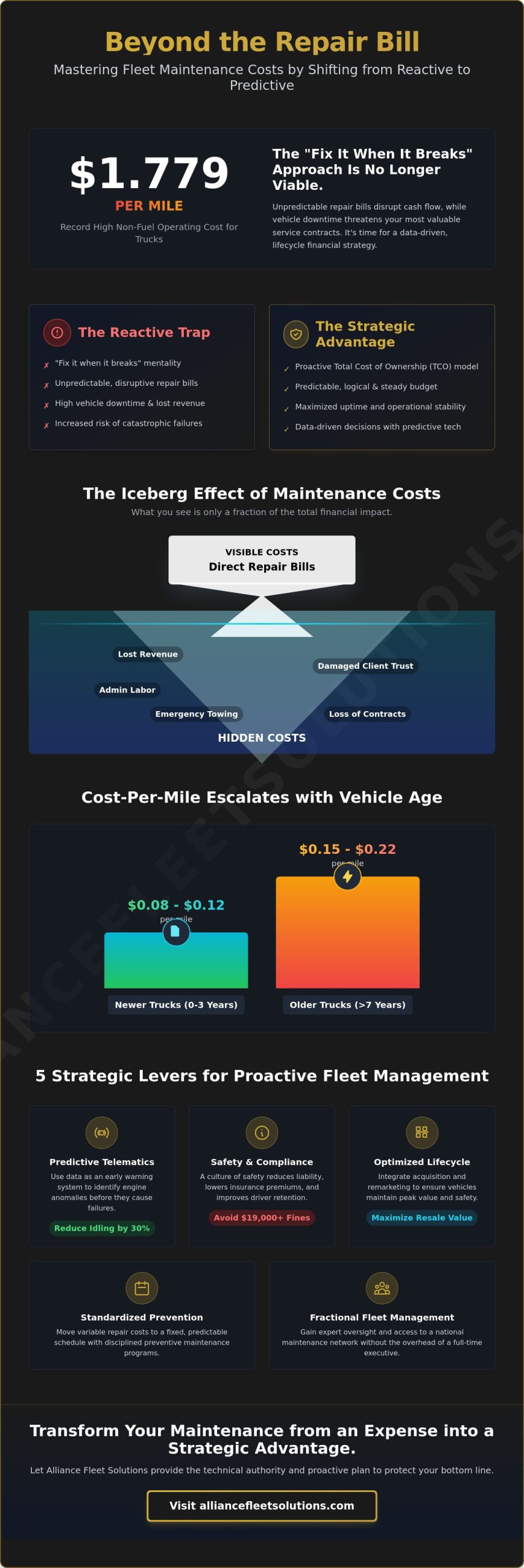
Did you know that non-fuel operating costs for trucks recently reached a record $1.779 per mile? This surge makes the traditional “fix it when it breaks” approach a significant risk to your company’s financial health. You’re likely dealing with unpredictable repair bills that disrupt your cash flow and high vehicle downtime that threatens your most valuable service contracts. Managing fleet maintenance costs in 2026 requires a shift from reactive repairs to a lifecycle financial strategy where data dictates your bottom line.
We agree that the administrative burden of coordinating national maintenance is a stress your team doesn’t need, especially with FMCSA fines for inspection violations now reaching $19,000. You deserve a partner who provides technical authority and a proactive plan to keep your drivers safe. This guide will show you how to transform maintenance from a rising expense into a predictable strategic advantage through TCO analysis and predictive technology. We’ll explore how leveraging telematics can reduce idling by 30% and help you achieve a lower total cost of ownership while maintaining a steady, logical budget that protects your operations.
Key Takeaways
- Learn how to shift from tracking simple repair bills to a comprehensive Total Cost of Ownership (TCO) model that balances fixed and variable expenses.
- Master the transition from reactive fixes to predictive technology, using telematics as an early warning system for managing fleet maintenance costs.
- Discover how standardized preventive schedules and fuel management programs can identify engine anomalies before they lead to catastrophic failures.
- Understand the benefits of fractional fleet management, providing your business with expert oversight and a national maintenance network without the overhead of a full-time executive.
- See how integrating acquisition and remarketing strategies ensures your vehicles maintain peak value and safety throughout their operational life.
Beyond the Repair Bill: The Rising Reality of Fleet Maintenance Costs
Effective managing fleet maintenance costs in 2026 requires looking past the line items on a mechanic’s invoice. For many businesses, maintenance is viewed as a series of reactive fixes, but this narrow perspective ignores the broader financial reality. In a market defined by inflation and persistent parts shortages, the “cost of doing nothing” has skyrocketed. When you delay a service, you aren’t just pushing a bill to next month; you’re increasing the risk of an exponential failure that could sideline a vehicle for weeks.
Think of your maintenance expenses as an iceberg. The visible tip is the direct repair bill. Beneath the surface lies the “Iceberg Effect,” where indirect costs like administrative labor, emergency towing, and disrupted schedules create a massive financial drag. A comprehensive fleet management strategy treats these expenses as a holistic business lever rather than a necessary evil. By shifting your focus, you transform maintenance into a tool for protecting your brand’s reputation and ensuring long-term operational stability.
The Hidden Costs of Vehicle Downtime
Downtime is the silent killer of profitability. When a truck is off the road, the financial hit includes lost revenue from missed deliveries and the ongoing cost of driver wages. Industry data from 2024 shows that non-fuel operating costs reached $1.779 per mile, emphasizing how every idle hour erodes your margins. Missed service windows don’t just delay one shipment; they damage client trust and can lead to the loss of national service contracts. Downtime ROI is the ratio of preventive spend to saved operational hours.
Maintenance as a Safety and Compliance Pillar
Safety is a non-negotiable standard that directly impacts your bottom line. In 2026, the FMCSA increased fines for willful falsification of Driver Vehicle Inspection Reports (DVIR) to as much as $19,000 per violation. Regular maintenance keeps you compliant and significantly reduces insurance premiums and legal liability risks. Beyond the numbers, a well-maintained fleet offers a psychological boost to your team. Drivers feel valued and safe when they operate equipment that is in top condition, which directly improves retention and on-road performance. It’s about creating a culture of reliability that starts in the shop and ends with a satisfied customer.
The TCO Framework: Analyzing Fixed vs. Variable Maintenance Drivers
To master managing fleet maintenance costs, you must first adopt a Total Cost of Ownership (TCO) model. This framework moves beyond the purchase price to account for every dollar spent over a vehicle’s operational life. Your costs generally fall into two categories: fixed and variable. Fixed costs, such as insurance and lease payments, remain steady. Variable costs, including fuel and repairs, are volatile and often disrupt cash flow. The goal of a sophisticated maintenance strategy is to migrate as much “variable” spend as possible into the “fixed” category through disciplined, scheduled programs.
Vehicle age plays a decisive role in the cost-per-mile escalation curve. Research for 2026 shows that newer trucks, specifically those between zero and three years old, typically require a maintenance budget of $0.08 to $0.12 per mile. However, once a vehicle surpasses seven years of service, that requirement jumps significantly to a range of $0.15 to $0.22 per mile. Large-scale organizations like the GSA Fleet use these data points to determine the exact moment a vehicle becomes a financial liability rather than an asset. Understanding this curve allows you to plan replacements before repair costs erode your margins.
How Maintenance Preserves Remarketing Value
A documented, comprehensive maintenance history is the single most important factor in vehicle resale value. When it’s time to cycle out equipment, buyers in the secondary market pay a premium for units that show a clear record of proactive care. At Alliance Fleet Solutions, we view maintenance not as a sunk cost, but as an investment that pays for itself at the point of disposal. For a detailed breakdown of how to maximize your assets, consult our vehicle remarketing guide.
Leasing Structures and Their Impact on Maintenance Budgeting
The type of lease you choose dictates your daily maintenance responsibilities. Open-end leasing provides flexibility and the potential for equity, but the burden of maintenance management remains on your shoulders. Conversely, closed-end leasing often bundles these costs into a predictable monthly payment, shielding you from repair volatility. The key is to align your lease term with the “sweet spot” of the vehicle lifecycle, ensuring you exit the asset before major overhauls, like $25,000 engine rebuilds, become necessary. Over-extending a vehicle’s service life often leads to a cycle of emergency repairs that far exceed the cost of a new lease. Exploring professional Maintenance Management can help you identify these critical exit points before they impact your bottom line.
Transitioning from Reactive to Predictive Maintenance with Telematics
The evolution of managing fleet maintenance costs is defined by three distinct stages: reactive, preventive, and predictive. Reactive maintenance is the costliest phase, where you wait for a component to fail before taking action. Preventive maintenance improves this by using calendar-based or mileage-based schedules to replace parts before they break. However, the modern gold standard is predictive maintenance. By utilizing Telematics and GPS Solutions, you can move away from “Calendar-Led” servicing and embrace a “Diagnostic-Led” model. This approach ensures you only pay for service when the data confirms it’s necessary, eliminating the waste of premature part replacements while catching issues that a standard schedule might miss.
Real-time engine data acts as a continuous health monitor for your entire operation. Instead of relying on a driver to report a dashboard light, your management team receives instant alerts regarding fault codes and performance irregularities. This proactive visibility is the backbone of a functional operation, allowing you to intercept a vehicle before a minor glitch escalates into a catastrophic engine or transmission loss. It’s a level of expert control that transforms maintenance from a headache into a strategic business asset.
Leveraging Data to Prevent Engine Failure
Remote diagnostics allow you to identify minor sensor issues while the vehicle is still on its route. The financial implications are massive. Research indicates that a typical engine overhaul in 2026 can cost between $15,000 and $25,000. In contrast, replacing a faulty sensor identified through telematics might only cost $200. “Telematics transforms vehicle data into a financial shield against emergency repairs.” By acting on these early warning signs, you protect your cash flow and ensure your assets remain on the road where they belong.
The Role of Driver Behavior in Maintenance Spend
Your drivers have a direct impact on your repair budget. Harsh braking, rapid acceleration, and excessive idling aren’t just safety concerns; they are primary drivers of accelerated component wear. Excessive idling, for example, can be reduced by as much as 30% through data monitoring, which significantly extends the life of your aftertreatment systems. Using driver scorecards allows you to coach your team toward habits that reduce the frequency of brake and tire replacements. While many systems track these metrics, the true value comes from professional oversight. Integrating these insights into your broader telematics and GPS solutions guide ensures that every data point leads to a measurable reduction in operating expenses.
5 Strategic Levers to Reduce Maintenance Expenses and Maximize Uptime
To move the needle on managing fleet maintenance costs, you need a structured approach that tackles expenses from multiple angles. It isn’t enough to just fix things when they break. You must optimize the entire ecosystem to ensure every dollar spent contributes to vehicle longevity. Implementing these five levers will transform your maintenance department from a cost center into a strategic asset.
- National Standardization: Establish a uniform preventive maintenance schedule across your entire fleet to eliminate regional spending variability and ensure safety compliance.
- Vendor Consolidation: Partner with a single provider to leverage volume pricing and secure standardized labor rates, which can range from $90 to $190 per hour in the current market.
- TCO Inflection Points: Use data to identify the exact moment an aging asset’s repair costs exceed its operational value, preventing the “money pit” scenario.
- Strategic Upfitting: Build vehicles for their specific duty cycle from day one to prevent premature component failure caused by improper weight distribution.
- Fuel-Based Diagnostics: Monitor consumption patterns to catch mechanical issues that haven’t yet triggered a dashboard alert.
Centralizing these efforts allows your team to focus on growth rather than coordinating repairs. For businesses looking to streamline these processes, our Maintenance Management programs provide the expert oversight needed to maintain a predictable monthly budget.
Professional Upfitting: Reducing Wear from Day One
Mechanical wear and tear doesn’t start at the first oil change; it starts the moment you load the vehicle. A truck or van that isn’t configured for its specific payload will suffer from premature suspension and brake failure. Alliance Fleet Solutions ensures your vehicles are purpose-built through professional upfitting. Custom shelving, racks, and power solutions do more than organize tools. They distribute weight correctly across the chassis, significantly reducing the strain on your drivetrain and tires. This proactive step ensures your assets are durable enough to handle the high-stakes demands of the logistics sector, protecting your investment before it even hits the road.
Fuel Programs as a Diagnostic Tool
Your fuel card is one of the most effective diagnostic tools in your arsenal. A sudden, unexplained drop in miles per gallon (MPG) often precedes a major mechanical issue, such as a failing fuel injector or a clogged aftertreatment system. By using centralized fuel management programs, you can identify “outlier” vehicles that are consuming more than the fleet average. This data allows you to pull a vehicle for inspection before a minor inefficiency turns into a roadside breakdown. It’s a steady, logical way to use existing spending data to protect your larger maintenance budget and ensure peak engine performance.
Optimizing the Maintenance Lifecycle with Alliance Fleet Solutions
Software alone cannot negotiate a labor rate or verify if a mechanic’s estimate for a complex transmission repair is inflated. Successful managing fleet maintenance costs requires a human element. You need a seasoned expert who understands the nuances of both the shop floor and the boardroom. Alliance Fleet Solutions acts as that essential backbone, bridging the gap between raw telematics data and actionable business decisions. We don’t just provide tools; we offer a comprehensive partnership that spans the entire vehicle lifecycle, from initial acquisition and professional upfitting to final remarketing.
Our approach ensures that your maintenance strategy aligns perfectly with your business’s financial goals. By leveraging our national maintenance network, your fleet gains access to pre-negotiated labor rates and standardized parts pricing. In a market where dealership service rates often climb toward $190 per hour, having a partner who can steer your equipment toward qualified independent shops charging significantly less is a massive advantage. We manage the logistics of upkeep so you can focus on the logistics of your clients.
The Value of Fractional Fleet Management
Many mid-sized organizations struggle with the administrative weight of maintenance coordination. You need the expertise of a full-time fleet manager, but the payroll costs for a dedicated executive can be prohibitive. Fractional fleet management provides a distinct competitive advantage by giving you that expertise at a fraction of the cost. Our team reviews every repair estimate for accuracy and necessity, ensuring you never pay for redundant services or “upsells” that don’t contribute to safety or uptime. This partnership model moves beyond transactional repairs to focus on the long-term health of your assets. It’s a hardworking, no-nonsense approach that reduces administrative overhead while keeping your drivers on the road.
Your Next Steps to Fleet Optimization
The path to a more predictable budget begins with a clear understanding of your current performance. We recommend a comprehensive fleet audit to identify inefficiencies in your current repair cycles and vendor relationships. Transitioning to a managed maintenance program is a steady, logical process that immediately alleviates the stress of unpredictable equipment failure. By integrating your leasing structures with a proactive service plan, you protect your cash flow and ensure your vehicles maintain peak value until the day they are sold. It’s time to transform your fleet from a rising expense into a strategic business asset. Schedule a consultation with Alliance Fleet Solutions to optimize your maintenance spend and take expert control of your operational future.
Take Control of Your Fleet’s Financial Future
Success in 2026 requires a departure from reactive, high-stress repair cycles. By adopting a Total Cost of Ownership model and utilizing real-time diagnostics, you move from simply fixing trucks to strategically managing fleet maintenance costs. You’ve seen how purpose-built upfitting and disciplined replacement cycles protect your margins while ensuring your drivers remain safe on the road. These aren’t just mechanical tasks; they’re the essential pillars of a resilient, profitable operation.
Alliance Fleet Solutions is ready to serve as your dependable partner in this journey. As a family-owned and operated company since 2018, we provide the technical authority and national maintenance network you need to stabilize your budget. We specialize in professional upfitting and TCO optimization, ensuring your fleet remains a strategic asset rather than a financial liability. It’s time to replace operational uncertainty with expert control and a plan built for long-term reliability.
Partner with Alliance Fleet Solutions to Slash Your Maintenance Costs
Your fleet is the backbone of your business. With the right data-driven strategy and a committed partner at your side, you can transform maintenance into your greatest competitive advantage.
Frequently Asked Questions
What is the average cost of fleet maintenance per mile in 2026?
Owner-operators should budget between $0.15 and $0.25 per mile for maintenance and repairs in 2026. This rate depends heavily on the age of your equipment. Newer trucks typically require $0.08 to $0.12 per mile, while older assets over seven years old often see costs rise to $0.22 per mile or more as major systems require overhauls.
How does preventive maintenance differ from predictive maintenance?
Preventive maintenance relies on fixed schedules, such as changing oil every 10,000 miles regardless of the vehicle’s actual condition. Predictive maintenance uses real-time telematics and sensors to monitor component health and forecast failures before they happen. This data-driven approach is a more precise method for managing fleet maintenance costs because it eliminates unnecessary service while preventing emergency breakdowns.
Can telematics really reduce my maintenance bills?
Telematics systems reduce bills by catching minor faults, like a $200 sensor issue, before they escalate into a $15,000 engine failure. These tools also track driver habits like harsh braking and excessive idling, which directly impact the wear rate of tires and brakes. Monitoring this data allows you to extend the service life of critical components across your entire fleet.
Should I lease or buy my fleet vehicles to minimize maintenance costs?
Leasing often provides a more predictable maintenance landscape by allowing you to cycle out vehicles before they reach high-cost repair thresholds. Closed-end leases can bundle maintenance into a single monthly payment, shielding you from repair volatility. Buying requires your team to manage the full risk of aging assets, which often leads to unpredictable spikes in your operating budget.
How often should a commercial truck undergo a full maintenance inspection?
Commercial vehicles with a GVWR over 10,001 lbs must pass a DOT periodic inspection at least once every 12 months to remain compliant with 49 CFR §396.17. For high-utilization fleets, we recommend more frequent internal inspections every 90 days. This steady rhythm helps you avoid FMCSA fines for falsified inspection reports, which can now reach $19,000 per violation.
What are the most common hidden costs in fleet maintenance?
The most significant hidden costs are administrative overhead and the lost revenue associated with vehicle downtime. When a truck is in the shop, you continue to pay for insurance and driver wages while the asset fails to generate income. These indirect expenses, along with the labor required to coordinate repairs, often outweigh the direct cost of the mechanic’s invoice.
Is it better to use a centralized maintenance provider or local shops?
A centralized provider offers technical authority and national labor rates that local shops typically cannot provide. You benefit from volume pricing and a single point of contact for your entire operation. This partnership model ensures that every repair is reviewed for accuracy, preventing the “upselling” and inconsistent service quality often found when managing dozens of independent local vendors.
How does vehicle upfitting affect my long-term repair expenses?
Professional upfitting reduces long-term expenses by ensuring your vehicles are purpose-built for their specific payload. When racks, shelving, and equipment are installed correctly, the weight is distributed properly across the chassis. This prevents premature failure of the suspension, brakes, and drivetrain that occurs when a vehicle is poorly configured for its daily duty cycle.