
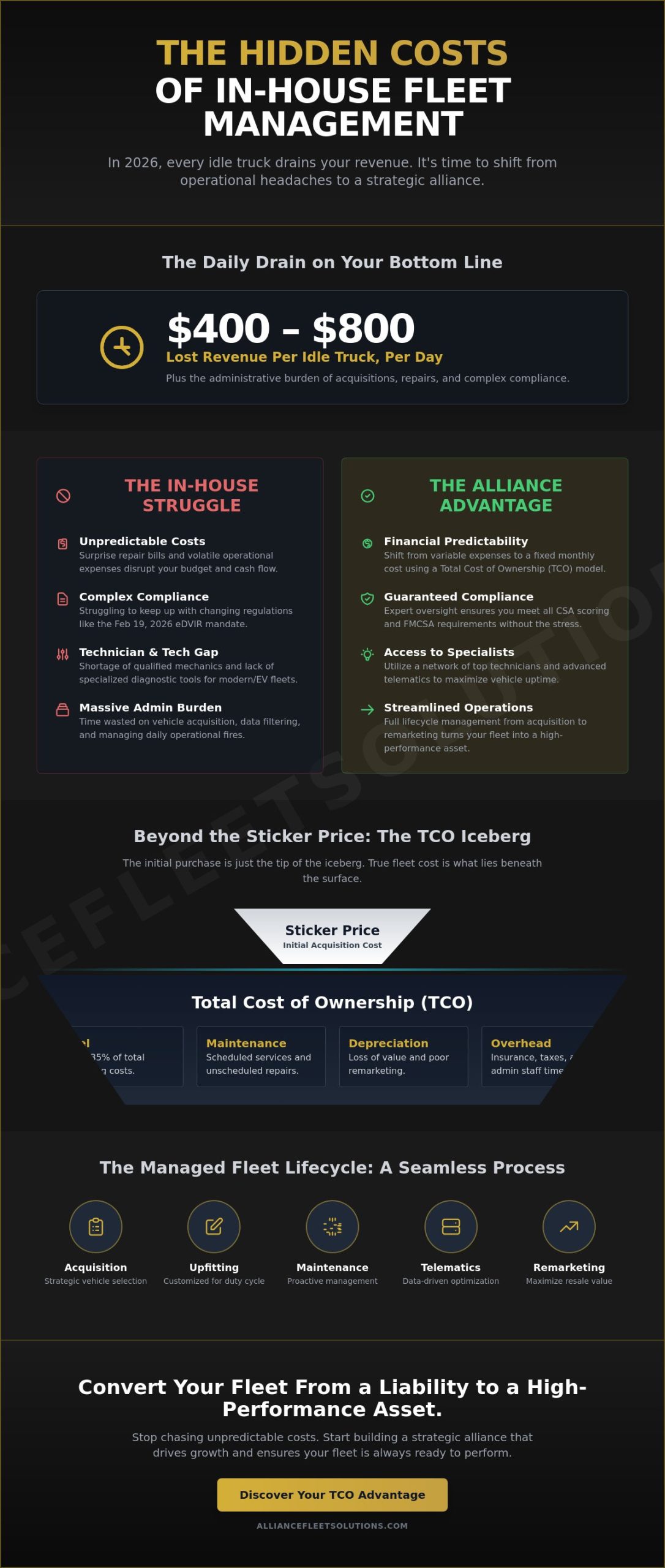
Every day one of your trucks sits idle in 2026, your business loses between $400 and $800 in revenue. When you add the administrative burden of vehicle acquisition and the complexity of the FMCSA’s February 19, 2026, ruling on electronic DVIRs, in-house management often creates a losing battle against rising costs. You want to focus on your core mission, yet you’re stuck chasing unpredictable repair bills and filtering through endless telematics data. Understanding the strategic benefits of outsourcing fleet management is no longer just about cutting costs; it’s about forming a professional alliance that converts your vehicle liabilities into high-performance assets.
We understand that you need a predictable monthly budget and a fleet that stays on the road. This article shows you how to reduce your total cost of ownership and leverage expert maintenance management to keep your drivers safe. We’ll examine how professional oversight streamlines your operations, maximizes vehicle uptime, and ensures you meet the latest 2026 CSA scoring requirements without the typical stress of fleet ownership. Discover how to move beyond the frustration of equipment failure and toward a more reliable, data-driven operation.
Key Takeaways
- Modern fleet outsourcing has evolved into a strategic partnership that manages the entire vehicle lifecycle from acquisition to remarketing.
- Shifting your focus from initial sticker price to Total Cost of Ownership (TCO) provides the financial predictability your business needs to grow.
- You’ll see how the benefits of outsourcing fleet management include bridging the technician gap and utilizing advanced telematics to maximize vehicle uptime.
- Fractional fleet management offers a scalable way to access expert oversight while maintaining full control over your day-to-day operations.
- A successful transition begins with a comprehensive fleet audit to uncover hidden costs and align your maintenance schedule with your specific business goals.
What is Fleet Management Outsourcing in 2026?
In 2026, fleet management outsourcing represents a deep strategic partnership rather than a simple service contract. It’s an alliance with a Fleet Management Company (FMC) that takes full responsibility for a vehicle from the moment of acquisition until its final remarketing. This shift is vital because the industry has moved beyond basic oil changes. Modern fleet operations require a sophisticated understanding of What is Fleet Management, encompassing everything from regulatory compliance to asset optimization. When you explore the benefits of outsourcing fleet management, you’ll find it converts your fleet from a source of administrative headaches into a streamlined business asset.
The Evolution of Fleet Operations
Managing a fleet in-house has become exponentially more complex since 2020. Back then, a mechanic primarily needed physical tools; today, they need specialized diagnostic software to handle advanced vehicle sensors and the ongoing transition to electric vehicles (EVs). A 2025 study showed that 64% of fleet professionals already operate at least some EVs, bringing new challenges in charging infrastructure and high-voltage maintenance. These technical demands, combined with a critical shortage of qualified technicians, make internal shop management a high-risk endeavor. Transitioning to efficient fleet operations requires a level of technical depth that most non-logistics businesses simply can’t maintain. Additionally, with the FMCSA finalizing rules on electronic Driver Vehicle Inspection Reports (eDVIRs) on February 19, 2026, the administrative load for compliance has reached a breaking point for many internal teams.
Key Services Included in Modern Outsourcing
Modern outsourcing covers the full lifecycle of your vehicles. It starts with strategic vehicle acquisition and professional upfitting, ensuring every truck is built for its specific duty cycle from day one. Once on the road, an FMC manages comprehensive maintenance programs and fuel management to control the 35% of operating costs typically spent on energy. Advanced telematics integration provides real-time performance monitoring, which is essential for the benefits of outsourcing fleet management to be fully realized. Finally, professional remarketing ensures you recoup the highest possible value when it’s time to cycle out an asset. This isn’t a vendor relationship where you call for a fix; it’s a strategic alliance that ensures your fleet remains the functional backbone of your business.
Financial Predictability and the TCO Advantage
Sticker price is often a distraction. When you buy or lease a vehicle, the initial price tag only accounts for a fraction of what that asset will cost over its operational life. One of the primary benefits of outsourcing fleet management is the shift toward a Total Cost of Ownership (TCO) framework. This model accounts for depreciation, insurance premiums, taxes, and maintenance over the vehicle’s entire lifespan. By analyzing these variables, an alliance with an FMC ensures you aren’t just buying a truck; you’re investing in a predictable financial outcome.
Professional remarketing plays a massive role in this equation. Most businesses lose significant value at the end of a vehicle’s life because they lack the data to time the market. This is where the benefits of outsourcing fleet management become tangible; in 2026, FMCs use predictive analytics to identify the exact moment an asset should be sold to maximize resale value. This revenue is then funneled back into your next acquisition, lowering your net cost. Whether you choose open-end leasing for its flexibility and potential equity gains or closed-end leasing for fixed-cost certainty, the right structure protects your cash flow from market volatility.
Shifting from Variable to Fixed Costs
Unpredictable repair bills are the enemy of a healthy balance sheet. Outsourcing transforms these budget-busting events into steady, manageable expenses through maintenance management programs. Integrating fuel management programs further stabilizes your monthly spend, which is critical since fuel accounts for up to 35% of total operating costs in 2026. Cost predictability directly impacts a company’s borrowing power by presenting a more stable and reliable financial profile to lenders.
The ROI of Professional Upfitting
Effective fleet management starts before the keys are even turned. Professional upfitting ensures your vehicles are configured for their specific tasks, which significantly reduces long-term wear and tear on the chassis and engine. When a vehicle is built correctly at the point of acquisition, maintenance costs remain lower over the asset’s life because the equipment isn’t being strained beyond its intended use. This precision also boosts driver efficiency and safety metrics, as technicians have the exact tools and ergonomic setups they need to perform. Accessing specialized expertise and advanced telematics through an FMC allows you to track these safety improvements in real-time. If you’re ready to stabilize your operations, it’s time to review your current fleet spend with a professional partner.
Accessing Specialized Expertise and Advanced Telematics
The ongoing shortage of qualified maintenance technicians in 2026 makes it nearly impossible for most businesses to maintain a high-functioning internal shop. Modern vehicles require specialized diagnostic expertise that goes far beyond traditional mechanical skills. One of the primary benefits of outsourcing fleet management is gaining immediate access to a nationwide network of experts who provide 24/7 maintenance support. This ensures your vehicles stay on the road, avoiding the $400 to $800 daily revenue loss associated with downtime. Expert oversight also guarantees that your fleet remains compliant with the FMCSA’s updated 2026 CSA scoring model. This new system utilizes approximately 116 grouped violation types to evaluate your safety performance, and having a partner to monitor these scores in real-time is an essential safeguard for your operating authority.
Turning Telematics Data into Actionable Insights
While approximately 67% of commercial fleets use GPS tracking technology as of April 2026, many operators remain data rich but insight poor. They collect coordinates but fail to execute on the information. An FMC bridges this gap by moving from simple data collection to predictive maintenance. By utilizing advanced systems that cost between $45 and $100 per vehicle per month, partners can leverage AI video telematics and fuel fraud detection to identify risks before they become accidents or expenses. This data-driven approach analyzes diagnostic data to identify and address mechanical issues before they lead to vehicle failure. You aren’t just watching your trucks; you’re proactively managing their performance to maximize uptime and driver safety. Understanding these technical benefits of outsourcing fleet management allows you to optimize routes and reduce idle time, directly impacting your bottom line.
Strategic Acquisition and Remarketing
Securing the right assets at the right price requires significant market leverage that individual businesses rarely possess. Outsourcing allows your company to access fleet-level pricing and incentives typically reserved for the largest corporations. Beyond the initial purchase, there is a literal science to vehicle replacement cycles. Knowing exactly when to sell an asset is the difference between a high return and a heavy loss on your investment. Professional remarketing networks consistently outperform local trade-in values by reaching a broader, more targeted audience of buyers. By outsourcing this process, you ensure your fleet remains modern and efficient without the administrative burden of managing individual sales or complex procurement negotiations. This lifecycle approach keeps your capital fluid and your equipment reliable.
Overcoming the Control Hurdle: Fractional Fleet Management
The most common objection business owners raise when considering a partnership is the fear of losing control. You’ve built your company from the ground up; handing over the keys to your vehicle operations feels like a risk to your autonomy. However, the modern benefits of outsourcing fleet management actually center on increasing your control through better data and professional oversight. Fractional fleet management provides a scalable, flexible solution that allows you to outsource specific operational burdens while you retain all high-level strategic decision-making power.
This model is particularly effective for businesses that need expert guidance but aren’t ready for a full-time, in-house fleet manager. In 2026, a qualified fleet professional commands a high salary that many small to mid-sized companies can’t justify. By utilizing fractional services, you gain the technical authority of a seasoned expert without the full-time headcount cost. You decide which tasks to delegate and which to keep. This ensures your fleet remains the essential backbone of your business without draining your internal administrative resources.
Customizing Your Level of Support
Outsourcing is no longer a binary choice. You can choose a “Maintenance Only” plan to handle the technical complexities of your shop or opt for a “Full Turnkey” model that manages everything from fuel cards to vehicle cycling. Transparency is maintained through sophisticated client portals that offer real-time reporting on every asset. You see what we see. This visibility relies on established maintenance management protocols that ensure every repair is authorized, documented, and justified. You stay in the driver’s seat of your budget while we handle the mechanical and administrative heavy lifting.
Safety and Compliance Oversight
Liability is a significant burden for any business owner operating a fleet in 2026. With the FMCSA’s updated CSA scoring model now focusing on only the past 12 months of violations, a single safety lapse can quickly degrade your company’s reputation. Professional management reduces this risk through:
- Continuous compliance audits to ensure every vehicle meets national safety standards.
- Monitoring driver behavior through AI-powered telematics to identify high-risk patterns.
- Automated scheduling for preventative maintenance to prevent equipment-related accidents.
- Managing the documentation required for the February 19, 2026, electronic DVIR mandate.
These programs protect your business from the “nuclear verdicts” and rising insurance premiums that characterize the current logistics landscape. If you’re ready to secure your fleet’s future without sacrificing your oversight, schedule a fractional management consultation with our team today.
Building Your Alliance: Transitioning to Managed Fleet Services
Moving from an in-house model to a managed partnership requires a structured approach to ensure no vehicle is left behind. A successful transition is not an overnight switch; it is a calculated shift toward professional oversight. The process begins with a comprehensive fleet audit. This isn’t just a list of assets; it’s a deep dive into your operational data to identify hidden costs. You might discover that your current downtime is costing you $800 per vehicle per day, or that your fuel spend is 10% higher than industry benchmarks. This methodical rollout ensures you capture the benefits of outsourcing fleet management without disrupting your daily service commitments.
Once you identify the financial leaks, you must follow a clear implementation strategy:
- Define Operational Goals: Determine if your priority is maximum vehicle uptime for a service-heavy fleet or optimizing cash flow through open-end leasing structures.
- Select an Industry Expert: Choose a partner with the technical authority to handle your specific upfitting and maintenance needs.
- Phased Implementation: Start with a pilot group or a specific region to minimize friction and allow your team to adapt to new reporting portals.
The Value of a National Partner with a Local Touch
National coverage is essential for businesses with distributed operations, yet responsiveness must remain personal. The Alliance philosophy treats your fleet as if it were our own, providing a steady and logical rhythm to your maintenance schedule. When you evaluate a potential partner, look beyond their size. Assess their technical authority and their ability to provide on-site or mobile repair solutions. A partner should act as a strategic business asset, not just a service provider, ensuring that your long-term reliability and safety remain the top priority. This collaborative relationship is what distinguishes a true alliance from a purely transactional vendor.
Ready to Optimize Your Fleet?
The global fleet management market is valued at over $30.1 billion in 2026, driven by companies seeking to streamline operations amidst rising labor and parts costs. The long-term ROI of strategic outsourcing is clear: lower total cost of ownership, higher vehicle uptime, and a significant reduction in administrative headaches. By securing the benefits of outsourcing fleet management, you free your internal team to focus on growth and core mission objectives. We invite you to explore fleet management services tailored to your specific fleet size and operational demands. If you’re ready to convert your vehicles into high-performance assets, Schedule a Fleet Consultation with Alliance Fleet Solutions today.
Securing Your Fleet’s Performance for 2026 and Beyond
The landscape of vehicle operations is moving too fast for traditional in-house models to keep pace. By shifting your focus from initial acquisition costs to a comprehensive Total Cost of Ownership framework, you protect your business from the $800 daily cost of vehicle downtime. You’ve seen how fractional management allows you to retain strategic control while experts handle the technical complexities of 2026 regulatory compliance and predictive maintenance. Realizing the full benefits of outsourcing fleet management means you no longer have to choose between growth and operational stability.
Alliance Fleet Solutions specializes in B2B fractional fleet management and expert professional upfitting services designed for high-stakes industries. With our national coverage for vehicle acquisition and maintenance, we act as the essential backbone of your functional fleet. Don’t let administrative headaches or unpredictable repair costs stall your progress. It’s time to build a professional alliance that prioritizes your uptime and long-term safety. Request a Custom Fleet Analysis from Alliance Fleet Solutions today and take the first step toward a more efficient, data-driven future.
Frequently Asked Questions
Is outsourcing fleet management more expensive than in-house?
Outsourcing generally results in a lower total cost of ownership than managing operations in-house. While you pay for management services, you gain access to fleet-level pricing on vehicles and parts that individual businesses can’t negotiate alone. Professional oversight also prevents “maintenance creep,” where small issues become expensive failures. This financial predictability helps you avoid the budget spikes common with aging, unmanaged fleets.
What size fleet justifies outsourcing?
Fleets of any size can benefit, but businesses with 5 to 50 vehicles often see the most immediate impact. At this scale, the administrative burden usually falls on a business owner or office manager who lacks specialized technical training. Outsourcing provides these companies with the same sophisticated tools and expertise used by corporations with thousands of vehicles. One of the key benefits of outsourcing fleet management is that it scales with your business as you grow.
How does fractional fleet management differ from full outsourcing?
Fractional fleet management allows you to hire a dedicated expert for a specific number of hours or tasks rather than handing over your entire operation. It’s a middle ground for companies that want professional guidance but prefer to keep certain functions, like vehicle housing or daily dispatch, in-house. This model provides high-level strategic oversight without the cost of a full-time executive salary. It’s a flexible way to bridge the gap between a DIY approach and a turnkey solution.
Can I still use my local preferred repair shops if I outsource?
You can often continue working with your preferred local shops as long as they meet specific safety and billing standards. We integrate these vendors into our maintenance management system to ensure all work is documented and authorized. This allows you to maintain established community relationships while benefiting from our professional oversight and price auditing. If a local shop can’t handle a complex repair, you have immediate access to our broader national network.
What happens to my current vehicle equity when I switch to a managed lease?
Your existing vehicle equity remains yours and is typically applied as a credit toward your new managed lease or returned to your business as cash. When transitioning to an open-end lease, we help you remarket your current assets through professional channels to ensure you get the highest possible return. This capital can then be used to upgrade to more efficient, safer vehicles. We ensure a transparent transition that protects your investment during the fleet refresh process.
How does outsourcing help with DOT compliance?
Outsourcing places your compliance in the hands of experts who monitor changing FMCSA regulations in real-time. We manage the transition to digital systems, such as the electronic Driver Vehicle Inspection Reports (eDVIRs) finalized in February 2026. By conducting regular audits and monitoring telematics data, we help you maintain a clean CSA score. This proactive approach reduces the risk of fines and keeps your operating authority secure in an increasingly regulated industry.
Will my drivers have support after hours or on weekends?
Drivers receive 24/7 roadside assistance and maintenance support every day of the year. When a breakdown occurs at midnight or on a Sunday, your driver calls a dedicated support line rather than waking up a company owner. This immediate response minimizes downtime and ensures the driver’s safety in high-stakes situations. Providing this level of support is one of the major benefits of outsourcing fleet management that improves driver retention and operational reliability.
What is the typical length of a fleet management contract?
Contract lengths vary based on your specific needs, but most strategic partnerships range from 12 to 36 months. Many agreements are tied to the lifecycle of the vehicles under lease, ensuring consistent support from acquisition through remarketing. We offer flexible terms that allow you to adjust your service level as your fleet size or operational goals change. This ensures the partnership remains aligned with your business growth over the long term.