
The lowest monthly payment on your fleet contract might actually be your most expensive financial mistake this year. While a low rate looks good on an initial quote, the true cost of your fleet depends on who carries the depreciation risk and who captures the remarketing profit at the end of the term. Conducting a thorough open end vs closed end vehicle lease comparison is now a critical compliance step, as the January 1, 2026, update to FRS 102 requires you to recognize these leases on your balance sheet as both assets and liabilities.
You’re likely tired of unpredictable end-of-lease fees and mileage penalties that cut into your operating margins. We understand that your national fleet needs a structure that supports predictable cash flow and provides the freedom to upfit vehicles without restriction. This guide promises to help you master the operational differences between lease structures so you can choose the most cost-effective path for your business. We’ll break down the 20% bonus depreciation rules for 2026 and the updated IRS lease inclusion tables from Revenue Procedure 2026-15 to ensure your decision drives long-term ROI and operational uptime.
Key Takeaways
- Perform a strategic open end vs closed end vehicle lease comparison to determine whether your business or the lessor should carry the depreciation risk and capture remarketing rewards.
- Explore the flexibility of Open-End TRAC leases, which offer an “ownership-lite” experience with month-to-month options after the initial 12-month term.
- Identify how to mitigate the hidden costs of closed-end leases, such as mileage penalties and strict vehicle condition restrictions that can drain your margins.
- Leverage fractional fleet management and professional upfitting to bridge the gap between vehicle acquisition and long-term operational uptime.
Decoding the Fundamentals of Commercial Vehicle Leasing in 2026
Commercial vehicle leasing serves as a sophisticated financial engine for national fleet acquisition. It isn’t just about obtaining hardware; it’s about optimizing capital and managing the lifecycle of assets that drive your revenue. By treating a lease as a strategic tool rather than a simple expense, your business can acquire high-value trucks and vans without exhausting the credit lines needed for other growth initiatives. In this model, you’re essentially paying for the “use” of the vehicle, which allows for more agile asset replacement cycles and improved cash flow predictability.
Every lease functions on a mathematical pivot. At one end, you have the capitalized cost, which includes the purchase price of the chassis plus any professional upfitting required for your specific industry. At the other end is the residual value. The difference between these two figures represents the depreciation you pay for over the term. The central tension in an open end vs closed end vehicle lease comparison is the “Risk Ownership” spectrum. This determines which party sits in the “risk seat” if the used vehicle market experiences a sudden downturn. High-performing organizations realize that efficient fleet operations require a financial foundation that aligns perfectly with their specific risk tolerance and operational demands.
Why Lease Structure Matters for National B2B Operations
The accounting landscape changed significantly on January 1, 2026, with the update to FRS 102. Most operating leases now appear on the balance sheet as right-of-use assets and corresponding liabilities. This shift means your lease choice directly affects corporate debt ratios, audit thresholds, and EBITDA. Beyond accounting, the right structure allows you to scale a national fleet quickly without the friction of individual credit approvals for every unit. Integrating these financial choices with comprehensive fleet management services ensures that your acquisition strategy supports your long-term uptime goals.
Residual Value: The Pivot Point of Every Comparison
Residual value is the estimated wholesale worth of the vehicle at the point the lease concludes. In a market where used truck prices fluctuated by 12% during the 2025 calendar year, these estimates are rarely static. You’ll encounter two types of residuals: guaranteed and projected. A guaranteed residual protects you from market crashes, which is a core component of Closed-end lease fundamentals. Conversely, projected residuals in open-end contracts offer more flexibility but require the lessee to settle the difference if the vehicle sells for less than the predetermined amount at the end of the term.
Open-End Leases and the TRAC Account Advantage
The open-end lease, commonly referred to as a TRAC (Terminal Rental Adjustment Clause) lease, functions as an “ownership-lite” model for commercial entities. It offers the financial benefits of leasing while maintaining the operational freedom of ownership. Most of these agreements require a 12-month minimum commitment. Once you pass that first year, the lease typically moves to a month-to-month arrangement. This flexibility is vital for businesses that need to scale their fleet up or down based on seasonal demand or shifting project requirements. It’s a proactive approach that keeps your capital fluid and your fleet modern.
One of the primary reasons fleet managers choose this structure in an open end vs closed end vehicle lease comparison is the “no-penalty” promise. Because you bear the ultimate responsibility for the vehicle’s value, the lessor doesn’t impose mileage caps or wear-and-tear charges. If your drivers cover 40,000 miles a year or operate in harsh environments, you won’t face a surprise invoice when the keys are returned. You’re effectively managing your own depreciation through usage and maintenance rather than paying a premium for a third party to assume that risk. Our team at Alliance Fleet Solutions can help you calculate these projected book values to ensure your fleet remains a strategic asset rather than a liability.
The Mechanics of the Terminal Rental Adjustment Clause (TRAC)
The final settlement of a TRAC lease occurs when the vehicle is taken out of service and sold. This is where professional vehicle remarketing becomes a critical component of your ROI. If the vehicle sells for more than its unamortized book value, your company receives the difference as a “Positive Adjustment.” In a strong used vehicle market, like the one seen in early 2026, this can transform your fleet from a cost center into a legitimate profit center. Conversely, if the sale price is lower than the book value, you pay the difference, making accurate depreciation schedules essential for predictable cash flow.
Who Benefits Most from Open-End Structures?
High-mileage national fleets benefit most from open-end structures because they avoid the excessive “overage” fees common in other models. It’s also the preferred choice for heavy-duty applications that require extensive truck upfitting. Since you aren’t worried about returning the vehicle to “stock” condition to avoid penalties, you can fully customize the interior and exterior to maximize technician productivity. This model grants you total control over the replacement cycle, allowing you to time your vehicle disposals when market conditions are most favorable for your bottom line.
Closed-End Leases: Predictability vs. Operational Constraints
The closed-end lease, often called a “walk-away” lease, functions as a fixed-cost service agreement. Your company pays a set monthly fee to use a vehicle for a predetermined period, typically 36 to 48 months, with a specific mileage ceiling such as 45,000 total miles. This structure provides absolute budget certainty because the lessor assumes all the depreciation risk. If the resale market for used cargo vans drops by 15% during your term, your bottom line remains unaffected. You simply return the keys at the end of the contract and move into a newer model without worrying about the vehicle’s actual market value.
A thorough open end vs closed end vehicle lease comparison reveals that while predictability is high, operational flexibility is low. This model requires strict adherence to the contract’s terms to avoid back-end expenses. It’s a “set it and forget it” financial tool that works well for organizations with rigid procurement budgets and highly predictable route patterns. However, this convenience comes at a premium, as lessors build a safety margin into the monthly rate to cover their potential losses in the used vehicle market.
The True Cost of ‘Walking Away’
The “walk-away” promise only holds true if the vehicle returns in “average” condition with the correct mileage. Lessors define excessive wear and tear strictly; they often charge for small dents, windshield chips, or upholstery stains that a fleet manager might consider standard for a working truck. Mileage overages are another significant hurdle. If your driver exceeds the limit by 10,000 miles at a rate of $0.20 per mile, you’ll face a $2,000 penalty per vehicle upon return. The lessor carries the depreciation risk, which is why monthly payments are often higher.
Ideal Use Cases for Closed-End Fleet Leasing
Closed-end leases are best suited for predictable, low-mileage applications. Executive fleets, local sales representatives, and “white-glove” delivery services that stay within a 50-mile radius are prime candidates for this model. These operations rarely exceed 15,000 miles per year and typically maintain vehicles in pristine condition. This structure is less common for specialized commercial truck lease requirements because heavy-duty work often involves unpredictable mileage and specialized equipment. If your business requires extensive upfitting or operates in high-impact environments, the rigid return standards of a closed-end lease can lead to substantial “re-conditioning” fees that erase any initial budgeting benefits.
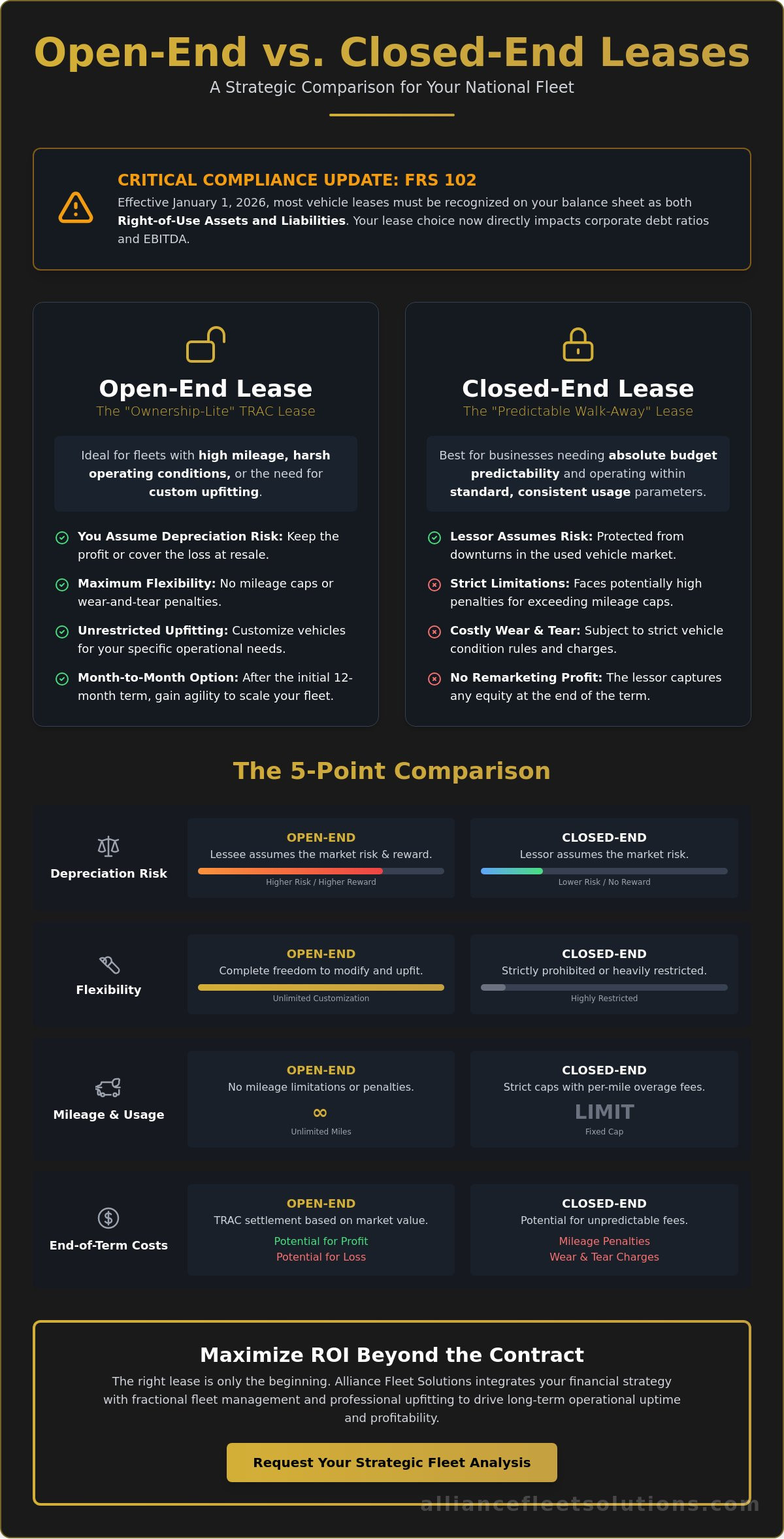
The 5-Point Comparison: Which Model Fits Your Fleet Strategy?
Choosing the right path requires more than a cursory glance at monthly rates. A data-driven open end vs closed end vehicle lease comparison focuses on five critical pillars: financial risk, mileage requirements, vehicle customization, term flexibility, and the end-of-lease process. In the open-end model, your business essentially owns the resale value. This means you benefit directly from strong used-market prices. Conversely, the closed-end model shifts this risk to the lessor, providing a safety net if vehicle values plummet. For national fleets with unpredictable territories, the flexibility of open-end terms often outweighs the rigid structure of closed-end agreements.
Administrative burdens also differ significantly. Closed-end leases require meticulous inspections for every scratch or dent, while open-end settlements focus purely on the financial gap between the book value and the final sale price. If your project contracts fluctuate on a 12 to 18 month cycle, the ability to swap vehicles without heavy early-termination fees makes the open-end structure a superior strategic asset. You aren’t just leasing a vehicle; you’re choosing how much control you want over your capital and your equipment’s lifecycle.
The Upfitting Conflict: Why Custom Builds Change the Math
Lessors typically discourage specialized upfitting on closed-end leases because niche modifications can lower the general resale value to a broad audience. If you install heavy-duty shelving or specialized refrigeration units, a closed-end lessor may even charge you to remove them at the end of the term. Open-end leases solve this conflict by allowing you to capture the residual value of your professional upfitting. When the vehicle is sold, high-quality modifications often increase the wholesale price, and that extra profit stays in your pocket. This makes the open-end model the logical choice for trade-specific fleets in 2026.
National Mileage Variability and Data-Driven Choices
Predicting mileage for a national fleet is notoriously difficult without telematics. Data from the 2025 calendar year shows that 42% of national fleet vehicles exceeded their initial mileage estimates by at least 10%. In these scenarios, the “Sweet Spot” for closed-end leases is strictly under 15,000 miles per year. If your drivers exceed this, the overage penalties will quickly eclipse any initial savings. Implementing proactive maintenance management is vital in an open-end scenario, as it preserves the physical condition of the asset and maximizes your final remarketing check.
Ready to optimize your acquisition strategy? Connect with our fleet experts to build a custom leasing roadmap that protects your margins.
Beyond the Contract: Maximizing ROI with Alliance Fleet Solutions
Alliance Fleet Solutions views every lease as the foundation of a long-term alliance, not just a line item on a spreadsheet. We provide the technical authority and accessible partnership required to manage high-stakes logistics in a volatile economy. For many mid-sized firms, our fractional fleet management fills a critical leadership gap. You gain the expertise of a seasoned fleet director without the executive-level salary, allowing you to focus on your core business while we handle the complexities of vehicle acquisition and regulatory compliance.
A thorough open end vs closed end vehicle lease comparison only reveals the potential ROI; capturing that value requires expert execution. We integrate every lease with specialized tools to drive down operational expenses. Our fuel management programs are a prime example, often reducing total fleet spend by approximately 12% to 15% through real-time monitoring and unauthorized purchase alerts. Additionally, our national remarketing network utilizes multiple wholesale channels to ensure your open-end disposals achieve top-tier market prices, turning your depreciation management into a competitive advantage.
A Lifecycle Approach to Fleet Optimization
Effective fleet management demands a holistic view of the asset from the day it’s upfitted to the day it’s sold. We use sophisticated telematics data to determine the optimal replacement window for every unit in your fleet. For instance, data from May 2026 suggests that cycling out heavy-duty vans before they reach 120,000 miles can save up to $4,500 in emergency repair costs per vehicle. As a family-owned, national service provider, we maintain a commitment to reliability that larger, purely transactional firms simply cannot match. We treat your fleet as if it were our own, prioritizing uptime and safety at every stage.
Next Steps: Customizing Your Leasing Roadmap
Your next move should be a data-backed evaluation of your current commitments. Every fleet has unique operational DNA, and a standard contract rarely fits. We recommend a comprehensive Fleet Audit before you commit to any new master lease agreement for the 2027 fiscal year. This audit identifies where mileage penalties are draining your margins and where open-end structures could provide better liquidity. We’re ready to build a side-by-side financial comparison that reflects your actual routes and upfitting needs. Contact Alliance Fleet Solutions for a customized lease comparison today.
Secure Your Fleet’s Financial Future
The right choice between lease structures isn’t just a procurement detail; it’s a strategic decision that dictates your company’s balance sheet health. As the January 1, 2026, accounting standards update brings lease liabilities into sharper focus, your open end vs closed end vehicle lease comparison must prioritize long-term ROI over initial monthly costs. Whether you need the flexibility of a TRAC lease to handle high national mileage or the fixed-cost security of a closed-end model for local sales teams, your decision should align with your specific operational DNA.
Alliance Fleet Solutions provides the technical authority to handle this lifecycle from initial professional upfitting to final disposal. Our expert vehicle remarketing ensures you capture every dollar of residual value, while our national reach offers the personalized care of a professional, family-owned partner. We provide the comprehensive lifecycle management required to keep your team on the road and your margins protected. We’re ready to help you navigate the 20% bonus depreciation rules and updated IRS inclusion tables to maximize your fleet’s efficiency.
Optimize your fleet financing with a custom lease comparison from Alliance Fleet Solutions.
Let’s build a fleet that drives your business forward with confidence and clarity.
Frequently Asked Questions
What is the primary difference between an open-end and a closed-end lease?
The primary difference is which party bears the financial risk of the vehicle’s residual value at the end of the term. In an open-end lease, your business is responsible for the difference between the book value and the actual sale price when the vehicle is retired. In a closed-end lease, the lessor assumes this risk, allowing you to walk away from the vehicle as long as mileage and condition requirements are met. This fundamental distinction is the most critical factor in any open end vs closed end vehicle lease comparison.
Is an open-end lease more expensive for a business in the long run?
An open-end lease often proves more cost-effective for high-mileage fleets because it eliminates the rigid overage fees found in other models. While your company takes on the depreciation risk, you also capture 100% of the profit if the vehicle sells for more than its projected book value. Data from the 2025 used vehicle market indicates that well-maintained commercial assets frequently return a positive adjustment to the lessee at the end of the term.
Can I customize a vehicle under a closed-end lease agreement?
Customization is extremely limited in a closed-end agreement because the lessor requires the vehicle to be returned in a stock condition to protect its general resale value. If you install specialized shelving or professional upfitting, you’ll likely face a removal fee or a charge to restore the vehicle to its original state. For businesses that require trade-specific modifications, an open end vs closed end vehicle lease comparison almost always favors the open-end structure for its flexibility.
What happens if I exceed the mileage limit on a closed-end lease?
Exceeding the mileage limit triggers a per-mile penalty that is billed at the end of the contract. According to 2026 industry standards, these rates typically range from $0.15 to $0.25 per mile. If a single van in your fleet exceeds its 45,000-mile limit by 10,000 miles, you’ll face a surprise invoice of at least $1,500. These penalties are designed to compensate the lessor for the accelerated depreciation caused by heavy usage.
How does a TRAC lease benefit a company’s cash flow?
A TRAC lease provides lower monthly payments than traditional financing because you only pay for the projected depreciation of the asset over the term. This structure keeps your capital fluid for other growth initiatives while satisfying the January 1, 2026, FRS 102 reporting requirements. Additionally, the ability to move to a month-to-month arrangement after the initial 12-month period allows you to cycle vehicles out based on your specific cash flow needs.
Which lease type is better for heavy-duty commercial trucks?
Open-end leases are the industry standard for heavy-duty commercial trucks due to their intensive upfitting needs and unpredictable route patterns. These vehicles often operate in harsh environments that would result in massive excessive wear penalties under a closed-end contract. By choosing an open-end model, you maintain total control over the vehicle’s maintenance and disposal timing without the fear of condition-based fines from a lessor.
Do open-end leases require a large down payment?
Open-end leases typically require minimal or no down payment, which preserves your working capital for daily operations. This low entry cost is a strategic advantage for businesses that need to scale a national fleet quickly without exhausting their primary credit lines. It’s a solution-oriented approach that prioritizes your company’s liquidity while ensuring you have the high-quality assets required to maintain uptime and safety.
Can I end an open-end lease early without massive penalties?
You can end an open-end lease early with much more flexibility than a closed-end agreement. Since you’re responsible for the unamortized book value, you simply settle that balance and dispose of the vehicle through a remarketing network. This is particularly beneficial if a project contract ends prematurely or if market data from early 2026 shows a peak in used vehicle values, allowing you to capture a higher return on the asset.