
Your standard depreciation schedule is likely hiding the true cost of your assets and setting you up for a budget shortfall. Calculating fleet vehicle depreciation requires more than a simple percentage drop; it demands an “Upfit-Adjusted Basis” to account for the specialized equipment that makes your trucks functional. You understand the frustration of seeing a resale projection miss the mark by thousands, especially when custom upfitting costs aren’t properly factored into the depreciable life of the asset.
We’ll help you master the strategic variables needed to project vehicle value loss and optimize your total cost of ownership. This guide breaks down the 2026 tax landscape, including the 100% bonus depreciation for qualified property and the new $2,560,000 Section 179 expensing limit. You’ll learn how to choose between straight-line and accelerated methods to improve your cash flow management. We’ll also provide a reliable formula for TCO projections that ensures your remarketing timing is always data-driven and your acquisition strategy remains lean.
Key Takeaways
- Learn how to establish an “Upfit-Adjusted Basis” that includes professional upfitting and telematics to reflect the true operational value of your assets.
- Master the core formulas for calculating fleet vehicle depreciation to ensure your total cost of ownership projections are grounded in 2026 market realities.
- Determine whether straight-line or accelerated depreciation methods best support your company’s cash flow management and long-term financial goals.
- Discover how accurate data tracking streamlines the vehicle remarketing process and simplifies the transition between acquisition and disposal.
Understanding the Role of Depreciation in Fleet TCO
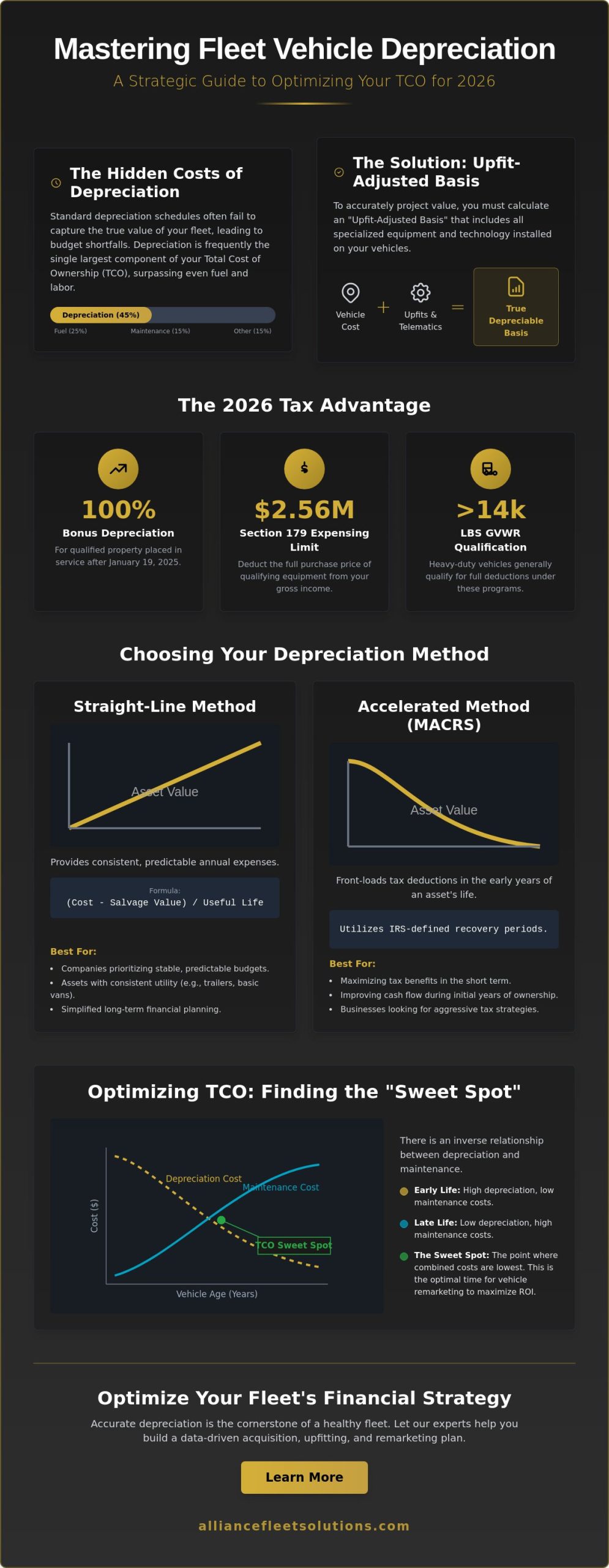
Depreciation isn’t just a line item on a tax return. It represents the steady, inevitable erosion of your fleet’s market value over time. For commercial operators, this decline stems from a combination of high mileage, mechanical wear, and shifting market demand for older models. In 2026, calculating fleet vehicle depreciation accurately has become the cornerstone of financial health for any logistics or service business. It often accounts for the single largest portion of your Total Cost of Ownership (TCO), frequently surpassing fuel or labor costs. While a repair bill is immediate and visible, depreciation is a silent drain on your balance sheet that only reveals its full impact at the point of remarketing.
Successful managers must distinguish between book depreciation and tax depreciation to maintain expert control over their budgets. Book depreciation helps you understand the actual operational value of your vehicles for internal financial reporting and cash flow management. Tax depreciation, often governed by the Modified Accelerated Cost Recovery System (MACRS), serves as a recovery mechanism to reduce your taxable income. Balancing these two perspectives allows you to make informed decisions about when to cycle a vehicle out of service. By Understanding Depreciation Methods, you can better project the residual value of your assets and avoid the budget shortfalls that occur when a truck sells for less than its remaining book value.
Why 2026 is a Critical Year for Depreciation Strategy
The 2026 fiscal landscape offers unique opportunities for fleet optimization. According to verified tax data from March 2026, 100% bonus depreciation remains available for qualified property placed in service after January 19, 2025. This is particularly relevant for heavy-duty assets; vehicles with a gross vehicle weight rating (GVWR) of more than 14,000 pounds generally qualify for this full deduction or the standard Section 179 expensing limit of $2,560,000. Total Cost of Ownership is the comprehensive sum of all expenses associated with an asset from the moment of acquisition until its final disposal. Market volatility remains a factor, as used vehicle prices have shown an average fluctuation of 12% in the first quarter of 2026, making conservative residual estimates essential for long-term reliability.
Depreciation vs. Maintenance Costs
There is a natural, inverse relationship between the cost of owning a vehicle and the cost of keeping it operational. During the first three years of a vehicle’s life, depreciation is aggressive while maintenance requirements are minimal. As the vehicle ages and the depreciation curve flattens, the cost of preventive maintenance and mobile repairs begins to climb. Finding the “sweet spot” usually occurs when the combined cost of depreciation and maintenance reaches its lowest point. To maximize your ROI, you need a strategy that identifies this threshold before repair costs exceed the vehicle’s remaining value. For a deeper look at managing these operational expenses, explore our Strategic Guide to Maintenance Management for Business Fleets in 2026.
Choosing Your Method: Straight-Line vs. Accelerated Depreciation
Selecting the right approach for calculating fleet vehicle depreciation is a strategic decision that impacts your bottom line as much as your maintenance schedule. You must choose between methods that provide consistent, predictable expenses and those that front-load tax benefits. While market depreciation, the actual drop in resale value, follows its own curve, your accounting method defines how you recover costs on paper. In 2026, the gap between market value and book value can be significant, especially for specialized trucks with custom upfitting. Managing this discrepancy is vital for maintaining accurate financial statements and ensuring you don’t face a “gain on sale” tax hit when you retire an asset.
Straight-Line Calculation Basics
The straight-line method offers the most stability for long-term fleet budgeting. The formula is straightforward: subtract the salvage value from the purchase price and divide by the asset’s useful life. For example, a $50,000 delivery van with a $10,000 salvage value and a five-year life results in a consistent $8,000 annual expense. This predictability makes it the preferred choice for service businesses that prioritize steady financial statements over aggressive tax deductions. It works best for assets with consistent utility throughout their lifecycle, such as trailers or basic service vans. If you’re looking to simplify your fleet’s financial outlook, our experts can help you refine your vehicle acquisition strategy to match this steady model.
MACRS and Accelerated Recovery
Most commercial fleets rely on the Modified Accelerated Cost Recovery System (MACRS) for tax purposes. This method front-loads depreciation, reflecting the reality that most vehicles lose value fastest in the first 24 months. According to IRS guidelines on vehicle depreciation, businesses must typically use the actual expense method to claim these deductions. In 2026, the tax code is particularly favorable for fleet owners. The Section 179 expensing limit has reached $2,560,000, and 100% bonus depreciation remains available for qualified property placed in service after January 19, 2025.
For vehicles over 6,000 lbs GVWR, the five-year recovery period is the standard. However, you must account for the “half-year convention.” This rule treats all property placed in service during the year as if it were acquired at the midpoint, which effectively spreads a five-year recovery over six calendar years. Using accelerated methods is a powerful strategy during high-revenue years to offset tax liability. It aligns your tax savings with the period of highest vehicle reliability, helping you maximize cash flow while the asset is most productive.
Factoring in Upfitting and Custom Configurations
Most fleet managers make the mistake of using the vehicle’s window sticker price as the starting point for their accounting. However, a commercial asset’s true value includes every dollar spent to make it road-ready. When calculating fleet vehicle depreciation, you must establish an “Adjusted Basis.” This figure aggregates the purchase price, sales tax, delivery charges, and the cost of all permanent modifications. Failing to include these specialized investments leads to an undervalued asset on your books and a distorted view of your total cost of ownership. Accurate tracking ensures that your financial projections reflect the specialized nature of your equipment rather than just the base chassis.
You must also weigh the risk of “over-upfitting.” While custom shelving, interior partitions, and branding are essential for operations, they don’t always translate to higher resale value in the secondary market. A niche configuration might be perfect for your specific workflow but could limit the pool of potential buyers during remarketing. To maintain expert control over your budget, separate “removable” equipment, like certain specialized tools or modular bins, from “permanent” upfits that are welded or bolted to the frame. This distinction allows you to decide whether to depreciate the equipment with the vehicle or transfer it to a new asset later in the lifecycle.
Calculating the Upfit-Adjusted Basis
Establishing the correct basis requires a disciplined aggregation of all capitalized costs before the vehicle enters service. Start with the negotiated purchase price and add any non-refundable taxes and registration fees. Next, integrate the costs of Professional Upfitting, including both the hardware and the labor required for installation. Sales tax must be included in the depreciable basis because it is a direct cost of acquisition that cannot be recovered until the asset is sold. By following these IRS guidelines on vehicle depreciation, you ensure your tax recovery matches your actual capital outlay.
Telematics and Technology Depreciation
Modern fleets rely heavily on integrated tech, but these assets follow different depreciation rules than the vehicle itself. Telematics and GPS Solutions often involve a mix of capitalized hardware and expensed software subscriptions. While the hardware units are typically depreciated over a five-year period, the monthly service fees are deducted as operational expenses. If you upgrade your technology mid-lifecycle, you must adjust your basis to reflect the new investment. This proactive approach prevents “ghost assets” from remaining on your books after the hardware has become obsolete or has been replaced by newer, more efficient systems.
Step-by-Step: How to Calculate Your Fleet Depreciation
Moving from theory to practice requires a disciplined approach to your asset ledger. To maintain expert control over your finances, you need a repeatable process that translates vehicle usage into hard numbers. Calculating fleet vehicle depreciation shouldn’t be a once-a-year headache; it should be a monthly ritual that informs your cash flow and acquisition strategy. By following a standardized sequence, you ensure that every truck in your fleet is accounted for using the same rigorous logic, which simplifies audits and improves the accuracy of your total cost of ownership projections.
Follow these five steps to establish a reliable depreciation schedule for your commercial assets:
- Step 1: Establish the Cost Basis. Aggregate the final purchase price, non-refundable taxes, delivery fees, and all professional upfitting costs. This is the “Adjusted Basis” we defined previously.
- Step 2: Determine the Useful Life and Residual Value. Estimate how many years the vehicle will remain in service and its projected salvage value at the end of that term based on current 2026 market trends.
- Step 3: Choose the Depreciation Method. Decide between the stability of the Straight-Line method or the tax-heavy front-loading of MACRS.
- Step 4: Calculate the Annual Depreciation Expense. Apply your chosen formula to the cost basis. If using the actual expense method, ensure you account for the first-year bonus depreciation rules.
- Step 5: Adjust for Business-Use Percentage and Mileage. Per IRS rules verified in March 2026, you must use the vehicle more than 50% for business to claim Section 179. If use is less than 100%, multiply your annual expense by the business-use percentage to find your deductible amount.
Determining Accurate Residual Values
Your salvage value estimate is the most volatile variable in your calculation. To get this right, you must look beyond simple age and consider the mechanical health of the asset. Implementing robust Fuel Management Programs can significantly improve engine longevity, which directly translates to a higher resale price. In 2026, vehicles with documented maintenance and fuel efficiency records command a 15% premium in the secondary market. Adjust your residual projections downward for high-mileage routes, especially if they exceed the 2026 standard mileage rate expectations of 72.5 cents per mile.
Applying the Calculation to Your Budget
Once you have your annual figures, divide them by 12 to integrate depreciation into your monthly cash flow statements. This provides a realistic view of your “paper” expenses versus your liquid cash. Use this data to build a standardized depreciation schedule that triggers replacement alerts when an asset’s book value approaches its salvage value. This proactive documentation is your best tool for justifying vehicle replacement requests to stakeholders. If you need assistance building these projections, our fleet management team can help you streamline your asset lifecycle from acquisition to disposal.
Maximizing ROI Through Strategic Remarketing and Leasing
The final phase of any successful asset lifecycle is the transition from operation to recovery. While calculating fleet vehicle depreciation provides the roadmap for your monthly expenses, the actual remarketing of the vehicle determines your final return on investment. If your book value is higher than the market price at the time of sale, you face a capital loss that can disrupt your acquisition budget for the following year. Conversely, if you’ve maintained the asset well and projected its value conservatively, you can recapture equity to fund your next purchase. Our approach treats remarketing not as an afterthought, but as a strategic exit that requires precision data from day one.
The Remarketing Connection
The gap between an asset’s “Book Value” and its “Market Value” is the most critical metric for a fleet manager. In the 2026 secondary market, specialized vehicles that show consistent preventive maintenance records often sell for a 10% premium over the industry average. To minimize the risk of a loss on disposal, you must align your depreciation methods with actual market trends. Alliance Fleet Solutions optimizes this phase by leveraging deep industry connections to recover maximum capital for our clients. We ensure that your vehicles are presented to the right buyers at the right time, effectively closing the loop on your total cost of ownership.
Leasing as a Depreciation Management Tool
Leasing offers a unique way to manage the financial burden of a declining asset. In a closed-end lease, the lessor assumes the depreciation risk, which is ideal for businesses that want predictable monthly costs and no responsibility for the vehicle’s eventual sale. However, high-growth fleets often prefer the “Open-End Lease” or TRAC (Terminal Rental Adjustment Clause) lease. This structure allows your business to treat the asset similarly to a purchase for tax purposes while maintaining the flexibility to adjust the lease term based on actual usage and mileage. It’s a powerful tool for maintaining expert control over your balance sheet.
Managing these variables can be overwhelming for growing companies. This is where fractional fleet management services provide a distinct advantage. By outsourcing the technical aspects of calculating fleet vehicle depreciation and remarketing, you gain access to expert-level analysis without the overhead of a full-time department. We help you balance the immediate tax benefits of 100% bonus depreciation with the long-term goal of high resale value. Partner with Alliance Fleet Solutions to optimize your fleet lifecycle and tax position.
Master Your Fleet’s Financial Future
Accurate financial planning transforms depreciation from a hidden cost into a strategic advantage. By establishing an upfit-adjusted basis and aligning your recovery methods with 2026 tax regulations, you protect your company’s cash flow from unexpected shortfalls. Mastering the process of calculating fleet vehicle depreciation ensures that your disposal timing is always data-driven; this allows you to recapture maximum equity during the remarketing phase.
Alliance Fleet Solutions has been family-owned and operated since 2018, providing the technical authority you need to navigate these complex variables. We offer national coverage for professional upfitting and maintenance management, alongside deep expertise in both open-end and closed-end leasing structures. Our team acts as a dedicated partner to streamline your asset lifecycle and eliminate the stress of inaccurate projections.
Get a Customized Fleet Cost Analysis from Alliance Fleet Solutions and take full control of your total cost of ownership today. Your fleet’s efficiency is our priority, and we’re ready to help you build a more resilient, profitable operation.
Frequently Asked Questions
What is the most common depreciation method for commercial truck fleets?
MACRS is the most common method for commercial truck fleets for tax purposes. It allows you to front-load expenses during the first few years when the vehicle loses value most rapidly. For internal financial reporting, many managers prefer the straight-line method to maintain steady annual projections. This dual approach ensures your tax strategy remains aggressive while your operational budget stays predictable and easy to manage.
Can I depreciate the cost of custom upfitting and shelving?
You can and should depreciate the cost of professional upfitting and shelving by adding them to the vehicle’s cost basis. This adjusted basis includes the chassis price plus sales tax and all permanent modifications. Including these costs ensures your accounting reflects the total capital investment. It also helps in calculating fleet vehicle depreciation accurately to avoid undervaluing your specialized assets on the company balance sheet.
How does Section 179 interact with standard fleet depreciation in 2026?
Section 179 allows you to expense up to $2,560,000 of the vehicle’s cost immediately in 2026. This deduction is taken before applying standard MACRS depreciation to the remaining balance. If you purchase a truck over 14,000 lbs GVWR, you might also qualify for 100% bonus depreciation as of March 2026. This combination provides a powerful first-year tax shield for high-growth logistics companies.
What happens to depreciation if I sell a fleet vehicle earlier than expected?
Selling a vehicle earlier than expected often results in a depreciation recapture if the sale price exceeds the remaining book value. This gain is taxed as ordinary income in the year of the sale. It highlights why setting realistic residual values is so important. If your calculations are too aggressive, you’ll face an unexpected tax bill at the point of remarketing.
How does high mileage affect the calculated depreciation of a commercial van?
High mileage significantly lowers the residual value of a commercial van, even if your accounting method remains unchanged. While MACRS follows a set schedule, your operational calculating fleet vehicle depreciation must account for the 72.5 cents per mile standard set in April 2026. Vans exceeding 25,000 miles per year typically see a 15% steeper decline in market value compared to low-mileage units.
Is there a difference between depreciation for electric vehicles (EVs) and diesel trucks?
There is currently no difference in IRS recovery periods; both EVs and diesel trucks typically follow a five-year MACRS schedule. However, EVs often qualify for specific federal tax credits that can lower the initial cost basis. You must still track the residual value carefully, as the secondary market for used EV batteries is currently more volatile than the market for traditional diesel engines.
Can I change my depreciation method once I have started using it for an asset?
You generally cannot change your depreciation method once you’ve filed your first tax return for that specific asset. The IRS considers a change in method a change in accounting principle, which usually requires filing Form 3115. It’s vital to choose the right strategy during the acquisition phase to ensure your long-term cash flow goals align with your tax recovery schedule.
How do I calculate depreciation for a vehicle used for both business and personal use?
To calculate depreciation for a split-use vehicle, you must multiply the total annual depreciation by the business-use percentage. According to IRS rules verified in March 2026, you must use the vehicle more than 50% for business purposes to qualify for Section 179. Maintaining a detailed mileage log is essential to substantiate these claims and protect your deductions during a potential audit.