
The lowest monthly payment on a truck lease might actually be your most expensive financial move once you reach the end of the term. While a new Freightliner Cascadia currently leases for approximately $3,200 in May 2026, the real cost depends on who carries the residual risk. Choosing between a TRAC lease vs fair market value lease for trucks isn’t just a matter of paperwork; it’s a strategic decision about your fleet’s lifecycle. You’ve likely felt the frustration of unpredictable resale values or the bite of high mileage penalties that disrupt your bottom line.
We understand that managing a fleet in 2026 requires more than just keeping trucks on the road. With total monthly operating costs for leased semi-trucks now reaching up to $13,100, you need a predictable acquisition strategy that aligns with your specific tax goals. This guide promises to help you navigate the new FRS 102 accounting standards and Revenue Procedure 2026-15 depreciation limits to minimize your total cost of ownership. We’ll compare the 100% tax-deductible benefits of TRAC leases against the walk-away flexibility of FMV options to ensure your fleet remains a strategic asset rather than a liability.
Key Takeaways
- Determine whether you or the lessor should manage vehicle lifecycle risk by comparing the fundamental structures of a TRAC lease vs fair market value lease for trucks.
- Learn how the “Terminal Adjustment” in open-end leasing can either return equity to your business or create a final payment liability based on resale performance.
- Evaluate the “walk-away” convenience of FMV leases to keep your fleet modern without the burden of vehicle remarketing or disposal logistics.
- Identify which model suits your operation’s mileage needs, contrasting the unlimited flexibility of TRAC leases with the contractual limits of standard FMV agreements.
- Discover how to align your leasing choice with 2026 accounting standards to protect your balance sheet and maximize total fleet uptime.
Understanding the Fundamentals: TRAC vs. Fair Market Value (FMV) Leases
Effective January 1, 2026, updates to FRS 102 have fundamentally changed how fleet managers view their balance sheets. Most leases now require recognition as both a right-of-use asset and a lease liability. This shift makes the choice of a TRAC lease vs fair market value lease for trucks more than a simple monthly payment calculation. It’s a strategic decision regarding asset control. Understanding Leases in this new regulatory environment requires a clear grasp of who carries the financial weight of a truck’s depreciation. We’ve seen that the choice you make today determines your fleet’s agility three to five years down the road.
The core distinction between these two structures lies in the residual value risk. In a TRAC lease, the fleet operator takes on the risk and potential reward of the vehicle’s eventual sale price. In contrast, a Fair Market Value (FMV) lease places that burden squarely on the lessor. This choice dictates your cash flow at the end of the term and impacts your total cost of ownership over the truck’s lifecycle. It’s about deciding whether you want to manage the vehicle’s disposal or simply return the keys and move on to the next acquisition.
What is a TRAC Lease for Trucks?
A TRAC lease is an open-end agreement specifically designed for commercial motor vehicles. At the start of the contract, you and the lessor agree on a projected residual value. When the lease ends, the truck is sold. If the sale price exceeds that residual value, you receive the surplus as a rental adjustment. If it sells for less, you pay the difference. This structure offers significant tax advantages under Revenue Procedure 2026-15. Monthly payments are generally 100% deductible as an operating expense, even though you retain many of the benefits of ownership. It’s ideal for high-mileage fleets that want to avoid standard wear-and-tear penalties and maintain control over the remarketing process.
What is a Fair Market Value (FMV) Lease?
The FMV lease is often considered the “true” operating lease because of its closed-end nature. You essentially pay for the use of the truck for a set period. Once the term expires, you can walk away, return the keys, and upgrade to a newer model. You don’t have to worry about market fluctuations or unpredictable resale values. This predictability is vital for fleets that prioritize a modern image and consistent technology refreshes. While these agreements often include mileage and condition restrictions, they provide a fixed cost structure that simplifies budgeting. At Alliance Fleet Solutions, we help you determine if this walk-away flexibility aligns with your operational goals or if the equity potential of a TRAC lease offers a better path to fleet optimization.
The Mechanics of TRAC Leases: Risk, Reward, and Residuals
The open-end structure of a TRAC (Terminal Rental Adjustment Clause) lease operates on a simple premise: you’re betting on the truck’s value at the end of the term. Unlike a traditional loan, you aren’t paying down the entire principal. Instead, you’re paying for the depreciation you expect to occur. When evaluating a TRAC lease vs fair market value lease for trucks, the TRAC model stands out because it allows for 100% tax deductibility while giving you the right to any equity the vehicle earns. Reviewing the leasing pros and cons helps clarify that this benefit comes with the responsibility of the vehicle’s final sale price.
This mechanic is why the TRAC model is the standard for over-the-road (OTR) trucking. These fleets often put 120,000 miles or more on a truck annually. A standard closed-end lease would typically crush these operators with mileage penalties. By using a TRAC lease vs fair market value lease for trucks, the operator accepts the lower resale value caused by high mileage in exchange for lower monthly payments and zero overage fees. In May 2026, used truck values for 2022 models with under 500,000 miles are holding steady, making the TRAC residual a powerful tool for savvy managers.
The Terminal Rental Adjustment Clause Explained
The “Terminal Adjustment” is the final settlement that occurs once the lease term ends. The lessor sells the vehicle at a public or private auction to determine its actual value. If a 2026 Peterbilt 579 sells for $5,000 more than the predetermined residual value, you receive that $5,000 as a rental credit. However, if the market for used sleepers dips and the truck sells for $3,000 less than the residual, you’re obligated to pay that difference. This creates a powerful incentive to keep your equipment in top condition. If your team keeps the truck in “above-average” condition, that terminal adjustment could be the difference between a neutral exit and a significant cash injection for your next acquisition.
Who Benefits Most from a TRAC Lease?
Fleets that prioritize rigorous maintenance management are the primary winners in a TRAC arrangement. Since you’re the one who profits from a higher resale value, every oil change and preventive inspection directly protects your future equity. It’s also the best fit for vocational trucks with specialized upfitting. These unique builds don’t always fit into the rigid wear and tear buckets of a standard FMV lease. If you want to leverage your operational expertise into financial gain, Alliance Fleet Solutions provides the technical oversight to ensure your trucks hold their value until the final sale.
Fair Market Value (FMV) Leases: Predictability and Technology Refresh
The FMV lease acts as a fixed-cost insurance policy for your fleet’s balance sheet. When comparing a TRAC lease vs fair market value lease for trucks, the FMV option is often the superior choice for urban delivery and “final mile” fleets where mileage stays within predictable bounds. Since these contracts are closed-end, you aren’t responsible for the vehicle’s market value when the term ends. If the used truck market experiences a downturn in late 2026, your business remains unaffected. You simply return the keys on the scheduled date and move into your next unit.
This predictability is essential for businesses following the new FRS 102 accounting standards. As of January 1, 2026, most leases must be recognized on the balance sheet as both a right-of-use asset and a liability. By removing the “Terminal Adjustment” variable found in TRAC leases, you can forecast your fleet expenses with 100% accuracy. This allows for aggressive growth because your capital isn’t tied up in the fluctuating value of aging steel. You pay for the use of the truck, not the risk of its eventual disposal.
Eliminating Residual Value Risk
The greatest advantage of an FMV lease is the transfer of risk. The lessor calculates the residual value at the start; that number is their problem, not yours. In May 2026, used truck values for certain segments have shown significant volatility. An FMV lease protects you from these swings. You don’t need to be a remarketing expert to run a successful logistics company. You focus on your routes and your customers while the lessor handles the disposal of the asset. This “walk-away” freedom is particularly valuable for businesses that don’t have the internal infrastructure to manage vehicle sales.
Modernizing Your Fleet with Refresh Cycles
FMV leases are the engine behind efficient fleet operations. By cycling trucks every 36 to 48 months, you ensure your drivers are always behind the wheel of a vehicle covered by a factory warranty. This strategy eliminates the spike in maintenance costs that typically occurs after the 500,000-mile mark. It also ensures your fleet utilizes the latest fuel management programs integrated into 2026 engine platforms.
Staying current with technology isn’t just about image; it’s about maximizing uptime. While some fear “excessive wear and tear” charges, clear communication and proactive maintenance management easily mitigate these risks. We’ve found that 85% of these charges are avoidable with a consistent inspection schedule. You get the benefit of the latest safety features and fuel-saving aerodynamics without the long-term headaches of ownership. This keeps your fleet at the cutting edge of the industry while maintaining a lean, predictable budget.
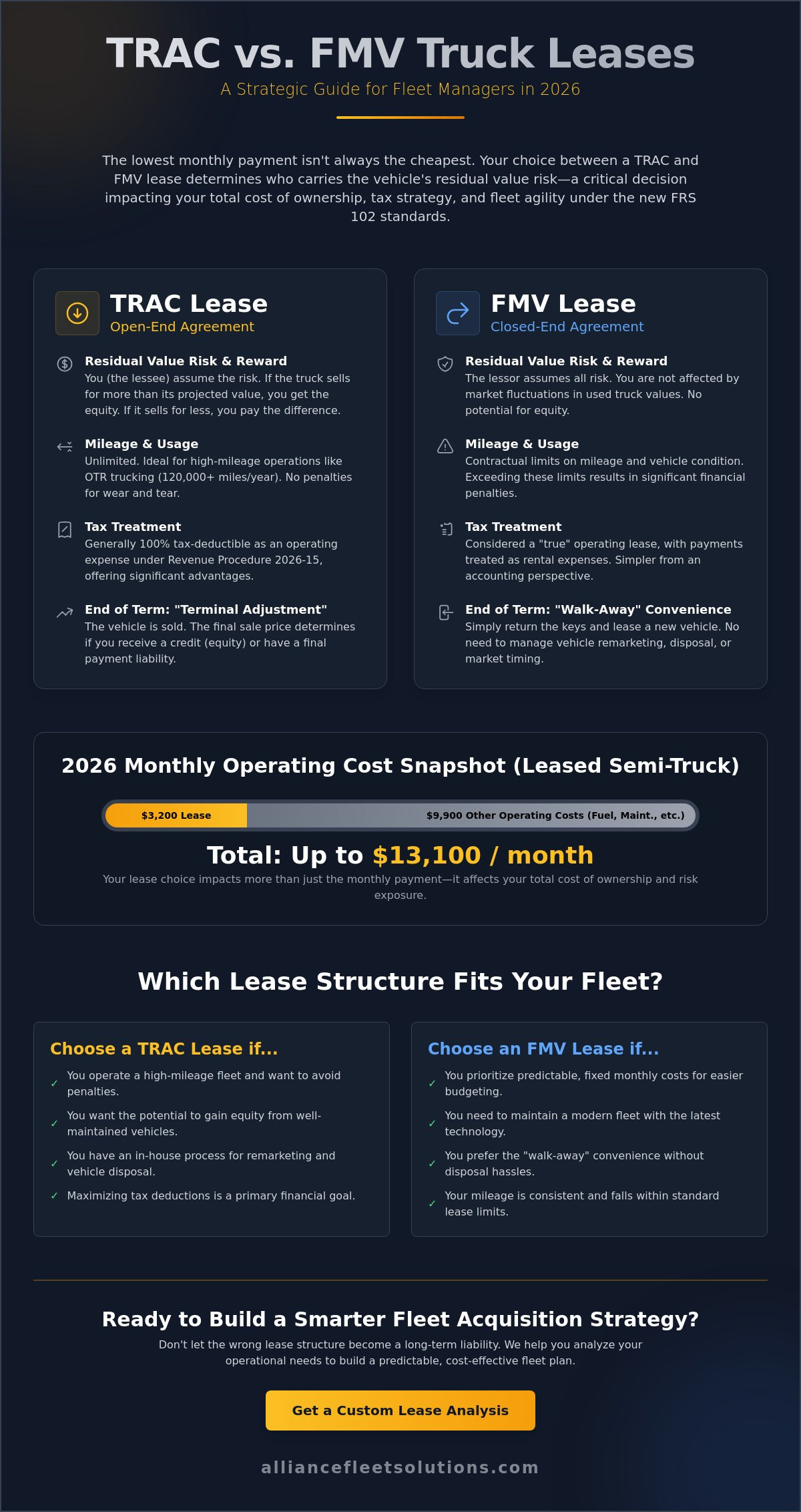
Direct Comparison: Choosing the Right Lease for Your Operational Reality
Deciding on a TRAC lease vs fair market value lease for trucks requires a side-by-side look at your daily operations. While the TRAC model offers unlimited mileage, it ties your final cost to the truck’s condition. If your routes involve rough terrain or high-impact hauling, the “Terminal Adjustment” might be higher than expected. Conversely, an FMV lease provides a safety net with a fixed walk-away date, provided you stay within the contractual mileage limits. For many fleets in 2026, the choice comes down to five critical pillars: mileage flexibility, maintenance control, residual risk, tax strategy, and end-of-term obligations.
- Mileage: TRAC leases have no overage fees, making them ideal for long-haul routes exceeding 120,000 miles annually. FMV leases typically cap mileage at 100,000 or 110,000 miles.
- Maintenance: TRAC leases reward those who invest in upkeep, as a better condition leads to a higher sale price. FMV leases require adherence to strict return standards to avoid “excessive wear” charges.
- End of Term: A TRAC lease requires a mandatory settlement through the sale of the asset. An FMV lease offers the choice to return the truck, purchase it at market value, or renew the lease.
The Impact of Professional Upfitting
Specialized equipment often dictates your leasing path. If your operation requires professional upfitting, such as custom service bodies, cranes, or specialized refrigeration units, a TRAC lease is almost always the better fit. Lessors are often hesitant to offer FMV terms on highly specialized builds because the secondary market for a “niche” truck is limited. With a TRAC structure, you retain the ability to sell the truck to a specific buyer in your industry who values that custom configuration. This ensures you maximize the ROI on your initial upfitting investment rather than paying for the “devaluation” of a custom build in a general auction.
Tax and Accounting Considerations for 2026
The financial landscape in 2026 is shaped by Revenue Procedure 2026-15 and the updated FRS 102 standards. For businesses seeking to maximize immediate deductions, the 100% deductibility of TRAC lease payments remains a powerful tool. However, the first-year depreciation limit of $20,300 for owned or TRAC-leased vehicles must be balanced against the simplicity of FMV operating expenses. Since FRS 102 now brings most leases onto the balance sheet, the “off-balance sheet” benefit of FMV leases has diminished. You should consult your tax advisor to determine if your credit score, which ideally sits at 720 or higher for the best rates, makes a specific structure more advantageous for your debt-to-equity ratios. To see how these structures fit your specific fleet goals, contact our vehicle acquisition team for a custom analysis.
Strategic Fleet Acquisition with Alliance Fleet Solutions
Selecting the right TRAC lease vs fair market value lease for trucks is only the first step in a long-term operational journey. In the fast-paced logistics environment of May 2026, simply securing a monthly payment isn’t enough to protect your margins. You need a partner that understands how vehicle acquisition integrates with daily maintenance, fuel efficiency, and eventually, asset disposal. At Alliance Fleet Solutions, we bridge the gap between financial structures and the mechanical reality of the road. We don’t just provide a lease; we build a strategic alliance that aligns your financing with your specific industry demands.
Our approach centers on maximizing your uptime from the moment a truck is placed in service. By integrating our fleet management services into your acquisition strategy, we ensure that your choice between TRAC and FMV is backed by real-world data. Whether you’re managing a local delivery fleet or a long-haul operation with total monthly operating costs reaching $13,100 per unit, we provide the technical authority to optimize every dollar spent.
Lifecycle Management: From Acquisition to Remarketing
The true value of a TRAC lease is often realized at the very end of the term. Our vehicle remarketing expertise gives you a distinct advantage during the terminal adjustment phase. We leverage our deep industry connections to ensure your trucks sell for the highest possible value, turning a potential liability into a credit for your business. For fleets that require professional upfitting, we streamline the procurement process, ensuring that specialized bodies and equipment are financed correctly within your lease structure. If your internal team is stretched thin, our fractional fleet management offers the expert oversight needed to handle lease administration and telematics monitoring without the overhead of a full-time executive.
The Advantage of a Professional Partnership
Moving beyond transactional leasing allows you to focus on strategic fleet optimization. We look at the total cost of ownership (TCO) rather than just the initial interest rate. In 2026, a credit score of 720 or higher can secure the most competitive terms, but the real savings come from choosing vehicles that hold their value and stay out of the shop. We help you select the right makes and models to ensure your fleet remains modern, safe, and efficient. It’s time to stop guessing which lease structure fits your balance sheet. Request a custom lease analysis from our team today, and let’s build a data-driven acquisition plan that drives your business forward.
Take Control of Your Fleet’s Lifecycle Strategy
Deciding on a TRAC lease vs fair market value lease for trucks is the catalyst for long-term operational efficiency. You now understand that TRAC leases offer a high-mileage solution with equity potential, while FMV leases provide the predictability needed to keep your technology current. Both paths require a deep understanding of 2026 tax regulations and market trends to truly minimize your total cost of ownership. The decision you make today will resonate through your balance sheet for years to come.
Alliance Fleet Solutions has served as a dependable, family-owned partner since 2018. We provide national coverage for commercial fleets, offering everything from professional upfitting to expert vehicle remarketing. Our team doesn’t just process paperwork; we build a strategic alliance designed to keep your trucks on the road and your capital working for you. It’s time to move beyond transactional financing and embrace a solution-oriented approach to acquisition.
Optimize your fleet today with a custom lease analysis from Alliance Fleet Solutions. We’re ready to help you navigate the complexities of 2026 logistics with confidence and expert control.
Frequently Asked Questions
Can I convert a TRAC lease to an FMV lease mid-term?
No, you can’t typically convert these structures mid-contract because they represent different legal and tax frameworks. A TRAC lease is an open-end agreement while an FMV lease is closed-end. Attempting a change would usually involve an early termination of the current lease and the initiation of a new contract. This process often incurs penalties or requires a full buyout of the existing asset at its current book value.
Does a TRAC lease count as debt on my company balance sheet?
Yes, under the FRS 102 updates effective January 1, 2026, most commercial leases must be recognized on the balance sheet. You’ll record both a right-of-use asset and a corresponding lease liability. This change ensures greater transparency for lenders and stakeholders. While a TRAC lease vs fair market value lease for trucks may have different tax treatments, both now impact key financial metrics like your debt-to-equity ratio and EBITDA.
What is the “Terminal Adjustment” in a TRAC lease?
The Terminal Adjustment is the final settlement that occurs once the truck is sold at the end of the lease term. It’s the mechanism that reconciles the actual sale price with the projected residual value set at the start of the contract. If the truck sells for more than the residual, you receive a credit. If it sells for less, you’re responsible for the deficiency. This makes maintenance management critical to your final payout.
Are mileage penalties common in FMV leases for heavy-duty trucks?
Yes, mileage penalties are a standard feature of Fair Market Value leases. These contracts typically include a set annual limit, such as 100,000 miles, to protect the lessor’s residual value. If you exceed these limits, you’ll face per-mile overage charges that can significantly increase your total cost. If your routes are unpredictable or exceed 120,000 miles annually, a TRAC lease is usually the more cost-effective choice because it lacks these specific penalties.
Which lease type is better for trucks with specialized upfitting?
A TRAC lease is almost always superior for trucks with professional upfitting or niche configurations. Because FMV leases rely on a predictable secondary market, lessors often avoid them for highly customized vehicles. A TRAC structure allows you to retain control over the remarketing process. This ensures you can target buyers who specifically value your crane, service body, or refrigeration unit rather than selling at a general auction where custom features may be undervalued.
Can I purchase the truck at the end of an FMV lease?
Yes, most FMV agreements provide an option to purchase the vehicle at its current fair market value once the term expires. Unlike a TRAC lease where the residual is fixed upfront, the FMV purchase price is determined by the market conditions at the time of the lease end. This gives you the flexibility to either walk away or keep the asset if it still fits your operational needs and has been well-maintained.
How does the 2026 tax code affect commercial truck leasing?
Revenue Procedure 2026-15 provides the current framework for 2026, establishing a first-year depreciation limit of $20,300 for vehicles where additional depreciation applies. It also outlines lease inclusion tables that may reduce your deductible lease payments to maintain equivalence with ownership limits. These regulations mean your choice in the TRAC lease vs fair market value lease for trucks debate must be vetted by a tax professional to maximize your specific business deductions.
Is a TRAC lease the same as a $1 buyout lease?
No, these are fundamentally different financial products. A $1 buyout lease is a finance lease where the intent is full ownership from the start, often resulting in higher monthly payments. A TRAC lease is technically an operating lease for tax purposes, allowing for lower monthly payments and 100% tax deductibility of those payments. The TRAC model uses a variable residual value that you must settle at the end, whereas a $1 buyout has a fixed, nominal conclusion.