
Owning a heavy-duty fleet in 2026 isn’t a sign of operational strength; it’s often a strategic anchor that drags down your balance sheet. When 15% of your vehicles are sidelined by unpredictable maintenance or part shortages, your service delivery suffers and your capital remains locked in depreciating assets. You already know that capital tied up in a truck is capital that isn’t growing your company. Transitioning to a model for leasing trucks for business allows you to shift from reactive firefighting to proactive fleet optimization.
At Alliance Fleet Solutions, we believe your vehicles should be your greatest asset, not your biggest headache. We’ll help you master commercial procurement to maximize uptime and secure predictable monthly expenses that protect your cash flow. This guide examines the technical frameworks for lowering your total cost of ownership and building a high-performance fleet that’s customized for your specific logistics needs. You’ll learn how to streamline your acquisition process and ensure every truck in your alliance is ready for immediate, high-stakes use.
Key Takeaways
- Transition from CapEx to OpEx to stabilize cash flow and protect your fleet growth against 2026 market volatility and vehicle shortages.
- Evaluate the strategic differences between open-end and closed-end leases to find the ideal balance of flexibility and financial predictability for your specific routes.
- Calculate the true Total Cost of Ownership (TCO) by integrating maintenance management into your strategy to eliminate hidden operational expenses and maximize uptime.
- Understand the strategic advantages of leasing trucks for business by integrating professional upfitting into your agreement to ensure every vehicle is job-ready from day one.
- Move beyond transactional contracts by leveraging fractional fleet management to gain expert oversight and a competitive edge in your logistics operations.
The Business Case for Leasing Trucks in 2026
The logistics industry entered 2026 facing a 15% increase in vehicle acquisition costs compared to three years prior. For many carriers, the traditional model of purchasing assets outright no longer aligns with the need for agility. Modern leasing trucks for business provides a strategic pivot from capital expenditure (CapEx) to operational expenditure (OpEx). This shift allows fleet managers to convert massive upfront investments into predictable monthly payments, which is vital when navigating the current market volatility. By opting for a lease, you avoid the 18 month lead times often seen with direct factory orders, as lessors maintain established pipelines with major OEMs.
Staying competitive in 2026 requires access to the latest powertrain technologies and safety suites. Rapid advancements in autonomous assists and zero emission mandates mean a truck purchased today may be technologically obsolete by 2030. Understanding Vehicle leasing fundamentals helps businesses realize they’re paying for the use of the vehicle during its most productive years, rather than its entire lifecycle. This strategy ensures your drivers are behind the wheel of reliable, high uptime equipment that attracts top talent and satisfies strict regulatory standards while preserving your existing credit lines for core business investments like warehouse automation or staff expansion.
Preserving Capital and Improving Cash Flow
Cash is the lifeblood of any logistics operation. Conventional financing often requires down payments of 10% to 20%, which can drain reserves needed for fuel, payroll, or emergency repairs. Leasing typically requires minimal upfront capital, accelerating your ability to scale from five power units to fifteen in a single quarter. From a tax perspective, lease payments are often fully deductible as business expenses, providing a more immediate benefit than long term depreciation schedules. In the current economic climate, fleet liquidity refers to a company’s ability to reallocate capital from depreciating assets into revenue generating growth opportunities without disrupting daily operations.
Mitigating the Risks of Vehicle Depreciation
Heavy duty trucks are notorious for steep depreciation curves; they often lose 25% of their market value within the first twelve months of service. Owners frequently find themselves in “upside-down” loans where the remaining debt exceeds the truck’s actual value. When you choose leasing trucks for business, you transfer this residual value risk to the lessor. You simply return the vehicle at the end of the term, avoiding the headache of the secondary sales market. This approach is a cornerstone of efficient fleet operations, as it protects your balance sheet from sudden drops in used equipment prices while maintaining a fleet that’s always under warranty.
Choosing Between Open-End and Closed-End Lease Structures
Selecting the right financial framework is a pivotal step when leasing trucks for business. Your choice between open-end and closed-end structures determines who carries the residual value risk and how you manage vehicle disposal. This decision impacts your liquidity and operational agility through 2026. While both options provide access to modern equipment, they serve very different operational profiles. Large-scale operations often look to established benchmarks, such as the GSA Fleet leasing program, to understand how structured acquisition minimizes waste in massive vehicle inventories.
Open-End Leasing: The Flexible Commercial Standard
Open-end leases are the workhorse of the commercial sector. This model utilizes a Terminal Rental Adjustment Clause, commonly known as a TRAC lease. In simple terms, you and the leasing company agree on a projected residual value at the start. When the lease ends, the truck is sold. If the sale price is higher than the projected value, your business receives a credit. If it’s lower, you pay the difference. This structure is ideal for specialized trucks requiring heavy upfitting, such as service bodies or refrigeration units, where the resale value is highly variable. Since there are no mileage restrictions, it’s the preferred choice for long-haul routes or 24/7 service cycles.
Closed-End Leasing: Predictability for Budgeting
Closed-end leases offer a “walk-away” solution that prioritizes budget certainty. You pay a fixed monthly amount for a set term, typically 36 to 48 months. At the end of the period, you return the keys and walk away without worrying about the vehicle’s market value. This model works best for light-duty or last-mile delivery vehicles that follow predictable routes. While many managers fear excessive wear-and-tear charges, these are easily managed through rigorous preventive maintenance schedules that keep the vehicle in contract-compliant condition. Data from 2024 shows that businesses using closed-end leases for standard delivery vans reduced their administrative overhead by 15% compared to those managing their own remarketing.
To determine the best fit, analyze your annual mileage projections. If your trucks consistently exceed 25,000 miles per year, the “excess mileage” fees of a closed-end lease can become a significant liability. Conversely, if your fleet operates in a high-density urban environment where mileage is low but vehicle turnover is frequent, the predictability of a closed-end lease protects your capital. Remarketing is the final piece of the puzzle. Open-end leases give you the potential to profit from a well-maintained vehicle at the end of the term, while closed-end leases shift all market volatility risk to the lessor.
- Open-End: Best for high mileage, specialized equipment, and companies that want to manage their own equity.
- Closed-End: Best for predictable routes, standard vehicles, and businesses that prefer fixed monthly costs.
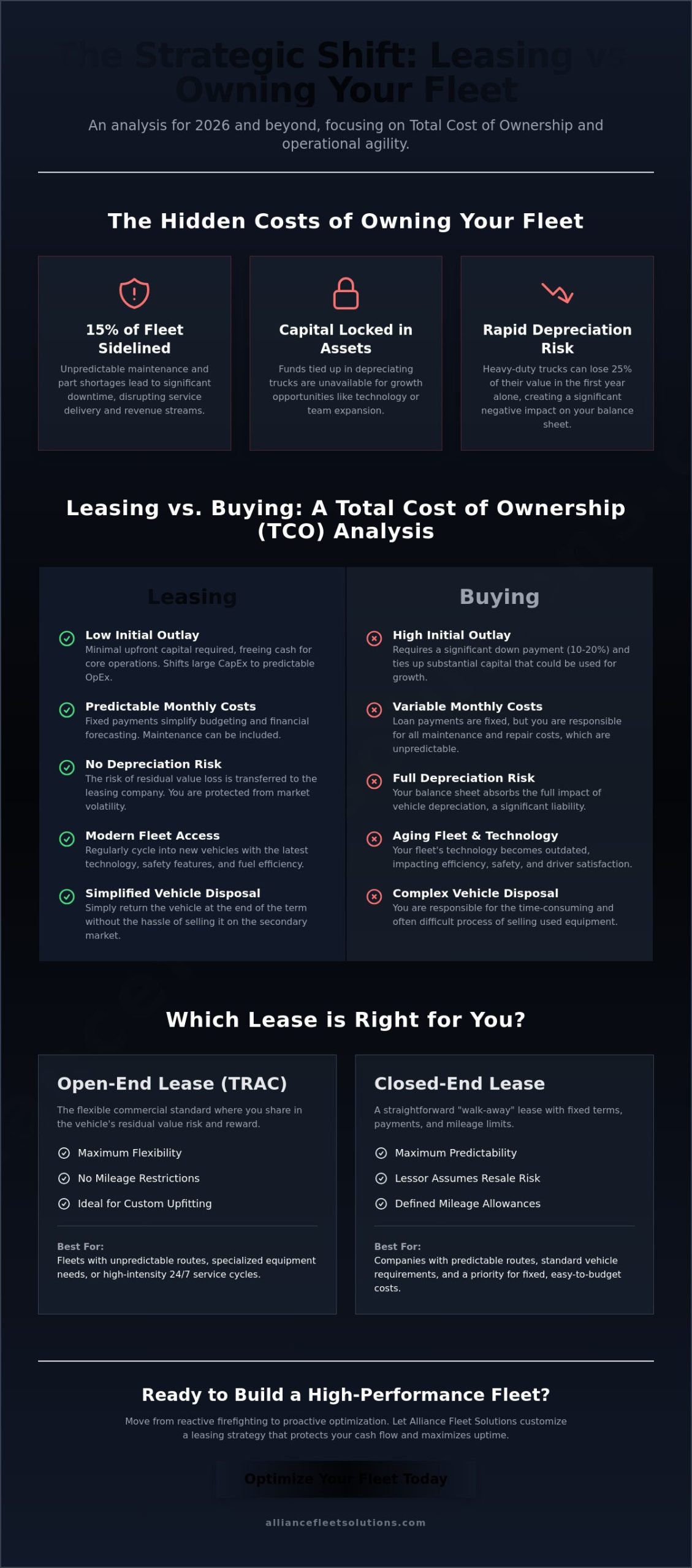
Leasing vs. Buying: Analyzing the Total Cost of Ownership (TCO)
The sticker price of a new vehicle represents roughly 30% of its total cost over a five-year lifecycle. When leasing trucks for business, smart fleet managers look beyond the initial capital outlay to evaluate the Total Cost of Ownership (TCO). Owning an aging asset often feels like building equity, but in the heavy-duty sector, that equity frequently dissolves into rising repair bills and diminished resale value. A lease structure transforms these volatile variables into a fixed, predictable line item.
The Hidden Costs of Fleet Ownership
Ownership forces your team to manage a complex web of secondary expenses that drain internal resources. These “soft costs” often include:
- Administrative hours spent tracking service intervals and regulatory compliance.
- Premium rates for emergency roadside assistance and towing.
- The logistical burden of vehicle disposal and the risk of fluctuating used-market prices.
Integrating maintenance management into your lease agreement stabilizes your monthly spend. It removes the guesswork from your budget. Every hour your truck spends in a bay is an hour it isn’t generating revenue. Downtime isn’t just a pause in your schedule; it’s a direct leak in your company’s net profit margin.
Uptime and Operational Reliability
Reliability is the primary engine of growth for logistics and service firms. By leasing trucks for business, you ensure your drivers are behind the wheel of late-model equipment equipped with the latest safety technology. This proactive approach prevents the “maintenance spike” that typically occurs between years four and five of a truck’s life, where major component failures become more frequent.
Operating a younger fleet also allows you to leverage fuel management programs that utilize the high-efficiency engines found in 2025 and 2026 models. Data from 2025 industry reports suggests that newer Class 8 trucks can see fuel efficiency improvements of up to 8% compared to models just five years older.
The common objection to leasing is the lack of “ownership” at the end of the term. However, an eight-year-old truck with 500,000 miles is rarely a financial asset. It’s a liability that requires constant attention. By cycling your fleet every 36 to 48 months, you maximize uptime and ensure your brand is represented by clean, dependable, and efficient equipment. This strategy creates an alliance between your operational needs and your financial goals, keeping your business moving without the drag of depreciating hardware.
Customizing Your Fleet: The Role of Professional Upfitting
Buying a stock truck off the lot often feels like trying to fit a square peg in a round hole. While a standard chassis provides the foundation, it rarely addresses the unique demands of your daily operations. Statistics from 2023 indicate that 82% of fleet managers find stock vehicles insufficient for their specific service requirements without post-purchase modifications. When you’re leasing trucks for business, the most efficient strategy involves integrating professional upfitting directly into your lease agreement. This approach spreads the cost of customizations over the term of the lease, protecting your cash flow while ensuring your team has the right tools from the first mile.
Alliance Fleet Solutions acts as your strategic partner during this phase. We don’t just source vehicles; we engineer solutions. By coordinating with professional upfitters before the vehicle reaches your yard, we eliminate the 14 to 21 days of downtime typically lost when businesses handle modifications after delivery. This proactive management keeps your fleet on the road and generating revenue immediately.
Industry-Specific Configurations
Every industry has a unique blueprint for success. HVAC fleets require specialized shelving and secure refrigerant tank storage to prevent shifting during transit. Construction teams need heavy-duty headache racks and integrated toolboxes that can withstand 2,000 pounds of equipment. For specialized delivery, the focus shifts to high-cycle liftgates and climate-controlled cargo areas. Beyond storage, we prioritize weight distribution. An imbalanced truck can increase tire wear by 20% and significantly extend braking distances, creating a safety liability. Our configurations ensure that every pound is placed strategically to maximize vehicle longevity and driver safety.
Streamlining the Procurement Process
- Step 1: Identifying Needs. We analyze your specific tool, storage, and power requirements to determine the necessary layout.
- Step 2: Engineering Specs. Our team calculates the intended payload to ensure the chassis and suspension are rated for the custom build.
- Step 3: Professional Coordination. We manage the relationship with upfitters, ensuring quality control and adherence to the 2026 safety standards.
- Step 4: Turn-Key Delivery. Your truck arrives fully equipped and branded, ready for its first job-site visit the moment the keys are handed over.
Customization shouldn’t be a headache that delays your operations. It’s a strategic investment in your team’s productivity. Alliance Fleet Solutions simplifies the complex logistics of vehicle prep so you can focus on scaling your business. Our approach turns a standard vehicle into a precision tool designed for your specific workload.
Maximize your operational efficiency by choosing a partner that understands the mechanics of your industry. Contact Alliance Fleet Solutions to start building your custom fleet today.
Strategic Fleet Partnerships: Beyond the Lease Agreement
Successful leasing trucks for business requires a shift in perspective. A lease isn’t just a monthly payment; it’s a strategic alliance. By 2026, the rising complexity of electric vehicle (EV) mandates and advanced telematics makes a “set it and forget it” approach impossible. We act as your expert partner to ensure your fleet remains a profit center, not a drain on resources. This relationship focuses on long-term ROI rather than just the initial procurement cost.
Alliance Fleet Solutions provides the technical backbone your operations require. We don’t just hand over the keys and walk away. We monitor uptime, manage preventive maintenance schedules, and provide the mobile repair capabilities that keep your drivers on the road. Our mobile units bring expertise directly to your yard, which reduces downtime by an average of 24 hours per service event. This proactive stance is what separates a true alliance from a simple transaction.
Fractional Fleet Management Benefits
Small and medium enterprises often lack the budget for a full-time fleet director. With average salaries for these roles exceeding $120,000, many businesses leave their fleet management to chance. Fractional fleet management provides expert oversight at a fraction of that cost. This model allows you to leverage data-driven insights to save thousands annually. By analyzing 2025 fuel consumption and repair data, fractional managers can pinpoint exactly which units are underperforming.
- Data-Driven Decisions: We use real-time diagnostics to prevent catastrophic failures before they happen.
- Optimized Replacement: Stop guessing when to trade in. We identify the perfect window to switch units before maintenance costs spike.
- Expert Compliance: We handle the regulatory paperwork and safety audits so you stay legal and operational.
You can learn more about how these services scale with your company through our comprehensive fleet management guide.
The Lifecycle Approach to Leasing
Effective leasing trucks for business involves managing the entire vehicle journey. It starts with procurement and specialized upfitting, but it must end with proactive remarketing. We analyze market data to identify the exact moment a vehicle’s maintenance costs begin to exceed its residual value. According to 2024 industry reports, structured remarketing strategies can recover 8% more capital compared to traditional disposal methods.
A strategic alliance ensures your fleet stays modern and cost-effective. We handle the complexities of the secondary market so you don’t have to. From the first mile to the final sale, we prioritize your bottom line and operational stability. Partner with Alliance Fleet Solutions for your next commercial lease to build a resilient, high-performing fleet that drives your business forward.
Secure Your Competitive Edge for 2026
Navigating the logistics landscape of 2026 requires more than just acquiring vehicles. It demands a calculated strategy that prioritizes uptime and capital efficiency. By analyzing Total Cost of Ownership (TCO) data, savvy managers realize that leasing trucks for business provides a shield against the volatility of the used truck market. Choosing between flexible open-end and closed-end lease structures allows you to tailor your fleet’s lifecycle to match your specific operational demands. Professional upfitting ensures your equipment is ready for industry-specific tasks from day one, reducing the time your assets spend in the shop. Alliance Fleet Solutions offers national coverage and a solution-oriented alliance approach to keep your operations moving. It’s about more than a contract; it’s about a partnership that optimizes every mile. Our team provides the technical authority needed to streamline your fleet acquisition while you focus on growth. Don’t let equipment delays stall your progress in the coming year.
Request a Custom Fleet Leasing Quote from Alliance Fleet Solutions and start building a more resilient fleet today. Your success on the road is our primary mission.
Frequently Asked Questions
Is leasing trucks for business better than buying in 2026?
Leasing trucks for business often proves superior to purchasing in 2026 because it preserves capital and mitigates the risk of rapid technological obsolescence. With the 2027 EPA emissions standards approaching, many fleets prefer shorter 36 to 48 month lease cycles to maintain high uptime. This strategy avoids the heavy upfront costs of outright ownership. It ensures your operation stays equipped with the latest fuel efficient models without the burden of long term asset depreciation.
What is the difference between an open-end and closed-end truck lease?
The primary difference lies in who bears the residual value risk at the end of the term. In an open end lease, the business assumes the risk; if the truck sells for less than the projected value, the lessee pays the difference. Closed end leases, which accounted for approximately 65% of small business fleet contracts in 2024, allow you to walk away after the term ends. This provides predictable costs and protects your balance sheet from market fluctuations.
Can I customize a leased business truck with specialized equipment?
You can absolutely customize a leased truck with specialized equipment like liftgates, refrigeration units, or telematics systems. Most lessors allow you to include these upfits in the total capitalized cost of the lease. This spreads the expense over the entire term rather than requiring a large initial investment. We recommend coordinating with your provider early to ensure all modifications meet safety standards and are properly documented for the eventual return or buyout.
How does truck leasing affect my business taxes and balance sheet?
Truck leasing impacts your financials through specific accounting standards like ASC 842, which requires most leases to appear on the balance sheet as right of use assets. Despite this, leasing trucks for business still offers significant tax advantages. Under Section 179 of the tax code, eligible businesses could deduct the full amount of equipment expenses up to a limit of $1.22 million in 2024. Always consult a tax professional to maximize these deductions for your specific 2026 filing.
What happens at the end of a commercial truck lease term?
At the end of the term, you typically have three options: return the vehicle, purchase it at a predetermined price, or extend the lease. If you choose to return the truck, it must meet the fair wear and tear guidelines specified in your 2026 contract. Many fleet managers utilize this transition point to upgrade to newer models. This ensures their fleet remains compliant with the latest safety regulations and maintains optimal fuel efficiency across all routes.
How much mileage is typically allowed on a business truck lease?
Standard commercial leases usually allow for 15,000 to 20,000 miles per year for light duty trucks and significantly more for heavy duty assets. If your routes exceed these limits, you can negotiate a high mileage lease upfront to avoid per mile overage charges. These charges often range from $0.15 to $0.30 per mile depending on the vehicle class. Accurate route planning helps you select a mileage tier that maximizes your return on investment.
Does a commercial lease include maintenance and repairs?
A full service lease includes comprehensive preventive maintenance and repairs, while a net lease leaves those responsibilities to the business. Choosing a full service option can increase vehicle uptime by as much as 20% by ensuring regular inspections. This model converts variable repair costs into a predictable monthly expense. It allows your team to focus on logistics while our alliance handles the technical aspects of keeping your fleet on the road.
What is fractional fleet management and how does it work with leasing?
Fractional fleet management is the practice of outsourcing specific management tasks to an expert partner rather than hiring a full time internal manager. When paired with leasing, this service helps you optimize vehicle lifecycles and streamline maintenance schedules without the overhead of a dedicated department. It provides smaller fleets with the same strategic data and purchasing power as large corporations. This approach ensures your fleet operations remain efficient and scalable throughout the 2026 fiscal year.