
Did you know that according to 2024 ATRI data, repair and maintenance costs surged by 12% in a single year, pushing total operational costs to a record $2.27 per mile? You’re likely feeling the weight of these numbers every time an asset sits idle or a fuel bill arrives. It’s difficult to maintain a steady bottom line when unexpected breakdowns and a lack of visibility into how to reduce total cost of ownership for fleet operations create constant financial friction.
We understand that your fleet is the backbone of your business. Every minute of downtime is a missed opportunity. This 2026 strategic guide provides a clear roadmap to regain control by building a stronger alliance between your procurement, leasing, and maintenance cycles. You’ll learn how to transform your vehicles from mounting expenses into streamlined strategic assets that drive profit.
We’ll break down the specific steps to maximize your uptime, secure higher vehicle resale values, and use fractional management to eliminate the administrative burden that slows your growth. It’s time to move beyond reactive fixes and master a proactive approach to your bottom line.
Key Takeaways
- Identify the “hidden iceberg” of fleet expenses by looking beyond the sticker price to account for administrative time and lost productivity.
- Learn how strategic procurement and professional upfitting can prevent over-spending while significantly extending your vehicle’s service life.
- Master how to reduce total cost of ownership for fleet operations by integrating proactive maintenance management and telematics to eliminate high-cost driver behaviors.
- Evaluate modern lease structures and interest rate impacts to optimize your 2026 cash flow and overall balance sheet health.
- Develop a high-impact remarketing strategy from the day of acquisition to maximize resale value and utilize fractional management for better ROI.
Understanding the TCO Formula: Moving Beyond the Sticker Price
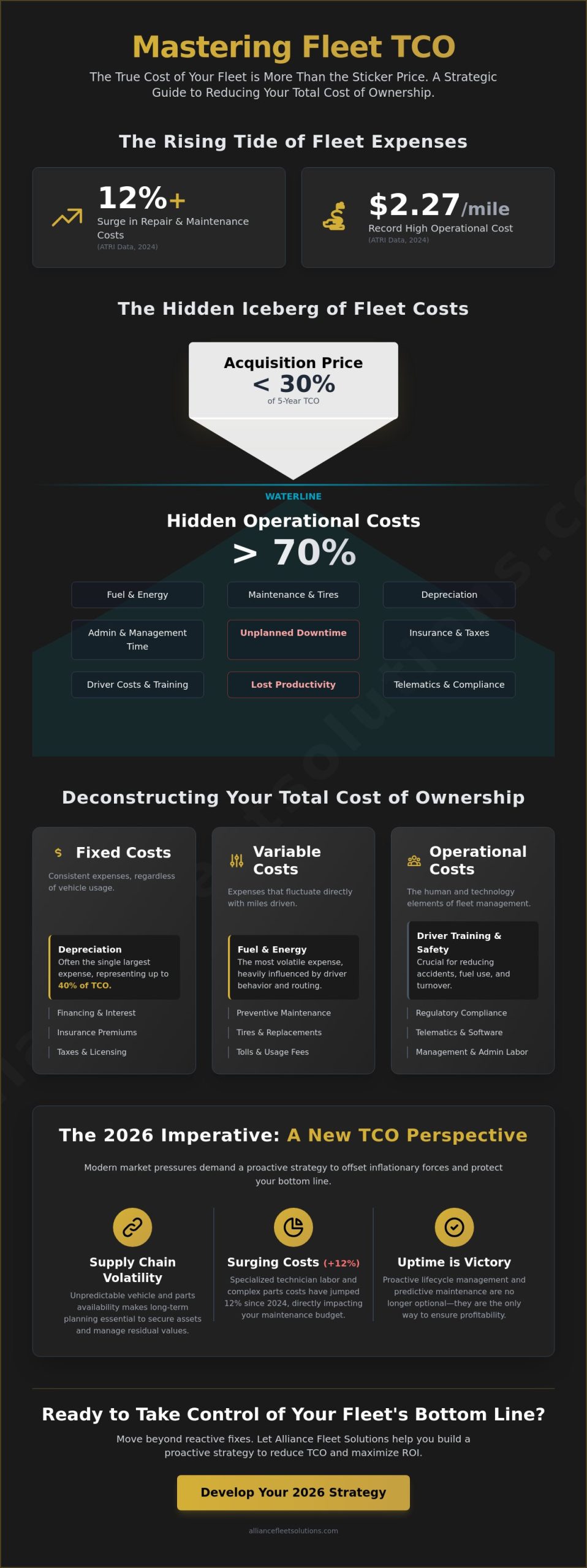
Fleet managers often fixate on the initial purchase price. That’s a dangerous trap. To master What is Total Cost of Ownership?, you must analyze every expense from acquisition through final disposal. TCO represents every cent spent during the vehicle’s life. If you only look at the invoice, you’re only seeing a fraction of the financial commitment. The initial purchase price is frequently the least important factor in long-term ROI because it usually accounts for less than 30% of the total spend over a five-year cycle.
Understanding how to reduce total cost of ownership for fleet assets requires identifying the “Hidden Iceberg.” While acquisition costs are visible above the waterline, the massive bulk of expenses remains submerged. This includes administrative labor, unplanned downtime, and lost productivity. When a truck sits idle in a shop, you aren’t just paying for a repair; you’re losing revenue and damaging client trust. These indirect costs can inflate your budget by 15% to 20% if they aren’t tracked aggressively.
Lifecycle management serves as the primary framework for cost reduction. It treats the vehicle as a dynamic asset rather than a static expense. By planning for the end at the very beginning, you can optimize trade-in cycles and minimize the “tail-end” maintenance costs that plague aging fleets. It’s about finding the sweet spot where reliability and resale value intersect.
The Key Components of Fleet TCO
- Fixed costs: Depreciation is the heavy hitter here, often representing 40% of a vehicle’s TCO. This category also includes financing interest, insurance premiums, and annual taxes.
- Variable costs: These expenses fluctuate with every mile driven. Fuel is the most volatile, followed by preventive maintenance, tires, and tolls.
- Operational costs: These are the “human” and “tech” elements. Driver training, safety compliance, and telematics subscriptions fall into this bucket. They’re essential for maintaining high safety scores and operational uptime.
Why 2026 Requires a New TCO Perspective
The landscape shifted in the last 24 months. Supply chain variability continues to impact residual values, making it harder to predict what a truck will be worth in 2029. Specialized technician labor and parts costs have surged by 12% since 2024, driven by the complexity of modern engines. Implementing efficient fleet operations is no longer a luxury. It’s the only way to offset these inflationary pressures. You need a partner who understands that every hour of uptime is a victory for your bottom line. Success in 2026 demands a proactive stance on maintenance to keep how to reduce total cost of ownership for fleet at the center of your strategy.
Strategic Procurement and Upfitting: Lowering Costs at the Source
Reducing expenses starts long before a vehicle hits the road. Strategic procurement is the foundation of how to reduce total cost of ownership for fleet operations because it locks in your primary fixed costs. Many operators make the mistake of over-specifying, choosing heavy-duty platforms for light-duty tasks. This error can increase fuel consumption by 12% to 18% over the life of the asset. Conversely, under-powered vehicles face accelerated wear on transmissions and braking systems. By understanding total cost of ownership, you can select assets that align perfectly with your duty cycles, ensuring you don’t pay for capacity you’ll never use.
Asset selection also impacts your team’s productivity and retention. Drivers who work in custom-configured vehicles that prioritize ergonomics and ease of access are less likely to experience fatigue or workplace injuries. This directly reduces driver turnover, which currently costs the industry an average of $8,000 to $12,000 per new hire in recruitment and training expenses. When the vehicle is a tool that works with the driver rather than against them, operational errors decrease significantly.
The TCO Benefits of Professional Upfitting
Getting the configuration right during the initial build avoids the 20% “correction tax” often seen when fleets must perform mid-cycle reworks. Strategic upfitting can reduce lifecycle maintenance by up to 15% by ensuring components are matched to specific duty cycles. Professional upfitters use weight optimization techniques, such as substituting heavy steel shelving for high-strength aluminum or composite materials. This can shed 200 to 400 pounds from a standard work van, directly improving fuel economy and reducing wear on tires and suspension components. A lighter, better-balanced vehicle is safer to operate and lasts longer in high-demand environments.
Smart Vehicle Sourcing Strategies
Smart sourcing requires a balance between upfront manufacturer incentives and long-term reliability data. While a $5,000 rebate is attractive, it’s quickly negated if that specific model spends an extra 10 days in the shop annually compared to a more reliable alternative. Partnering with fleet management services allows businesses to leverage volume purchasing power that is usually reserved for national carriers. This collaborative approach ensures you get the best price while maintaining a focus on high projected residual values.
The math is simple. A vehicle with a 10% higher residual value at the end of a five-year cycle can lower your effective monthly cost by $150 or more. Analyzing the cost-per-mile difference between light-duty and heavy-duty alternatives reveals that “right-sizing” is the most effective way to protect your margins. If you’re looking to optimize your current acquisition strategy, consulting with a fleet specialist can help identify these hidden savings before you sign your next lease or purchase agreement.
Financial Optimization: Comparing Lease Models for TCO Reduction
Your choice of financing directly dictates your fleet’s liquidity and long-term viability. In the 2026 economic landscape, with interest rates projected to hover between 4.0% and 4.5%, the cost of capital is a primary driver of operational expense. Smart lease structures don’t just provide vehicles; they act as a buffer against market volatility. By selecting a model that aligns with your specific duty cycles, you can effectively master how to reduce total cost of ownership for fleet operations while maintaining a healthy balance sheet.
Professional lease management allows you to hit the “sweet spot” of the vehicle lifecycle. For heavy-duty assets, this typically occurs between months 36 and 48. Replacing assets during this window prevents the 15% to 20% spike in maintenance costs often seen as vehicles transition out of factory warranties. This proactive cycling ensures your capital isn’t tied up in aging, inefficient hardware.
Open-End vs. Closed-End Leasing
Choosing between these two models depends on your mileage predictability and risk tolerance. Alliance Fleet Solutions views this decision as a cornerstone of your financial strategy. Consider these distinctions:
- Open-End Leasing: This model offers maximum flexibility for high-mileage fleets, often exceeding 50,000 miles per year. The lessee assumes the residual value risk but also keeps any equity gain if the vehicle sells for more than its depreciated book value. It’s an ideal choice for specialized industries where vehicle wear is non-standard.
- Closed-End Leasing: This provides ultimate predictability for standard-use fleets. You return the vehicle at the end of the term with no further obligation, provided mileage and condition limits are met. This protects your business from the 30% fluctuations seen in the used truck market over the last four years.
If your routes are consistent and predictable, a closed-end lease simplifies budgeting. If your operations require heavy customization or variable routes, the open-end model prevents restrictive overage fees.
Tax and Accounting Considerations
To truly understand how to reduce total cost of ownership for fleet, you must account for the net impact of tax regulations. Under the Tax Cuts and Jobs Act of 2017, bonus depreciation is scheduled to drop to 20% in 2026. This makes the timing of your acquisitions and the structure of your lease critical for maximizing deductions. Leveraging MACRS (Modified Accelerated Cost Recovery System) allows for accelerated depreciation, which improves cash flow in the early years of an asset’s life.
Operating leases can also offer off-balance sheet financing benefits, though current accounting standards (ASC 842) require most leases to appear on the balance sheet. Despite this, the impact on your debt-to-equity ratio is often more favorable than traditional bank financing. This preserved borrowing capacity is essential for businesses looking to scale quickly without over-leveraging their primary credit lines. By aligning your lease terms with these 2026 tax realities, you can reduce your effective TCO by an estimated 6% through strategic tax positioning alone.
Operational Excellence: Telematics, Maintenance, and Fuel
Operational excellence isn’t a luxury. It’s the most effective way to understand how to reduce total cost of ownership for fleet operations in a competitive market. Implementing maintenance management is the first step toward stopping catastrophic failures before they happen. By moving away from reactive “fix it when it breaks” mentalities, you protect your capital investment and keep your drivers on the road.
Telematics systems provide the visibility needed to correct high-cost driver behaviors. Excessive idling is a silent profit killer. A typical Class 8 truck can burn a gallon of fuel for every hour it idles, which adds thousands of dollars in unnecessary expenses across a fleet annually. Beyond fuel, telematics help reduce “soft costs” by automating compliance tracking and reporting. Manual data entry and record-keeping can consume up to 15% of a fleet manager’s workweek; automation recovers this time for high-value strategic planning.
Preventive vs. Predictive Maintenance
Scheduled check-ups eliminate the 4x cost multiplier associated with emergency repairs. When a component fails on the highway, you’re forced to pay for towing, premium emergency labor rates, and the high cost of expedited parts. Every hour a vehicle spends in an unplanned repair bay costs a fleet an average of $125 in lost revenue and driver wages. Predictive maintenance takes this a step further by using real-time data to identify component failure before it causes downtime. By integrating these digital tools with physical service, you master how to reduce total cost of ownership for fleet assets without sacrificing safety.
Fuel Management and Route Optimization
Fuel accounts for roughly 24% of total fleet operating costs. Strategic fuel management programs directly boost bottom-line profitability by tracking every gallon consumed. These systems identify fuel theft or unauthorized usage by cross-referencing GPS location data with fuel card transactions. Route optimization works in tandem with these programs to reduce unnecessary mileage. Even a 5% reduction in total miles driven significantly lowers tire wear and extends the interval between major engine overhauls. This disciplined approach ensures that every mile driven contributes to your revenue rather than draining your resources.
Stop letting unplanned repairs drain your budget. Partner with Alliance Fleet Solutions to streamline your maintenance and maximize your uptime.
Maximizing Resale Value: Remarketing and Fractional Management
Effective remarketing isn’t a last-minute task performed when a truck finally breaks down. It’s a proactive strategy that begins the day you acquire the asset. If you want to master how to reduce total cost of ownership for fleet operations, you must treat every vehicle as a liquid asset. The difference between a well-timed sale and a desperate liquidation can represent 15% to 20% of the vehicle’s original purchase price. This final stage of the lifecycle is where the most significant TCO gains are often realized or lost.
Strategic Vehicle Remarketing
Choosing the right disposal channel is the first step in maximizing returns. While auctions offer immediate liquidity, retail sales to other small fleets often yield a higher price point. Wholesale remains a middle ground for those needing to move volume quickly. Data from 2024 industry benchmarks suggests that the “replacement window” is narrower than ever. Selling a heavy-duty truck at the 48-month mark, rather than waiting until 60 months, can prevent a 12% spike in maintenance costs that typically occurs as major components reach their end-of-life.
- Maintenance Documentation: A complete, digital service history can add $3,000 to $5,000 to the resale price of a Class 8 truck.
- Physical Condition: Professional detailing and minor cosmetic repairs before listing provide a 200% return on investment by attracting higher-tier buyers.
- Timing: Aligning sales with peak demand cycles in the logistics industry ensures your assets don’t sit idle on a lot.
The Case for Fractional Fleet Management
Many small to mid-sized enterprises struggle with the overhead of a dedicated, six-figure fleet director. Fractional fleet management solves this by providing executive-level expertise on a part-time or project basis. This model allows you to access sophisticated procurement strategies and billing audits without the burden of a full-time salary. It’s a lean approach to how to reduce total cost of ownership for fleet assets by eliminating administrative bloat.
Fractional managers help scale resources based on seasonal demand. If your fleet expands by 25% during the summer months, your management support scales with it. This flexibility ensures that you aren’t paying for unused capacity during slower periods. By outsourcing complex tasks like fuel tax reporting and title management, your internal team can focus on core revenue-generating activities.
Alliance Fleet Solutions acts as your strategic partner throughout this entire journey. We don’t just fix trucks; we build an alliance that prioritizes your uptime and long-term profitability. Our team ensures your maintenance records are impeccable, your replacement cycles are optimized, and your resale value is protected. We provide the technical authority and mobile capabilities needed to keep your fleet running at peak efficiency from acquisition to the final sale.
Mastering Your Fleet’s Financial Future
Achieving a leaner, more efficient operation in 2026 requires looking past the initial acquisition price. By integrating strategic upfitting and analyzing lease structures, you address the 60% of marginal costs that the American Transportation Research Institute attributes to vehicle operations. Success hinges on operational excellence; utilizing telematics to monitor fuel and maintenance can lower unexpected repair expenses by 25% according to industry benchmarks. Understanding how to reduce total cost of ownership for fleet assets isn’t just about cutting spending. It’s about maximizing every stage of the vehicle lifecycle, from the first mile to the final remarketing sale.
Alliance Fleet Solutions provides the expert guidance you need to navigate these complexities. As a family-owned and operated business, we offer comprehensive lifecycle management that covers everything from initial upfitting to final remarketing. Our team creates flexible leasing structures tailored to your specific business goals, ensuring your capital works as hard as your drivers do. Partner with Alliance Fleet Solutions to optimize your TCO today. Your road to long-term profitability starts with a dependable partner who understands the mechanics of your success.
Frequently Asked Questions
What is the biggest contributor to fleet Total Cost of Ownership?
Depreciation remains the largest contributor to fleet TCO, typically accounting for 35% to 45% of total expenses over a vehicle’s lifecycle. While fuel and maintenance are visible daily costs, the loss in asset value impacts your bottom line most heavily. Alliance Fleet Solutions helps you mitigate this by implementing rigorous preventive maintenance schedules that preserve vehicle condition and maximize resale value.
How does vehicle upfitting impact the resale value of a fleet truck?
Strategic upfitting can increase a truck’s resale value by 10% to 15% when using modular components that appeal to a broad secondary market. Specialized or permanent modifications often limit your buyer pool and can actually decrease value. We recommend high quality, transferable shelving and safety equipment. This approach ensures your fleet remains versatile while protecting your initial investment during the eventual disposal process.
Is it better to lease or buy vehicles to reduce TCO in 2026?
Leasing is often the superior choice for 2026 fleet operations because it enables 36 to 48 month replacement cycles that avoid the high maintenance costs of aging assets. This strategy is a key part of how to reduce total cost of ownership for fleet operations by keeping vehicles under warranty. You gain predictable monthly payments and avoid the risk of sudden market fluctuations in used vehicle values.
How much can telematics realistically reduce fleet operational costs?
Telematics systems typically reduce total operational costs by 10% to 15% through real time monitoring of idling, routing, and driver behavior. Data from the 2025 Geotab State of Fuel Economy report shows that reducing idle time by just 10% can save a medium duty fleet thousands in annual fuel expenses. These insights allow us to streamline your operations and identify mechanical issues before they lead to expensive roadside breakdowns.
What is the difference between an open-end and a closed-end lease for TCO?
The primary difference lies in which party bears the residual value risk at the end of the contract. In an open end lease, the fleet owner is responsible for the difference between the book value and the actual sale price. Closed end leases transfer this risk to the lessor, which provides more budget certainty. Choosing the right structure depends on your annual mileage and how aggressively you manage your vehicle lifecycles.
How do fuel management programs prevent hidden fleet expenses?
Fuel management programs eliminate unauthorized spending and slippage, which industry data suggests accounts for 2% to 5% of total fuel expenditures. These programs provide detailed reporting on every gallon purchased, ensuring drivers use the most cost effective stations. By integrating this data with your maintenance records, you can also identify vehicles with declining efficiency that require immediate mechanical attention to maintain peak performance.
When is the optimal time to replace a fleet vehicle to minimize TCO?
The optimal replacement window usually occurs between 60,000 and 80,000 miles or around the 60 month mark. At this point, the vehicle typically retains its highest relative resale value before maintenance costs begin to spike. Replacing assets during this window is a proven method for how to reduce total cost of ownership for fleet managers. It ensures you exit the asset before major component failures disrupt your uptime.
Can fractional fleet management actually save my business money?
Fractional fleet management can reduce your administrative overhead by 20% to 30% by providing expert oversight without the cost of a full time executive. This model gives you access to professional procurement, maintenance tracking, and safety compliance tools at a fraction of the traditional cost. It allows your team to focus on core business goals while we handle the technical complexities of keeping your trucks on the road.