
Your fleet isn’t just a collection of trucks; it’s a portfolio of assets that either drain your capital or drive your growth. If you’re tired of unpredictable maintenance spikes and watching asset values plummet, you’re not alone. Currently, 87% of fleet owners expect to integrate electric vehicles by 2030, yet many still struggle with disconnected data between fuel, maintenance, and leasing. With the FMCSA revoking over 90,000 CDLs in a recent crackdown and officially legalizing electronic DVIRs as of February 19, 2026, the margin for operational error has never been thinner.
Effective commercial vehicle lifecycle management is the only way to stop reacting to breakdowns and start managing your vehicles as strategic assets. You can lower your Total Cost of Ownership (TCO) and maximize uptime by mastering the stages from procurement to data-driven disposal. This article provides a clear roadmap to optimize your fleet’s return on investment. We’ll explore how proactive planning and new 2026 regulations, such as the mandate for Event Data Recorders, allow you to streamline operations, increase resale value, and ensure your business stays ahead of the curve.
Key Takeaways
- Shift your perspective from the initial sticker price to a holistic strategy that identifies and eliminates hidden operational costs.
- Master the five critical stages of commercial vehicle lifecycle management to turn your fleet into a continuous loop of asset optimization.
- Learn the exact formula for calculating Total Cost of Ownership (TCO) and how to pinpoint the ideal time for vehicle replacement.
- Identify the “Goldilocks zone” of preventive maintenance to ensure maximum uptime without overspending on unnecessary service.
- Discover how fractional fleet management provides the strategic backbone your business needs to scale efficiently while maintaining expert control.
Beyond the Purchase Price: What is Commercial Vehicle Lifecycle Management?
Many fleet managers fixate on the initial sticker price, yet that number usually represents less than 30% of an asset’s total cost. True commercial vehicle lifecycle management is a holistic B2B strategy that optimizes an asset from the moment of specification to the final remarketing sale. It replaces the traditional, reactive “fix-it” mentality with a proactive model where every decision serves a single goal: maximizing the total return on investment. This approach ensures that your fleet remains a strategic asset rather than a growing liability.
In this framework, “Uptime” isn’t just a metric; it’s the primary currency of your fleet. Every hour a vehicle sits in a repair bay is an hour it isn’t generating revenue. By shifting to a lifecycle mindset, you stop viewing repairs as isolated expenses. Instead, you start seeing them as strategic investments in asset longevity. This shift requires a deep understanding of Fleet management principles to balance the tension between immediate costs and long-term reliability.
The Hidden Costs of a Disconnected Fleet
Disconnected data creates “ghost costs” that quietly erode your bottom line. Industry data as of April 2026 indicates that unscheduled downtime can cost a carrier up to $760 per day in lost revenue and driver wages. Beyond the repair bill, you face administrative overhead and rising insurance premiums. Poor procurement choices, such as selecting a chassis that is difficult to service, often lead to exponentially higher maintenance costs later in the vehicle’s life. A disconnected fleet lacks the visibility to catch these trends before they impact the P&L statement.
Why 2026 Requires a New Lifecycle Approach
The operational landscape has shifted significantly. Fleet managers now face record-high costs per mile driven by persistent inflation in parts and labor. Supply chain disruptions have extended vehicle lifecycles, forcing many operators to keep older trucks on the road longer than originally planned. This reality demands data-driven decisions. With the FMCSA’s 2026 focus on electronic DVIRs and data-first compliance, you can’t afford to guess about your fleet’s health. You need a commercial vehicle lifecycle management strategy that accounts for rising operating costs while leveraging technology to streamline every stage of the vehicle’s journey.
The Five Critical Stages of a Strategic Fleet Lifecycle
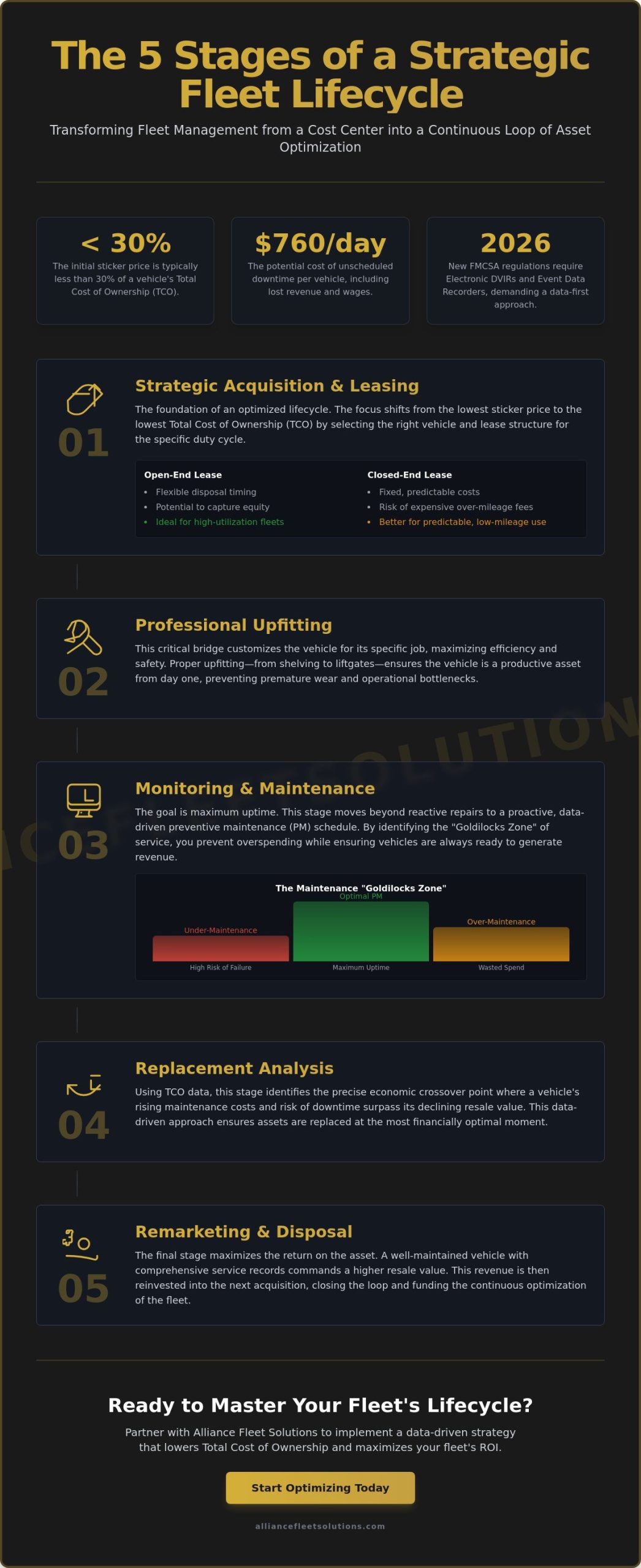
Successful commercial vehicle lifecycle management doesn’t function as a straight line with a beginning and an end. Instead, it operates as a continuous loop where each stage informs the next. If you procure the wrong chassis in stage one, you’ll pay for it through increased downtime in stage three. By viewing these stages as an integrated system, you ensure that the data gathered during a vehicle’s operational life directly improves your next acquisition strategy. This circular approach is the only way to consistently lower TCO in a volatile market.
A comprehensive strategy involves five distinct phases: Strategic Acquisition, Professional Upfitting, Monitoring and Maintenance, Replacement Analysis, and Remarketing. While many managers focus only on the purchase and the eventual sale, the value is won or lost in the details of how these stages connect. If you’re looking to streamline these transitions, exploring professional fleet solutions can provide the technical oversight needed to keep the loop closed and efficient.
Step 1: Strategic Acquisition and Leasing
Don’t fall into the trap of chasing the lowest monthly payment at the expense of long-term flexibility. The structure of your lease dictates your exit strategy and your ability to pivot when market conditions change. Open-end leases offer significant advantages for high-utilization fleets because they allow for flexible disposal timing and the potential to capture equity. Conversely, closed-end leases provide fixed costs but can lead to expensive “over-mileage” fees. Sourcing the right vehicle for a specific duty cycle is the core of comprehensive fleet management services. It’s about finding the asset that delivers the best performance over five years, not just the one that is cheapest on day one.
Step 2: Professional Upfitting for Operational Efficiency
Upfitting is the critical bridge that transforms a generic truck into a specialized work tool. When you invest in professional upfitting, you’re designing for both productivity and durability. Custom configurations that prioritize weight distribution and ergonomic access reduce the physical strain on your drivers, a vital consideration given that the FMCSA has removed over 3,000 low-quality CDL training providers as of April 2026. A well-upfitted vehicle also includes safety integrations that ensure compliance from the first mile, preventing the costly retrofitting that often plagues disconnected fleets.
Step 3: Monitoring and Preventive Maintenance
Once the vehicle is in service, telematics and real-time data become your most valuable assets. You aren’t just tracking location; you’re monitoring engine health, fuel burn, and idle time. Proactive maintenance management uses this data to trigger service before a component fails. Since the FMCSA finalized the rule on February 19, 2026, making electronic DVIRs explicitly legal, the speed at which a driver can report a defect and a shop can initiate a repair has increased significantly. This rapid response is your primary defense against the $760 daily downtime costs that can derail your profitability.
Calculating Total Cost of Ownership (TCO) and ROI
Calculating the true cost of an asset requires looking far beyond the monthly lease payment. To master commercial vehicle lifecycle management, you must apply a rigorous TCO formula: (Acquisition + Upfitting + Operating Costs) minus Resale Value. This calculation reveals the actual price of doing business. While acquisition and upfitting are largely fixed, operating costs are volatile. They fluctuate based on fuel prices, maintenance intensity, and the hidden “opportunity cost” of vehicle downtime. If a truck sits idle, you aren’t just paying for a repair; you’re losing the $760 in daily revenue that the asset should be generating.
Finding the “sweet spot” for vehicle replacement is a moving target that requires constant data analysis. This is the precise moment when the rising cost of maintenance and the risk of failure begin to outweigh the declining cost of depreciation. In 2026, this window is narrowing. With rising labor rates and parts scarcity, the cost of keeping an aging vehicle on the road can spike overnight. Telematics data provides the visibility needed to track these trends in real time, allowing you to exit an asset while it still holds significant secondary market value.
The Age vs. Mileage Debate: Which Drives Cost More?
Many fleet managers prioritize mileage as the primary indicator for replacement, but age often drives maintenance costs faster. Time causes rubber seals to degrade, fluids to break down, and corrosion to set in, regardless of the odometer reading. This is especially true in “severe service” environments, such as urban delivery or construction, where stop and go cycles and high idle hours accelerate wear. High idling hours can be more damaging than highway miles, as they increase engine soot and strain cooling systems without adding to the mileage count. A strategic lifecycle plan must weigh engine hours and calendar age as heavily as total distance traveled.
Maximizing Fuel Economy and Operating Efficiency
Fuel remains one of the largest variables in your TCO equation. Implementing fuel management programs is essential for preserving lifecycle ROI. These programs do more than track pump prices; they monitor driver behavior, such as hard braking and rapid acceleration, which can decrease fuel efficiency by up to 30%. Telematics also helps identify underutilized assets. If a vehicle is consistently under-driven, it may be a candidate for redistribution or early disposal, preventing it from becoming a “ghost asset” that incurs insurance and depreciation costs without providing a return.
Optimization Strategies: Extending Life Without Increasing Risk
Effective commercial vehicle lifecycle management requires finding the “Goldilocks” zone of maintenance. You don’t want to over-service an asset and waste capital on premature component replacements, but you can’t afford to ignore the subtle signs of fatigue that lead to catastrophic failure. This balance is achieved through standardized maintenance schedules that apply across your entire fleet, regardless of location. When every vehicle follows the same rigorous playbook, you eliminate the variance that often leads to unpredictable spikes in your operating budget.
Strategic optimization begins with the physical build of the vehicle. Professional upfitting should be designed with repairability in mind. If a technician must spend four hours removing custom shelving just to access a fuel pump, your upfit has become a liability. By utilizing modular designs and standardized mounting points, you ensure that routine service remains fast and cost-effective. If you need to audit your current equipment for these efficiencies, you can contact our fleet experts to review your specifications.
Preventive Maintenance: The Backbone of Uptime
The math behind proactive service is simple: scheduled downtime is consistently 5x cheaper than emergency repairs. When you control the schedule, you avoid the $760 daily loss associated with unscheduled breakdowns. Mobile repair solutions further enhance efficient fleet operations by eliminating the “logistics lag” of moving vehicles to and from a brick-and-mortar shop. This keeps your drivers on their routes and ensures that preventive maintenance happens exactly when the data says it should, not just when it’s convenient for a third-party service center.
Smart Remarketing: Turning Used Metal into Capital
The final 12 months of an asset’s life are the most critical for your total return on investment. Remarketing is a strategic exit, not a fire sale. To capture the highest resale value, you must maintain impeccable service records. Since the FMCSA’s February 19, 2026, ruling on electronic DVIRs, having a digital, verifiable history of every inspection and repair has become a major selling point in the secondary market. The most common mistake in commercial vehicle lifecycle management is selling too late. Once a vehicle enters the “steep” part of the maintenance curve, the cost of the next major repair will likely exceed the remaining equity in the asset. Exiting just before this spike preserves your capital for the next procurement cycle.
The Alliance Advantage: Partnering for Lifecycle Success
Managing a fleet in 2026 requires more than just mechanical skill; it demands a strategic alliance between procurement, maintenance, and data analysis. Alliance Fleet Solutions serves as the essential backbone for your business by integrating these disconnected silos into a single, streamlined process. When you consolidate your leasing, custom upfitting, and preventive maintenance under one roof, you eliminate the communication gaps that lead to costly delays. This unified approach ensures that your commercial vehicle lifecycle management strategy remains agile enough to adapt to market shifts while keeping your Total Cost of Ownership (TCO) as low as possible.
A single point of contact simplifies every stage of the asset’s journey. You don’t have to coordinate between a leasing agent in one state and an upfitter in another. Instead, you gain a partner who understands how a specific upfit choice today will affect your resale value five years from now. This foresight is what transforms fleet management from a recurring expense into a powerful competitive advantage. By focusing on long-term reliability and safety, we allow you to focus on your core business operations without the constant stress of equipment failure.
Fractional Management: Enterprise Strategy for Every Fleet
Many growing businesses can’t justify the six-figure salary of a full-time fleet director, yet they face the same complex regulations and rising costs as enterprise carriers. Alliance Fleet Solutions bridges this gap through fractional fleet management. This model gives you access to seasoned experts who provide high-level oversight without the overhead of a full-time executive. Whether you’re navigating the 2026 mandate for Event Data Recorders or managing the transition to electric vehicles, our team acts as your in-house advocate. We ensure that your procurement decisions align with your operational needs, providing the peace of mind that comes from professional lifecycle oversight.
Getting Started with Your Lifecycle Audit
If you’re ready to stop reacting to breakdowns and start optimizing your assets, begin with a targeted audit. Focus your attention on the oldest 10% of your vehicles first. These are the assets most likely to exceed the $760 daily downtime threshold and drain your profitability. Use this simple checklist to evaluate your current health:
- Review the last 12 months of maintenance spend against the current resale value.
- Check for consistent electronic DVIR compliance to ensure verifiable service histories.
- Identify vehicles with idle hours that exceed 20% of total engine time.
- Analyze fuel efficiency trends across similar duty cycles to spot underperforming units.
Don’t let hidden costs erode your bottom line. Contact Alliance Fleet Solutions for a lifecycle consultation and let’s build a strategy that maximizes your uptime and ensures your fleet remains a strategic asset for years to come.
Secure Your Fleet’s Future Through Strategic Lifecycle Control
The landscape of 2026 demands a shift from reactive repairs to a data-driven loop of asset optimization. You’ve seen how the true cost of an asset is won or lost in the details of the “Goldilocks” maintenance zone and strategic remarketing. By integrating professional upfitting with real-time telematics, you eliminate the disconnected data that leads to $760 in daily downtime losses. Mastering commercial vehicle lifecycle management isn’t just about saving money on parts; it’s about ensuring your business remains the backbone of a functional logistics operation.
Alliance Fleet Solutions provides the technical authority and national maintenance network you need to streamline these complex stages. Our comprehensive fractional fleet management bridges the gap between procurement and operations, giving you expert oversight without the enterprise price tag. From specialized upfitting expertise to a strategic remarketing network, we act as your supportive partner in every mile.
Maximize your fleet ROI with Alliance Fleet Solutions and take control of your total cost of ownership today. Your fleet is ready to work harder for you.
Frequently Asked Questions
What is the most important KPI in vehicle lifecycle management?
Total Cost of Ownership (TCO) per mile is the gold standard KPI for commercial vehicle lifecycle management. It provides a comprehensive view by integrating acquisition, fuel, and maintenance expenses against the asset’s actual utilization. Tracking this metric allows you to identify exactly when an older truck becomes more expensive to maintain than to replace, ensuring you exit the asset before it drains your profitability.
Is it better to lease or buy commercial vehicles for lifecycle control?
Leasing often provides superior lifecycle control because it enforces a disciplined replacement cycle and preserves your working capital. While buying gives you full ownership, it can lead to keeping “ghost assets” on the road long after their peak efficiency. Leasing structures allow you to pivot quickly as new safety regulations, such as the 2026 mandate for Event Data Recorders, emerge in the market.
How does professional upfitting affect vehicle resale value?
High-quality upfitting increases resale value by protecting the chassis from premature wear and ensuring the vehicle remains attractive to secondary market buyers. Standardized, modular upfits are especially valuable because they’re easier for the next owner to adapt to their specific needs. In contrast, poorly executed modifications can decrease an asset’s value by 15% to 20% due to potential safety concerns or structural damage.
What is the “sweet spot” for commercial vehicle replacement?
The “sweet spot” is the precise point where the cost of the next major repair is projected to exceed the vehicle’s remaining equity. For many heavy-duty trucks, this often occurs between year five and year seven. However, with April 2026 data showing rising inflation in parts and labor, this window is shifting earlier to avoid the high cost of emergency breakdowns and unscheduled downtime.
Can telematics actually reduce my total cost of ownership?
Telematics reduces TCO by identifying inefficient driver behaviors and predicting mechanical failures before they result in a tow. Recent industry reports indicate that fleets using advanced telematics can reduce fuel consumption by up to 15% through idle time reduction. These systems also streamline compliance with the finalized February 2026 electronic DVIR rules, preventing costly administrative delays and FMCSA fines.
What happens if I decommission a vehicle too late?
Decommissioning a vehicle too late results in a “maintenance trap” where repair costs outpace the asset’s revenue generation. You also face a significant drop in resale value as the vehicle enters a higher risk category for secondary buyers. Beyond the financial loss, older vehicles lack the safety technology mandatory for 2026, such as Advanced Emergency Braking, which can increase your insurance liability.
How does fractional fleet management work for small businesses?
Fractional fleet management provides small businesses with the expertise of a seasoned fleet director on a part-time or project basis. This partnership allows you to implement enterprise-level commercial vehicle lifecycle management without the overhead of a full-time executive salary. You gain a strategic ally to handle complex tasks like lease negotiations, upfit specifications, and national maintenance coordination while you focus on your core operations.
What is the difference between open-end and closed-end leasing in a lifecycle?
Open-end leases offer maximum flexibility because the lessee assumes the residual risk and captures any equity at the end of the term. This is ideal for high-utilization fleets with unpredictable routes. Closed-end leases provide a fixed monthly cost and allow you to walk away at the end of the term, but they often include strict mileage limits and penalties for excessive wear and tear.