
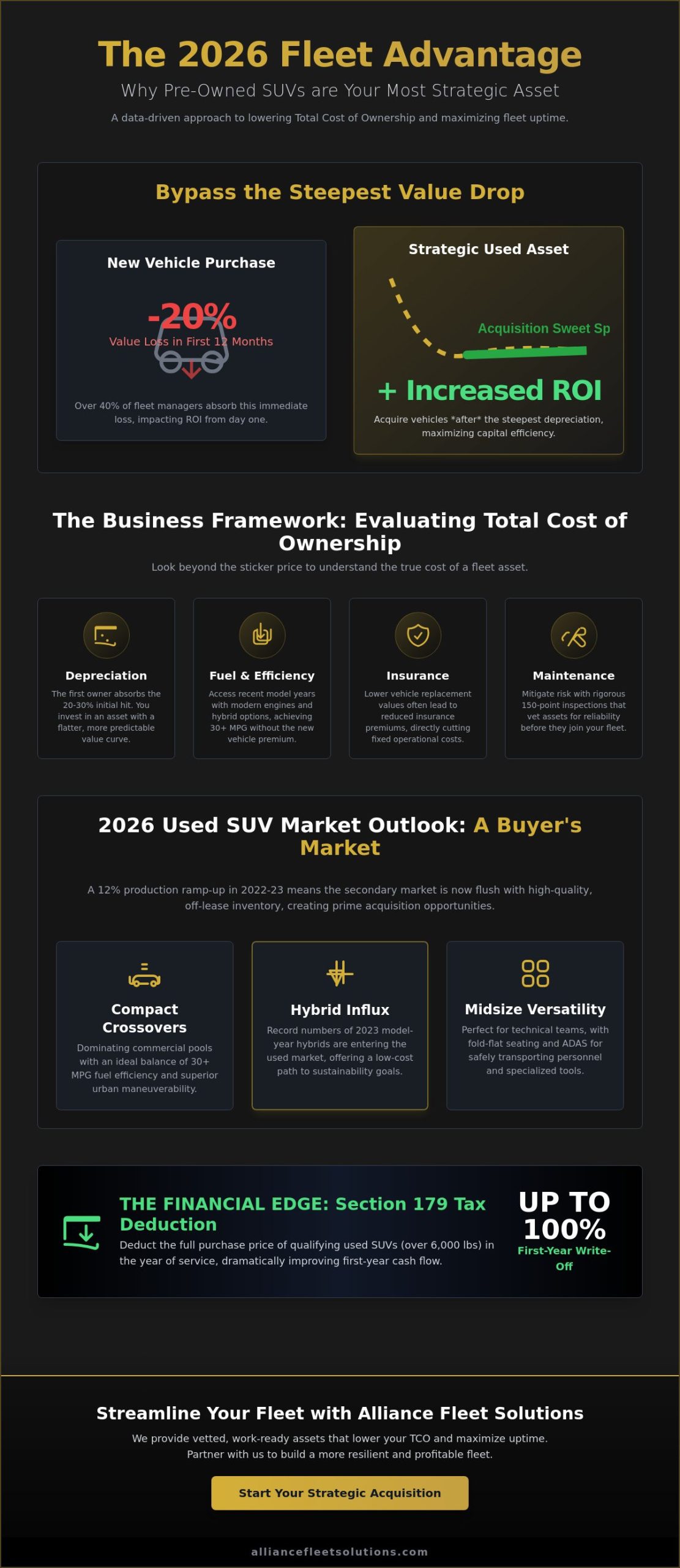
Would you intentionally choose a 20% loss on a capital investment within the first twelve months? According to research from J.P. Morgan, new commercial vehicles often experience their steepest depreciation curve immediately after purchase, yet over 40% of fleet managers surveyed in recent industry reports still prioritize new inventory over proven secondary assets. You likely already know that unpredictable maintenance on aging assets can cripple your schedule, but the right pre-owned strategy balances reliability with fiscal responsibility. Identifying the best used suv to buy for your 2026 fleet operations requires looking past the odometer to find vehicles that offer both high uptime and strong remarketing potential.
At Alliance Fleet Solutions, we believe your vehicles should be strategic assets, not just line-item expenses. We promise to show you how to lower your monthly fleet spend by selecting units that have already cleared the initial depreciation hurdle. We’ll preview the specific models that offer the best upfitting flexibility and the highest projected resale value to ensure your mobile teams stay productive through every mile of the vehicle lifecycle.
Key Takeaways
- Learn why prioritizing used assets in 2026 helps your business bypass steep first-year depreciation and secure a faster return on investment.
- Discover how to evaluate the four pillars of Total Cost of Ownership to identify the best used suv to buy for your specific operational needs.
- Explore curated recommendations for compact and midsize SUVs that perfectly balance passenger safety with professional upfitting potential.
- Implement proactive risk mitigation through 150-point commercial inspections and telematics to maximize engine health and fleet uptime.
- Understand how a strategic partnership streamlines vehicle acquisition and ensures your used assets are ready for work on day one.
Why Used SUVs Are a Strategic Business Asset in 2026
In the 2026 fiscal environment, savvy fleet managers are shifting away from the traditional “new-only” procurement model. This change is driven by the need to protect profit margins against high interest rates and fluctuating fuel costs. Identifying the best used suv to buy requires a shift in focus from aesthetic appeal to rigorous mechanical data. By targeting vehicles that have already cleared their initial 20% to 30% depreciation hit, businesses can deploy capital more effectively while maintaining a high standard of service.
A “fleet-ready” used SUV isn’t just a pre-owned vehicle; it’s a vetted asset that meets specific benchmarks for reliability, safety, and utility. We define these assets by their ability to maintain high uptime and protect the operator. Professional fleet managers prioritize models with top-tier IIHS safety ratings and versatile cargo configurations that accommodate specialized equipment. Integrating these pre-owned units is a cornerstone of efficient fleet operations, as it allows for a more diverse and resilient vehicle pool.
To succeed with this strategy, your organization must move past the “used vehicle” stigma. We achieve this through professional acquisition channels and strict inspection protocols. When you analyze the Total Cost of Ownership, a well-maintained three-year-old SUV often outperforms a new model by reducing insurance premiums and lowering the total debt load on the business balance sheet.
Depreciation as a Financial Tool
The “sweet spot” for commercial SUV acquisition currently sits between 36 and 60 months of age. At this stage, the steep curve of first-year depreciation has flattened, yet the vehicle typically retains 60% to 70% of its functional life. SUVs hold their value significantly better than traditional sedans; the 2023 production year models, for example, show a 15% higher retention rate than comparable mid-size cars. Remarketing Value represents the projected net price a fleet vehicle fetches at the end of its service life after accounting for condition, mileage, and market demand.
Market Trends: SUV Availability in 2026
The 2026 market is currently benefiting from the massive supply chain recovery that occurred during the 2022-2023 period. Because manufacturers ramped up production by approximately 12% during those years, the secondary market is now flooded with high-quality, off-lease inventory. We’re seeing a specific surge in the following areas:
- Compact Crossovers: These units dominate commercial pools due to their balance of 30+ MPG efficiency and urban maneuverability.
- Hybrid Influx: A record number of hybrid SUVs from the 2023 model year are entering the used market, offering businesses a way to meet sustainability goals without the high entry price of new EVs.
- Midsize Versatility: Models with fold-flat seating and advanced driver-assistance systems (ADAS) are the best used suv to buy for technical teams requiring both passenger space and tool storage.
By leveraging these trends, your business can build a robust fleet that balances immediate reliability with long-term financial health.
The Business Framework: Evaluating Total Cost of Ownership (TCO)
Selecting the best used suv to buy for a commercial fleet requires looking far beyond the initial invoice. Smart fleet managers prioritize Total Cost of Ownership (TCO), a metric that accounts for every dollar spent from acquisition to remarketing. While a lower purchase price is attractive, a vehicle that spends 15% more time in the shop than its peers will quickly erode any upfront savings. You’re not just buying a vehicle; you’re investing in an asset that must maintain high uptime to remain profitable.
The four pillars of used vehicle TCO include depreciation, fuel consumption, insurance premiums, and maintenance expenses. Depreciation is often lower on used units since the first owner already absorbed the steepest value drop. However, older assets typically carry higher insurance risks and lack the latest safety tech. For 2026, tax laws like Section 179 continue to offer significant advantages, allowing businesses to deduct the full purchase price of qualifying used SUVs over 6,000 pounds in the year they’re put into service. This immediate write-off can drastically improve your first-year cash flow.
- Depreciation: Used assets retain value better in the secondary market.
- Fuel: Older engines may lack the 10-speed transmissions found in newer models.
- Compliance: Tax incentives like Section 179 provide immediate ROI.
- Repairs: Out-of-warranty units require a dedicated budget for wear-and-tear items.
Predictive Maintenance and Reliability
Reliability isn’t a guessing game when you have access to historical repair data. For 2026 fleets, identifying “bulletproof” drivetrains is essential. Models featuring the GM 5.3L V8 or the Toyota 3.5L V6 have consistently shown lower failure rates in high-mileage duty cycles according to 2025 industry reliability reports. You can’t rely on luck to keep these units on the road. Implementing structured maintenance management ensures that small issues don’t escalate into catastrophic engine or transmission failures. Partnering with a provider for professional fleet maintenance solutions helps stabilize your monthly repair spend and prevents the logistical nightmare of unexpected downtime.
Fuel Management for Used Fleets
Fuel expenses represent roughly 20% to 30% of a fleet’s operating budget. Older SUVs often lack the sophisticated cylinder deactivation or hybrid assist systems found in 2025 or 2026 models, making them more expensive to fuel. If your mobile service teams operate primarily in urban environments, the ROI of choosing a used hybrid SUV is often realized within 18 months of operation. To keep these costs in check, many businesses integrate their assets into fuel management programs that track every gallon consumed. Fleet managers utilize telematics data to pinpoint specific used vehicles that consume excessive fuel due to engine wear or driver behavior, allowing for targeted intervention. This data-driven approach ensures that even an older best used suv to buy remains a lean, efficient component of your logistics strategy.
Top 2026 Recommendations: Best Used SUVs for Fleet Use
Selecting the best used suv to buy for your fleet requires a cold analysis of total cost of ownership (TCO) rather than just the sticker price. By 2026, the secondary market offers a robust selection of 2022 and 2023 models that have already cleared their steepest depreciation curves. Compact SUVs serve as the backbone for sales teams and light delivery. These vehicles offer the maneuverability needed for urban environments while keeping fuel overhead low. For companies requiring more versatility, midsize workhorses provide the necessary volume for professional upfitting without the fuel penalty of a heavy-duty chassis.
Full-size SUVs remain essential when your operations demand maximum towing and payload capacity. These units often function as mobile command centers or heavy equipment haulers. In the 2026 landscape, fleet managers must also assess the viability of hybrid and EV used SUVs. These platforms offer significant fuel savings for high-mileage routes, though they require a different approach to preventive maintenance and charging infrastructure. Balancing these categories ensures your fleet remains agile and cost-effective.
The Reliability Leaders: Toyota and Honda
Toyota models like the RAV4 and Highlander remain the industry gold standard for resale value. Data from 2024 industry reports suggests these models retain up to 15% more value after three years compared to segment averages. The Honda CR-V excels in high-utilization environments where uptime is critical. Maintenance costs for these specific models typically average $500 to $700 annually over the first 100,000 miles. This predictability allows fleet managers to streamline their budgets and avoid the sudden equipment failures that stall logistics operations. We’ve found that these brands provide the most consistent return on investment for long-term service cycles.
The Upfitting Favorites: Ford and Chevrolet
The Ford Explorer stands out because its Interceptor heritage ensures a chassis built for heavy-duty cycles. It offers 87.8 cubic feet of maximum cargo space, making it ideal for custom shelving, partitions, and specialized tool storage. The Chevrolet Tahoe remains the benchmark for durability in heavy-duty commercial SUV applications. With a towing capacity often exceeding 8,200 pounds, it handles equipment transport that would strain smaller frames. When you’re evaluating the best used suv to buy for technical crews, consider the Tahoe’s 122.9 cubic feet of cargo volume. This space allows for complex interior configurations that maximize technician efficiency and secure expensive gear during transit.
- Compact SUVs: Best for 25,000+ annual miles in urban settings.
- Midsize SUVs: Ideal for field engineers requiring 4WD and interior storage.
- Full-Size SUVs: Necessary for pulling trailers over 5,000 pounds.
- Hybrid/EV: Recommended for fleets with centralized overnight charging access.
Risk Mitigation: Inspections, Telematics, and Remarketing
Selecting the best used suv to buy for your fleet is only the first step. Protecting that investment requires a rigorous risk mitigation strategy that starts before the vehicle even hits the road. At Alliance Fleet Solutions, we advocate for a 150-point commercial inspection that goes far beyond a standard consumer check. This process focuses on high-wear fleet components that dictate long-term uptime. We look for specific indicators of future failure, such as transmission fluid oxidation, suspension bushing wear, and cooling system pressure integrity. Skipping this deep dive often results in a 15% increase in unscheduled repairs during the first year of ownership.
Avoid the common trap of auction-house gambles. While prices might look attractive on the surface, these units often carry hidden mechanical baggage. The “Alliance” approach involves professional sourcing where we vet titles, service histories, and previous duty cycles. It’s about finding assets that have been maintained to a professional standard, ensuring your business isn’t inherited someone else’s maintenance backlog.
The Role of Telematics in Used Fleets
Older engines need closer supervision to stay productive. Modern telematics systems provide real-time diagnostic trouble code (DTC) monitoring, which lets your team catch minor sensor issues before they escalate into “limp mode” events. GPS tracking does more than just monitor drivers; it improves route efficiency to reduce unnecessary mileage and wear. You’ll see the best results by integrating these data streams with comprehensive fleet management services. This integration automates your maintenance schedule based on actual engine hours rather than just calendar dates.
Executing a Seamless Remarketing Strategy
Maximizing the resale value of your fleet assets depends on precision timing. Data from 2024 and 2025 fleet cycles indicates that used SUVs often hit a “value cliff” once they cross the 100,000-mile threshold or the seven-year mark. To capture the highest return, aim for a replacement point around 85,000 miles. This keeps the vehicle attractive to second-tier buyers who still want a reliable unit.
- Wholesale Channels: These offer the fastest liquidation and lower administrative costs for larger fleet turnovers.
- Retail Remarketing: This can yield higher returns but requires professional reconditioning and more time on the market.
- Documentation: Consistent, digital maintenance records can increase final sale prices by up to 12% by proving the vehicle’s health.
When you identify the best used suv to buy, you must also plan for its eventual exit. A documented service history is the most effective tool for protecting your bottom line when it’s time to sell. Our team helps you manage these cycles to ensure your capital stays fluid and your fleet stays young.
Partner with Alliance Fleet Solutions to build a data-driven strategy for your used vehicle acquisitions and remarketing.
Streamlining Your Fleet with Alliance Fleet Solutions
Identifying the best used suv to buy for your business involves more than just comparing sticker prices. It requires a strategic partner who understands that every minute a vehicle sits in a shop is a minute of lost revenue. Alliance Fleet Solutions specializes in customized vehicle acquisition, sourcing specific used SUVs that align with your unique duty cycles and operational demands. We don’t just find a car; we secure a business asset that fits your balance sheet.
Our team manages professional upfitting for used assets to ensure they’re ready for work on day one. We eliminate the typical 14 to 21-day delay businesses face when coordinating between dealerships and equipment installers. From telematics integration to interior shelving and safety partitions, we handle the technical details so your drivers can hit the road immediately. This proactive approach minimizes downtime and accelerates your return on investment.
We provide flexible leasing options that cater to the realities of used vehicle procurement. You can choose between open-end and closed-end structures depending on your risk tolerance and cash flow needs. For organizations that lack a dedicated internal fleet department, our fractional fleet management offers expert oversight. You gain access to professional fleet consultants who manage maintenance schedules and compliance without the expense of a full-time executive salary.
Why Partner with Alliance?
Our national network provides exclusive access to high-quality, off-lease commercial vehicles that never hit the retail market. We focus on sourcing SUVs with documented service histories to ensure long-term reliability. Because we’re a family-owned alliance, we focus on your long-term ROI rather than hitting monthly sales quotas. Our comprehensive maintenance and fuel programs are designed to maximize uptime, using preventive data to stop mechanical failures before they happen.
Next Steps for Your Fleet
The first step toward optimization is understanding your current expenses. You can request a detailed TCO analysis to see how your current SUV fleet compares to 2026 market benchmarks. We specialize in helping businesses transition from an all-new fleet to a strategic mix of new and used assets, which can significantly reduce capital expenditure while maintaining operational standards. Our process is transparent, data-driven, and focused on your bottom line.
Ready to optimize your acquisition strategy? Contact Alliance Fleet Solutions for a customized acquisition strategy to find the best used suv to buy for your specific business needs today.
Future-Proof Your Fleet Strategy for 2026
Selecting the best used suv to buy for your 2026 operations requires more than a glance at the odometer. Successful fleet managers now prioritize a 36-month TCO framework to mitigate the steep depreciation curves typical of new vehicle acquisitions. By integrating advanced telematics and rigorous 150-point inspections, you transform a pre-owned vehicle into a high-uptime asset that meets the demands of 24/7 service cycles. Your fleet’s reliability shouldn’t be left to chance or local market fluctuations. Alliance Fleet Solutions bridges the gap between procurement and performance. We leverage our national sourcing network for premium off-lease vehicles to ensure your business stays mobile. Our team provides expert upfitting for commercial-grade SUVs and implements comprehensive TCO reduction strategies that protect your quarterly margins. You’ve analyzed the data and identified the right models for your specific logistics needs. It’s time to turn those insights into a competitive advantage that drives your business forward throughout the coming year. We’re ready to help you build a resilient, high-performing fleet that meets the demands of tomorrow.
Build a More Profitable Fleet with Alliance Fleet Solutions
Frequently Asked Questions
Is it better for a business to buy or lease a used SUV in 2026?
Buying a used SUV is typically better for businesses in 2026 because it allows you to capitalize on immediate asset ownership and Section 179 tax deductions. While leasing offers lower monthly payments, purchasing secures a tangible asset that retains roughly 40% of its value after five years. This strategy eliminates mileage penalties that often cost $0.25 per mile. We help you evaluate the total cost of ownership to ensure your capital works harder.
What is the ideal mileage for a used SUV intended for commercial fleet use?
The ideal mileage for the best used suv to buy for commercial use falls between 30,000 and 55,000 miles. Vehicles in this range have already moved past their steepest depreciation curve, which usually hits 20% in the first year. These units typically retain 2 to 3 years of manufacturer powertrain warranty coverage. Selecting a vehicle within these parameters ensures you maximize uptime while minimizing the risk of major mechanical failures during the first 24 months.
Can used SUVs be professionally upfitted with the same equipment as new models?
You can professionally upfit used SUVs with the exact same shelving, partitions, and electronics found in brand new models. Most manufacturers maintain consistent interior dimensions across 5 to 7 year model cycles, so 2022 components fit 2026 fleet additions perfectly. We streamline the integration of telematics and safety partitions to ensure your used fleet meets 100% of your operational requirements. This approach saves you the 30% premium associated with new vehicle upfitting.
Which used SUV has the lowest maintenance cost for businesses?
The Toyota RAV4 consistently ranks as the best used suv to buy for businesses seeking the lowest annual maintenance costs. Data from repair tracking platforms shows these vehicles average less than $500 in unscheduled repairs annually. Their high parts availability ensures that your mobile repair technicians can complete fixes quickly. Choosing a model with a proven 4 cylinder engine maximizes fuel efficiency and reduces the frequency of cooling system overhauls compared to V8 alternatives.
How do telematics solutions help manage a fleet of older, used vehicles?
Telematics solutions utilize the standard OBD-II port to provide 100% visibility into the health of older fleet vehicles. These systems track 20+ engine parameters, allowing managers to transition from reactive repairs to predictive maintenance schedules. Implementing these tools can reduce fuel waste from idling by 15% across your entire fleet. By monitoring diagnostic trouble codes in real time, you prevent minor sensor issues from escalating into expensive engine failures that cause unplanned downtime.
What are the tax benefits of purchasing a used SUV for business use?
Purchasing a used SUV allows your business to leverage Section 179 of the IRS tax code for a 100% write-off in the first year. For vehicles weighing over 6,000 pounds, you can deduct the full purchase price from your gross income. This immediate deduction can lower your tax liability by thousands of dollars depending on your specific tax bracket. It’s a strategic move that turns a necessary equipment acquisition into a powerful tool for managing your company’s cash flow.
How does Alliance Fleet Solutions ensure the quality of a used vehicle before acquisition?
Alliance Fleet Solutions utilizes a rigorous 160-point mechanical inspection to guarantee the reliability of every vehicle we acquire. Our technicians examine everything from brake pad thickness to transmission fluid clarity, ensuring every component meets a minimum 75% service life threshold. We also pull comprehensive history reports to verify that the vehicle has zero accident records and a consistent maintenance history. This meticulous process forms the foundation of our alliance, providing you with confidence that your fleet is road-ready.