
What if your fleet wasn’t a depreciating asset, but a predictable engine of growth? With interest rates projected to remain 2% higher than the previous decade’s average through 2026, the traditional buy-and-hold model is failing 45% of logistics firms. You already understand that every hour a truck sits in the shop represents over $1,200 in lost revenue. Managing custom upfits and administrative burdens often feels like a second full-time job you didn’t sign up for.
This guide shows you how to leverage fleet truck leasing to stabilize your monthly cash flow and eliminate the maintenance headaches that stall your progress. We’ve built this strategic roadmap to help you master the complexities of commercial vehicle acquisition while reducing your total cost of ownership. We’ll examine how to secure custom-upfitted vehicles ready for work and establish a partnership that handles the administrative burden, ensuring your operations stay lean and your uptime remains high.
Key Takeaways
- Shift your perspective from vehicle ownership to utility-based access to streamline your capital and focus on core operations.
- Navigate the critical differences between open-end and closed-end structures to determine which fleet truck leasing model best protects your bottom line.
- Learn why proactive professional upfitting is the essential bridge between a standard chassis and a high-performance business tool that generates immediate ROI.
- Transition from reactive repairs to a data-driven lifecycle strategy that uses telematics to maximize engine health and fuel efficiency.
- Explore the fractional fleet advantage and see how a strategic alliance can provide expert-level management without the overhead of an internal department.
What is Fleet Truck Leasing? Beyond the Monthly Payment
Fleet truck leasing isn’t just a way to put a driver in a seat. It’s a comprehensive asset management strategy designed to keep your cargo moving without the anchor of ownership. By 2026, the logistics industry has shifted toward “utility-based” access. This means smart companies pay for the use of the vehicle rather than the vehicle itself. While a standard Vehicle Leasing agreement provides the basic framework, commercial applications demand more than just a finance contract. Specialized fleet lessors have replaced traditional banks for 68% of new heavy-duty acquisitions because they offer technical expertise that a standard lender lacks. The core objective is simple. You want to maximize uptime while driving the Total Cost of Ownership (TCO) to its lowest possible point.
Effective fleet truck leasing creates a partnership where the lessor shares the operational burden. This approach allows your business to stay agile. You can scale your fleet up or down based on seasonal demand without the long-term commitment of a 72-month loan. It’s about maintaining a modern, reliable fleet that reflects your company’s commitment to safety and performance.
Leasing vs. Buying: A 2026 Financial Reality Check
Owning a fleet in 2026 often ties up capital that’s better used for core business growth. Leasing preserves your credit lines for emergency expansions or technology upgrades. From a tax perspective, leasing typically functions as an operating expense. This keeps the debt off your balance sheet, which is a critical advantage for maintaining a strong debt-to-equity ratio. You also sidestep the risk of rapid depreciation. When the lease ends, the lessor handles the residual value risk. If a truck’s market value drops by 15% due to sudden shifts in fuel technology, that’s their problem, not yours. This risk mitigation is essential for protecting your company’s long-term financial health.
The Role of Fleet Management in Modern Leasing
A lease without management is just a debt obligation with extra steps. Real value comes from integrating acquisition, maintenance, and disposal into a single, fluid workflow. You shouldn’t have to coordinate between three different vendors just to get a routine inspection. Modern fleet management services act as a force multiplier for small teams. They allow a single office manager to oversee 50 power units with the same precision as a dedicated logistics department. This alliance between finance and maintenance ensures that your fleet truck leasing strategy actually supports your bottom line. It transforms a monthly bill into a strategic advantage that keeps your drivers on the road and your customers satisfied.
Open-End vs. Closed-End Leasing: Choosing Your Structure
Selecting the right structure for fleet truck leasing dictates your long-term capital efficiency. It’s the difference between a fixed expense and a managed asset. In 2026, fleet managers must balance market volatility against operational uptime to ensure their equipment remains a tool for growth rather than a liability. Most commercial agreements fall into two categories: open-end and closed-end leases. Each serves a distinct operational profile based on mileage, vehicle customization, and financial risk tolerance.
For organizations modeling their operations after federal standards, GSA Fleet leasing services offer a blueprint for lifecycle management and acquisition. Following these professional standards helps private fleets maintain a competitive edge. Effective structures match the lease duration to the specific duty cycle of the vehicle. A Class 8 tractor might have a 60-month sweet spot before maintenance costs spike, while a local delivery van might hit that wall at 36 months.
Open-End Leasing: The Flexible Workhorse
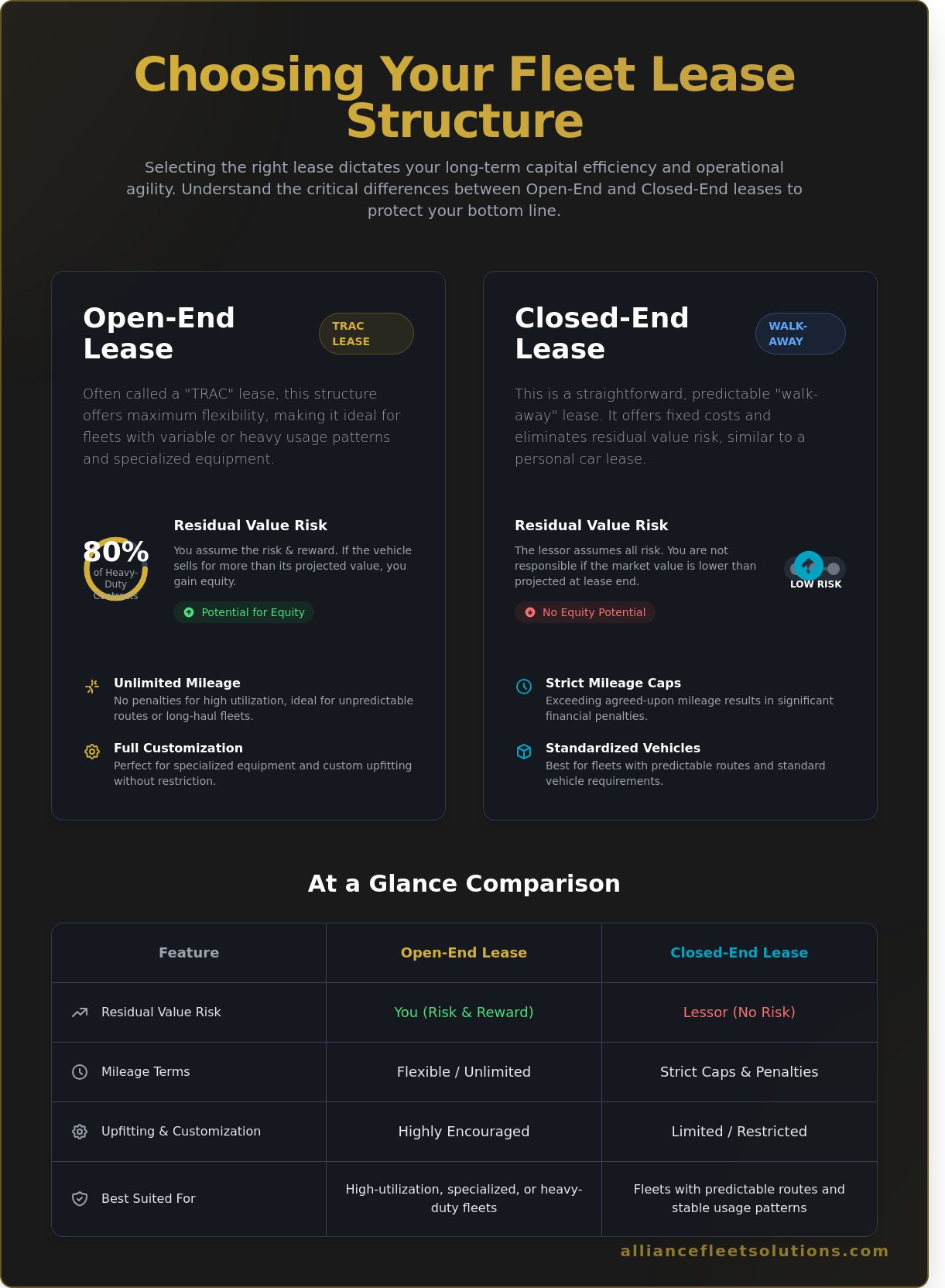
The Terminal Rental Adjustment Clause (TRAC) lease dominates the commercial landscape. It accounts for approximately 80% of all heavy-duty vehicle contracts. In this model, you assume the residual risk. If the truck sells for more than the projected value at the end of the term, you pocket the equity. If it sells for less, you pay the difference. This structure is ideal for specialized equipment. Custom upfitting or unique duty cycles make standardized valuations difficult, so the flexibility of a TRAC lease is essential.
High-utilization fleets benefit from the lack of mileage penalties. You’re in control of the vehicle’s lifecycle. This model works best for:
- Long-term use: Vehicles intended to stay in service for 5 to 7 years.
- Customization: Trucks with specialized bodies, cranes, or refrigeration units.
- High Mileage: Routes exceeding 100,000 miles annually where standard penalties would be prohibitive.
Closed-End Leasing: Predictability and Ease
Often called a “walk-away” lease, this structure prioritizes budget certainty. You pay a fixed monthly rate and return the keys when the term ends. It’s a popular choice for light-duty delivery fleets or standardized 12-foot box trucks. However, this predictability comes with strict boundaries. Excess mileage charges often range from $0.15 to $0.25 per mile. Wear-and-tear clauses are also stringent. For companies with high-mileage routes, these fees can quickly erode the benefits of the fixed payment.
Closed-end leases fit businesses that prioritize a clean balance sheet and simple vehicle cycling. If you’re struggling to calculate the total cost of ownership for these models, our team can help you maximize your fleet optimization through data-driven analysis. This structure ensures you’re always running late-model equipment with the latest safety technology without the burden of resale management.
The Strategic Advantage of Professional Upfitting
A bare chassis is just a vehicle; professional upfitting transforms it into a revenue-generating asset. Within the framework of fleet truck leasing, upfitting acts as the critical bridge between a manufacturer’s base model and a functional business tool. Just as an elite athlete wouldn’t hit the slopes without specialized gear from a premier source like Avalanche Pro Shop, a logistics professional shouldn’t deploy a fleet without the exact upfitting required for the job. Many managers make the mistake of treating upfitting as an afterthought, yet 2025 data shows that post-delivery upfitting can add 45 to 60 days of avoidable downtime before a vehicle ever enters service. This delay erodes the ROI of your lease before the first mile is even driven.
By integrating upfitting into the initial lease agreement, you secure a predictable financial structure that protects your cash flow. We often hear the objection that custom trucks are too expensive to lease. In reality, rolling these specialized costs into a single monthly payment often reduces the total cost of ownership by 15% compared to separate equipment financing. It also ensures your lease remains compliant with evolving federal standards, such as those monitored by the Truck Leasing Task Force, which focuses on fair and transparent terms for operators across the industry.
Custom Configuration for Industry-Specific Needs
Precision engineering matters for the long-term health of your equipment. When you specify refrigeration units, heavy-duty lift gates, or ergonomic shelving during the design phase, you maximize vehicle longevity. A truck engineered for its exact 12,500-pound payload will experience 22% fewer suspension failures than a generic model forced into the same role. These specialized specs ensure your fleet truck leasing strategy supports operational reality. You can review our professional upfitting case studies to see how custom configurations delivered a 30% increase in technician efficiency for our partners in the field.
Reducing Lead Times Through Integrated Procurement
The “one-stop-shop” model is the standard for 2026. Sourcing the chassis and the upfit simultaneously eliminates the coordination gap that frequently leads to warranty conflicts between manufacturers and installers. If a lift gate is installed incorrectly by a third party, your chassis warranty might be voided; integrated procurement avoids this risk entirely. This unified approach cuts procurement cycles by an average of 8 weeks. Turnkey delivery is the standard for 2026 fleet operations where a fully equipped truck arrives ready for immediate deployment on day one.
- Direct Sourcing: Eliminates the need to move vehicles between multiple vendors.
- Warranty Protection: Ensures all components are covered under a unified service agreement.
- Immediate ROI: Vehicles start generating revenue the moment they arrive at your facility.
Lifecycle Management: Maintenance, Telematics, and Remarketing
Effective fleet truck leasing isn’t just about the initial contract; it’s about managing the vehicle’s entire journey from delivery to disposal. Most fleets lose 15% of their potential profit by failing to address the “maintenance cliff,” which typically occurs after 400,000 miles for Class 8 trucks. By 2026, successful managers will have shifted entirely from reactive repairs to data-driven preventive maintenance schedules. This transition ensures that equipment stays on the road during peak delivery windows rather than sitting in a shop waiting for parts.
Telematics serve as the nervous system of this operation. Modern systems monitor engine health in real-time, allowing teams to swap a failing sensor before it causes a roadside breakdown. This proactive approach reduces unscheduled downtime by 22% on average. It also tracks driver behavior and fuel efficiency, identifying the 10% of drivers who might be unnecessarily increasing your fuel spend through excessive idling or hard braking. By treating data as a strategic asset, you turn every mile driven into a lesson in fleet optimization. For mixed-equipment operators, this same discipline extends to specialized machinery; a resilient telehandler parts supply chain strategy applies the same principles of proactive procurement to keep your entire national fleet running at peak capacity.
Maximizing Uptime via Managed Maintenance
Managed maintenance programs offer a strategic alliance with national vendor networks. This ensures you pay consistent, pre-negotiated labor rates whether your truck is in Ohio or Oregon. The administrative burden of managing a diverse fleet can consume 20 hours of a manager’s week, but consolidated billing streamlines the process into a single, clear report. Integrating fuel management programs allows for deeper insights. If a truck’s fuel economy drops by 0.5 MPG suddenly, the system flags it for a fuel injector inspection before a check engine light even appears. This level of oversight prevents small mechanical issues from cascading into catastrophic engine failures.
Remarketing: Capturing Value at the End of the Road
The final phase of the lifecycle determines your total cost of ownership. Professional remarketing channels often yield 15% higher returns than local trade-ins because they tap into a broader buyer base. Timing is critical. Selling a unit six months too late can result in a $5,000 drop in residual value. By utilizing commercial vehicle leasing data, managers can predict these market shifts and exit at the peak. This data-driven approach ensures you aren’t just getting rid of an old asset, but rather harvesting the maximum remaining value to reinvest in your next lease cycle.
Ready to protect your bottom line and eliminate the stress of vehicle downtime? Consult with our fleet specialists today to build a custom lifecycle strategy that works for you.
The Fractional Fleet Advantage: Why Alliance Fleet Solutions?
Mid-sized businesses often struggle with a resource gap. You need enterprise-level logistics expertise, but the overhead of a full internal fleet department is often prohibitive. Alliance Fleet Solutions bridges this gap through Fractional Fleet Management. We don’t operate as a distant vendor; we function as a direct extension of your internal team. Our experts handle the technical heavy lifting, from compliance monitoring to preventive maintenance scheduling, allowing your staff to focus on core revenue-generating activities.
Our model combines the personalized touch of a family-owned business with the muscle of a national-scale partner. This means you get a dedicated account manager who understands your specific routes and cargo requirements, backed by a procurement network that secures Tier 1 pricing. Clients who switch to our managed model typically see a 22% reduction in administrative labor costs within the first 12 months. We provide the stability you need to navigate the logistics challenges of 2026 with total confidence.
Transitioning from a messy, owned fleet to a streamlined model is the fastest way to improve your balance sheet. Owned vehicles often hide their true costs in depreciation and unpredictable emergency repairs. By adopting a strategy centered on fleet truck leasing, you convert volatile capital expenses into predictable operating costs. We help you offload the risk of asset disposal and vehicle obsolescence, ensuring your drivers are always behind the wheel of modern, efficient equipment. See how Alliance Fleet Solutions transforms fleet operations from a chaotic cost center into a high-performing strategic asset through our integrated leasing and fractional management model.
Custom-Tailored Leasing for Growth
We recognize that a standard contract won’t fit every business model. Alliance offers both open-end and closed-end lease structures to align with your financial goals. Our open-end leases provide maximum flexibility and equity potential for high-mileage operators. Conversely, our closed-end options protect you from market fluctuations and residual risk. Our “Alliance” approach relies on transparent pricing; we eliminate the hidden administrative fees that often add 3% to 5% to the total cost of ownership at larger leasing firms. We manage the entire lifecycle, from initial spec’ing to final disposal, to maximize your uptime.
Next Steps: Evaluating Your Fleet Potential
The first step toward optimization is a rigorous fleet audit. We recommend identifying your “legacy” vehicles immediately. These are typically units older than 7 years or those where annual maintenance costs exceed 20% of the vehicle’s current market value. Replacing these high-cost assets is the priority for any 2026 fleet strategy.
To prepare for a consultation, gather your last 12 months of repair invoices, fuel logs, and current maintenance schedules. This data allows our team to build a precise ROI model tailored to your specific operation. Contact Alliance Fleet Solutions for a customized lease analysis to see how fleet truck leasing can transform your bottom line and stabilize your operations for the long haul.
Future-Proof Your Operations for the Road Ahead
Success in 2026 requires more than just acquiring vehicles. It demands a strategy where custom upfitting meets real-time telematics to maximize uptime across every route. By selecting the right structure, whether open-end or closed-end, you lock in predictable costs while staying agile in a shifting market. Alliance Fleet Solutions has been a family-owned and operated partner since 2018, helping businesses navigate these technical complexities with expert control. We provide access to comprehensive national maintenance and fuel networks, ensuring your drivers stay on the road across all 50 states. Our specialists focus on fractional management and custom upfitting, allowing you to scale your business without the heavy overhead of a full-time internal department. Strategic fleet truck leasing isn’t just a transaction; it’s a long-term commitment to your bottom line. We’ve refined our processes over the last 6 years to ensure every vehicle serves as a high-performing strategic asset. Optimize your fleet with a strategic leasing partner; contact Alliance Fleet Solutions today. Your growth is our priority, and we’re ready to help you lead the industry.
Frequently Asked Questions
Is it better to lease or buy a commercial truck for a small business?
Leasing is often the superior choice for cash flow management because it requires significantly lower upfront capital than a 20% down payment on a purchase. For 74% of small businesses, fleet truck leasing provides the flexibility to upgrade to 2026 models with the latest safety tech every 3 to 5 years. This strategy ensures your fleet maintains high uptime and benefits from the most recent fuel efficiency standards without long-term debt.
What is the difference between open-end and closed-end truck leasing?
Open-end leases place the residual value risk on your business, making them ideal for high-mileage commercial applications where vehicle wear is unpredictable. At the end of the term, you’re responsible for the difference between the book value and the actual sale price. Closed-end leases, often called walk-away leases, fix your costs. You return the vehicle after 48 or 60 months without worrying about market fluctuations, provided you meet mileage and condition terms.
Can I include custom upfitting and equipment in my fleet lease?
You can include custom upfitting, such as refrigeration units or specialized shelving, directly in your lease agreement. Alliance Fleet Solutions helps you bundle these $15,000 to $45,000 equipment costs into a single monthly payment. This preserves your working capital while ensuring your vehicles are ready for service on day one. Most 2026 lease structures allow for 100% financing of these essential modifications to streamline your operations.
How does a TRAC lease work for commercial vehicles?
A TRAC lease is the most common structure for heavy-duty vehicles because it offers specific tax benefits and terminal flexibility. It includes a Terminal Rental Adjustment Clause that determines the final payment based on the vehicle’s residual value at the end of the term. If the truck sells for more than the $30,000 residual set at the start, you receive a credit. If it sells for less, you pay the difference.
What happens if my leased truck exceeds the mileage limit?
Exceeding your mileage limit typically results in a fee ranging from $0.15 to $0.35 per mile depending on the vehicle class. On a 100,000-mile contract, a 10,000-mile overage could cost you $3,500 at turn-in. We recommend reviewing your telematics data quarterly to adjust your driving routes. If your 2026 operations change, many fleet truck leasing providers allow you to restructure your contract mid-term to avoid these heavy penalties.
How much does it cost to outsource fleet management through a lease?
Outsourcing fleet management through a lease usually adds a monthly fee of $60 to $150 per vehicle. This investment covers preventive maintenance scheduling, registration renewals, and 24/7 roadside assistance. By consolidating these tasks, companies typically reduce their internal administrative labor by 18 hours per month. It transforms unpredictable repair bills into a fixed, manageable operating expense that protects your company’s bottom line and ensures consistent uptime.
Can I lease used trucks for my business fleet?
You can lease late-model used trucks, which typically reduces monthly payments by 22% to 35% compared to new 2026 models. These vehicles are usually 2 to 4 years old and undergo a rigorous 150-point inspection to ensure mechanical reliability. While they may have higher maintenance needs than new units, the lower entry cost helps rapidly expanding fleets scale their operations without the heavy depreciation hit of a new purchase.
How does telematics integration work with a leased fleet?
Most 2026 lease models come with factory-installed telematics hardware that integrates directly with your fleet management software. This technology tracks 45 unique data points, including fuel consumption, idle time, and real-time engine diagnostics. By monitoring this data, fleet managers reduce fuel costs by 14% on average. Alliance Fleet Solutions uses these insights to streamline your preventive maintenance, ensuring your trucks stay on the road and out of the repair shop.