
A single hour of unplanned downtime on a high-stakes construction site can cost a national fleet operator upwards of $600 in lost productivity, according to recent industry benchmarks. You likely agree that managing a diverse fleet across multiple states is a logistical puzzle that often breaks at its weakest link: the supply chain. When a machine fails, regardless of its location in your national fleet, sourcing quality telehandler parts shouldn’t feel like a gamble that puts your project deadlines at risk. At Alliance Fleet Solutions, we believe your maintenance strategy should be a competitive advantage, not a source of constant stress.
This article provides the blueprint to master the complexities of parts procurement and eliminate the unpredictability that plagues your bottom line. You’ll learn how to standardize maintenance schedules across your entire fleet and build a resilient national supply chain that significantly reduces your total cost of ownership. We’ll explore how shifting to a proactive alliance with expert suppliers ensures your equipment remains operational through 2026 and beyond. By the end of this guide, you’ll have a clear roadmap to maximize uptime and transform your logistics from a cost center into a streamlined asset.
Key Takeaways
- Learn how to identify the hidden costs of equipment downtime and why a proactive parts strategy is essential for maintaining national fleet continuity.
- Understand the strategic framework for selecting high-performance telehandler parts aurora to balance cost-efficiency with long-term equipment reliability.
- Discover how to leverage telematics and “Just-in-Time” procurement to predict component failures and reduce expensive inventory holding costs.
- Identify the critical hydraulic systems and attachments that require specialized maintenance to ensure peak operational safety and performance.
- Explore the benefits of a national maintenance alliance that integrates professional parts management with mobile, on-site service capabilities.
The Critical Role of Telehandler Parts in Fleet Continuity
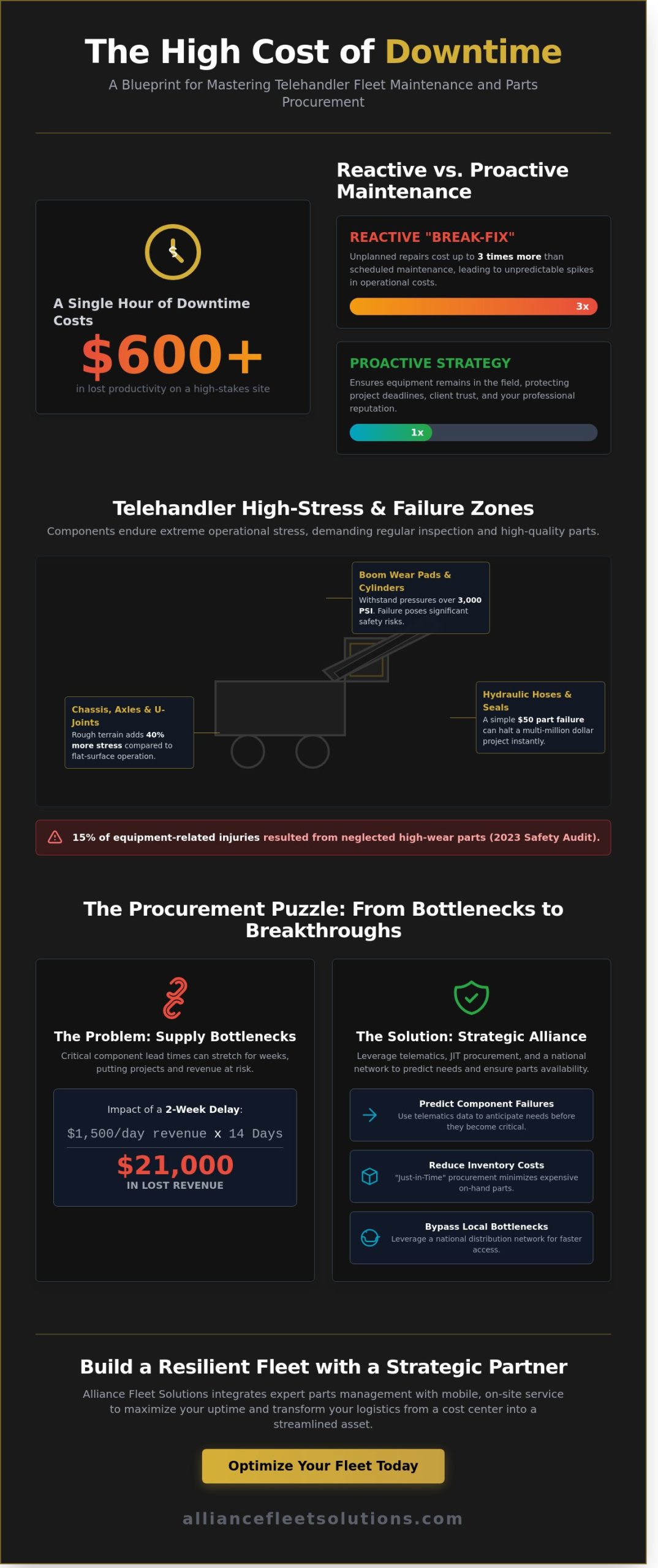
The Telescopic handler functions as the indispensable backbone of modern construction and logistics. It handles 90% of the heavy lifting and material placement on high-density job sites. When these machines operate at peak efficiency, project momentum stays high. However, the true cost of downtime is often underestimated. A simple $50 seal or a worn hydraulic hose can halt a multi-million dollar project. This leads to thousands of dollars in lost productivity every single hour. Securing high-quality telehandler parts aurora managers rely on is not just a maintenance task; it’s a vital business strategy.
Relying on a reactive “break-fix” cycle creates unpredictable spikes in operational costs. Industry data indicates that unplanned repairs cost 3 times more than scheduled maintenance. Maintaining fleet continuity requires a shift toward proactive management. This ensures that your equipment remains in the field rather than sitting in a repair bay. Client trust hinges on your ability to meet deadlines. Every day a machine remains idle due to a missing component, your professional reputation takes a hit. We focus on keeping your machines moving so your business stays profitable.
Understanding Telehandler Operational Stress
Telehandler components endure mechanical stresses that standard forklifts never face. These machines frequently operate in rough terrain where uneven ground puts constant torsional pressure on the chassis and axles. High-wear zones include boom wear pads and hydraulic extension cylinders which must withstand pressures exceeding 3,000 PSI. Component failure in these areas creates significant site safety risks. A 2023 safety audit revealed that 15% of equipment-related injuries resulted from neglected wear parts. Regular inspection of these high-stress zones prevents catastrophic failure and protects your personnel on the ground.
The Business Case for Strategic Parts Sourcing
Lead times for critical components have fluctuated wildly over the last 24 months, with some specialized parts taking weeks to arrive. Calculating the impact of these delays is simple: if a machine generates $1,500 in daily revenue, a two-week delay costs your business $21,000. Implementing fleet management services streamlines the procurement process. It allows you to leverage national distribution networks to bypass local supply chain bottlenecks. By sourcing your telehandler parts aurora through an established partner, you ensure that your fleet remains optimized for maximum uptime and long-term reliability.
Essential Telehandler Components: From Hydraulics to Attachments
Telehandlers serve as the mechanical backbone of Aurora construction sites and logistics hubs. Maintaining high uptime requires a proactive approach to sourcing telehandler parts aurora. A machine’s performance depends on the synchronization of its hydraulic, powertrain, and safety systems. Fleet managers often target a 10,000 to 12,000-hour service life, but reaching this milestone requires replacing wear components before they reach a state of critical failure.
Hydraulic System Integrity
The hydraulic system operates under intense pressure, often exceeding 3,500 PSI. High-grade seals and hoses prevent fluid leaks that lead to dangerous pressure loss. Common failure points include cylinder rod seals and control valve O-rings. It’s best to use precision-engineered filters that meet ISO 4406 cleanliness standards to protect sensitive pumps from microscopic debris. Internal bypass often manifests as “boom drift.” This occurs when a boom drops 2 inches or more within a 10-minute window while under load. Identifying these pressure drops early prevents expensive pump replacements and keeps the machine stable during high-lift operations.
Engine and Powertrain Reliability
High-hour machines demand rigorous attention to the drivetrain. Tier 4 Final engines require specific DPF filters and DEF sensors to remain compliant with EPA regulations. Neglecting a $150 sensor can lead to a forced engine derate, which effectively halts production. Transmission health is equally vital. Rough terrain puts 40% more stress on axle components and U-joints compared to flat-surface operation. Regular replacement of transmission fluid filters every 500 to 750 hours ensures smooth shifting and prevents clutch plate glazing. This maintenance schedule is vital for machines operating in the variable temperatures of the mountain west.
Safety and Attachment Components
Structural integrity is non-negotiable for equipment designed to lift several tons. Load Moment Indicators (LMIs) and proximity sensors must function perfectly to prevent tip-overs. OSHA 1926.1412 requires daily inspections of these systems to ensure operator safety. Wear pads on the boom sections need replacement once they reach 50% of their original thickness to maintain boom stability. You should also check forks for surface cracks or a 10% reduction in blade thickness. If you’re managing a fleet, sourcing reliable telehandler parts aurora ensures these safety components are always in stock. Maintaining a strong alliance with a parts specialist minimizes the risk of extended downtime. Tire condition is another factor; a 15% loss in tread depth can significantly reduce traction and lateral stability on 30-degree slopes.
- Hydraulic Hoses: Replace every 2,000 hours or if outer jackets show cracking.
- LMI Sensors: Calibrate annually to ensure accurate load readings.
- Boom Wear Pads: Lubricate every 50 hours to prevent scoring on the boom sections.
- Fuel Filters: Change every 250 hours to protect high-pressure common rail injectors.
OEM vs. Aftermarket: Navigating the Parts Selection Framework
Choosing between Original Equipment Manufacturer (OEM) components and aftermarket alternatives isn’t a simple binary choice; it’s a strategic calculation. Many fleet managers assume aftermarket parts are inherently inferior, but 2023 industry data shows that 85% of tier-one aftermarket manufacturers produce components to the exact same specifications as the original brands. When sourcing telehandler parts aurora operators must prioritize long-term reliability over the initial price tag. High-quality aftermarket options often utilize improved materials that solve known design flaws identified in the original parts after years of field use.
The decision framework relies on three factors: machine age, component criticality, and warranty status. We help our partners analyze the total cost of ownership rather than just the invoice amount. A premium part that extends the mean time between failures (MTBF) by 1,500 hours is always more valuable than a “value” part that risks a mid-project breakdown.
The OEM Advantage for High-Value Assets
For machines under three years old, OEM parts are typically non-negotiable. Using non-certified components can void manufacturer warranties, leading to massive out-of-pocket expenses if a major powertrain failure occurs. If you’re following a commercial vehicle leasing strategy, genuine components protect the residual value of the asset at the end of the term. Modern telehandlers rely on complex CAN bus systems. Genuine parts ensure 100% software compatibility, preventing the “ghost” fault codes that frequently cause unnecessary downtime in newer models.
Strategic Use of Aftermarket Components
A hybrid approach maximizes fleet ROI. We recommend aftermarket parts for non-critical systems like mirrors, cab glass, or lighting. These categories provide up to 40% cost savings without compromising machine safety. When vetting telehandler parts aurora suppliers, we look for specific certifications:
- ISO 9001 Certification: Ensures the manufacturer follows rigorous quality management systems.
- SAE Standards: Verifies that hydraulic hoses and fittings meet Society of Automotive Engineers pressure and temperature ratings.
- Material Traceability: Confirms the steel or polymer grade used in structural components.
For national fleets, consistency is the biggest challenge. We vet our suppliers to ensure that a hydraulic seal purchased for a site in Aurora performs exactly like one purchased for a site across the country. This standardization streamlines maintenance schedules and reduces the need for localized troubleshooting. By framing repairs as strategic fleet solutions, you turn maintenance from a cost center into a competitive advantage.
Streamlining Parts Procurement for National Fleets
Managing a nationwide fleet requires more than just reactive fixes; it demands a strategic approach to inventory. By implementing a “Just-in-Time” strategy, managers can reduce inventory holding costs by approximately 15% annually. Instead of stockpiling expensive components that gather dust, fleets should rely on a streamlined supply chain that delivers components exactly when needed. This approach is vital when sourcing telehandler parts aurora, where local availability must align with national demand to keep projects on schedule.
Standardizing parts across different telehandler makes and models further simplifies the process. When your fleet uses consistent components for hydraulic systems or electrical harnesses, you reduce the complexity of your inventory. This consistency allows for consolidated billing and national pricing agreements, which can lower overall procurement costs by 10% to 12% across a large fleet. It removes the guesswork and ensures that every technician, regardless of location, works with familiar, high-quality components.
Predictive Maintenance and Data Integration
Predictive maintenance serves as the backbone of modern fleet management. By leveraging telematics and gps solutions, you can predict component failure before a machine stops on the job site. Fleet managers can monitor hour meters and fault codes in real-time to trigger automatic parts orders. This data-driven planning reduces “emergency freight” costs, which often account for 25% of unplanned maintenance expenses. You don’t wait for a breakdown; you solve the problem during scheduled downtime.
Centralized vs. Decentralized Inventory
Deciding between on-site “critical spares” and rapid national distribution is a balancing act for any logistics professional. While keeping filters and seals on-site ensures immediate fixes, a centralized procurement model drives efficient fleet operations by standardizing costs and quality. Utilizing a single-source supplier alliance reduces the administrative burden of managing dozens of vendors. This structure ensures that sourcing telehandler parts aurora remains fast and cost-effective, providing a strategic advantage in a competitive market.
Ready to optimize your supply chain and reduce equipment downtime? Partner with Alliance Fleet Solutions to secure the reliable parts and expert support your national fleet requires.
Alliance Fleet Solutions: Your Strategic Partner in Fleet Maintenance
Alliance Fleet Solutions treats fleet maintenance as a high-stakes business strategy where every minute of uptime counts. We don’t just provide a catalog of components; we integrate parts management into a wider optimization plan. For project managers seeking telehandler parts aurora, we offer more than just local inventory. We provide a national reach that ensures your equipment stays mobile regardless of where your fleet operates. Our approach moves past simple transactions to build a strategic partnership that prioritizes your bottom line over one-off sales.
The “Alliance” philosophy focuses on the entire lifecycle of your machinery. We understand that a grounded telehandler represents lost revenue and missed deadlines on a construction site. By using structured maintenance programs, we help you stay ahead of mechanical failures. This proactive stance allows our partners to maximize vehicle lifespan and maintain high safety standards across their entire inventory. We act as the backbone of your operations, providing the technical authority needed to manage complex logistics and heavy-duty repairs. Learn how Alliance Fleet Solutions transforms fleet operations from a chaotic cost center into a high-performing strategic asset through integrated lifecycle management.
Comprehensive Fleet Support
Managing a modern fleet requires balancing acquisition costs with operational reliability. We streamline this process by integrating fleet truck leasing with proactive maintenance schedules. This ensures your capital isn’t tied up in depreciating assets while your machines remain in peak condition. Our expert guidance covers everything from professional vehicle upfitting to fractional fleet management services. This specialized oversight is particularly valuable for complex equipment like telehandlers, where specialized knowledge is required to maintain hydraulic systems and load-bearing components.
Get Started with a Maintenance Assessment
Efficiency begins with accurate data and clear metrics. We help you evaluate your current parts spend and downtime metrics to identify hidden costs that eat into your profits. Industry data suggests that a 10% reduction in unplanned downtime can significantly boost a project’s overall margin. When you request a customized fleet strategy, we look at your historical repair data to identify recurring failure points. This allows us to stock critical telehandler parts aurora before you even realize you need them, preventing long shipping delays.
- Analyze your current maintenance spend to find cost-saving opportunities.
- Evaluate your fleet’s downtime to improve job site productivity.
- Develop a customized replenishment schedule for high-wear components.
- Implement professional upfitting to ensure every vehicle is job-ready.
Don’t wait for a major mechanical failure to address your fleet’s health. A structured approach to parts and service is the only way to ensure long-term reliability in a fast-paced industry. Partner with Alliance Fleet Solutions today to secure your fleet’s future and streamline your maintenance operations.
Future-Proof Your National Fleet Operations
Maintaining a competitive edge in 2026 requires more than just reactive fixes; it demands a proactive parts strategy. Fleet managers who prioritize high-quality telehandler parts aurora and surrounding regions can reduce unexpected repair costs by up to 25% annually. By integrating expert telematics for predictive repair, you stop failures before they begin. Alliance Fleet Solutions provides the comprehensive national maintenance management and professional upfitting required to keep your industry-specific machinery running at peak capacity. We handle the technical complexities so you can focus on scaling your operations. Our team bridges the gap between mechanical necessity and business profitability through streamlined procurement and reliable logistics. You don’t have to navigate the selection between OEM and aftermarket components alone. We’re here to serve as your strategic partner in long-term reliability.
Maximize your fleet uptime with Alliance Fleet Solutions
Your success depends on equipment that stays in the dirt and out of the shop. Let’s build a more resilient fleet together.
Frequently Asked Questions
How do I know if a telehandler part is genuine OEM or aftermarket?
Check the packaging for the manufacturer’s logo and a 10 to 12 digit serial number. Genuine OEM parts typically come in branded JLG, Genie, or Manitou packaging and include a factory-backed warranty document. Aftermarket parts often use generic branding and may lack the precise casting marks found on original components. Alliance Fleet Solutions ensures every component meets rigorous performance standards to maximize your machine’s uptime.
What are the most common telehandler parts that fail?
Hydraulic hoses and wear pads account for approximately 40 percent of unplanned telehandler maintenance. Constant friction on the boom sections causes wear pads to thin, while hydraulic hoses often succumb to pressure spikes or external abrasions. If you’re sourcing telehandler parts aurora contractors trust, prioritize high-quality seals and filters. These components prevent 90 percent of premature engine and hydraulic system failures by blocking microscopic contaminants.
Can using aftermarket parts void my telehandler lease agreement?
Yes, many standard lease agreements from providers like United Rentals or Sunbelt require the use of OEM parts for major repairs. Using non-certified components can violate the terms of a triple-net lease, potentially resulting in penalties during the end-of-term inspection. We recommend reviewing your specific contract clauses. Most manufacturers specify that using aftermarket parts won’t void the entire warranty, but it won’t cover any damage caused specifically by that non-OEM component.
How does telematics help in managing telehandler parts?
Telematics systems like JLG ClearSky provide real-time fault codes and hour-meter readings to predict component failure before it happens. This data allows fleet managers to order parts 5 to 7 days in advance of a scheduled service interval. By monitoring engine load and hydraulic pressure, you can reduce emergency repair costs by 15 percent. This proactive approach transforms maintenance from a reactive headache into a streamlined business strategy.
What is the average lead time for specialized telehandler components?
Standard maintenance items like filters are usually available for same-day pickup, but specialized components like boom cylinders or axles typically have a lead time of 3 to 10 business days. Global supply chain data from 2023 indicates that electronic control modules can sometimes take longer due to semiconductor availability. We leverage our network to secure telehandler parts aurora businesses need, minimizing the time your equipment spends sitting idle on the jobsite.
Should I keep an inventory of telehandler parts on my jobsite?
Maintaining a critical kit containing 5 to 10 essential items like fuses, hydraulic couplers, and fuel filters is a best practice for remote sites. This small investment prevents hours of downtime for simple fixes. For larger fleets, keeping 2 percent of your machine’s value in high-turnover parts ensures your operators stay productive. Our mobile repair units act as an extension of your inventory, bringing the shop directly to your location.
How do I choose between repairing a telehandler and replacing it?
Follow the 50 percent rule which suggests that if a single repair costs more than 50 percent of the machine’s fair market value, replacement is usually the better financial move. Most telehandlers reach their economic life limit between 8,000 and 12,000 operating hours. Beyond this point, the frequency of component failure increases by 25 percent annually. We help you analyze these metrics to ensure your fleet remains a strategic asset rather than a liability.
What safety standards should I look for when buying telehandler attachments?
Every attachment must comply with the ANSI/ITSDF B56.6 safety standard for rough terrain forklift trucks. Ensure the attachment includes a data plate that matches the specific make and model of your machine. This plate must display the revised load capacity to keep the operator safe. Using unapproved attachments accounts for a significant portion of tip-over accidents, so always verify the manufacturer’s approval before installation.