
What if your lease agreement didn’t charge you for every extra mile your drivers logged during a record-breaking quarter? In 2026, rigid contracts are becoming a liability for logistics firms that need to scale quickly. You’ve likely felt the sting of end-of-term penalties that eat into your profit margins. By switching to open-end leasing, you shift the risk and the reward back into your own hands. This financing structure treats your vehicles as strategic assets rather than temporary rentals, allowing for the specialized upfitting your specific routes require.
We know that budget stability is the backbone of a functional fleet. You deserve a financing partner that values uptime and long-term ROI over hidden fees. This guide will help you master the mechanics of open-end agreements so you can secure lower monthly payments and unlimited mileage freedom. We’ll explore how this model provides a clear path to vehicle equity, ensuring your fleet remains a competitive advantage rather than a financial drain. By the end of this article, you’ll have the technical knowledge to streamline your fleet optimization and protect your bottom line.
Key Takeaways
- Understand how the “ownership-lite” model provides the ultimate flexibility for high-mileage commercial fleets without the constraints of traditional mileage caps.
- Compare the financial implications of different lease structures to determine whether predictability or operational freedom best aligns with your business goals.
- Master the mechanics of open-end leasing and the Terminal Rental Adjustment Clause (TRAC) to effectively manage depreciation risk and avoid unexpected costs.
- Learn why custom-upfitted vehicles thrive under flexible terms that protect your investment in specialized equipment and labor.
- Discover how a strategic partnership and fractional fleet management can streamline your financing strategy to maximize vehicle uptime and ROI.
Defining the Open-End Lease Model for Commercial Fleets
Managing a fleet in 2026 requires a shift away from rigid consumer-style contracts toward professional solutions that prioritize uptime. An open-end leasing agreement serves as the engine for this strategy. In this commercial arrangement, the lessee assumes the residual value risk of the vehicle. It functions as an “ownership-lite” model, providing the operational freedom of a purchase while preserving your liquid capital. This structure is specifically engineered for the high-intensity demands of the modern service and logistics sectors. Most of these agreements feature a mandatory minimum term, typically 12 months, followed by a flexible month-to-month extension period that lets you decide exactly when to retire the asset.
The Mechanics of Residual Value
The financial heart of this model is the projected value of the asset at the end of its service life. We calculate this residual value based on historical data and 2026 market forecasts. Because your business is responsible for the final sale price, you have a vested interest in the vehicle’s condition. Diligent preventive maintenance isn’t just a suggestion; it’s a way to protect your bottom line. A foundational grasp of Vehicle leasing principles shows that while the lessor provides the vehicle, the lessee manages its lifecycle value. If the market for used medium-duty trucks fluctuates by 10% or 12%, that change directly impacts your final settlement. This setup empowers you to maximize the return on every vehicle in your fleet.
Who Benefits Most from Open-End Structures?
Fleet managers overseeing high-mileage operations find the most value in open-end leasing. When vehicles regularly clock 30,000 miles or more per year, the “closed-end” alternative becomes a liability due to strict mileage penalties. Industries such as HVAC, plumbing, and long-haul logistics thrive here because their routes and demands are often unpredictable. This model also appeals to CFOs seeking off-balance-sheet financing. By keeping these obligations off the primary balance sheet, companies can maintain better credit profiles for other capital investments. This strategy helps streamline your cash flow for future growth.
- Eliminates mileage-based overage charges: You aren’t punished for growing your service area.
- Custom upfitting: You can install heavy-duty shelving, cranes, or refrigeration units without violating the lease.
- Flexible exit: You can cycle vehicles out of the fleet exactly when maintenance costs begin to spike, avoiding the expensive “maintenance cliff.”
By shifting the risk to the lessee, the lessor can offer lower monthly payments. This creates a partnership where your operational efficiency directly translates into financial savings. Our goal at Alliance Fleet Solutions is to ensure your vehicles stay on the road, protecting that residual value and keeping your logistics chain moving without interruption.
Open-End vs. Closed-End Leasing: A Comparative Framework
Choosing between these two structures dictates your financial exposure and operational flexibility. Closed-end leases offer a “walk-away” simplicity that suits predictable business cycles. Conversely, open-end leasing provides the scalability and control required for high-intensity work. While one prioritizes budget certainty, the other prioritizes the long-term value of the asset.
The Freedom of Unlimited Mileage
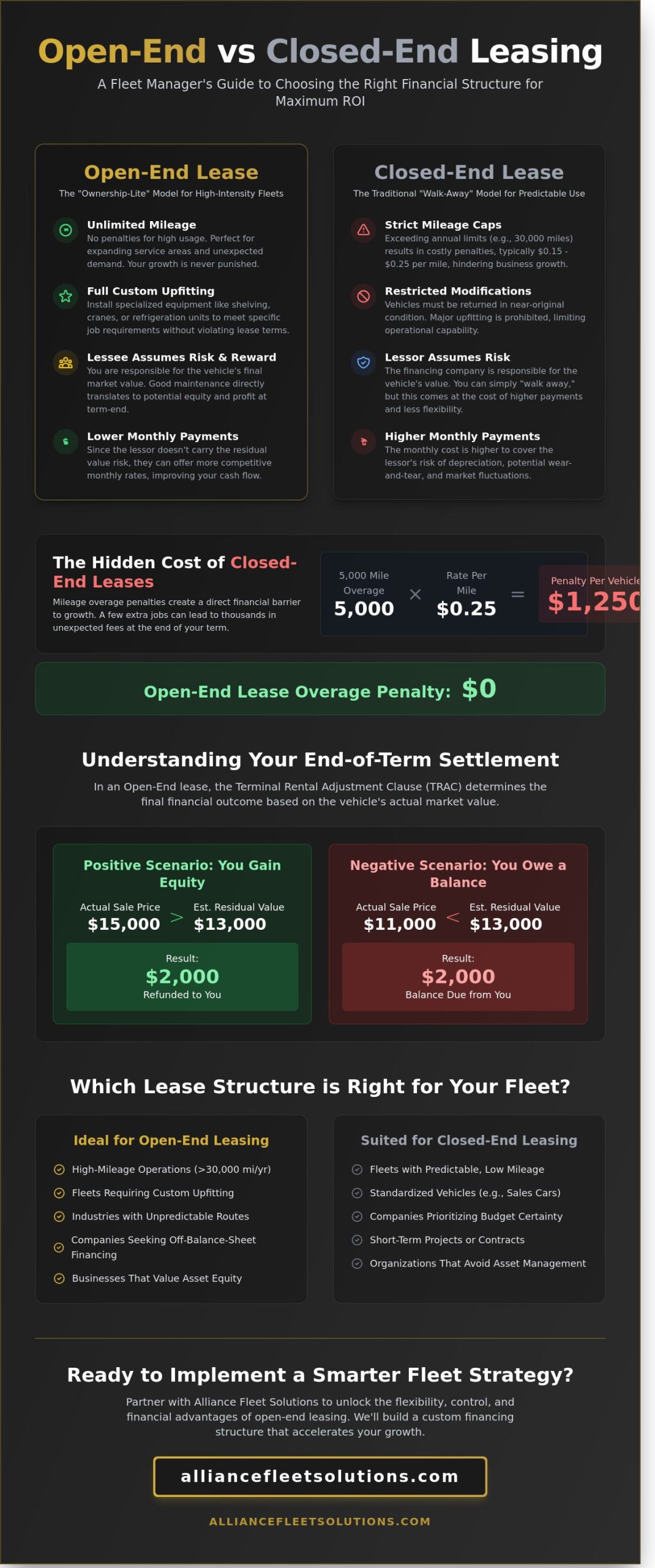
Standard closed-end contracts often penalize business growth. These agreements set strict annual limits, and exceeding them triggers fees ranging from $0.15 to $0.25 per mile. For a fleet vehicle covering 30,000 miles annually, a 5,000-mile overage results in a $1,250 penalty per unit. This creates a psychological barrier to taking on new clients or expanding service territories. Open-end leasing removes these caps entirely. You don’t have to track every odometer reading or limit your route expansion to avoid end-of-year surcharges. This freedom is a cornerstone for efficient fleet operations where agility and responsiveness are competitive advantages.
Wear-and-Tear Standards
Closed-end leases require vehicles to return in “fair” condition. This leads to subjective disputes over minor dents, scratches, or interior wear that the lessor might deem excessive. Open-end models shift the focus to market value. This structure is ideal for rough-duty sectors like construction, oil and gas, or heavy hauling. Because you bear the ultimate financial responsibility for the vehicle’s resale, you control the timing and cost of repairs. You won’t face inflated refurbishment fees from a leasing company at the end of the term. Instead, you manage maintenance through your own trusted service providers, ensuring the vehicle remains productive until the day it is sold.
Over a typical 36-month term, the Total Cost of Ownership (TCO) reflects your operational reality. A closed-end lease provides a fixed monthly expense, which simplifies budgeting for light-duty delivery vans with predictable routes. However, open-end models often yield a lower TCO for heavy-use assets. If the market resale value at month 36 exceeds the depreciated book value, your business keeps the equity. This turns your fleet into a strategic asset rather than just a recurring line-item expense. If you want to maximize your return on every mile driven, partnering with a fleet expert can help you calculate the precise break-even point for your specific equipment.
Demystifying the TRAC Clause and Depreciation Risk
The Terminal Rental Adjustment Clause (TRAC) acts as the functional heart of open-end leasing. It’s the mechanism that differentiates a commercial lease from a standard consumer agreement. While some fleet managers hesitate at the mention of a TRAC clause, fearing an unexpected “balloon payment” at the end of the term, this structure actually offers a level of control that closed-end leases lack. The risk isn’t a hidden trap; it’s a shared responsibility that rewards well-managed fleets.
A TRAC lease allows your business to act as the ultimate beneficiary of the vehicle’s value. If you maintain your equipment meticulously and the market remains stable, you share in the profit. For example, imagine a Class 8 truck with an undepreciated book value of $55,000 at the end of a 48-month term. If that truck sells at auction for $60,000, your business receives a $5,000 check. If the truck sells for $51,000 because of excessive wear or high mileage, you’d be responsible for the $4,000 shortfall. This creates a direct link between vehicle care and your bottom line.
Calculating the Final Adjustment
The math behind the settlement is transparent. You subtract the Undepreciated Book Value from the Net Sales Price to determine the Adjustment. To prevent large end-of-lease surprises, we help you set monthly depreciation rates that reflect your actual mileage and application. In 2026, used vehicle market data is more accessible and precise than ever before. Access to real-time auction results and historical pricing trends allows us to project residuals with a high degree of accuracy, often within a 3% margin of error. This data-driven approach ensures your monthly payments are realistic, not just low.
Mitigating Depreciation Risk
You don’t have to leave your final settlement to chance. Implementing a robust maintenance management program is the most effective way to preserve asset value and ensure a positive adjustment. Beyond maintenance, choosing the right vehicle specifications during the initial acquisition phase prevents rapid depreciation. A Depreciation Hedge is a strategy using high-demand vehicle models to ensure the resale value remains consistently higher than the projected book value. By selecting popular engine configurations and avoiding overly niche customizations, you protect your capital and maximize your return on investment.
Why Custom-Upfitted Fleets Prefer Open-End Terms
For businesses running specialized service vans or heavy-duty trucks, a standard factory model is rarely enough to get the job done. Upfitting, which includes everything from heavy-duty shelving and refrigeration units to hydraulic cranes, transforms a basic vehicle into a high-performance business tool. However, the choice between lease types dictates whether that upfit becomes a sunk cost or a strategic investment. In a closed-end lease, managers often face strict “de-identification” clauses. These mandates require the removal of all custom equipment before returning the keys. This process wastes expensive labor hours and often leaves the hardware damaged or unusable for future rigs. Open-end leasing eliminates this friction by allowing the upfit to remain with the vehicle through the final sale.
The ROI of Professional Upfitting
Custom configurations do more than just organize tools; they drive measurable bottom-line results. A 2023 industry analysis found that optimized shelving layouts can save technicians up to 30 minutes of search time per day. When combined with smart fuel management strategies, lightweight aluminum upfits reduce overall vehicle weight, which directly lowers consumption rates. Fleet managers can often amortize these upfitting costs into the monthly lease payment, spreading the capital expense over the asset’s entire useful life. Specialized vehicles often command a 15% to 20% premium in niche secondary markets because they’re ready for immediate work, bypassing the six-week lead times common at many upfit shops.
Lifecycle Management for Specialized Vehicles
Managing a specialized fleet requires a precise “acquisition to disposal” timeline that doesn’t always align with a rigid 36-month contract. A crane truck or a refrigerated van might need a longer or shorter service life based on the specific wear and tear of the auxiliary equipment. Open-end leasing provides the flexibility to retire the asset exactly when the upfit reaches its mechanical limit, rather than when a calendar date dictates. To maximize returns, managers should focus on these strategies:
- Select modular upfits that are easy to repair or refresh.
- Choose industry-standard refrigeration or power brands to ensure parts availability.
- Document all maintenance on the upfit equipment to prove value to the next buyer.
These choices ensure the vehicle appeals to the 85% of used-market buyers who are looking for turn-key solutions that allow them to start billing clients on day one.
Implementing an Open-End Strategy with Alliance Fleet Solutions
Alliance Fleet Solutions transforms your fleet from a recurring expense into a calculated strategic asset. We act as your primary partner to ensure your lease structure aligns with your actual daily operations and long-term growth targets. Our fractional fleet management model provides the technical authority of a dedicated executive without the overhead of a full-time salary. We coordinate the full “Alliance” of services, which includes procurement, specialized upfitting, and professional remarketing. This proactive approach ensures every truck or van serves as a high-performing business investment rather than just a tool.
Our team focuses on maximizing your ROI by streamlining every phase of the vehicle lifecycle. We handle the heavy lifting of fleet logistics so you can focus on your core business operations. By treating each vehicle as a strategic asset, we help you maintain high uptime and reduce the total cost of ownership. Our commitment to reliability means we don’t just set up a contract; we manage the ongoing health and financial performance of your entire mobile inventory.
The Power of Professional Remarketing
Resale value is the engine that drives success in open-end leasing. When you partner with Alliance, you gain immediate access to national auction networks and a deep pool of private buyers. This broad reach consistently generates higher returns than local trade-in options. Those high resale prices translate directly into “refund checks” for your business at the end of the lease term. We track market volatility closely to protect your equity. For example, during 2023, heavy-duty vehicle values shifted by as much as 12% in a single quarter. Our experts identify the precise timing for vehicle disposal to capture the peak market price, ensuring you aren’t leaving money on the table when it’s time to cycle out your equipment.
Getting Started: Your Fleet Analysis
Determining if open-end leasing fits your specific cash flow needs requires a data-driven look at your current operations. We provide a comprehensive fleet audit to evaluate your mileage patterns, maintenance history, and wear-and-tear benchmarks. This audit provides a clear roadmap for your next steps. Following the analysis, our team handles the following:
- Custom vehicle sourcing to find the exact makes and models for your industry.
- Coordinated upfit planning to ensure every vehicle is work-ready upon delivery.
- Strategic lifecycle modeling to predict the optimal replacement window.
A well-structured fleet is the backbone of a functional business. You can Partner with Alliance Fleet Solutions for your next lease to begin streamlining your operations and protecting your bottom line. We provide the expert control you need to navigate the complexities of vehicle procurement and disposal with confidence.
Future-Proof Your Fleet Strategy for 2026
Navigating the complexities of vehicle acquisition requires more than just a line of credit. It demands a strategy that aligns your capital with your operational reality. By adopting open-end leasing, you gain the freedom to manage depreciation through IRS-approved TRAC clauses without the rigid mileage constraints that often penalize growing businesses. This model is particularly effective for specialized vehicles. It allows for custom upfitting that meets your specific industry requirements without the fear of end-of-term penalties. You’re in control of the vehicle’s lifecycle from the first mile to the final sale.
Alliance Fleet Solutions provides the expert vehicle remarketing needed to maximize your returns, combined with the personal touch of a family-owned business and the reach of a national-scale operation. We’ve built our reputation on providing custom upfitting solutions that keep logistics professionals moving in a fast-paced market. Build a more flexible fleet with Alliance Fleet Solutions today and ensure your infrastructure remains resilient through 2026 and beyond. Your fleet is the backbone of your business, and we’re ready to help you optimize every mile of the journey.
Frequently Asked Questions
Is an open-end lease considered an operating lease or a capital lease?
Under the FASB ASC 842 standards implemented in 2019, an open-end lease is typically classified as a finance or capital lease. This happens because the lessee assumes the risks and rewards of ownership through a residual value guarantee. You’ll need to record these vehicles as assets and liabilities on your balance sheet. Our team helps you understand these technical requirements to ensure your fleet optimization strategy stays compliant with current accounting rules.
Can I end an open-end lease early without massive penalties?
You can terminate an open-end lease early without the rigid “early termination fees” found in consumer contracts, usually after an initial 12-month period. Since you’re responsible for the book value, you simply pay the difference between the remaining balance and the vehicle’s current market sale price. This structure gives fleet managers the agility to cycle out underperforming assets. It avoids the 3 to 6 month payment penalties common in closed-end agreements.
What happens if my vehicle is totaled in an accident during an open-end lease?
If a vehicle is totaled, you’re responsible for the difference between the insurance payout and the remaining book value. Standard commercial insurance often pays the Fair Market Value, which can be 15% to 20% lower than your balance during the first year of service. We recommend GAP coverage to protect your cash flow against these gaps. This ensures a single collision doesn’t create a sudden five-figure liability for your business operations.
Do I have to buy the vehicle at the end of an open-end lease?
You aren’t required to purchase the vehicle at the end of an open-end leasing agreement, though you do guarantee its value. You can choose to buy the asset, trade it in for a new model, or have us sell it at auction on your behalf. If the sale price is higher than the remaining book value, your business keeps 100% of that equity. This flexibility is why many commercial fleets prefer this model over fixed-term retail leases.
How is the monthly depreciation rate determined in an open-end agreement?
The monthly depreciation is set as a fixed percentage of the original capitalized cost, typically ranging from 1.25% to 2.50% based on the asset type. For instance, a heavy-duty truck might be depreciated at 2% monthly to reach a specific target value over 40 months. This predictable schedule allows you to track your equity with precision. It prevents the surprise of unexpected depreciation when it’s time to refresh your equipment.
Are there any tax benefits to choosing open-end leasing for my business?
Open-end leasing offers substantial tax advantages through Section 179 deductions and bonus depreciation. For the 2024 tax year, the Section 179 deduction limit is $1,220,000, which lets businesses deduct the full purchase price of qualifying equipment immediately. Additionally, bonus depreciation is available at 60% for 2024. These incentives help you maximize cash flow and lower your total tax liability while you maintain a modern, dependable fleet.
What is the minimum term for a typical commercial open-end lease?
The standard minimum term for a commercial open-end lease is 12 months. While most logistics companies structure their agreements for 36 to 60 months, the one-year floor provides the necessary flexibility for short-term projects. Shorter terms may require higher depreciation rates to keep the book value in line with market reality. This 12-month minimum ensures the lease qualifies for commercial treatment and allows the initial depreciation curve to stabilize.
How does Alliance Fleet Solutions help minimize my risk of a balloon payment?
Alliance Fleet Solutions minimizes your risk by using real-world market data to set accurate residual values from the start. We analyze auction results and historical resale data from the last 24 months to ensure your depreciation rate matches actual wear and tear. Our proactive approach prevents large, unexpected payments at the end of the term. We act as your strategic partner to ensure your fleet remains a productive asset rather than a financial burden.