
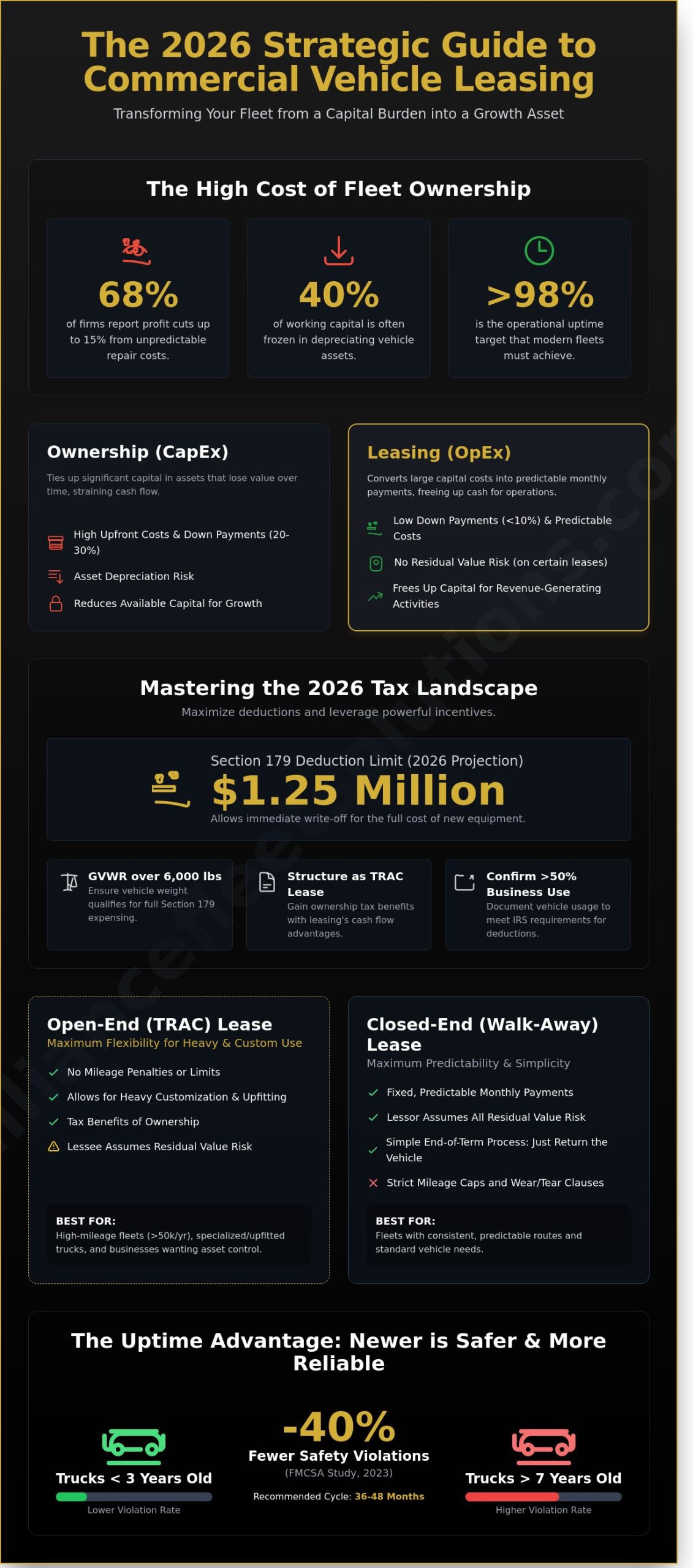
In the 2025 fiscal year, nearly 68% of mid-sized logistics firms reported that unpredictable repair costs slashed their net profit margins by as much as 15%. If your business is still tying up 40% of its working capital in depreciating assets, you’re likely struggling to find the right balance through commercial vehicle leasing or traditional ownership. You already know that cash flow is the lifeblood of expansion. Keeping your capital liquid while maintaining a modern fleet isn’t just a financial preference; it’s a critical requirement for 2026 operations.
We’ve designed this guide to help you master these complexities and transform your fleet into a strategic business asset. Our goal is to empower your team with a clear roadmap to secure predictable monthly costs, maximize tax benefits, and ensure operational uptime stays above 98%. We’ll walk you through a comprehensive checklist covering everything from custom upfitting for immediate deployment to the complexities of vehicle disposal, providing the expert control you need to focus on scaling your core business.
Key Takeaways
- Learn how to transform fleet costs from capital burdens into operational assets by leveraging the 2026 tax landscape and Section 179 deductions.
- Navigate the critical differences between TRAC and walk-away structures to select a commercial vehicle leasing model that aligns with your specific mileage and risk requirements.
- Discover how to look beyond monthly payments to master Total Cost of Ownership by integrating proactive maintenance management directly into your lease agreement.
- Streamline your vehicle procurement and remarketing processes by utilizing national sourcing networks to bypass inventory shortages and ensure rapid deployment.
- Identify the operational gaps in your business and learn how fractional fleet management provides expert oversight to maximize uptime and strategic growth.
The Strategic Business Case: Why Lease Commercial Vehicles in 2026?
Fleet managers face tighter margins and stricter emissions standards as we head into 2026. Shifting from capital expenditure (CapEx) to operational expenditure (OpEx) through commercial vehicle leasing transforms the balance sheet from a liability into a tool for growth. Instead of a $150,000 upfront hit for a single Class 8 truck, companies pay a predictable monthly service fee. This keeps debt-to-equity ratios low, which makes the company more attractive to lenders when it’s time to secure expansion loans. Leasing also ensures the fleet remains agile. If market demand drops by 12% in a specific region, short-term lease structures allow for faster scaling than selling owned assets at a loss in a saturated used market.
Beyond the immediate benefits of leasing, maintaining a strong overall credit profile is essential for securing favorable terms on any financing, including future expansion loans. For businesses aiming to strengthen their financial standing, you can discover Allen & Allen, Inc., a firm specializing in credit consulting and education.
Preserving Capital and Improving Cash Flow
Cash is the lifeblood of logistics. Most lease agreements require down payments of less than 10%, compared to the 20% or 30% typically required for traditional financing. This liquidity allows businesses to reinvest capital into revenue-generating activities like advanced telematics or driver retention programs. The opportunity cost of tying up $1.2 million in a 10-truck fleet is high; that same capital could fund a new regional distribution center or a mobile maintenance partnership. Strategic commercial vehicle leasing stabilizes monthly budgeting by providing a single, predictable payment that simplifies long-term financial forecasting.
Leveraging Tax Incentives and Depreciation
The 2026 tax environment continues to favor fleet modernization, even as some pandemic-era incentives shift. While bonus depreciation is scheduled to drop to 20% in 2026, Section 179 remains a powerful tool for immediate expensing. The deduction limit for 2026 is projected at $1.25 million, which allows most small to mid-sized operators to write off the entire cost of new equipment in the first year. Use this checklist to identify lease structures that qualify for maximum write-offs:
- Verify the GVWR: Ensure the vehicle is over 6,000 pounds to qualify for full Section 179 expensing.
- Structure as a TRAC Lease: Terminal Rental Adjustment Clauses offer the tax benefits of ownership with the cash flow benefits of leasing.
- Confirm Business Use: Document that the vehicle is used for business purposes at least 50% of the time to satisfy IRS auditors.
Younger fleets mean fewer violations and higher uptime. A 2023 FMCSA study showed that trucks under three years old have 40% fewer safety violations than those over seven years old. By cycling vehicles every 36 to 48 months, managers eliminate the “repair or replace” dilemma that plagues older fleets. This proactive approach ensures your alliance with drivers remains strong by providing them with the safest, most efficient equipment available in the industry.
The Lease Structure Checklist: Open-End vs. Closed-End Models
Selecting the right commercial vehicle leasing structure directly impacts your fleet’s total cost of ownership and long term liquidity. The decision hinges on who assumes the residual value risk: the fleet owner or the leasing company. While fuel efficiency depends on driving habits, your financial efficiency depends on matching your lease to your operational reality. Most heavy duty operators find that the wrong lease structure can erase the savings gained through technical maintenance or driver training.
The Open-End (TRAC) Lease: Flexibility for Heavy Use
The Terminal Rental Adjustment Clause (TRAC) lease stands as the industry standard for high mileage operations. In this model, the lessee assumes the residual value risk. If the vehicle sells for more than the predetermined residual value at the end of a 48 month term, your company receives the credit. If it sells for less, you pay the difference. This structure offers a significant advantage for 75% of long haul logistics firms because it eliminates mileage penalties. You can compare open-end and closed-end leasing models to see how these financial fluctuations affect your specific budget.
- Mileage Audit: Choose an Open-End structure if your vehicles exceed 50,000 miles annually.
- Asset Customization: Use this for specialized trucks where unique equipment might affect resale value.
- Term Length: Aim for 36 to 48 months to balance depreciation against maintenance costs.
The Closed-End Lease: Predictability for Fixed Operations
The closed-end or “walk-away” lease provides maximum predictability. You pay a set monthly fee and return the keys at the end of the term. This is ideal for last mile delivery fleets with fixed routes that rarely exceed 15,000 miles per year. However, the lessor protects their asset with strict “excessive wear and tear” clauses. These contracts often include a 15 to 25 cent per mile penalty for overages, which can quickly turn a cost saving measure into a financial burden. To safeguard your investment, always negotiate gap insurance directly into your commercial vehicle leasing agreement to cover the difference between the insurance payout and the lease balance in the event of a total loss.
Navigating these complex contractual terms is crucial, and should disputes arise over penalties or fulfillment, it’s wise to understand your legal options. For businesses managing significant assets, it can be helpful to explore Business Litigation Services to protect your interests.
Maintaining your vehicles is the best way to protect residual values and avoid end of lease penalties. You can streamline your fleet maintenance with our mobile repair services to ensure every asset remains in peak condition for inspection.
- Predictable Routing: Best for service industries like HVAC or plumbing with localized territories.
- Wear and Tear: Document every minor dent or scratch every 30 days to avoid surprise fees.
- Short Cycles: 24 to 36 month terms allow you to rotate in newer, more fuel efficient models more frequently.
The Total Cost of Ownership (TCO) Checklist: Beyond the Monthly Payment
Focusing solely on the monthly payment is a strategic error that erodes profit margins. Within the scope of commercial vehicle leasing, Total Cost of Ownership (TCO) serves as the definitive metric for fleet health. TCO accounts for every dollar spent from acquisition to remarketing, including fuel, taxes, and downtime. A well-structured lease agreement should function as a shield against unpredictable spikes in operating costs.
- Maintenance Integration: Ensure repair costs are capped by folding scheduled service into the lease structure.
- Fuel Efficiency: Select vehicle specs that maximize MPG based on your specific route topography and load weights.
- Data Visibility: Use telematics to track idle time and aggressive driving, which can increase fuel consumption by up to 33 percent.
Real-time telematics provide the visibility needed to adjust driver behavior before it impacts the bottom line. By monitoring GPS data and engine diagnostics, managers can identify high-cost outliers in the fleet. This data-driven approach transforms commercial vehicle leasing from a simple rental agreement into a strategic asset management tool.
Professional Upfitting and Vehicle Configuration
Planning your fleet begins long before the keys are turned. Professional upfitting should be finalized during the acquisition phase to ensure the vehicle is ready for work on day one. Rolling these costs into your lease preserves your working capital for core business operations. Consider this checklist for configuration:
- Assess interior shelving and bin requirements for specific trade tools to reduce search time.
- Evaluate refrigeration unit specifications for 100 percent temperature compliance during transport.
- Determine liftgate weight capacities to avoid structural failures and safety incidents.
Quality upfits don’t just improve daily efficiency; they protect the vehicle’s residual value. Fleets with industry-standard configurations often see a 12 percent higher return at the end of the lifecycle compared to poorly modified units.
Integrated Maintenance and Fuel Programs
Choosing between “Full Maintenance” and “Managed Maintenance” depends on your tolerance for risk. Full maintenance provides a fixed cost that simplifies budgeting, while managed programs offer flexibility for fleets with varying usage patterns. Effective fuel management programs must provide Level 3 data, which includes odometer readings and driver IDs to prevent fraud and unauthorized purchases. “Preventive maintenance is not an expense; it is an insurance policy against the $1,000-per-day cost of a downed vehicle.” This proactive stance ensures your fleet remains a strategic asset rather than a liability. For operators running specialized lifting equipment across multiple job sites, a resilient telehandler parts management strategy is equally essential to preventing the unplanned downtime that erodes your total cost of ownership.
The Acquisition and Remarketing Checklist: Managing the Lifecycle
Effective fuel management starts long before a driver turns the key. It begins with a strategic approach to commercial vehicle leasing that prioritizes the right specifications for the specific job. Managing the vehicle lifecycle ensures your fleet remains modern, efficient, and cost-effective. Older trucks often see a 3% to 5% drop in fuel economy every year after they pass the 150,000-mile mark. Replacing these assets at the optimal time prevents your margins from evaporating at the pump.
Sourcing and Procurement Excellence
Access to a national sourcing network is critical for maintaining uptime. While local dealerships often face inventory shortages that can delay operations for months, a professional partner leverages relationships with multiple OEMs and specialized body builders to secure units quickly. Small and mid-sized businesses can capture 10% to 15% savings by tapping into volume fleet pricing typically reserved for massive corporations. Use this checklist to verify your procurement strategy:
- Verify OEM direct ordering capabilities to bypass retail markups.
- Confirm access to nationwide upfitting partners for specialized body builds.
- Audit delivery timelines to prevent operational gaps during peak seasons.
Review these strategic vehicle acquisition tips to refine your sourcing process and ensure you’re getting the most efficient models available.
Vehicle Remarketing and Disposal Strategy
The final phase of the lifecycle determines your total cost of ownership. Professional remarketing maximizes equity by timing the sale when demand is highest. In 2023, fleets using proactive disposal strategies saw a 12% higher return compared to those relying on local trade-ins. To ensure success with an Open-End lease, you must treat your old assets as capital. Follow these steps to maximize ROI:
- Detail vehicles to professional standards to increase auction bid prices.
- Utilize multi-channel disposal including wholesale, private networks, and high-volume auctions.
- Schedule new asset delivery 30 days before old asset disposal to guarantee zero downtime.
Smart commercial vehicle leasing isn’t just about the monthly payment; it’s about the equity you recover at the end. By coordinating the transition between old and new assets, you maintain a constant flow of efficient, fuel-saving technology without interrupting your service schedule.
Building Your Alliance: Why Fractional Fleet Management is the Final Step
Fractional fleet management offers a strategic advantage by providing expert-level oversight without the $115,000 average annual salary of a full-time fleet director. You access high-level technical authority and logistics planning on a scalable basis. This model ensures your operations remain lean while your equipment stays road-ready. It’s the most efficient way to bridge the gap between basic vehicle ownership and professional logistics execution.
Identify if your business is losing revenue through these common operational gaps:
- Maintenance Variance: Your repair costs fluctuate by more than 15% month-over-month.
- Downtime Metrics: Vehicles sit idle for more than 48 hours for routine scheduled services.
- Fuel Inefficiency: Total fuel spend exceeds 30% of your operational budget without clear data on why.
- Compliance Risks: DOT records aren’t updated within 24 hours of a change.
Alliance Fleet Solutions acts as the strategic backbone for your B2B logistics. We don’t just fix trucks; we manage the lifecycle of your assets to maximize ROI. By integrating commercial vehicle leasing into a broader management strategy, we ensure you aren’t just paying for iron, but for guaranteed uptime and predictable cash flow. To see exactly how this integrated approach works in practice, review the Alliance Fleet Solutions case study on strategic fleet lifecycle management, which breaks down how a single point of contact can transform fleet operations from a chaotic cost center into a high-performing strategic asset.
The Value of a Solution-Oriented Partnership
Our commitment to dependable, no-nonsense service means we prioritize your bottom line over simple transactions. We provide the calm, expert control needed to stabilize volatile logistics costs. Before your initial consultation, prepare the following data points to help us build your roadmap:
- Last 12 months of maintenance invoices and repair logs.
- Current fuel card reports showing MPG by vehicle class.
- Existing lease agreements or proof of ownership documents.
- Telematics data highlighting idling time and route efficiency.
For a deeper dive into optimizing your assets, review The Ultimate Guide to Fleet Management.
Customized Fleet Solutions for National Operations
Alliance Fleet Solutions serves clients across the United States with consistent, high-level standards. Whether you operate five units or five hundred, our mobile capabilities ensure your equipment remains active. We’ve streamlined commercial vehicle leasing to remove the friction of traditional procurement, allowing you to scale your fleet as fast as your market demands.
Determine if your current provider is a vendor or a true ally with this final check:
- Does your provider offer on-site mobile repairs to eliminate transport time?
- Do they provide a dedicated point of contact who understands your specific industry?
- Is their billing transparent, or are there hidden fees for “administrative” tasks?
Stop managing vehicles and start growing your business. Schedule your fleet leasing consultation with Alliance Fleet Solutions today to secure the backbone of your operations.
Mastering Your 2026 Fleet Strategy
Navigating the complexities of 2026 fleet operations requires more than just picking a truck. Success depends on mastering the total cost of ownership and selecting a structure that matches your specific cash flow needs. Whether you choose an open-end model for maximum flexibility or a closed-end model to minimize residual risk, your decision impacts the bottom line for years to come. Modern commercial vehicle leasing isn’t a simple transaction; it’s a strategic alliance that keeps your drivers on the road and your maintenance costs predictable. For businesses looking to optimize their operations with custom-upfitted vehicles and eliminate administrative burdens, explore our comprehensive fleet truck leasing strategies designed to stabilize monthly cash flow and reduce total cost of ownership. Since 2018, Alliance Fleet Solutions has operated as a family-owned partner providing comprehensive national coverage for businesses of all sizes. We bring deep technical expertise to every lifecycle stage, from initial acquisition to final remarketing. You don’t have to manage these high-stakes logistics alone when you have a dedicated team handling the heavy lifting. Our approach ensures your fleet remains a strategic asset rather than a financial burden. Streamline your operations with a custom commercial lease from Alliance Fleet Solutions. Your fleet is the backbone of your business, and we’re here to ensure it stays strong and reliable.
Frequently Asked Questions
What is the main difference between commercial vehicle leasing and personal leasing?
Commercial vehicle leasing focuses on business utility and tax efficiency rather than consumer credit standards. While personal leases often restrict you to 10,000 or 12,000 miles per year, commercial agreements accommodate 30,000 miles or more to meet rigorous operational needs. This structure allows you to maximize your fleet’s ROI through specialized terms tailored to heavy-duty usage. It’s a strategic partnership designed to keep your business moving efficiently.
Can I include custom upfitting and branding in my commercial lease?
You can include 100% of your upfitting and branding costs directly into your monthly lease payment. Whether you need specialized shelving, refrigeration units, or full vinyl wraps, these additions are treated as part of the vehicle’s total capitalized cost. This approach preserves your liquid capital for other operational needs. It ensures your trucks are work-ready the moment they arrive at your facility, streamlining your deployment process.
How does an Open-End lease (TRAC) protect my business if I drive high mileage?
A Terminal Rental Adjustment Clause (TRAC) lease protects your business from mileage penalties by making you responsible for the vehicle’s residual value. If you drive 60,000 miles annually, you won’t pay the $0.25 per mile overage fee common in closed-end leases. Instead, you’ll manage the final sale price at the term’s end. This flexibility ensures your monthly cash flow remains predictable regardless of your route density or service area expansion.
What tax benefits are available for commercial vehicle leasing in 2026?
In 2026, businesses can still utilize Section 179 expensing and adjusted bonus depreciation to lower their tax liability. Bonus depreciation is scheduled at 20% for that tax year, allowing for an immediate write-off of a portion of the vehicle’s cost. These incentives make commercial vehicle leasing a powerful tool for fleet optimization. Consult your tax professional to confirm how these specific 2026 codes apply to your equipment acquisition strategy.
What happens at the end of a commercial vehicle lease term?
At the end of a 36 or 48 month term, you typically have the option to purchase the vehicle, trade it in for a newer model, or sell it. In an open-end lease, if the vehicle sells for more than the residual value, your business retains the profit. If it sells for less, you’re responsible for the difference. This structure encourages proper preventive maintenance to ensure the highest possible resale value when the term concludes.
Is maintenance included in most commercial lease agreements?
Most commercial lease agreements offer optional full-service maintenance programs that can be bundled into your monthly bill. Managed maintenance plans often reduce unexpected repair costs by 20% through scheduled preventive care at 5,000 or 10,000 mile intervals. We prioritize your uptime by coordinating these services through our mobile repair network. This proactive approach prevents small mechanical issues from turning into expensive, time-consuming breakdowns that stall your operations.
How does telematics impact my lease costs and insurance premiums?
Telematics systems directly lower your total cost of ownership by providing real-time data on engine health and driver safety. Implementing these tools can lead to a 12% drop in fuel consumption and a 10% reduction in insurance premiums for many fleets. We integrate these solutions to streamline your operations and ensure your drivers stay safe on the road. This data-driven approach transforms a standard lease into a strategic business asset.
Can I lease specialized equipment like telehandlers or heavy-duty trucks?
You can absolutely lease heavy-duty trucks and specialized equipment like telehandlers through our tailored programs. Commercial vehicle leasing isn’t limited to standard vans; it covers Class 8 tractors and specialized machinery with lift capacities exceeding 12,000 pounds. Our team helps you secure the exact tools needed for your specific logistics or construction projects, and we also provide guidance on sourcing critical telehandler parts for national fleet uptime to keep your equipment running at peak performance. This ensures you have the right equipment to maintain maximum uptime and operational efficiency.