
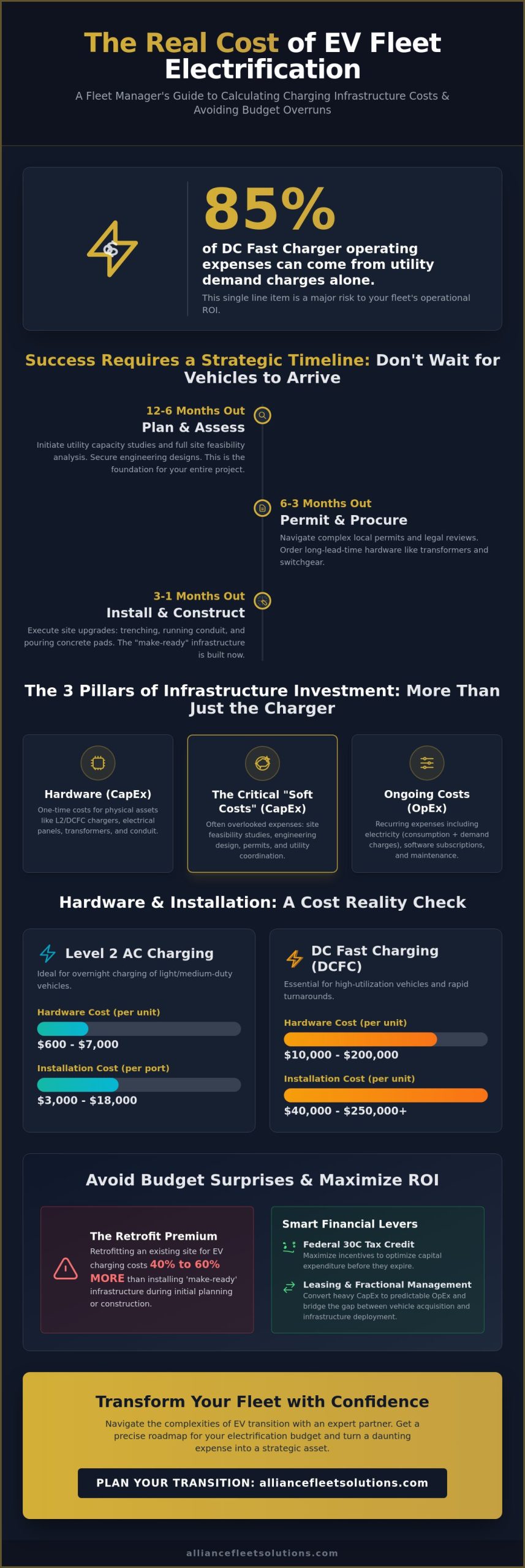
Did you know that demand charges can account for as much as 85% of the operating expenses for a DC fast charger? For a fleet manager, this isn’t just a line item on a utility bill; it’s a significant risk to your operational ROI. You’re likely already dealing with the stress of hidden site preparation costs and the frustration of trying to synchronize vehicle delivery with charger installation. It’s a high-stakes transition where missing a single detail can lead to costly downtime or stranded assets.
We understand that you need more than just a rough estimate to move forward with confidence. This guide focuses on the precision required for calculating EV fleet charging infrastructure costs, offering a comprehensive breakdown of hardware, installation, and the ongoing energy management strategies needed for commercial success. You’ll gain a clear roadmap for your 2026 electrification budget, including how to maximize the Federal 30C Tax Credit before it expires on June 30. We’ll show you how to transform charging infrastructure from a daunting utility expense into a scalable strategic asset that powers your business forward.
Key Takeaways
- Establish a planning window of at least six to twelve months to ensure your site is ready before your first vehicles arrive.
- Master the nuances of calculating EV fleet charging infrastructure costs by accounting for hidden site upgrades like trenching and transformer capacity.
- Identify strategies to mitigate unpredictable utility demand charges by leveraging Time-of-Use rates and smart charging schedules.
- Optimize your capital expenditure by stacking federal tax credits with open-end leasing to manage the residual value of your electric assets.
- Learn how fractional fleet management bridges the gap between vehicle acquisition and infrastructure deployment for a seamless transition.
The Core Components of EV Fleet Infrastructure Costs
Transitioning a commercial fleet to electric power is a structural business shift that requires looking at your depot as a mini-utility. It is a complex process where the vehicle is often the simplest part of the equation. To build a reliable operation, you must categorize your investment into three distinct pillars: hardware, soft costs, and operational expenses. Most managers focus on the charger price tag, but the real complexity lies in the infrastructure behind the wall. Failing to account for the interplay between these cost centers can lead to significant budget overruns and operational delays.
Precision in calculating EV fleet charging infrastructure costs begins with a clear distinction between “front-of-the-meter” and “behind-the-meter” expenses. Front-of-the-meter costs involve the utility company’s equipment, such as transformers and high-voltage lines required to bring power to your site. Behind-the-meter costs encompass everything on your side of the utility connection, including the electrical panels, conduit, trenching, and the charging units themselves. Understanding this split is vital because it determines who is responsible for the work and who pays the bill.
Timing is your most valuable asset. You shouldn’t wait for vehicles to arrive before you start digging trenches. Effective planning must begin six to twelve months before vehicle acquisition. This window allows for utility capacity studies and the strategic expansion of electric vehicle charging networks within your local grid. Partnering with professional fleet management services ensures these moving parts stay synchronized. This partnership prevents the costly scenario of having a new fleet sitting idle because the site lacks the power to charge them.
Capital Expenditures (CapEx) vs. Operational Expenses (OpEx)
Hardware and construction represent the bulk of your Capital Expenditures. These are one-time investments in your facility’s future. However, the long-term viability of your fleet depends on accurately forecasting Operational Expenses. This includes recurring energy consumption, software subscriptions for load management, and preventative maintenance. Many organizations now utilize leasing models to shift these heavy upfront CapEx costs into predictable monthly OpEx payments, which helps maintain cash flow while scaling the fleet.
The “Soft Costs” of Electrification Planning
Soft costs are the invisible expenses that often catch fleet managers off guard. You must budget for site feasibility studies and professional engineering designs to ensure your facility can handle the increased load safely. High-voltage installations require specific permits and legal reviews that vary by jurisdiction. Additionally, the administrative time spent coordinating with utility providers is extensive. These tasks require dedicated professional oversight to avoid project bottlenecks and ensure compliance with local building codes.
Estimating Hard Costs: Hardware, Installation, and Site Upgrades
Hardware selection is where your operational strategy meets physical reality. Precision in calculating EV fleet charging infrastructure costs requires a deep dive into hardware specifications and the civil engineering required to support them. For most commercial applications, the choice between Level 2 and DC Fast Charging (DCFC) dictates your entire budget. As of June 2026, Level 2 commercial hardware ranges from $600 to $7,000 per unit, with an average of $3,500 per connector. These are ideal for overnight charging. Conversely, DCFC hardware costs between $10,000 and $200,000 per unit, depending on the power level required to keep high-utilization vehicles on the road.
Installation often exceeds the cost of the hardware itself. For a Level 2 port, expect installation costs between $3,000 and $18,000. DC fast chargers require a much heavier lift, with installation ranging from $40,000 to over $250,000 per unit. These figures are heavily influenced by your facility’s existing electrical capacity. If your site requires new transformers or extensive trenching to run conduit, costs will escalate quickly. This makes “make-ready” infrastructure the smartest long-term investment. Data shows that retrofitting a site for EV charging costs 40% to 60% more than installing the necessary conduit and capacity during initial construction.
Strategic placement is equally critical to maintain efficient fleet operations and maximize uptime. Chargers must be positioned to minimize vehicle movement within the yard while remaining accessible for maintenance. Our team helps you evaluate these site-specific variables through our Fractional Fleet Management services, ensuring your layout supports growth without requiring future demolition.
Charger Selection and Scalability
While non-networked chargers are cheaper upfront, they lack the data capabilities required for commercial reporting. Networked chargers allow for remote monitoring and load balancing, which is essential for managing energy costs. Ensure any hardware you purchase is OCPP (Open Charge Point Protocol) compliant. This compliance prevents “vendor lock-in,” allowing you to switch software providers without replacing your physical chargers as your fleet evolves.
Electrical Infrastructure and Site Preparation
Site preparation involves more than just wiring. You must factor in the cost of concrete pads, protective bollards, and professional upfitting for charger housing. High-traffic logistics hubs often require additional physical protection to prevent accidental damage from heavy equipment. Upgrading your service panel and installing new utility transformers are the primary drivers of site prep costs. Engaging your utility provider early can help you identify if they offer “Charge Ready” programs that might cover these specific infrastructure upgrades.
Operational Expenses: Navigating Utility Rates and Maintenance
The transition from diesel to electric power shifts your primary energy cost from a variable pump price to a complex utility tariff. While the hardware is now in place, the ongoing process of calculating EV fleet charging infrastructure costs must extend beyond the initial purchase into the monthly utility cycle. In the logistics sector, energy isn’t just a bill; it’s a raw material that must be managed with the same precision as your vehicle parts inventory. Mismanaging this “electric fuel” can quickly erode the savings you expected from electrification.
Utility structures for commercial fleets are significantly more volatile than residential rates. In regions like Texas, as of June 2026, commercial rates average around 6.81¢/kWh, but this base rate is only one part of the story. You must also account for demand charges, which are fees based on the highest amount of power your site draws during a specific window. Data shows that demand charges can account for as much as 85% of the total operating expenses for a DC fast charger. Managing these peaks is the difference between a profitable fleet and a budget deficit.
The Impact of Demand Charges and Smart Charging
Utility companies often calculate demand charges based on your site’s single highest 15-minute peak of power usage during a billing cycle. If all your trucks plug in simultaneously at 5:00 PM, that one 15-minute surge can reset your entire month’s bill to a higher tier, regardless of how little energy you use the rest of the time. Budgeting for Load Management Software is essential to cap your total power draw automatically. Managed charging is a cost-containment strategy that uses software to stagger vehicle power draws and avoid expensive peak energy thresholds.
Recurring Software and Network Fees
Modern charging infrastructure relies on a “stack” of digital services to remain functional. You’ll need to budget for cloud-based management systems that provide the data tracking and reporting required for tax compliance and internal auditing. These platforms often require annual subscriptions. Additionally, cybersecurity and firmware updates are non-negotiable for networked hardware to protect your facility from digital vulnerabilities. Integrating this charger data into your existing telematics and GPS solutions allows for a unified view of vehicle health and energy consumption.
Reliability is the backbone of any functional operation, which is why a dedicated maintenance management plan for your chargers is just as important as the plan for your trucks. Regular inspections prevent “charger down” scenarios that can strand your drivers. By utilizing professional fuel management programs, you can track energy usage across the entire organization, ensuring that every kilowatt is accounted for and every charging session is optimized for the lowest possible rate.
The TCO Equation: Leasing, Incentives, and Strategic Budgeting
Thinking of infrastructure as a standalone hardware purchase is a common mistake that leads to skewed financial projections. To build a sustainable electrification model, you must view the charger as an integrated component of the vehicle’s total cost of ownership (TCO). This perspective shift is vital when calculating EV fleet charging infrastructure costs, as it allows you to balance heavy upfront capital with long-term operational savings. While the initial investment in high-voltage equipment is substantial, the combination of maintenance reduction and strategic financing creates a compelling breakeven point, typically achieved within three to seven years for most commercial applications.
The breakeven analysis relies on contrasting the rising maintenance costs of internal combustion engine (ICE) vehicles with the lower, more predictable energy and upkeep requirements of electric assets. However, the residual value of EVs remains more volatile than their diesel counterparts due to rapid advancements in battery technology. This is where professional Vehicle Remarketing expertise becomes essential. Recovering maximum asset value at the end of the lifecycle requires a data-driven approach to secondary markets, ensuring that your initial infrastructure investment doesn’t get weighed down by poor vehicle resale performance.
Leveraging Incentives and Grants
You can significantly offset your CapEx by “stacking” available financial incentives. The Federal 30C Tax Credit is a primary tool, providing a credit of 30% of the cost of hardware and installation, up to $100,000 per charger. It’s critical to act quickly, as this specific credit is set to expire on June 30, 2026. Beyond federal support, many utilities offer “Make-Ready” programs. These initiatives, such as Southern California Edison’s “Charge Ready,” often cover the entire cost of the electrical infrastructure needed to support the chargers, leaving your business responsible only for the charging units themselves. Coordinating these grants requires proactive engagement with local utility providers during the early engineering phase.
Open-End vs. Closed-End Leasing for EV Fleets
Choosing the right financing structure is the most effective way to manage the risk of emerging technology. Open-End Leasing offers the flexibility commercial fleets need because it doesn’t impose the rigid mileage restrictions or “wear and tear” penalties found in closed-end consumer leases. This structure allows you to adjust the depreciation rate based on actual vehicle usage and market conditions. Utilizing an open-end lease allows your business to amortize charging equipment costs over the same term as the vehicle, which lowers the monthly cost of ownership while capturing the full benefit of federal tax incentives before they expire.
Managing the total lifecycle from procurement to the final sale ensures your infrastructure supports a profitable operation rather than becoming a stranded cost. If you’re ready to stabilize your electrification budget, our team can help you structure an Open-End Leasing program tailored to your specific fleet requirements.
How Alliance Fleet Solutions Optimizes Your Electrification ROI
Successfully calculating EV fleet charging infrastructure costs is the foundation of a resilient logistics strategy. However, the true value of electrification is realized during the execution and long term management of these assets. We treat your charging infrastructure as a strategic business asset rather than a simple utility expense. Our goal is to eliminate the friction between vehicle delivery and charger activation, ensuring your fleet remains mission ready from day one. By integrating technical authority with a partnership focused approach, we provide the calm, expert control needed to handle the high stakes requirements of the logistics sector.
The Power of Fractional Fleet Management
The transition to electric power often introduces “soft costs” that many businesses fail to anticipate. These include the hundreds of administrative hours spent reviewing engineering designs, negotiating with utility providers, and managing electrical contractors. Our Fractional Fleet Management model allows you to access expert level electrification strategy without the overhead of a full time manager. We act as the essential backbone of your operation, coordinating between utilities, contractors, and vehicle OEMs to keep your project on schedule. This proactive approach reduces the administrative burden on your internal team while ensuring your facility remains safety compliant and operationally efficient. We handle the technical complexities so you can focus on your core business growth.
End-to-End Support from Procurement to Disposal
A functional EV operation requires total lifecycle synchronization. Our Vehicle Acquisition services focus on sourcing the specific EV models that match your duty cycles and charging requirements. We don’t just deliver a vehicle; we provide Professional Upfitting to ensure every truck is mission ready upon arrival. This includes specialized charger mounting and protective housing designed to prevent operational downtime in heavy duty environments.
As your fleet evolves, managing the exit strategy is just as vital as the initial purchase. We utilize our Vehicle Remarketing expertise to recover maximum asset value, helping you navigate the unique secondary market for electric vehicles. Throughout the vehicle’s life, our Telematics and GPS Solutions and Fuel Management Programs provide a unified view of your energy consumption and vehicle health. By partnering with us, you move beyond the theoretical exercise of calculating EV fleet charging infrastructure costs and into a phase of active, profitable execution. We provide the momentum and progress required to handle your transition swiftly and correctly.
Secure Your Fleet’s Future Through Strategic Electrification
Navigating the transition to electric power requires more than just buying chargers; it demands a fundamental shift in how you manage your facility and energy use. Success depends on synchronizing vehicle procurement with infrastructure development at least six to twelve months in advance. By prioritizing “make-ready” site preparation and leveraging smart load management software, you can protect your operation from the volatility of utility demand charges. Precision in calculating EV fleet charging infrastructure costs ensures that your capital works harder, turning a complex technical challenge into a long-term competitive advantage.
As a family-owned and operated expert partner, we provide the national service coverage and technical authority needed to stabilize your transition. We integrate telematics and maintenance management into every step of the process, from initial site studies to vehicle remarketing. You don’t have to manage these high-stakes complexities alone. Our team is ready to act as the supportive backbone of your functional operation. Contact Alliance Fleet Solutions for a Comprehensive Electrification Cost Analysis to begin your journey toward a scalable, reliable, and cost-efficient electric fleet today.
Frequently Asked Questions
How much does a typical Level 2 commercial charger cost including installation?
The total cost for a single Level 2 commercial charging port generally ranges from $3,600 to $25,000. This includes hardware costs that average $3,500 per connector and installation fees that vary between $3,000 and $18,000. Factors such as the distance from your electrical panel and the need for trenching or concrete work will determine where your project falls within this range.
What are utility demand charges and how do they affect fleet charging costs?
Demand charges are utility fees based on the highest amount of electricity your facility draws during any 15-minute interval in a billing cycle. These charges are a vital factor in calculating EV fleet charging infrastructure costs because they can account for up to 85% of your total energy expenses. Implementing managed charging software helps cap this power draw to keep your monthly bills predictable.
Can I lease my EV charging infrastructure along with my vehicles?
Yes, you can bundle your charging hardware and installation costs into an open-end lease. This financial structure allows you to convert a significant upfront capital expenditure into a manageable monthly operational expense. By aligning your infrastructure and vehicle terms, you maintain better cash flow while scaling your electric fleet operations according to your specific business needs.
How long does it take to recoup the costs of EV infrastructure through fuel savings?
Most commercial fleets achieve a full return on investment within three to seven years when they utilize available federal and state incentives. This timeline is driven by the significant gap between electricity prices and diesel costs, alongside a reduction in routine vehicle maintenance. Accurately calculating EV fleet charging infrastructure costs is the first step in identifying your specific breakeven point based on your fleet’s daily mileage.
What is the difference between networked and non-networked chargers for business?
Networked chargers connect to the internet to provide remote monitoring, data reporting, and automated load balancing. These features are essential for commercial fleets that need to track energy usage for tax compliance or manage peak power draws. Non-networked chargers are simple “dumb” units that provide power without any data capabilities, making them difficult to manage in a professional fleet environment.
Are there federal tax credits available for commercial EV charging stations in 2026?
The Alternative Fuel Vehicle Refueling Property Credit, also known as the 30C tax credit, is available until June 30, 2026. This credit covers 30% of the cost of your charging hardware and installation, with a maximum benefit of $100,000 per charger. To qualify, your facility must be located in an eligible census tract, making early site verification a priority for your budget planning.
How does telematics data help in calculating infrastructure needs?
Telematics and GPS solutions provide real-world data on vehicle idle times, daily range requirements, and return-to-base schedules. We use this information to determine the exact number of chargers and power levels your facility requires. This data-driven approach prevents you from overspending on unnecessary capacity while ensuring your infrastructure can handle the actual energy demands of your daily routes.
What happens if our facility does not have enough power for an EV fleet?
If your site lacks capacity, you will need to coordinate with your utility provider for “front-of-the-meter” upgrades, such as new transformers or increased service lines. Many utilities offer “make-ready” programs that may cover the costs of these major electrical upgrades. We act as your fractional fleet management partner to coordinate these complex utility negotiations and ensure your site preparation stays on schedule.