
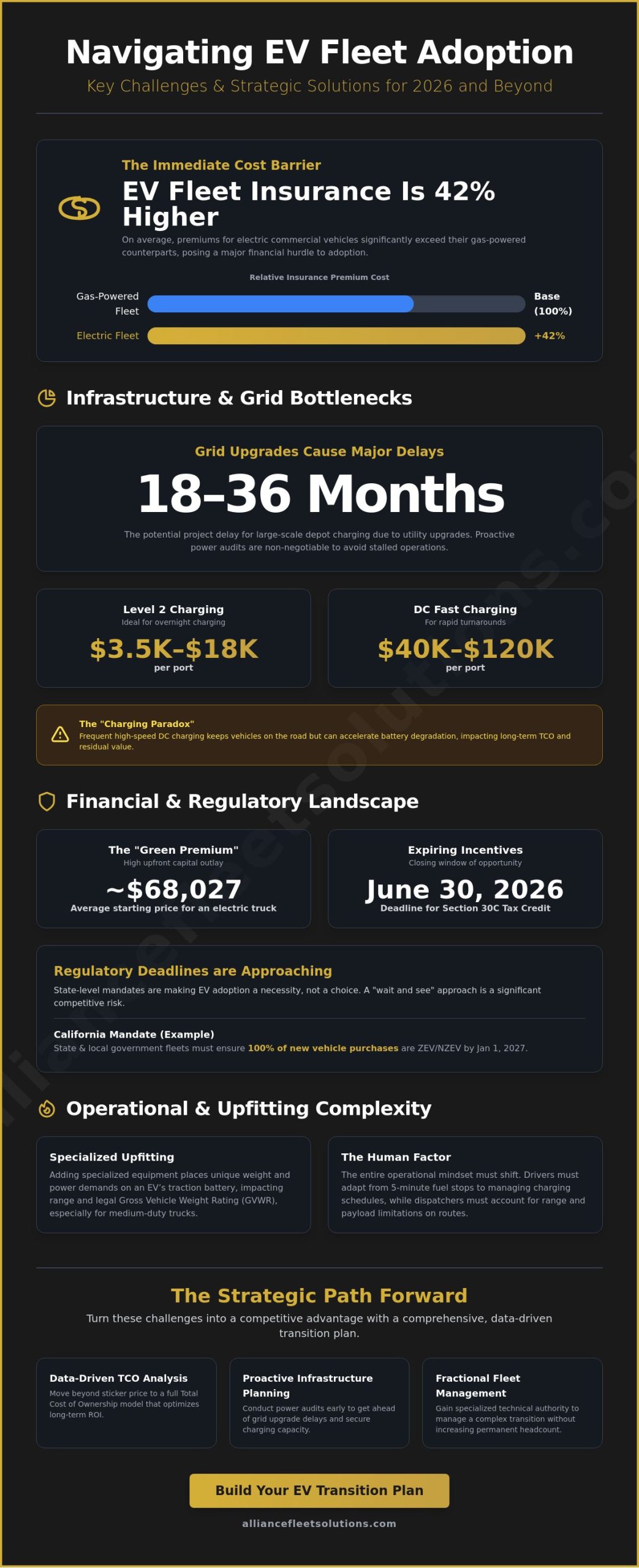
Did you know that insurance premiums for electric vehicles are currently averaging 42% more than their gas-powered counterparts? For a fleet manager, this statistic is more than just a number; it’s a significant barrier to maintaining a healthy bottom line. You’re likely already feeling the weight of high upfront acquisition costs and the looming June 30 expiration of federal infrastructure tax credits. It’s understandable to feel cautious when the transition feels like a series of expensive hurdles rather than a streamlined upgrade.
Successfully managing electric vehicle fleet adoption challenges requires a shift from simple vehicle replacement to a comprehensive financial and structural pivot. This strategic roadmap identifies the technical and operational roadblocks standing in your way and provides actionable solutions to maximize your long-term ROI. We’ll explore how to build a clear transition plan that reduces your Total Cost of Ownership and ensures that EVs integrate seamlessly into your daily logistics. By focusing on smart acquisition and maintenance management, you can keep your operations dependable and your budget on track through 2026 and beyond.
Key Takeaways
- Understand how shifting regulations in 2026 make proactive EV integration a critical competitive advantage rather than a voluntary choice.
- Identify and solve electric vehicle fleet adoption challenges related to site power capacity by matching charging infrastructure to your specific vehicle duty cycles.
- Mitigate financial risks by adopting flexible acquisition strategies that account for rapid technological shifts and the current volatility of EV residual values.
- Maintain operational efficiency by planning for the unique weight and power demands that specialized upfitting places on an electric vehicle’s traction battery.
- Learn how fractional fleet management provides the specialized technical authority needed to oversee a complex transition without increasing your permanent headcount.
The 2026 Landscape: Why Electric Vehicle Fleet Adoption Challenges Persist
The logistics sector has reached a defining moment. For years, adding an electric vehicle to a fleet was a choice driven by voluntary sustainability goals or brand image. In 2026, that phase has ended. We’re now seeing a transition into a period of regulatory necessity and competitive survival. While the EPA repealed federal GHG standards in early 2026, state-level mandates continue to push government and high-priority fleets toward zero-emission targets. A “wait and see” approach is quickly becoming a competitive disadvantage as the window for early-mover incentives closes and infrastructure lead times grow.
Regulatory Pressures and Corporate Mandates
The regulatory environment is currently a patchwork of state requirements and evolving federal rules. For instance, state and local government fleets in California must ensure 50% of their vehicle purchases are ZEV or NZEV through the end of 2026. This requirement rises to 100% by January 1, 2027. Beyond legislation, corporate ESG reporting now requires transparent, audit-ready data on carbon footprints. Proactive fleet owners are using this time to build an operational buffer. They’re securing charging infrastructure before the Alternative Fuel Vehicle Refueling Property Credit (Section 30C) expires on June 30, 2026. Early adoption isn’t just about being “green”; it’s about avoiding the operational panic of future legislative shocks.
The Reality of the “Green Premium”
The initial cost of entry remains one of the primary electric vehicle fleet adoption challenges. With the average starting price for an electric truck sitting around $68,027, the initial capital outlay is significant. However, the conversation has shifted from sticker price to Total Cost of Ownership (TCO). Operational savings in fuel and maintenance can eventually bridge the gap, but only if the data is managed with expert control. 2026 marks a tipping point as vehicle variety increases, allowing managers to better match specific duty cycles to the right hardware rather than forcing a one-size-fits-all solution. Success requires a hardworking, no-nonsense approach to data-backed decision-making.
The shift isn’t just mechanical; it’s psychological. Drivers used to five-minute fuel stops must now manage charging schedules and energy conservation techniques. Dispatchers must account for range limitations on specialized routes, carefully distinguishing between light-duty wins and more complex medium-duty operational hurdles. While light-duty vans are often an easy win, medium-duty trucks face significant weight constraints that impact legal GVWR. Facing these electric vehicle fleet adoption challenges head-on ensures your operation remains the essential backbone of your client’s supply chain during this period of rapid industry evolution.
Infrastructure and Grid Reliability: Beyond the Charging Station
Transitioning to an electric fleet involves more than just a vehicle purchase. It requires a fundamental overhaul of your facility’s energy footprint. One of the most overlooked electric vehicle fleet adoption challenges is the actual power capacity of your depot. Many managers assume their existing electrical service can handle a few chargers, but scaling up often triggers massive infrastructure requirements. Research indicates that grid upgrades for large-scale depot charging can delay electrification projects by 18 to 36 months. This timeline makes proactive planning the only way to avoid stalled operations.
Choosing the right hardware is a balance of speed and cost. A Level 2 commercial installation typically costs between $3,500 and $18,000 per port. These are ideal for vehicles with long dwell times, such as overnight parking. If your operation requires rapid turnarounds, DC fast charging is necessary, though costs jump significantly to between $40,000 and $120,000 per port. There is also a “Charging Paradox” to manage. While fast charging keeps trucks on the road, frequent use can accelerate battery degradation. Balancing high-speed needs with battery health is a technical tightrope that requires a data-driven approach to maintenance management.
Assessing Facility Readiness
Never sign a vehicle lease before conducting a comprehensive power audit. You must determine if your local utility transformer can support the simultaneous draw of multiple high-voltage chargers. Utilizing smart charging software can help prevent expensive peak-load surcharges by staggering charging sessions based on vehicle priority and utility rates. Working with a partner to integrate fleet management and infrastructure planning ensures your facility is ready for the technical demands of 2026 without risking unexpected downtime.
Range Anxiety and Route Optimization
Range anxiety is a legitimate operational risk. Real-world battery performance is highly sensitive to payload weight and extreme weather conditions. You can’t rely on manufacturer estimates for specialized routes. Telematics and GPS solutions are essential tools here; they allow you to identify which routes are truly “EV-ready” based on actual historical data. While public charger reliability has improved to the 90-95% range in early 2026, that still leaves a margin for error. Your strategy must include contingency plans for equipment failure or grid outages. Managing these electric vehicle fleet adoption challenges effectively means having a backup plan for every route to keep your commitments to your clients.
Financial Hurdles: Managing Capital Costs and Residual Value Risks
High sticker prices often dominate the headlines, but the most pressing electric vehicle fleet adoption challenges involve the back-end of the vehicle lifecycle. A traditional “buy and hold” strategy, which serves diesel fleets for a decade or more, frequently fails with EVs. Battery technology is advancing so rapidly that a vehicle purchased today might be operationally obsolete in five years. This rapid evolution creates significant volatility in residual values. If you own the asset outright, you’re bearing 100% of the risk that the secondary market won’t want your aging tech when it’s time to remarket.
Leasing Strategies for EV Adoption
Choosing the right lease structure is your best defense against technology obsolescence. In a closed-end lease, the lessor assumes the risk of the vehicle’s market value dropping, providing you with a predictable exit strategy. Conversely, an open-end lease offers more flexibility for high-mileage operations but leaves your business responsible for the final sale price. Utilizing commercial vehicle leasing allows you to refresh your technology every three to four years. This keeps your fleet equipped with the latest range and charging capabilities while your competitors are stuck with legacy hardware.
Timing is also critical for your capital expenditure plan. The Alternative Fuel Vehicle Refueling Property Credit (Section 30C) expires on June 30, 2026. If you haven’t finalized your charging infrastructure procurement by then, your Total Cost of Ownership (TCO) model will take a hit. You must also account for the fact that EV insurance premiums currently average 42% more than gas-powered vehicles. These aren’t just minor details; they’re the variables that determine whether your transition is a strategic asset or a financial drain. Smart acquisition requires looking past the purchase price to the entire lifecycle cost.
Predicting Maintenance and Fuel ROI
The financial upside of electrification comes from lower operational costs over time. With significantly fewer moving parts, maintenance expenses typically drop, provided you have a proactive maintenance management plan in place. However, you can’t manage what you don’t measure. Integrating fuel management programs with your electric charging data is essential. This allows you to track kWh consumption with the same rigor you previously applied to gallons of diesel. By merging these data streams, you can build a TCO model that accurately predicts when your operational savings will finally eclipse the “green premium” paid at acquisition.
The Upfitting and Operational Complexity Challenge
The physical integration of specialized equipment onto an electric chassis represents one of the most technical electric vehicle fleet adoption challenges. Unlike traditional internal combustion engine (ICE) vehicles, EVs are already burdened by the significant weight of their battery packs. When you add heavy service bodies, cranes, or refrigeration units, you risk exceeding the Gross Vehicle Weight Rating (GVWR) or drastically reducing the vehicle’s operational range. Every pound of upfit equipment directly subtracts from your payload capacity and your distance between charges. Managing this weight is not just about efficiency; it is a matter of legal compliance and safety.
Powering auxiliary equipment presents another layer of complexity. In a traditional truck, a Power Take-Off (PTO) unit draws energy from the engine. In an EV, equipment like hydraulic lifts or cooling systems must pull from the high-voltage traction battery. This “parasitic load” can catch dispatchers off guard if it isn’t calculated into the daily route plan. Because there’s a national shortage of EV-certified upfitting professionals, many fleets struggle to find partners who understand how to safely tap into these high-voltage systems without voiding warranties. Standardizing these specs across a mixed fleet is essential to maintain a dependable maintenance schedule.
Custom Configuration for EVs
You cannot simply port your existing ICE upfit designs over to an EV chassis and expect the same results. Successful electrification requires a ground-up rethink of vehicle layout. Aerodynamics, which are often secondary in low-speed diesel applications, become critical for preserving EV range at highway speeds. We recommend utilizing lightweight materials such as high-strength aluminum or composite shelving to offset battery weight. This proactive approach ensures your technicians have the tools they need without compromising the vehicle’s ability to complete its route.
Telematics and Performance Monitoring
Managing a mixed fleet of ICE and EV assets requires a single, unified view of performance. Integrating advanced telematics solutions allows you to monitor the State of Charge (SoC) in real time alongside driver behavior. This data is vital for preventing drivers from “bricking” a vehicle, a situation where the battery is completely depleted far from a charging station. These insights provide the hard data needed to justify future EV expansion to stakeholders. By showing exactly how payload affects efficiency, you turn technical electric vehicle fleet adoption challenges into manageable operational variables.
Ensuring your fleet is ready for the road starts with expert configuration. Partnering with a provider for professional upfitting ensures your specialized equipment works in harmony with your new electric drivetrain.
Navigating the Transition: Fractional Management and Strategic Partnerships
The technical depth of the electric vehicle fleet adoption challenges we’ve covered—from grid capacity constraints to complex parasitic loads—often exceeds the bandwidth of a traditional fleet department. Managing this transition isn’t just about adding a new fuel type to your spreadsheet. It’s about re-engineering your entire operational flow. For many mid-sized businesses, the biggest obstacle isn’t the technology itself, but the lack of internal expertise to oversee it. This is where fractional fleet management becomes a strategic business asset. It allows you to access high-level technical authority on a part-time or project basis, ensuring your transition remains on schedule without the overhead of a full-time executive salary.
A seasoned management partner oversees the entire vehicle lifecycle, from initial acquisition to the eventual remarketing of the asset. Disposing of used EVs presents unique hurdles in 2026. Secondary buyers are often cautious about battery health and technological obsolescence. Professional vehicle remarketing ensures you maximize the residual value of your assets by utilizing data-backed battery health diagnostics to reassure buyers. By managing the back-end of the lifecycle with the same rigor as the front-end, you protect your bottom line from the current volatility of the used EV market.
The Value of Outsourced Expertise
Navigating the 2026 landscape requires constant negotiation with utility providers and specialized upfitting vendors. An expert partner acts as your advocate, handling complex grid negotiations to ensure facility power upgrades don’t stall your rollout. They also streamline your administrative burden by consolidating your maintenance management into a single, proactive schedule. This approach ensures your mixed fleet remains compliant with evolving national safety standards while minimizing the stress of operational downtime. It turns a mechanical fix into a comprehensive business solution.
Implementation and Next Steps
Success doesn’t happen overnight. We recommend a phased rollout plan to minimize operational shock. Start with your most “EV-ready” routes and gradually expand as your infrastructure matures. Training is equally vital. Drivers must master the nuances of regenerative braking and efficient charging habits to preserve battery range. By treating electrification as a collaborative partnership rather than a forced mandate, you build a culture of reliability and safety. Partner with Alliance Fleet Solutions to build your 2026 EV strategy and turn these electric vehicle fleet adoption challenges into a clear path toward long-term ROI.
Securing Your Fleet’s Future in the Zero-Emission Era
The shift toward electrification is a significant operational pivot that demands more than just new hardware. By addressing electric vehicle fleet adoption challenges with data-driven TCO modeling for 2026 and proactive infrastructure planning, you safeguard your business against grid delays and residual value volatility. Success in this evolving market requires a comprehensive view of the vehicle lifecycle, ensuring that every upfit is optimized for weight and every route is backed by real-world telematics data.
Expert oversight makes the difference between an expensive experiment and a strategic advantage. We provide specialized EV upfitting expertise and comprehensive fractional fleet management to help you maintain expert control over your operations without increasing permanent headcount. Consult with our fleet experts to overcome your EV adoption hurdles and build a roadmap that prioritizes long-term reliability and financial performance. We’re committed to your success as a supportive, hardworking partner. Your transition starts with a single, well-planned step, and we’re here to ensure it’s the right one.
Frequently Asked Questions
What is the biggest hurdle for electric vehicle fleet adoption in 2026?
The primary barrier is the significant lead time and capital required for facility grid upgrades. Depending on your local utility’s capacity, these projects can delay your rollout by 18 to 36 months. Successful managers treat power availability as a foundational step rather than a secondary concern to avoid stalled operations and equipment downtime.
How much does it cost to install commercial EV charging infrastructure?
Installation costs vary based on the speed of the hardware. A Level 2 commercial installation typically ranges from $3,500 to $18,000 per port, while DC fast charging installation can cost between $40,000 and $120,000 per port. These figures don’t include the hardware itself, which adds a separate capital expense to your infrastructure budget.
Will EV fleet adoption actually lower my total cost of ownership?
Yes, most fleets see lower operational costs through reduced fuel and maintenance spending over time. However, you must account for electric vehicle fleet adoption challenges like insurance premiums, which are currently averaging 42% more than gas-powered vehicles. A precise TCO model is essential to ensure your operational savings outweigh the higher initial acquisition costs.
How do I manage range anxiety for my fleet drivers?
You can mitigate range anxiety by using telematics and GPS solutions to identify routes that are verified as EV-ready. This involves analyzing historical data to ensure battery capacity covers the route while accounting for payload weight and weather. Providing drivers with clear contingency plans for charging failures also helps maintain confidence in the technology.
Should I choose open-end or closed-end leasing for my EV fleet?
Closed-end leasing is generally the safer choice for EVs because it protects your business from the risk of falling residual values and technological obsolescence. If your operation involves high mileage and you’re comfortable managing the back-end market risk, open-end leasing remains a viable option. Most managers prefer the predictable exit strategy that a closed-end structure provides.
How does upfitting affect the battery range of a commercial EV?
Upfitting impacts range in two ways: through the physical weight of the equipment and the “parasitic load” drawn from the traction battery. Every extra pound reduces the distance your vehicle can travel between charges. If you’re running auxiliary equipment like hydraulic lifts or refrigeration, you must factor that energy draw into your daily route planning to avoid unexpected battery depletion.
What is fractional fleet management and do I need it for an EV transition?
Fractional fleet management gives you part-time access to a seasoned expert who oversees your strategy and vendor relationships. You likely need this service if your internal team lacks the bandwidth to handle complex electric vehicle fleet adoption challenges like grid negotiations or specialized vehicle acquisition. It provides high-level technical authority and expert control without the expense of a full-time executive salary.
Are there federal tax credits available for commercial EV fleets in 2026?
The Alternative Fuel Vehicle Refueling Property Credit (Section 30C) is available for charging infrastructure through June 30, 2026. It’s important to plan your procurement now, as the Section 45W commercial clean vehicle credit for vehicle purchases expired on September 30, 2025. Acting before the mid-year deadline is critical for maximizing your infrastructure ROI.