
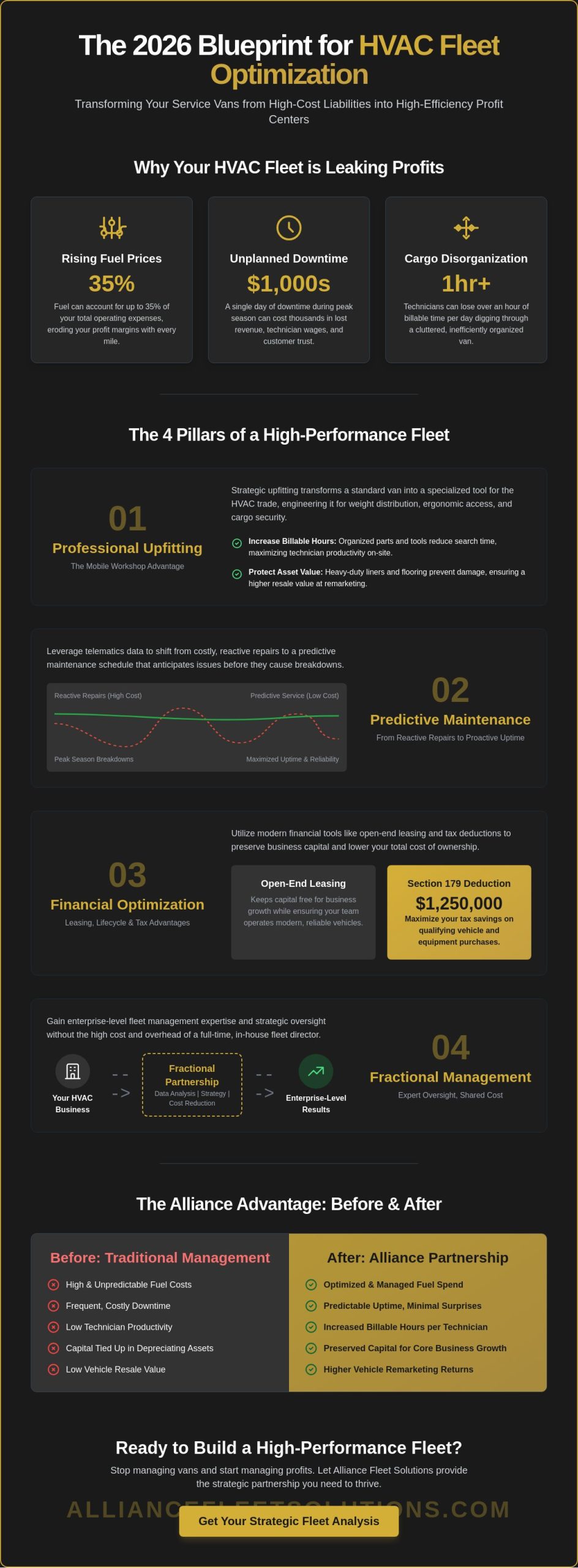
What if your service vehicles were actually the most productive technicians on your payroll? For most owners, HVAC service van fleet management feels like a constant battle against rising fuel prices, which can now account for up to 35% of your total operating expenses. It’s frustrating to watch profit margins evaporate when a van breaks down during a peak summer heatwave or when a technician loses an hour of billable time digging through a disorganized cargo hold. You need a fleet that works as hard as your best lead tech.
We’re here to help you move beyond reactive fixes and toward a proactive strategy for 2026. This guide promises to show you how to transform your vans from expensive cost centers into high-efficiency mobile workshops. We’ll examine how professional upfitting, smarter open-end leasing structures, and rigorous lifecycle management can drastically lower your total cost of ownership. From maximizing the $1,250,000 Section 179 tax deduction to implementing predictive maintenance, you’ll discover the roadmap to keeping your fleet on the road and your business in the black.
Key Takeaways
- Understand why specialized HVAC service van fleet management requires a distinct approach compared to standard delivery fleets to manage heavy equipment and sensitive diagnostic tools safely.
- Discover how professional upfitting transforms a cluttered cargo area into a high-efficiency mobile workshop that directly increases technician billable hours.
- Learn to shift from reactive repairs to predictive maintenance by using telematics data to prevent costly breakdowns during peak summer and winter seasons.
- Evaluate the financial advantages of open-end leasing to preserve business capital while ensuring your team always operates modern, reliable vehicles.
- Explore how fractional fleet management provides small-to-mid-sized firms with expert oversight and strategic partnership without the cost of a full-time internal department.
What is HVAC Service Van Fleet Management in 2026?
Effective HVAC service van fleet management is no longer just about tracking mileage or scheduling oil changes. In 2026, it represents the holistic oversight of your company’s most vital mobile assets. This discipline encompasses everything from vehicle acquisition and professional upfitting to maintenance management and eventual remarketing. While a delivery fleet focuses on moving boxes from point A to point B, your fleet operates as a network of mobile workshops. Each van carries thousands of dollars in specialized tools, heavy refrigerants, and delicate diagnostic equipment. This high-weight, high-value cargo requires a strategic approach to safety and efficiency that standard Fleet management models simply can’t provide.
The industry has shifted toward data-driven, fractional management models. Business owners are realizing they don’t need a full-time fleet director to achieve enterprise-level results. By partnering with experts who understand the mechanics of the HVAC industry, you can optimize your operations without the overhead of a dedicated internal department. This approach ensures your vans are ready to perform when the mercury rises or falls; it keeps your technicians focused on their craft rather than their equipment.
The High Cost of HVAC Fleet Downtime
Unplanned downtime is a silent profit killer. When a van is off the road, the “lost opportunity cost” extends far beyond the repair bill. You lose the billable hours of the technician, the potential revenue from emergency service calls, and the trust of customers who expected a prompt arrival. Industry data shows that unplanned vehicle breakdowns cost significantly more than scheduled service. This is due to emergency labor rates, lost revenue, and secondary component damage caused by neglect. During peak summer or winter seasons, a single day of downtime can cost a business thousands in gross profit. Proactive management mitigates these risks by identifying potential failures before they lead to a roadside emergency.
Software vs. Managed Services: Finding the Right Balance
Many HVAC firms reach a point where simple spreadsheets and basic GPS tracking are no longer sufficient. Standalone software can provide data, but it doesn’t provide solutions. The real value lies in professional fleet management services that interpret that data to drive business growth. While software might tell you a van is idling, a managed service partnership helps you implement fuel management programs to combat the fact that fuel accounts for 25% to 35% of total fleet expenses. As you scale, moving from a reactive software-only approach to a supportive partnership allows you to focus on high-level strategy while experts handle the technical logistics of your HVAC service van fleet management.
Professional Upfitting: Turning Vans into High-Efficiency Toolboxes
Professional upfitting is the strategic process of customizing a vehicle’s interior and exterior to meet the specific technical demands of the trade. In the context of HVAC service van fleet management, this goes far beyond simply bolting down a few generic shelves. It involves a comprehensive engineering approach to weight distribution, ergonomic access, and cargo security. Aligning your vehicle configurations with Federal Energy Management Program (FEMP) best practices ensures that your fleet remains right-sized and fuel-efficient, even when carrying heavy payloads of refrigerants and recovery equipment.
A well-organized van serves as a force multiplier for your technicians. When parts are logically categorized and tools are secured in dedicated zones, the time spent searching for equipment drops significantly. This directly translates to increased billable hours. Beyond productivity, proper upfitting protects your capital investment. Interior wall liners and heavy-duty flooring prevent the dents and chemical spills that degrade a vehicle’s metal skin. By maintaining the structural integrity of the van’s interior, you ensure a much higher return when it eventually comes time for vehicle remarketing.
Essential Upfitting Components for HVAC Vans
Your mobile workshops require specialized storage solutions. This includes reinforced refrigerant tank racks that prevent dangerous shifting during transit and heavy-duty ladder racks that reduce the risk of technician strain. Interior LED lighting and high-output power inverters are also critical; they allow your team to perform delicate component repairs or tool charging directly on-site regardless of external conditions. Security features like partition bulkheads and advanced locking systems protect your expensive inventory from theft, providing peace of mind when vehicles are parked at job sites or overnight.
The ROI of Custom Upfitting
The financial impact of professional upfitting is measurable and immediate. Consider a scenario where an organized layout saves a technician just 15 minutes per job. Over the course of a year, that efficiency gain can add dozens of billable hours to your bottom line per vehicle. This structure also reduces “shrinkage,” the common industry problem where expensive small parts or specialized tools are lost in the clutter of a messy van. Additionally, a clean, organized vehicle projects technical authority. When a client sees a perfectly maintained mobile workshop, it reinforces their trust in your service quality. If you are looking to optimize your current setup, exploring a tailored fleet management partnership can help you identify exactly which configurations will yield the highest return for your specific service mix.
Maximizing Uptime through Predictive Maintenance and Telematics
The transition from reactive repairs to predictive maintenance marks the most significant evolution in HVAC service van fleet management for 2026. Waiting for a “check engine” light to appear is a strategy of the past. Modern managers now use data to identify potential component failures before they result in a roadside emergency. Since unplanned vehicle breakdowns cost significantly more than scheduled service due to emergency labor rates and lost revenue, this shift is a financial necessity. A centralized maintenance management program provides the oversight needed to control these costs across a national or multi-state fleet, ensuring that every vehicle receives consistent care regardless of its location.
Integrating advanced technology allows you to improve fleet productivity with telematics by monitoring engine health in real time. These systems provide a direct window into the vehicle’s computer, flagging issues like cooling system inefficiencies or battery degradation before the technician even notices a symptom. This proactive approach alleviates the stress of peak-season operations, where a single downed van can disrupt an entire week of scheduled installations. By acting as a supportive partner in your operations, these tools transform fleet upkeep from a logistical headache into a streamlined, logical process.
Telematics: More Than Just GPS Tracking
While location data is helpful, the true value of telematics and GPS solutions lies in operational optimization. Fuel accounts for 25% to 35% of total fleet operating expenses; tracking idle time allows you to identify and correct behaviors that waste resources. Geofencing ensures your technicians are at the correct job sites, while driver behavior monitoring helps reduce the wear and tear that leads to premature mechanical failure. These systems serve as the digital backbone of a functional operation, providing the transparency required to manage a mobile workforce effectively.
The HVAC Maintenance Checklist
HVAC vans face unique stressors that standard light-duty vehicles do not. Because these vans often operate at near-maximum payload capacity, they require more frequent brake and suspension checks. Your 2026-standard checklist should prioritize cooling system health to prevent overheating during summer idle times and rigorous tire load rating inspections. Maintaining the correct tire pressure and tread depth is vital for safety when carrying heavy refrigerant racks and equipment. For a deeper look at establishing these protocols, refer to our strategic guide to maintenance management. Following a steady, logical schedule ensures your mobile workshops remain reliable assets rather than liabilities.
Financial Optimization: Leasing Strategies for HVAC Fleets
Financial health serves as the essential backbone of any functional operation. While professional upfitting turns a van into a mobile workshop, your acquisition strategy determines whether that workshop is a profit center or a drain on your liquidity. Integrating strategic leasing into your HVAC service van fleet management plan allows you to preserve capital for business growth and equipment inventory rather than tying up cash in depreciating assets. This approach provides the flexibility to scale your fleet as your contract volume increases without the high upfront costs of new vehicle acquisition.
The tax advantages of commercial leasing in 2026 remain a powerful incentive for business owners. Under current regulations, the Section 179 deduction limit is $1,250,000, allowing many businesses to write off the full purchase price of qualified vehicles in the first year. Additionally, you may qualify for 40% bonus depreciation on the remaining cost basis. These incentives, combined with professional vehicle remarketing at the end of the term, ensure you recover maximum equity and maintain a modern, efficient fleet. Managing these cycles correctly prevents the “equity trap” of owning aged vehicles that cost more to repair than they’re worth on the open market.
Open-End vs. Closed-End Leasing for HVAC
Choosing the right lease structure depends heavily on your annual mileage and how hard your technicians treat their vehicles. Open-end leasing is often the flexible choice for high-mileage service fleets. Since there are no mileage restrictions or wear-and-tear penalties, you aren’t punished for a busy season that keeps your vans on the road longer than expected. Conversely, closed-end leasing provides predictable monthly costs and lower risk for businesses with stable, local routes. We help you evaluate these models based on your specific operational data to ensure your lease aligns with your actual vehicle usage patterns.
Reducing Total Cost of Ownership (TCO)
Lowering your TCO requires a holistic view of every dollar spent from acquisition to disposal. Aged fleets often hide costs in the form of repair spikes and fuel inefficiency. By integrating fuel cards and maintenance management into your lease, you gain a clear, consolidated view of your spending. Utilizing specialized fuel management programs can significantly impact your bottom line, especially since fuel remains one of the largest variable expenses for any HVAC provider. This logical, data-driven approach to spending ensures that every van in your fleet operates at peak financial efficiency. To find a structure that fits your specific business goals, consider a strategic leasing partnership that prioritizes your long-term success.
Fractional Fleet Management: The Alliance Fleet Solutions Advantage
Many small-to-mid-sized HVAC firms reach a plateau where their fleet size demands professional oversight, yet the budget does not support a full-time fleet director. This is where the concept of fractional fleet management provides a critical business solution. By partnering with Alliance Fleet Solutions (AFS), you gain access to seasoned experts who act as a seamless extension of your internal team. We bring the technical authority and national reach of a large-scale operation while maintaining the dedicated, family-owned commitment to partnership that your business deserves.
Our approach to HVAC service van fleet management is rooted in a comprehensive lifecycle strategy. We don’t just lease you a vehicle and walk away. Instead, we manage every stage of the asset’s life to ensure maximum uptime and financial performance. This commitment to long-term reliability allows you to project an image of calm, expert control to your customers, knowing your mobile workshops are always ready for the next high-stakes service call. We handle the logistics. You handle the clients.
The Lifecycle Management Workflow
We’ve refined a steady, logical workflow that covers the four pillars of fleet health: Acquire, Upfit, Manage, and Remarket. This process ensures that your fleet remains a strategic business asset rather than a source of operational stress.
- Step 1: Strategic vehicle selection and procurement. We leverage our industry expertise to handle vehicle acquisition, ensuring you get the right makes and models for heavy HVAC payloads while navigating current supply chain disruptions.
- Step 2: Custom upfitting designed for HVAC-specific workflows. Our team manages professional upfitting that prioritizes ergonomics and tool security, turning a standard van into a high-efficiency toolbox that maximizes billable hours.
- Step 3: Ongoing operational support. Once the van is on the road, we take over the heavy lifting. This includes maintenance management, fuel management programs, and telematics to keep your total cost of ownership as low as possible.
Why Outsourcing Management Wins
Outsourcing your fleet logistics gives you the freedom to focus on what actually drives your revenue: HVAC sales and high-quality service. You shouldn’t have to spend your mornings coordinating van repairs or auditing fuel receipts. With AFS, you have a single point of contact for all fleet needs, from initial leasing to final vehicle remarketing. This centralized oversight creates a sense of momentum and progress, reassuring you that your equipment is handled swiftly and correctly. If you’re ready to transform your mobile operations and move beyond reactive fixes, Partner with Alliance Fleet Solutions to optimize your service van fleet today.
Take Command of Your Fleet’s Future
Transforming your vehicles into high-efficiency mobile workshops is the most effective way to protect your margins in a competitive market. By combining professional upfitting with predictive maintenance and optimized leasing, you eliminate the hidden costs of disorganized vans and unexpected downtime. Proactive HVAC service van fleet management ensures your team stays focused on service calls rather than logistical failures. You’ve seen how the right lifecycle strategy can turn a standard cargo hold into a profit-driving asset that preserves capital and enhances technician productivity.
Alliance Fleet Solutions has been family-owned and operated since 2018, providing the technical authority and steady partnership you need to scale. We offer comprehensive lifecycle management that handles every detail from initial vehicle acquisition to final remarketing. Our specialized expertise in trade-specific upfitting means your vans are engineered for the unique weight and storage demands of the HVAC industry. You don’t have to manage these complex logistics alone.
Request a Custom Fleet Analysis from Alliance Fleet Solutions to see how we can streamline your operations and lower your total cost of ownership. Your fleet is the backbone of your business; let’s make it your greatest competitive advantage.
Frequently Asked Questions
What is the best van for an HVAC service fleet?
The Ram ProMaster and Ford Transit remain the preferred choices for 2026 due to their high-roof configurations and cargo capacity. The ProMaster’s low load floor reduces technician fatigue during frequent entries, while the Transit offers all-wheel-drive options for businesses operating in northern climates. Selecting the right model depends on your specific payload requirements and the geographic area your technicians serve.
How much does professional upfitting cost for a standard service van?
Upfitting costs vary significantly based on the complexity of your shelving, refrigerant racks, and power needs. A customized setup tailored for technical workflows ensures that every tool has a secure location, which prevents damage and tool loss. While the initial investment depends on your specific requirements, the return is realized through increased technician efficiency and better protection of the vehicle’s interior surfaces.
Should I lease or buy my HVAC service vans?
Leasing is generally the most effective strategy for preserving capital and maintaining a modern fleet. It allows you to take advantage of tax incentives like the Section 179 deduction while ensuring you aren’t stuck with the rising maintenance costs of an aged fleet. Open-end leasing provides the flexibility high-mileage HVAC companies need to operate without the burden of restrictive wear-and-tear penalties.
How does telematics help reduce HVAC fleet fuel costs?
Telematics systems identify excessive engine idling and optimize routing to reduce unnecessary mileage. Because fuel can account for up to 35% of your total operating expenses, even small reductions in idle time lead to substantial savings. These systems also provide real-time data on driver behavior, allowing you to correct habits that lead to high fuel consumption and premature engine wear.
What is fractional fleet management and how does it work?
Fractional fleet management is an outsourced model where a dedicated partner handles your fleet operations without the cost of a full-time internal department. Alliance Fleet Solutions acts as an extension of your team, managing everything from vehicle acquisition to maintenance schedules. This gives mid-sized businesses the technical authority and specialized oversight needed to compete with much larger national service providers.
How often should HVAC service vans undergo preventative maintenance?
HVAC vans should undergo a rigorous inspection every 5,000 miles due to the heavy loads they consistently carry. Standard maintenance schedules often fall short for trade vehicles that operate near their maximum payload capacity. Regular checks of the braking system, suspension, and tire load ratings are essential to prevent the unplanned downtime that typically occurs during peak summer and winter seasons.
Can Alliance Fleet Solutions help with vehicle remarketing when I am done with a lease?
Yes, vehicle remarketing is a core component of our comprehensive lifecycle management service. We manage the entire disposal process to ensure you recover the highest possible equity from your used assets. By timing the sale correctly and utilizing our professional network, we help you transition into new vehicles while maximizing the return on your previous investment.
Is upfitting included in a commercial fleet lease?
Professional upfitting is typically rolled into the total cost of your commercial lease. This allows you to finance the customization of your HVAC service van fleet management assets over the life of the term rather than paying for it upfront. It’s a strategic way to deploy high-efficiency mobile workshops while keeping your cash reserves available for other business growth opportunities.