
Did you know that the average cost of fleet maintenance in 2026 has climbed to as much as $0.25 per mile for aging vehicles? For a busy electrical contractor, every hour a van spends in the shop or a technician spends searching through a cluttered cargo area represents a direct hit to your bottom line. You already know that disorganized storage and unexpected mechanical failures don’t just delay jobs, they erode the trust you’ve built with your clients. Implementing robust electrical contractor fleet vehicle solutions is no longer a luxury; it’s a requirement for staying competitive in a high-stakes market.
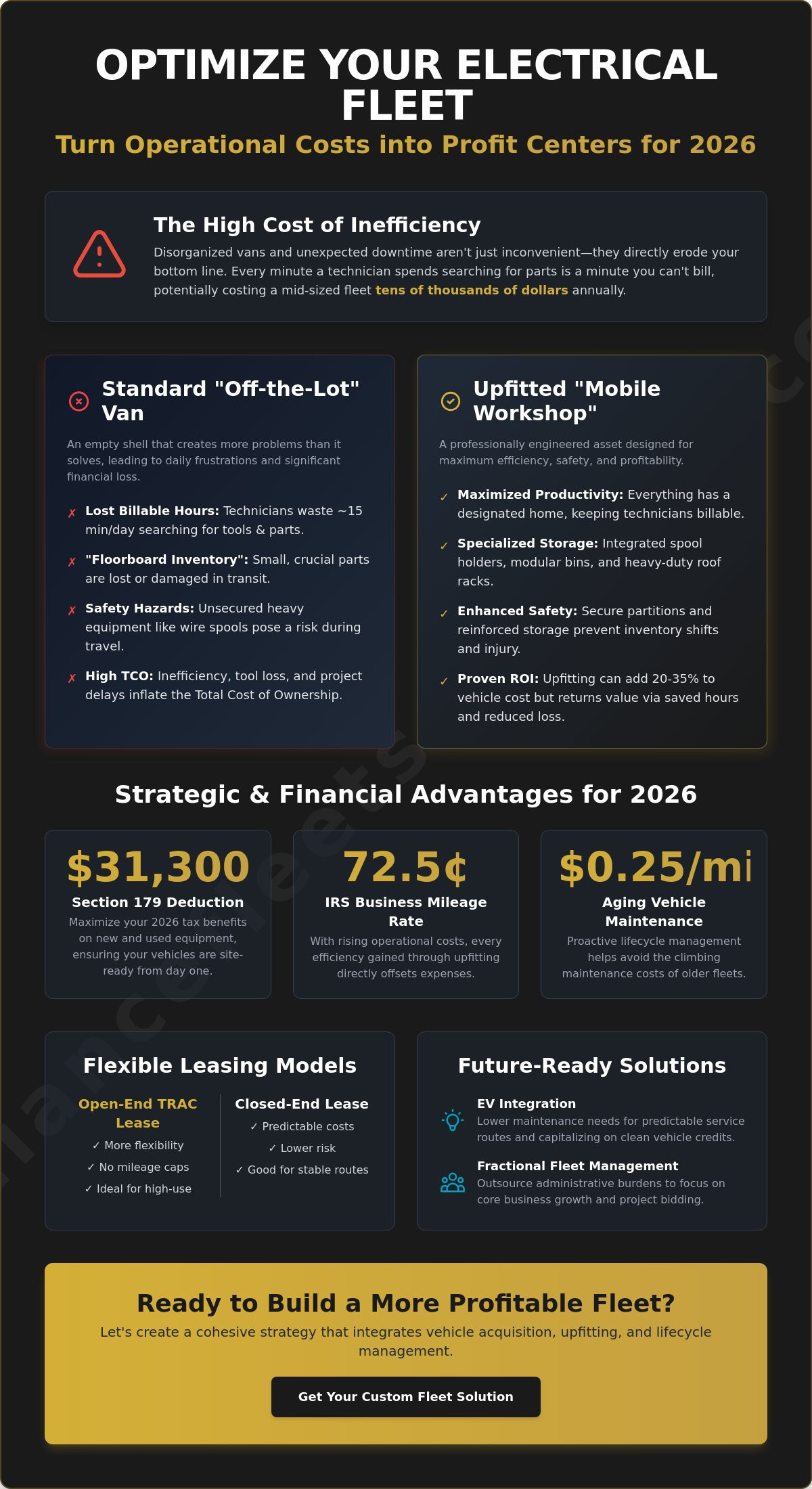
We’re here to help you turn those operational headaches into a streamlined, predictable profit center. This guide provides the strategic roadmap you need to optimize your fleet through professional upfitting and data-driven management. You’ll learn how to reduce downtime, manage the expiration of federal clean vehicle credits, and capitalize on the flexibility of open-end leasing. We’ll also examine how to leverage the $31,300 Section 179 deduction for 2026 to ensure your vehicles are site-ready from day one while keeping your administrative burden to a minimum.
Key Takeaways
- Learn how to integrate vehicle acquisition, upfitting, and lifecycle management into a cohesive strategy that outperforms standard off-the-lot van setups.
- Discover how professional upfitting maximizes cubic capacity and organizes high-volume inventory to keep your technicians billable and efficient.
- Compare open-end TRAC and closed-end leasing to determine which electrical contractor fleet vehicle solutions offer the most financial flexibility for your project volume.
- Assess the operational advantages of transitioning to electric vehicles, including significantly lower maintenance requirements for predictable service routes.
- Understand how fractional fleet management serves as a strategic asset, allowing you to outsource administrative burdens while focusing on growth and project bidding.
Optimizing Electrical Contractor Fleet Vehicle Solutions for 2026
Effective fleet management for electricians is far more than just purchasing white vans. It’s a comprehensive integration of vehicle acquisition, professional upfitting, and lifecycle management designed to keep your business profitable. Standard off-the-lot vans fail to meet the rigorous demands of the electrical trade. They lack the structural reinforcement for heavy wire spools and the specialized storage needed for delicate testing equipment. In 2026, the industry has moved toward the “mobile workshop” model. These designs prioritize technician ergonomics and tool security to prevent loss and injury. By choosing tailored electrical contractor fleet vehicle solutions, you’re investing in a system that maximizes the utility of every square inch of cargo space.
The High Cost of Inefficient Fleet Management
Disorganized vehicles directly impact your bottom line through lost billable hours. When a technician spends fifteen minutes digging through a cluttered van for a specific breaker or connector, that’s time you can’t charge to the client. Across a mid-sized fleet, these inefficiencies can cost a company tens of thousands of dollars each year. Beyond the daily clutter, unexpected vehicle downtime creates a ripple effect. It delays project deadlines and damages the professional reputation you’ve worked hard to build. Successful contractors manage these risks by focusing on the Total Cost of Ownership. TCO is the sum of all costs from procurement to remarketing.
Why 2026 Demands a Strategic Approach
The 2026 market requires a proactive stance on vehicle procurement. Continuing vehicle shortages mean that waiting until a truck breaks down to find a replacement is a recipe for disaster. You need a strategy that allows for fleet scalability during peak construction seasons while maintaining predictable costs. This is why maintenance management is essential. It ensures your vehicles stay compliant with the 2026 CVSA Out-of-Service Criteria, which went into effect on April 1, 2026. Consistent upkeep doesn’t just prevent fines; it preserves the vehicle’s resale value. With the 2026 IRS business mileage rate set at 72.5 cents per mile, every efficiency you gain through specialized electrical contractor fleet vehicle solutions helps offset the rising costs of operation.
Professional Upfitting: Customizing Vans and Trucks for the Electrical Trade
A standard cargo van is an empty shell that rarely meets the complex needs of a field technician. For a business to thrive, its vehicles must function as organized, mobile workshops. Professional upfitting is the process of transforming these shells into high-efficiency assets by installing specialized bin systems, ladder racks, and safety partitions. These electrical contractor fleet vehicle solutions do more than just store tools; they maximize cubic capacity. While upfitting can add 20% to 35% to the base vehicle cost, the return on investment comes through saved billable hours and reduced tool loss. This allows your team to transport high-volume materials like conduit and heavy switchgear without compromising vehicle stability or technician safety.
Maximizing Storage and Organization
Organization is the foundation of field productivity. When every component has a designated home, inventory tracking becomes a passive task rather than a chore. Effective electrical upfits include:
- Specialized Wire Management: Integrated spool holders and dispensers allow technicians to pull wire directly from the vehicle, reducing tangles and waste.
- Modular Shelving Units: Customizable bins and drawers provide secure homes for small parts like breakers, wire nuts, and connectors, preventing them from becoming “floorboard inventory.”
- Heavy-Duty Roof Racks: Specialized carriers accommodate 20-foot conduits and extension ladders, utilizing exterior space while keeping the interior clear for large equipment.
By investing in these tailored systems, you ensure that your team spends less time searching for parts and more time on billable tasks.
Safety and Security in the Field
Beyond efficiency, the primary goal of professional upfitting is the protection of your two most valuable assets: your people and your equipment. Heavy components like transformers or copper coils can become lethal projectiles during a sudden stop. Robust safety partitions create a physical barrier between the cargo area and the cab, protecting the driver from shifting loads. Ergonomic designs, such as drop-down ladder racks and waist-high pull-out drawers, are also essential. These features reduce technician fatigue and the risk of repetitive strain injuries, which are common in the electrical trade. As you look toward the future, including guidance on EV fleet implementation, it’s clear that weight distribution in upfitting is even more critical for maintaining battery range and vehicle performance.
Security is equally vital. Your tool inventory represents a significant capital investment. Modern truck upfitting often integrates with telematics-based security systems to monitor access and deter theft. A well-organized, clean vehicle also reinforces your professional brand. When a client sees a technician arrive in a meticulously upfitted van, it projects an image of expert control and reliability. If you’re ready to improve your operational flow, you can explore our full range of fleet management and upfitting services to find the right fit for your team.
Strategic Leasing Models: Open-End vs. Closed-End for Growing Contractors
Selecting the right financing structure is a critical business decision that impacts your cash flow and operational agility. For many, the choice between purchasing and leasing comes down to capital preservation. Buying a vehicle outright locks up thousands of dollars that could otherwise fund payroll or bulk material purchases. Strategic electrical contractor fleet vehicle solutions leverage leasing to keep capital liquid while providing access to the latest equipment. In the 2026 market, commercial leasing has become the standard, offering distinct tax advantages and predictable monthly costs that simplify budgeting for large-scale projects.
Open-End Leasing: The Flexible Choice
Open-end leases, often featuring a Terminal Rental Adjustment Clause (TRAC), are the preferred model for high-mileage trades. Data from May 2026 shows that 99.65% of commercial fleet financing transactions utilized open-end structures. This preference exists because open-end leases don’t impose the strict mileage restrictions or “wear and tear” penalties common in consumer-style contracts. As an electrical contractor, your service territory might expand unexpectedly; a single project might require thousands of miles of travel. A TRAC lease gives you the flexibility to drive as much as needed without financial penalty. At the end of the term, you’re responsible for the vehicle’s residual value. If the vehicle sells for more than the projected residual through professional vehicle remarketing, your business receives the credit. This model aligns the contractor’s interests with proper vehicle maintenance, ensuring the asset remains valuable even after years of heavy use.
Closed-End Leasing: The Predictable Choice
Closed-end leasing offers a “walk away” solution that prioritizes flat-rate predictability. These leases are best suited for contractors with fixed, local service routes where mileage is easily forecasted. You pay a set monthly fee and return the vehicle at the end of the term, provided it meets specific condition and mileage requirements. While this model limits your flexibility, it eliminates the risk of fluctuating resale values at the end of the lease. This predictability is helpful for smaller firms focusing on residential service within a tight geographic radius. For a deeper look at how these financial structures fit into a broader business plan, refer to our comprehensive fleet management guide. Regardless of the lease type, you should also consider long-term shifts in the industry, such as the U.S. Department of Energy guidance on fleet electrification, which provides a roadmap for integrating new technology into your existing electrical contractor fleet vehicle solutions.
Commercial leases also offer significant tax benefits. While the 45W clean vehicle credit ended in 2026 due to the “One, Big, Beautiful Bill,” contractors can still utilize the Section 179 deduction. For the 2026 tax year, the deduction limit for heavy vehicles is $31,300. Combined with the 72.5 cents per mile business mileage rate, these tools allow you to expense qualified equipment and operations effectively. By choosing the right lease structure, you ensure your fleet remains a productive asset rather than a financial anchor.
The Electrification Roadmap: Integrating EVs into Your Service Fleet
Electric vehicles represent a natural progression for the electrical trade. As an electrical contractor, driving an EV does more than lower your carbon footprint; it serves as a “working proof of concept” for your clients. When you arrive at a job site in an electric van to install charging infrastructure, you immediately demonstrate technical authority. However, integrating these into your electrical contractor fleet vehicle solutions requires a realistic assessment of route mileage and payload. While light-duty EVs often average 6.1 cents per mile in maintenance costs, heavy payloads of copper wire and conduit can significantly impact battery range. You must balance the benefit of lower operating costs with the logistical reality of your daily service radius.
Evaluating EV Infrastructure Needs
Transitioning to electric power involves more than just swapping vehicles. You need a structured approach to depot charging. A typical 5-step process includes: 1) Power capacity assessment, 2) Local permitting, 3) Hardware installation, 4) Network testing, and 5) Ongoing management. To maximize this investment, you should integrate telematics solutions. These tools allow you to monitor battery health and charging cycles in real time. This data is vital because heavy electrical equipment impacts range differently than standard cargo. By tracking how your specific tool loads affect kilowatt consumption, you can prevent range anxiety and ensure your technicians never lose billable hours to an empty battery.
Operational Cost Savings with Electric Fleets
The financial case for electrification is built on the reduction of scheduled downtime. EVs eliminate the need for oil changes, spark plug replacements, and complex transmission repairs. This keeps your vehicles on the road and out of the shop. Even with the federal 45W credit no longer available for new 2026 purchases, state-level incentives remain powerful. For example, California’s $1 billion rebate program offers between $7,500 and $120,000 for new electric commercial vehicles. Additionally, the federal 30C tax credit for charging equipment is set to expire on June 30, 2026. Acting before this deadline allows you to recoup significant costs on infrastructure.
Managing these new energy costs is simple with modern fuel management programs. These systems now include EV charging credit management, allowing you to track energy usage across your entire operation with the same precision as traditional fuel. If you’re ready to modernize your fleet, contact us today for expert vehicle acquisition and management support.
Fractional Fleet Management: Scaling Your Electrical Business Without the Overhead
Many mid-sized contracting firms reach a point where managing a dozen or more vehicles becomes a full-time job. However, hiring a dedicated, in-house fleet manager is often a financial stretch that many growing businesses can’t justify. This is where fractional fleet management serves as a secret weapon. It allows you to access specialized electrical contractor fleet vehicle solutions without the heavy overhead of an additional executive salary. By outsourcing these duties, business owners can redirect their energy toward high-value activities like project bidding and customer relations. Instead of chasing down maintenance records or renewal notices, you can focus on winning the next major commercial contract.
The Benefits of a Dedicated Fleet Partner
A dedicated partner takes over the heavy lifting of your daily operations. This includes the administrative burden of managing registrations, permits, and fuel card programs. These tasks are often spread across multiple employees, leading to missed deadlines and disorganized records. A fractional manager streamlines this by acting as a single point of contact. They also serve as a fleet advocate, using their industry volume to negotiate better pricing for vehicle acquisition and ongoing maintenance. This role is vital for identifying underperforming vehicles that are costing you more in repairs than they generate in revenue. Ultimately, fractional management provides enterprise-level expertise at a small-business price point.
Lifecycle Management and Remarketing
The final phase of a vehicle’s life is just as important as the day you buy it. Many contractors make the mistake of trading in old vans at a local dealership, which often results in a lower valuation. Professional vehicle remarketing ensures you maximize the return at the end of a vehicle’s lifecycle by utilizing specialized auction channels and buyer networks. This process is especially important for upfitted vehicles, where the value of the shelving and racks should be accounted for in the final sale price. Alliance Fleet Solutions manages the entire cycle from initial sourcing to the final sale, ensuring your capital remains liquid and your fleet stays modern. As you look to the future of your business, having a partner to handle these complexities is essential for sustainable growth. Contact Alliance Fleet Solutions to optimize your contractor fleet today.
Streamlining Your Electrical Service Operations for Growth
The 2026 market demands a shift from reactive repairs to proactive asset management. By integrating specialized professional upfitting and utilizing a national acquisition network, you can ensure your team is always equipped with the right tools for the job. We’ve explored how flexible open-end and closed-end leasing models preserve your capital while providing the agility needed to scale during peak seasons. These electrical contractor fleet vehicle solutions are designed to eliminate disorganized storage and reduce the high costs associated with vehicle downtime.
Choosing the right partner means gaining access to enterprise-level expertise that keeps your technicians billable and your administrative burden low. Whether you’re navigating the transition to electric vehicles or looking to outsource lifecycle management, the goal remains the same: a reliable fleet that supports your bottom line. You don’t have to manage these complexities alone. Partner with Alliance Fleet Solutions for your electrical contractor fleet needs. Let’s build a more efficient future for your business together.
Frequently Asked Questions
What are the best fleet vehicles for electrical contractors in 2026?
The best fleet vehicles for electrical contractors in 2026 are high-roof cargo vans like the Ford Transit, Mercedes-Benz Sprinter, and Ram ProMaster. These models offer the vertical clearance needed for professional shelving and large inventory storage. For residential service calls with lighter equipment needs, compact vans provide better fuel economy and easier parking in tight urban environments. Your choice should depend on your specific payload requirements and typical daily route lengths.
Is it better to lease or buy vans for a growing electrical business?
Leasing is often the superior choice for growing firms because it preserves capital for payroll and project materials. Open-end leases are particularly effective for electrical contractor fleet vehicle solutions because they don’t include the strict mileage penalties found in standard consumer contracts. While buying provides total ownership, leasing offers predictable monthly costs and simplified vehicle replacement cycles. This ensures your technicians always drive reliable, modern equipment that projects a professional brand image.
How much does professional upfitting for an electrician’s van cost?
Professional upfitting costs vary based on the complexity of the storage systems and specialized equipment required for your trade. Industry data shows that a comprehensive upfit, including ladder racks, safety partitions, and modular bins, typically adds between 20% and 35% to the base vehicle’s purchase price. This investment pays for itself by improving technician efficiency and reducing tool loss. It’s a strategic cost that turns an empty van into a functional mobile workshop.
Can an electric van handle the heavy payload of electrical tools and materials?
Electric vans can handle the heavy payload of electrical tools, but you must monitor how that weight impacts your total driving range. Modern electric cargo vans feature high-torque motors that manage heavy switchgear and wire spools effectively. However, payload significantly impacts battery consumption. Contractors using electric electrical contractor fleet vehicle solutions should plan routes carefully and consider depot charging to ensure vehicles remain productive throughout the entire workday.
What is fractional fleet management and how does it save money?
Fractional fleet management is a service model where you hire a fleet expert on a contract basis to handle administrative and strategic tasks. This approach saves money by providing enterprise-level expertise without the overhead of a full-time executive salary. Your fractional manager handles registrations, maintenance scheduling, and fuel management. This allows business owners to focus on high-value activities like project bidding and customer relations while reducing operational waste and repair costs.
How does telematics help electrical contractors improve fleet efficiency?
Telematics help electrical contractors improve efficiency by providing real-time data on vehicle location, idling time, and engine health. Reducing idling alone can cut fuel costs by up to 14% according to recent industry trends. These systems also allow for predictive maintenance, which helps you schedule repairs before a breakdown occurs. This proactive approach minimizes unscheduled downtime and ensures your service trucks stay on the road, where they are most profitable.
What should be included in a maintenance program for service trucks?
A robust maintenance program should include regular oil changes, brake inspections, tire rotations, and comprehensive safety checks. It’s critical to ensure your vehicles comply with the 2026 CVSA Out-of-Service Criteria to avoid fines and operational delays. Including electronic logging and medical certificate verification in your program also helps maintain regulatory compliance. Consistent upkeep preserves the vehicle’s resale value and ensures the safety of your technicians during transit to various job sites.
Are there specific tax incentives for leasing commercial vehicles in the US?
There are several tax tools available for commercial vehicle leasing, including the Section 179 deduction. For the 2026 tax year, the Section 179 deduction limit for heavy vehicles is $31,300. Additionally, the IRS has set the 2026 business mileage rate at 72.5 cents per mile. While federal EV credits have expired, these existing tax structures provide significant financial relief for contractors managing a commercial fleet and help offset the total cost of ownership.