
The local dealership lot is likely the most expensive place to source your next work vehicle. While it feels convenient, the best place to buy used cars for a commercial fleet isn’t behind a glass showroom with a retail markup. Most business owners realize that a deal on a used van quickly disappears when you factor in the reality that unplanned downtime costs fleets an average of $760 per day according to 2023 industry data. You’re often paying a premium for a vehicle that still needs thousands of dollars in upfitting and mechanical vetting before it’s truly work-ready.
Strategic fleet acquisition focuses on lifecycle planning rather than just the sticker price. Professionals look past the detailed aesthetic prep to find assets that offer long-term utility. Total Cost of Ownership (TCO) is the sum of acquisition, operation, and disposal costs—including the logistics of relocating units. To better estimate these specific delivery fees, you can discover more about Car Shipping Cost Calculator and integrate those figures into your budget. By understanding this metric, fleet managers can avoid the trap of a low purchase price that hides a mountain of future mechanical expenses.
We understand that your priority is maximizing uptime and ensuring a predictable bottom line. This guide will show you how to move beyond the transactional nature of retail dealerships and adopt a lifecycle management strategy instead. You’ll learn how to lower your total cost of ownership by sourcing vehicles through a partner that prioritizes mechanical reliability and immediate deployment. We’ll outline a scalable acquisition process that transforms your fleet into a strategic business asset rather than a source of constant frustration.
Key Takeaways
- Shift your procurement strategy from retail lots to professional remarketing channels to avoid hidden markups and ensure total service transparency.
- Discover why the best place to buy used cars for a growing business is through a strategic lifecycle partner that provides comprehensive maintenance logs and telematics data.
- Learn how to evaluate operational duty cycles and payload requirements to ensure every acquisition matches your specific fleet demands and performance needs.
- Understand the critical role of professional upfitting and engine health verification in minimizing future downtime and maximizing long-term vehicle ROI.
- Explore how strategic vehicle remarketing turns your aging assets into immediate capital to fund more efficient and reliable fleet expansion.
Why the Best Place to Buy Used Cars for Business Isn’t a Local Lot
Procuring vehicles for a commercial fleet requires a different mindset than buying a personal commuter. While a local consumer dealership might seem like the best place to buy used cars due to proximity, these environments are designed for emotional retail transactions rather than logical business investments. Retail lots carry heavy overhead costs, including prime real estate and expensive marketing campaigns, which are passed directly to the buyer through significant markups. For a business, these costs represent immediate capital loss before the vehicle even completes its first delivery.
Strategic fleet acquisition focuses on lifecycle planning rather than just the sticker price. Professionals look past the detailed aesthetic prep to find assets that offer long-term utility. Total Cost of Ownership (TCO) is the sum of acquisition, operation, and disposal costs. By understanding this metric, fleet managers can avoid the trap of a low purchase price that hides a mountain of future mechanical expenses.
The Retail vs. Commercial Pricing Gap
Retail dealerships bake consumer financing and high-commission sales structures into their pricing. This creates a gap where a business might pay 15% to 20% more than the actual market value of the asset. Sourcing through a professional vehicle remarketing process or fleet management partners eliminates these retail layers. These commercial channels provide access to inventory that hasn’t been marked up for the general public, allowing you to secure the best place to buy used cars for your specific operational needs without the retail fluff.
Reliability and Uptime in Used Fleet Assets
A low purchase price becomes irrelevant the moment a vehicle breaks down during a peak delivery window. In the logistics sector, industry data suggests downtime can cost a business upwards of $760 per day, per vehicle. Professional procurement focuses on verified maintenance history rather than just mileage or age. Consumer lots often lack comprehensive service records, leaving you in the dark about when the last transmission flush or brake replacement occurred.
Reliable assets require a history of disciplined care. Implementing professional maintenance management mitigates the inherent risks of buying used equipment. When you source through commercial partners, you gain access to vehicles that were likely part of a structured preventive maintenance program. This level of transparency ensures that your acquisition supports high uptime and protects your bottom line from the volatility of unplanned repairs.
Strategic Sourcing: Beyond the “For Sale” Sign
Finding the best place to buy used cars for a commercial fleet requires looking past the local consumer lot. Smart managers prioritize channels where maintenance records are transparent and volume is available. Commercial auctions provide access to thousands of units, though they require a keen eye for mechanical red flags. Private sellers might offer lower prices, but they often lack the detailed service logs necessary for maintaining 99% uptime across a growing fleet. While searching for the best place to buy used cars, remember that the cheapest price tag often hides the highest long-term maintenance costs.
Commercial Auctions and Off-Lease Sourcing
Off-lease vehicles represent a superior middle ground for growing businesses. These assets typically follow rigid preventive maintenance schedules mandated by leasing contracts, ensuring the powertrain hasn’t been neglected. When you purchase used GSA Fleet vehicles or off-lease units, you’re buying a documented history of professional care. Alliance Fleet Solutions leverages efficient fleet operations to help clients identify inventory that minimizes the risk of immediate mechanical failure. This strategic approach turns acquisition from a gamble into a predictable business expense.
The Upfitting Factor
A 2021 Ford Transit might look like a bargain at $28,000, but if the chassis doesn’t support your specific 1,500-pound shelving unit, the investment fails. Upfitting costs can easily exceed $12,000 per vehicle depending on the complexity of your racks and tech. You should plan these modifications during the acquisition phase rather than as an afterthought. Checking the gross vehicle weight rating (GVWR) against your intended payload ensures the vehicle can handle the stress of daily operations without premature suspension failure. Buying a “cheap” truck only to find the frame can’t support your industry-specific equipment is a mistake that stalls your ROI for months.
Telematics should be your first installation after securing a unit. By integrating diagnostic tools within the first 48 hours of possession, you can identify hidden engine faults or battery degradation that a visual inspection might miss. This proactive data collection ensures your “new” used asset doesn’t become a liability on its first day of service. If you need help evaluating your next purchase, consider how a partnership with Alliance Fleet Solutions can streamline your maintenance and inspection protocols from day one.
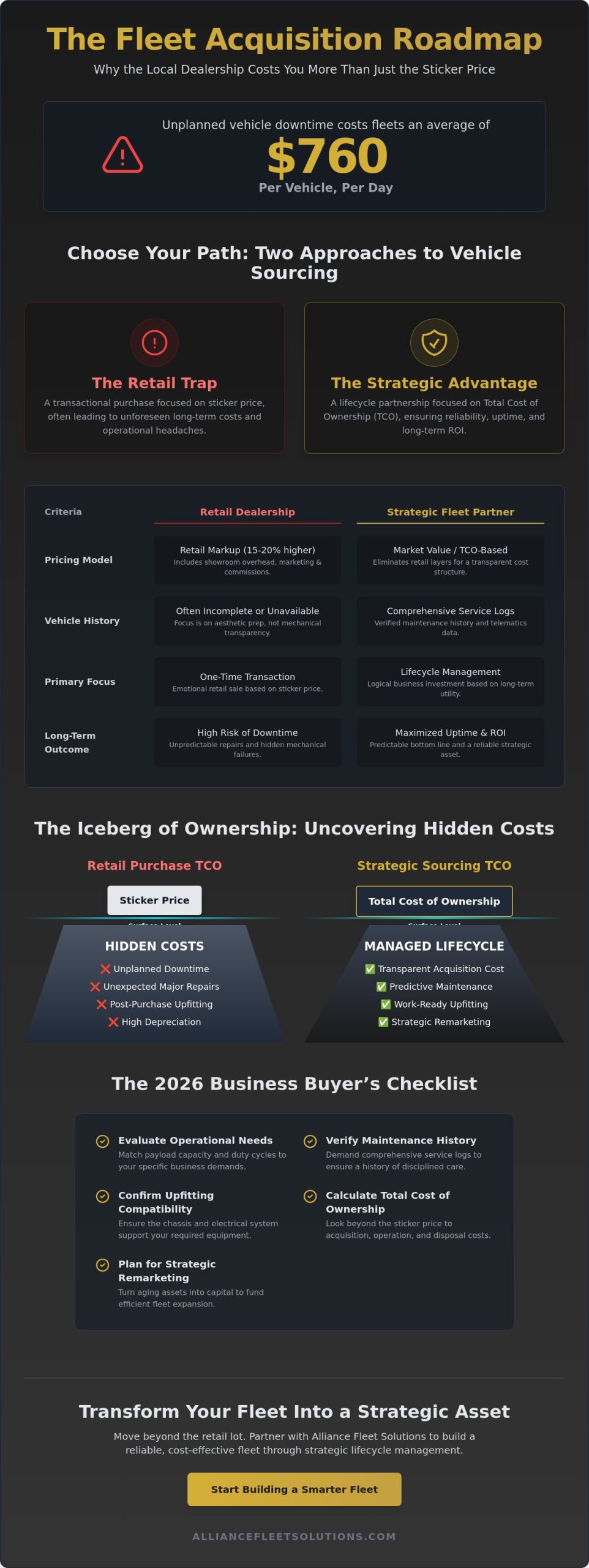
Comparing Acquisition Channels: Retail vs. Fleet Remarketing
Retail dealerships often represent the most visible option, yet they rarely serve the specific demands of a growing logistics operation. While a local lot might be the best place to buy used cars for a family, it’s seldom the most efficient route for a business. Retail markups typically range from $2,000 to $5,000 per unit above wholesale prices. Online marketplaces offer convenience, but they lack the specialized commercial vetting necessary to ensure uptime. For a strategic manager, fleet remarketing channels provide a direct line to vehicles that have lived under strict professional supervision since their first mile.
Financial strategy plays a massive role in this decision. Under current 2024 tax laws, the Section 179 deduction allows businesses to deduct the full purchase price of qualifying used equipment, including vehicles with a Gross Vehicle Weight Rating (GVWR) over 6,000 pounds. This can result in a substantial immediate write-off rather than depreciating the asset over five years. Before committing to a purchase, consult this guide on how to buy a fleet vehicle to understand how to leverage these tax advantages while avoiding common pitfalls in the procurement process.
The Transparency of Fleet Logs
Private sellers and retail dealers rely on basic vehicle history reports that often miss internal mechanical trends. Professional fleet logs are different because they track every fluid change, tire rotation, and sensor replacement. These logs often pull data directly from fuel management programs that monitor idle time and engine load. When you review a commercial maintenance log, look for consistency. A vehicle that missed its 50,000-mile preventive maintenance window by even 2,000 miles is a red flag for future engine wear. Fleet-maintained vehicles are superior because their previous owners viewed maintenance as an investment in uptime rather than an annoying chore.
Volume and Scalability
Scaling a fleet through retail channels is a logistical nightmare. It’s difficult to find five identical 2021 Ford Transit-250s with matching roof heights and engine specs across five different dealerships. This lack of standardization increases your long-term costs. If your fleet is uniform, your technicians only need to stock one type of oil filter and one set of brake pads. This simplifies your parts inventory and reduces repair time by 15% or more.
Fleet remarketing is the best place to buy used cars when you need to secure multi-vehicle packages. An alliance with a dedicated remarketing partner allows you to acquire “sister” vehicles that came off the same lease. This ensures that the wear patterns and mechanical configurations are nearly identical. You don’t have time to hunt for individual vans; you need a scalable solution that keeps your drivers on the road and your maintenance schedules predictable.
The 2026 Business Buyer’s Checklist for Used Vehicles
Finding the best place to buy used cars for your business requires more than browsing a local lot. It demands a rigorous, five-step verification process to protect your bottom line. You aren’t just buying a vehicle; you’re investing in an asset that must deliver consistent uptime to remain profitable.
- Step 1: Define the operational duty cycle. Calculate your average daily mileage and payload requirements. A vehicle that exceeds its Gross Vehicle Weight Rating (GVWR) by even 5% will see a 15% faster component failure rate.
- Step 2: Verify maintenance and telematics history. Review the Electronic Control Unit (ECU) logs. High-idle vehicles often have engine wear equivalent to double their recorded mileage.
- Step 3: Audit upfitting compatibility. Confirm the chassis accepts your specific trade tools, such as hydraulic lifts or custom shelving, without compromising the structural integrity or voiding warranties.
- Step 4: Analyze projected residual value. Look at three-year historical data for specific models. Vehicles that retain at least 42% of their value after 36 months are far superior for future remarketing.
- Step 5: Secure commercial-grade terms. Avoid consumer loans. Use commercial leasing or specialized business financing to preserve your credit lines for operational growth.
Selecting the best place to buy used cars often means choosing a partner who provides transparent data on these five points rather than just a low sticker price.
Technical Audit and Inspection
Commercial vehicles endure unique stresses that consumer cars never face. You must inspect the cooling system and oil coolers for signs of high-idle degradation. Check the frame and leaf springs for fatigue, especially in trucks used for heavy hauling. 2026 telematics data provides the most accurate health report. It reveals actual engine hours, which are often a more reliable indicator of longevity than the odometer reading alone. Focus your inspection on the turbocharger and Diesel Particulate Filter (DPF) in diesel units, as these components represent the highest failure risks in high-mileage assets.
Financial Planning for Used Assets
Deciding between a direct purchase and fleet management services is a critical pivot point for cash flow. Most businesses find a break-even point when annual maintenance costs reach 20% of the vehicle’s market value. At this stage, a new lease often yields a higher ROI than continuing to repair an aging asset. Consult with a fleet partner to leverage Section 179 tax deductions. These rules often allow for significant depreciation in the first year of service, provided the vehicle meets specific weight requirements. This strategy maximizes your immediate tax advantages while streamlining your fleet’s total cost of ownership.
Maximizing Value through Professional Vehicle Remarketing
Finding the best place to buy used cars for your business is only one half of a successful fleet strategy. True optimization happens when you align your acquisition goals with a professional disposal plan. The most efficient fleets don’t just buy vehicles; they manage a continuous cycle of capital. By viewing every truck as a liquid asset rather than a permanent expense, you create a financial loop that funds future growth without draining your primary operating budget.
A managed fleet reduces the constant “searching” for used inventory. When you work with a partner who understands the full lifecycle, the pipeline for new units is already established before your current vehicles reach their mileage limits. This proactive stance eliminates the panic buying that often leads to overpaying for sub-par equipment.
Turning Assets into Capital
Remarketing is the strategic disposal of assets to recover maximum equity. It’s a sophisticated process that goes far beyond simply trading in a vehicle at a local dealership. When you sell back into a professional network, you typically see returns 10% to 15% higher than standard trade-in offers. Dealerships often prioritize their own resale margins, but a remarketing partner focuses on your recovery value.
Alliance Fleet Solutions maximizes this value by leveraging detailed maintenance histories. A truck with a documented record of preventive maintenance and consistent uptime is worth significantly more on the secondary market. We turn your old fleet into the capital required for your next acquisition through:
- Detailed condition reporting to highlight high-value features.
- Strategic placement within professional wholesale networks.
- Optimization of the sales timeline to capitalize on market demand.
Partnering for Long-Term Success
Alliance Fleet Solutions acts as your outsourced fleet manager, providing the technical authority needed to navigate a complex market. For the 75% of growing businesses that don’t have a dedicated internal fleet department, our fractional management services offer a competitive edge. We handle the procurement, maintenance, and eventual disposal, allowing your team to focus on logistics and delivery.
This partnership ensures you aren’t just looking for the best place to buy used cars in a vacuum. You’re building a sustainable model where every vehicle is a strategic business asset. We focus on fleet optimization and mobile repair capabilities to keep your current units running longer, which directly improves your resale position when it’s time to rotate the fleet. Contact Alliance Fleet Solutions today for a full fleet consultation and start managing your vehicles with the precision your business deserves.
Secure Your Competitive Advantage Through Strategic Acquisition
Building a high-performing fleet requires a shift from reactive buying to strategic acquisition. You’ve seen that the retail market often fails to provide the transparency and scale necessary for modern logistics. By focusing on fleet remarketing channels and following a rigorous 2026 Business Buyer’s Checklist, you ensure every asset contributes to your bottom line from day one. Finding the best place to buy used cars isn’t about scouring local lots; it’s about accessing professional networks that prioritize uptime and long-term value.
Alliance Fleet Solutions acts as your essential backbone. As specialists in B2B fleet lifecycle management, we provide the technical authority needed to navigate complex markets. Our team delivers custom upfitting solutions for every industry and uses expert vehicle remarketing to maximize your ROI. We handle the mechanics of acquisition so you can focus on growth. We protect your uptime.
Your next fleet upgrade is an opportunity to streamline operations and secure your company’s future success.
Frequently Asked Questions
Is it better for a business to buy a used car or lease a new one?
Buying a used vehicle often yields a lower total cost of ownership because you avoid the 20% depreciation hit that occurs in the first 12 months of a new car’s life. While leasing offers lower monthly payments, ownership allows you to build equity and provides the flexibility to sell the asset whenever your fleet strategy changes. For many managers, finding the best place to buy used cars is the most effective way to maximize their annual capital expenditure.
What is vehicle remarketing and how does it help my business?
Vehicle remarketing is the strategic process of selling off fleet assets at the end of their service life to recover the highest possible value. By using professional remarketing channels, businesses can often see a 10% to 15% increase in resale returns compared to basic trade-ins. This process ensures your capital remains fluid. It allows you to reinvest those funds into newer, more efficient models to keep your operations running smoothly and minimize downtime.
Can I get a tax break for buying a used vehicle for my business in 2026?
You can likely claim a tax deduction under Section 179, though bonus depreciation is scheduled to decrease to 20% in 2026 according to the Tax Cuts and Jobs Act of 2017. To qualify, the vehicle must be used for business purposes more than 50% of the time. This deduction allows you to write off a portion of the purchase price immediately. It reduces your overall tax liability and improves your company’s year-end cash flow.
How do I know if a used commercial vehicle has been well-maintained?
You should demand a comprehensive preventive maintenance log and a CARFAX Vehicle History Report to verify every service interval. A well-maintained commercial vehicle will show regular oil changes every 5,000 to 7,500 miles and documented inspections of critical systems like brakes and suspension. If a seller can’t provide these digital or paper records, the risk of future downtime increases significantly. This can cost your business hundreds of dollars per day in lost productivity.
What are the risks of buying a used fleet vehicle from a private seller?
Buying from a private seller carries the risk of hidden mechanical issues because these transactions are almost always “as-is” without any warranty or service guarantee. Unlike a certified dealer, a private individual doesn’t have to provide a multi-point inspection or a 30-day return policy. This lack of protection can lead to immediate repair costs that erase any initial savings, making a reputable dealership the best place to buy used cars for long-term reliability.
Does Alliance Fleet Solutions help with sourcing used vehicles?
Alliance Fleet Solutions acts as your strategic partner by providing expert pre-purchase inspections to ensure any vehicle you source meets our high standards for uptime. While we specialize in mobile repair and fleet optimization, our technicians evaluate the mechanical integrity of potential additions to your fleet. This alliance ensures you don’t inherit another company’s maintenance problems. It allows you to focus on your core logistics operations while we handle the technical due diligence.
How does upfitting affect the resale value of a used business car?
High-quality upfitting like heavy-duty shelving or liftgates can increase a vehicle’s resale value by 15% to 25% if the equipment is from a recognized brand and remains in good condition. However, highly specialized or permanent modifications might narrow your pool of buyers. We recommend choosing modular upfits that allow for easy removal or adjustment. This flexibility makes the vehicle more attractive to a wider range of secondary market buyers in the logistics sector.