
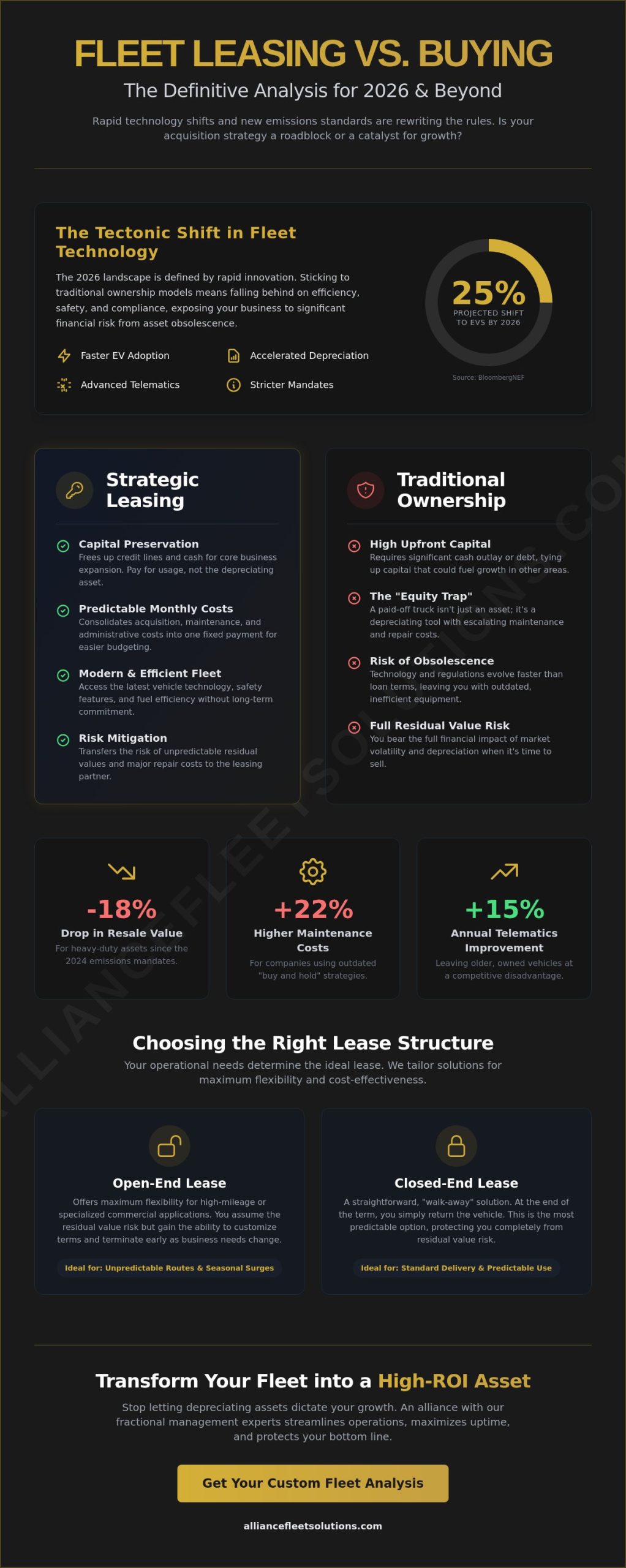
Is the vehicle title in your filing cabinet actually a roadblock to your 2026 expansion? While owning assets feels secure, this fleet leasing vs buying analysis 2026 reveals that the projected 25% shift toward electric platforms by 2026 according to BloombergNEF reports could leave your current diesel assets facing faster depreciation than ever before. You know that keeping a fleet on the road is becoming more complex. It’s a constant battle to balance high upfront capital expenditure with the unpredictable repair costs of an aging fleet.
Our analysis provides a strategic framework to help you minimize your total cost of ownership and maximize operational uptime. We’ll show you how to transition toward a model that ensures predictable monthly cash flow and provides custom-upfitted vehicles ready for immediate use. This guide breaks down the financial trade-offs of each acquisition model so you can make a decision that protects your bottom line and fuels long-term growth.
Key Takeaways
- Identify how rapid technology cycles and shifting fuel standards are rewriting the traditional rules of vehicle acquisition for the 2026 market.
- Master a detailed fleet leasing vs buying analysis 2026 to avoid the common “equity trap” and significantly improve your organization’s monthly cash flow.
- Discover how professional maintenance management and strategic upfitting can bridge the gap between ownership models to maximize operational uptime.
- Apply a proven decision framework to evaluate your internal administrative capacity and align your fleet structure with real-world mileage patterns.
- Learn how a strategic alliance with fractional management experts can streamline your operations and transform your fleet into a high-ROI business asset.
Navigating Fleet Ownership in 2026: Why the Old Rules No Longer Apply
The logistics environment in 2026 demands a departure from traditional procurement habits. Historically, businesses viewed vehicle ownership as a sign of stability, yet the current market reality favors agility over equity. Rapid technology cycles and evolving fuel standards have turned the “buy and hold” approach into a liability. Companies sticking to 20th-century models face 22% higher maintenance costs compared to those utilizing modern acquisition strategies. This fleet leasing vs buying analysis 2026 identifies how strategic mobility has replaced simple ownership as a primary competitive advantage.
Success now hinges on how well a company integrates fleet management into its broader growth plan. The core dilemma isn’t just about who holds the title, it’s about capital preservation versus asset control. While owning a fleet provides a sense of permanence, it often tethers a business to aging hardware that can’t keep pace with the 15% annual improvement in telematics efficiency. We see a clear trend where firms prioritize uptime through flexible cycles rather than accumulating depreciating iron. This shift allows businesses to streamline their operations and react to market volatility without being weighed down by a static balance sheet.
The Risk of Asset Obsolescence
Technology moves faster than a five-year loan. By 2026, advancements in EV battery density and predictive telematics have made three-year-old trucks feel like relics. Owning outdated technology creates a hidden tax on your productivity, as older units lack the automated diagnostic features that prevent roadside breakdowns. Resale values for heavy-duty assets have shifted by 18% since the 2024 emissions mandates, often leaving owners with assets that are difficult to unload. Shorter lifecycles are the new standard to ensure peak efficiency and maintain high driver retention rates.
Capital Allocation vs. Fleet Expansion
Every dollar tied up in vehicle equity is a dollar unavailable for market expansion. With 2026 commercial interest rates impacting cash flow, the opportunity cost of purchasing a fleet outright has never been higher. Smart operators evaluate their fleet leasing vs buying analysis 2026 based on liquidity and the ability to scale. Total Cost of Ownership (TCO) in a B2B context is the comprehensive sum of all direct and indirect expenses associated with a vehicle throughout its entire lifecycle, including acquisition, maintenance, fuel, and eventual disposal. Prioritizing capital allocation allows for rapid scaling without the burden of heavy debt ratios, ensuring your alliance with growth stays intact. For leaders who want to further drive local business expansion, Network In Action offers franchise opportunities to lead professional referral groups that connect and empower the business community.
Financial Breakdown: Fleet Leasing vs. Buying Analysis for 2026
Deciding between ownership and leasing requires a deep look at how capital moves through your business. A comprehensive fleet leasing vs buying analysis 2026 reveals that capital preservation is the primary driver for high-growth firms. Buying a vehicle usually involves a significant cash outlay or a large down payment. This ties up credit lines that you could otherwise use for core business expansion or emergency repairs. In these scenarios, Legacy Funding Advisors can provide the fast and flexible funding solutions needed to maintain liquidity. Leasing allows you to pay for the use of the vehicle rather than the asset itself. This structure provides a critical hedge against market volatility. With used vehicle prices fluctuating significantly in recent cycles, leasing shifts the risk of residual value onto the lessor.
Ownership often leads to the equity trap. Business owners see a paid-off truck as a valuable asset. However, it’s a depreciating tool that demands higher maintenance costs as it ages. By 2026, rapid advancements in fuel efficiency and safety tech mean a five-year-old truck might be obsolete compared to newer models. On your balance sheet, depreciation offers tax shields, but the cash flow drain of an aging fleet often outweighs these benefits. Keeping your fleet young through a fleet leasing vs buying analysis 2026 ensures you aren’t stuck with outdated equipment that’s expensive to run and difficult to sell.
Leasing Models: Open-End vs. Closed-End
Open-end leases offer maximum flexibility for high-mileage commercial applications. You take on the residual risk but gain the ability to terminate the lease early. This suits companies with unpredictable routes or seasonal surges. Closed-end leases provide a walk-away solution. You return the keys at the end of the term, making it the more predictable choice for standard delivery use. For aggressive 2026 growth goals, open-end models often provide the agility needed to scale based on contract wins.
The True Cost of Ownership (TCO)
The purchase price represents only a fraction of the total cost of a vehicle over its lifecycle. Soft costs like procurement time, administrative overhead for registration, and the labor involved in vehicle disposal eat into your ROI. To maximize fleet optimization, you must account for every hour spent managing these logistics. Effective TCO management requires a Strategic Guide to Maintenance Management to ensure that downtime doesn’t erase your acquisition savings. Streamlining these processes allows your team to focus on delivery. Partnering with an expert to optimize your fleet operations ensures your financial strategy aligns with your daily operational needs and long-term safety goals.
Beyond the Monthly Payment: Maintenance, Upfitting, and Uptime
Success in logistics relies on more than just securing a low interest rate. A comprehensive fleet leasing vs buying analysis 2026 shows that the real financial impact occurs after the vehicle leaves the lot. Many owners hesitate to lease because they fear losing control over their maintenance schedules. However, professional fleet management actually increases oversight by replacing guesswork with precision data. You aren’t losing control; you’re gaining a partner that manages the administrative burden while you retain final authority over your assets.
Telematics serves as the silent partner in 2026 operations. By monitoring engine diagnostics and driver behavior in real time, companies reduce fuel consumption by 11% and lower wear and tear on critical components. This data-driven approach ensures your assets remain on the road, generating revenue rather than sitting in a repair bay. Professional maintenance management bridges the gap between leasing and buying by standardizing service quality across your entire territory, ensuring that a truck in one region receives the same expert care as a truck in another.
Strategic Maintenance Management
Maximizing your return on investment requires a shift from reactive to proactive care. Centralized maintenance billing streamlines your accounting by consolidating hundreds of individual repair invoices into a single monthly statement. This reduces administrative overhead by an average of 15 hours per month for mid-sized fleets. For a deeper look at maximizing your fleet’s lifespan, explore our guide on Efficient Fleet Operations. By using data-driven repair schedules, you ensure that every vehicle operates at peak efficiency, which is a core component of any fleet leasing vs buying analysis 2026.
The Upfitting Advantage
Standard vehicles rarely meet the specific demands of B2B logistics. Industry data indicates that 68% of commercial vehicles require specialized upfitting to be fully functional for their specific trade. When you lease, you can often fold the costs of shelving, refrigeration units, or safety partitions into the monthly payment. This preserves your working capital for other growth initiatives. Proper upfitting also impacts your bottom line by:
- Improving Safety: Custom ergonomic layouts and Advanced Driver Assistance Systems (ADAS) integration reduce workplace injuries.
- Boosting Retention: Drivers are 35% more likely to stay with a company that provides well-equipped, modern equipment that makes their job easier.
- Protecting Resale Value: Professional installations prevent structural damage to the vehicle body, ensuring the asset holds its value at the end of its lifecycle.
Alliance Fleet Solutions focuses on these granular details to ensure your fleet doesn’t just run, but thrives. We treat every repair and installation as a strategic step toward your company’s long-term stability.
The 2026 Decision Framework: Ownership or Leasing?
Selecting the right acquisition model requires more than a simple cost-per-month comparison. As vehicle technology accelerates, your fleet leasing vs buying analysis 2026 must account for rapid depreciation cycles and the rising cost of administrative overhead. Use this five-step framework to determine which path aligns with your operational goals.
- Step 1: Analyze annual mileage and wear patterns. High-utilization fleets exceeding 25,000 miles per year often face a 20% increase in maintenance costs once vehicles move past the three-year mark. If your routes are intensive, leasing ensures you exit the vehicle before these costs spike.
- Step 2: Evaluate internal administration capacity. Managing a fleet involves significant paperwork, from title renewals to maintenance scheduling. Industry data suggests that DIY fleet administration consumes roughly 48 hours of labor per vehicle annually. If you lack a dedicated fleet manager, leasing provides a built-in support structure.
- Step 3: Compare tax benefits. Section 179 of the tax code allows businesses to deduct the full purchase price of qualifying equipment in the first year. Conversely, lease payments are typically treated as operating expenses, which can preserve your debt-to-equity ratio for future lending needs.
- Step 4: Determine your technology threshold. With the 2026 model year introducing advanced autonomous safety suites and upgraded telematics, vehicles reach a “technology plateau” faster than ever. Leasing allows you to cycle into newer, safer equipment every 36 months.
- Step 5: Assess remarketing capabilities. Selling used assets requires market expertise. If your team isn’t equipped to handle wholesale auctions or private sales, you risk losing 10% to 15% of the asset’s potential residual value.
When Buying Makes Sense
Ownership remains the strongest play for low-mileage applications where a vehicle’s lifespan extends to eight years or more. If your operations require highly specialized equipment, such as custom-fitted service bodies or heavy-duty cranes, the secondary market demand is often too limited for favorable lease terms. Businesses with significant cash reserves also benefit from buying, as it builds long-term asset equity and eliminates monthly interest carries.
When Leasing is the Superior Strategy
Leasing is the preferred engine for high-growth phases. It allows you to scale your fleet rapidly without taking on massive balance sheet debt. This model is essential for intensive use cases where uptime is strictly tied to vehicle age. Furthermore, leasing creates a natural link to Fuel Management Programs, as newer engines and integrated telematics consistently deliver better MPG ratings than aging, owned assets. This synergy helps streamline your total cost of ownership while keeping your drivers in the most reliable equipment available.
Ready to optimize your fleet’s performance and protect your bottom line? Contact Alliance Fleet Solutions today to build a customized maintenance and acquisition strategy.
Strategic Fleet Alliances: How Alliance Fleet Solutions Drives ROI
Deciding between ownership and leasing requires more than a simple spreadsheet calculation. A thorough fleet leasing vs buying analysis 2026 reveals that rigid, transactional models fail to account for the volatile equipment costs and high interest rates expected over the next 24 months. Alliance Fleet Solutions moves beyond the vendor role to create customized leasing structures that align with your operational DNA. We treat your vehicles as dynamic assets that must produce a measurable return on investment.
Mid-sized enterprises often struggle with the overhead of a full-time fleet director. Our fractional fleet management fills this gap, providing high-level strategic oversight without the executive salary. We handle the end-to-end lifecycle, from initial procurement to final vehicle remarketing. This partnership model outperforms traditional vendors because we share your goals for uptime and cost reduction. We focus on these core areas:
- Customized Agreements: We build lease terms around your specific mileage patterns and wear-and-tear profiles.
- Operational Integration: Our team acts as an extension of your logistics department.
- Proactive Optimization: We use real-time data to adjust strategies before costs spiral.
Vehicle Acquisition & Upfitting
Securing assets in a constrained 2026 supply chain requires deep industry connections. We leverage our network to bypass the 12-month backlogs that affected 35% of the heavy-duty market last year. Our professional upfitting ensures every truck meets FMVSS safety standards and your specific job requirements. We manage the entire keys-in-hand process, so your new additions are road-ready the moment they arrive. This eliminates the typical three-week delay seen when businesses manage upfitting independently.
Maximizing Resale with Remarketing
Expert remarketing recovers significantly more capital than traditional dealer trade-ins. While standard trade-ins often return only 65% to 70% of fair market value, our data-driven remarketing targets specific buyer pools to recover 85% or more. Timing the market is the difference between profit and loss. We monitor depreciation curves to identify the exact month to cycle out assets. This ensures you exit a vehicle at the peak of its value before maintenance costs spike. Using a data-backed fleet leasing vs buying analysis 2026 helps us predict these windows with high precision.
Ready to optimize your fleet’s financial performance? Partner with Alliance Fleet Solutions for a Comprehensive Fleet Analysis and secure your operational future.
Secure Your Competitive Edge in 2026
Success in the coming years requires moving beyond traditional ownership models to prioritize operational uptime and capital flexibility. This fleet leasing vs buying analysis 2026 proves that the right choice depends on your specific duty cycles and long-term growth targets. By shifting your focus from simple acquisition costs to total lifecycle value, you ensure your vehicles remain assets rather than liabilities. Alliance Fleet Solutions has been family-owned and operated since 2018; we understand that a functional fleet is the backbone of your business. We provide national coverage for commercial upfitting and acquisition. Our team delivers end-to-end lifecycle management that spans from initial procurement to final remarketing. You don’t have to navigate these complex financial and mechanical decisions alone. Our experts act as a strategic partner to streamline your maintenance and maximize your ROI. We’re ready to help you build a more resilient operation starting today.
Ready to optimize your bottom line? Request a custom fleet leasing vs. buying analysis for your business
Frequently Asked Questions
Is it better to lease or buy a fleet of trucks in 2026?
Choosing between leasing and buying in 2026 depends on your capital strategy and technology adoption goals. Our fleet leasing vs buying analysis 2026 shows that leasing provides a vital hedge against the rapid depreciation of early generation electric trucks. With the EPA Phase 3 Greenhouse Gas Standards tightening in 2026, leasing allows you to cycle out assets every 3 to 5 years. This ensures your fleet remains compliant without the risk of owning obsolete technology.
What is the difference between open-end and closed-end fleet leases?
Open-end leases offer flexible mileage and terms where the lessee assumes the residual value risk, while closed-end leases provide fixed terms with no obligation at the end. Most commercial fleets utilize open-end TRAC leases because they don’t have mileage restrictions or wear and tear penalties. This structure works best for high mileage logistics operations. It allows you to sell the vehicle and keep any equity once the lease concludes.
How does fleet leasing impact a company balance sheet in 2026?
Fleet leasing impacts your balance sheet by creating a right-of-use asset and a corresponding liability under ASC 842 accounting standards. While these obligations appear on the books, leasing preserves your cash for core business investments rather than tying up 100% of the asset cost. This strategy improves your current ratio. It provides a predictable monthly expense that streamlines your 2026 financial planning and tax reporting.
Can I include custom upfitting in a commercial vehicle lease?
You can include custom upfitting like refrigeration units, liftgates, or specialized shelving directly in your lease agreement. Rolling these costs into the monthly payment eliminates the need for a large upfront capital expenditure. Industry data indicates that upfitting can account for 25% to 40% of a vehicle’s total cost. Including it in the lease ensures the entire asset is covered under one predictable payment structure that matches the vehicle’s service life.
What is fractional fleet management and how does it save money?
Fractional fleet management provides your business with a part-time expert to handle complex logistics tasks without the cost of a full-time executive salary. This model reduces administrative overhead by 15% to 20% for mid-sized fleets. Your fractional manager focuses on preventive maintenance schedules and vendor negotiations. They ensure your operations stay lean while you maintain high uptime across your entire vehicle roster. It’s a strategic alliance that maximizes efficiency.
How do 2026 fuel management programs integrate with leased fleets?
Modern fuel management programs integrate with leased fleets through telematics platforms to track every gallon used. These systems sync with your lease accounting software to provide a total cost of ownership view in real time. Data from 2025 shows that integrated fuel monitoring reduces idling and unauthorized fuel spend by 10%. This level of transparency is essential for optimizing your fleet leasing vs buying analysis 2026 data and reducing your carbon footprint.
Does leasing a fleet help with vehicle maintenance and downtime?
Leasing helps minimize downtime by including comprehensive maintenance packages and 24/7 roadside assistance in the contract. A full-service lease ensures your trucks receive scheduled preventive maintenance at regular intervals. This proactive approach prevents the mechanical failures that stall your deliveries. Because we prioritize mobile repair and rapid response, your drivers spend more time on the road. You get a solution that keeps your fleet moving without the stress of unexpected repairs.
What happens at the end of a commercial fleet lease?
You have three primary options at the end of a commercial lease: return the vehicle, purchase it at a predetermined price, or extend the lease term. If you use an open-end lease, you’ll typically sell the asset and apply the proceeds to your next vehicle. Most contracts require a 90 day notice to initiate the transition. This structured exit ensures you can upgrade to newer models without disrupting your daily operations or cash flow.