
What if the reason your last fleet upgrade was rejected had nothing to do with the trucks and everything to do with your vocabulary? It’s a common frustration for fleet managers who see critical maintenance as a necessity while leadership views it as a drain on capital. According to 2024 industry benchmarks, fleet expenses can represent up to 15% of a company’s total operating costs, yet many managers struggle to justify these numbers to the C-suite. Learning how to create a fleet management proposal for executives is about shifting the conversation from mechanical fixes to operational resilience.
We agree that it’s difficult to quantify the value of preventive maintenance when executives are focused solely on the quarterly bottom line. We’ll show you how to secure their approval by framing your needs as a strategic alliance rather than a simple vendor contract. This guide provides a 2026 framework for building a winning proposal that highlights ROI and risk mitigation to ensure your fleet remains the backbone of a functional, profitable business.
Key Takeaways
- Shift your focus from tactical maintenance metrics to strategic business outcomes to align your proposal with the executive mindset.
- Learn how to create a fleet management proposal for executives that prioritizes a high-level value proposition and identifies critical budget leaks.
- Master the shift from purchase price to Total Cost of Ownership (TCO) to present a more accurate and persuasive financial model.
- De-risk your strategy by proposing phased implementation plans that ensure zero operational downtime during your fleet’s transition.
- Gain a professional checklist for presentation day to confidently handle executive pushback and secure your strategic partnership.
Understanding the Executive Mindset: Why Most Proposals Fail
Executives don’t view your fleet through the lens of mechanical specifications or engine displacement. While a fleet manager sees a complex system of moving parts, a Chief Financial Officer or CEO sees a massive capital investment that either generates revenue or drains it. When you’re learning how to create a fleet management proposal for executives, you must pivot from a technical perspective to a strategic one. Most proposals fail because they read like repair manuals instead of business cases. They focus on the “how” of maintenance rather than the “why” of fiscal sustainability.
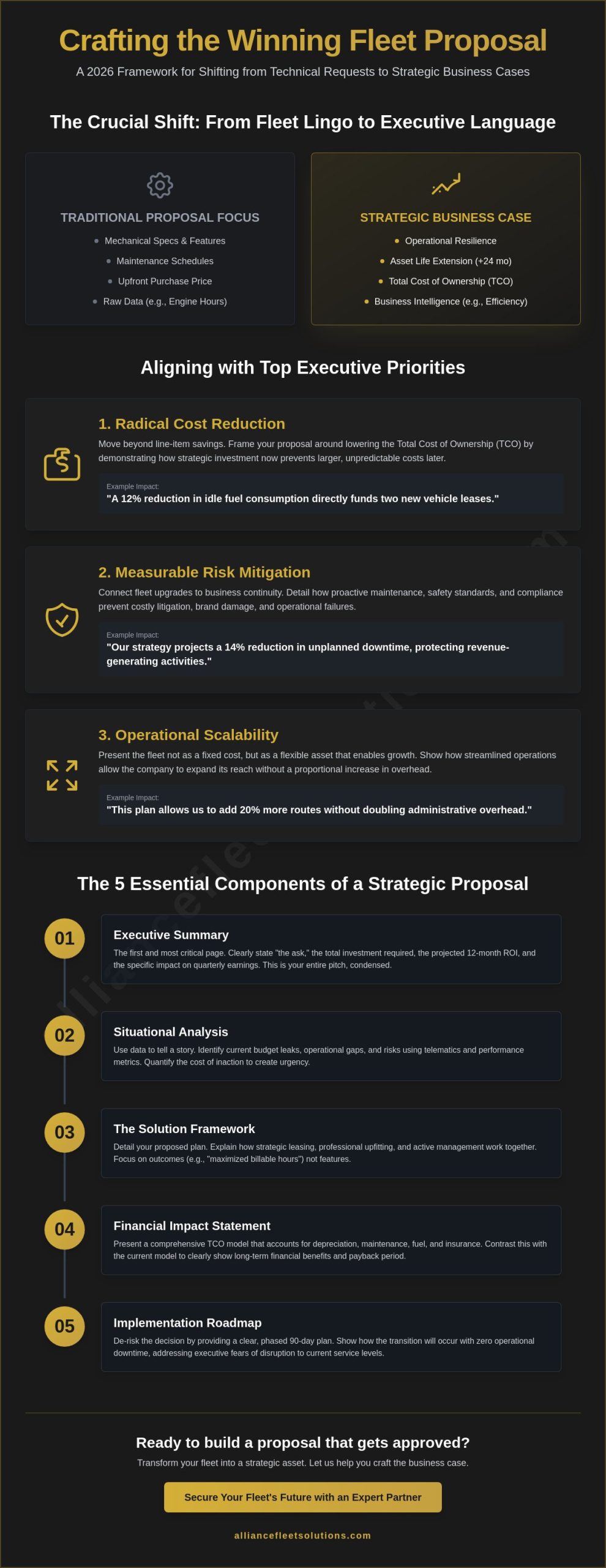
A successful pitch treats the fleet as a strategic asset. While a standard fleet management overview covers the basics of vehicle acquisition and maintenance, your proposal must address high-level business drivers. Executives prioritize three specific outcomes: radical cost reduction, measurable risk mitigation, and operational scalability. If your document leads with features like “faster oil changes” instead of “a 14% reduction in unplanned downtime,” it’ll likely be rejected. You’re not asking for a budget for repairs; you’re proposing a strategy to protect the company’s bottom line.
- Cost Reduction: Go beyond line-item expenses to show total cost of ownership (TCO) improvements.
- Risk Mitigation: Detail how proactive compliance and safety standards prevent litigation and brand damage.
- Scalability: Demonstrate how streamlined operations allow the company to add 20% more routes without doubling administrative overhead.
The ROI vs. Expense Debate
Executives often categorize fleets as “cost centers,” which are necessary evils that only consume capital. You must change this perception by framing every dollar spent as an investment in asset protection. When you present a maintenance schedule, don’t call it a bill. Call it a strategy to extend asset life by 24 months. In 2026, ROI is defined as the net financial gain realized from maximizing billable vehicle hours while simultaneously reducing emergency repair premiums and secondary transport costs.
Translating Technical Data into Business Intelligence
Raw data is useless to an executive unless it informs a decision. Use telematics and GPS solutions to tell a story about where the business is leaking money. Shift your reporting from “engine hours” to “operational efficiency” metrics that resonate in the boardroom. For example, instead of reporting idling times, show how reducing idle fuel consumption by 12% directly funds two new vehicle leases.
To win immediate attention, include a “One-Page Executive Summary” at the very beginning. This summary should highlight the total investment required, the projected payback period, and the specific impact on quarterly earnings. By keeping the focus on business intelligence, you prove that you understand how to create a fleet management proposal for executives that aligns with the company’s long-term growth targets.
The 5 Essential Components of a Strategic Fleet Proposal
A winning proposal focuses on business outcomes rather than just mechanical operations. When you master how to create a fleet management proposal for executives, you must prioritize five core pillars that align with 2026 corporate strategy. These components transform a simple request for vehicles into a comprehensive business case for operational excellence. Executives don’t just want to see a list of trucks; they need to see how those trucks generate a return on investment. Your proposal should include:
- Executive Summary: A one-page high-level value proposition that clearly states “the ask” and the expected 12-month ROI.
- Situational Analysis: A data-driven look at current budget leaks and operational gaps.
- The Solution Framework: A detailed plan showing how leasing, professional upfitting, and active management work in tandem.
- Financial Impact Statement: A Total Cost of Ownership (TCO) breakdown that accounts for depreciation, maintenance, and fuel.
- Implementation Roadmap: A 90-day low-friction plan for transitioning operations without disrupting current service levels.
By structuring your document this way, you demonstrate that you understand the mechanics of the industry and the language of business efficiency. Partnering with experts to streamline your fleet maintenance ensures these components remain actionable throughout the vehicle lifecycle.
Crafting the Situational Analysis
Start by performing a rigorous Gap Analysis on your current fleet performance. Most regional fleets lose 15% of their potential productivity to unplanned vehicle downtime and aging assets. You must identify hidden costs, such as the thousands of dollars wasted annually through inefficient fuel management programs or administrative overhead. Use government fleet management solutions as a benchmark to show where your company’s metrics fall behind national standards for uptime and safety. This section must prove that “doing nothing” is the most expensive option available to the board.
The Solution Framework: Customization and Upfitting
Executives often question why “off-the-lot” vehicles aren’t sufficient. You must explain that stock vehicles frequently fail to meet professional operational needs, leading to secondary costs in the field. Professional upfitting is a strategic asset that maximizes vehicle resale value by 12% or more while significantly improving employee safety. Whether it’s specialized shelving for HVAC technicians or heavy-duty liftgates for logistics, custom-configured fleets reduce ergonomic injuries and speed up service delivery. Understanding how to create a fleet management proposal for executives requires showing that every modification serves a specific, revenue-generating purpose. This proactive approach ensures your fleet remains a functional backbone of the business rather than a depreciating liability.
Financial Modeling: Moving from Price to Total Cost of Ownership (TCO)
The sticker price of a vehicle is a distraction. It represents only 15% to 20% of a fleet asset’s lifetime cost. Relying on purchase price as a primary metric is a common mistake that leads to budget overruns and operational friction. When you master how to create a fleet management proposal for executives, you must shift the focus to Total Cost of Ownership (TCO). This comprehensive model tracks every dollar from the moment of acquisition to the final remarketing sale.
A robust TCO analysis breaks down into four critical pillars:
- Depreciation: This is typically the largest expense, often consuming 35% to 45% of TCO. Strategic cycling ensures you exit the asset before the maintenance curve spikes.
- Maintenance and Repairs: Unscheduled repairs cost three times more than preventive care. Controlled maintenance keeps these costs predictable.
- Fuel Consumption: Even a 5% improvement in fuel efficiency through better routing or newer engines saves thousands over the vehicle’s life.
- Insurance and Compliance: Newer fleets with advanced safety tech often qualify for lower premiums and reduce the risk of nuclear verdicts in 2026.
The “Cost of Doing Nothing” (CODN) is your most persuasive tool. If the company maintains its current aging fleet, maintenance costs are projected to rise by 12% by the end of 2026. Delaying a fleet refresh isn’t a savings strategy; it’s a high-interest loan against future revenue.
Leasing Structures and Business Financial Goals
Aligning the fleet with the company’s balance sheet is vital for executive buy-in. Open-end leases offer maximum flexibility for high-mileage operations and are often treated as OpEx. Closed-end leases provide a fixed cost with no residual risk, which suits companies prioritizing predictable cash flow. Integrating professional maintenance management further stabilizes these monthly outflows by eliminating the volatility of emergency repairs. Finally, proactive vehicle remarketing ensures the company maximizes residual value, turning the end of a lease into a strategic cash injection.
Building the ROI Calculator
Executives need a side-by-side comparison to visualize the transition. A simple ROI table clarifies the impact of your proposal:
| Financial Metric | Current State (Aging Fleet) | Proposed State (Optimized Fleet) |
|---|---|---|
| Monthly Maintenance per Unit | $850 | $325 |
| Annual Downtime per Unit | 160 Hours | 35 Hours |
| Fuel Efficiency (MPG) | 6.2 MPG | 8.1 MPG |
Productivity gains are the hidden engine of ROI. Every hour a truck sits in a shop, the company loses an average of $650 in potential revenue. Fractional management reduces the need for full-time internal hires, allowing the company to access expert oversight at a fraction of the salary and benefits cost of a dedicated executive. By presenting these numbers clearly, you transform the fleet from a cost center into a strategic business asset.
De-Risking the Proposal: Addressing Executive Objections
Executives often view change through the lens of risk. The most common hurdle you’ll face is the fear of operational disruption. They worry that switching systems or vendors will cause trucks to sit idle and revenue to stall. To overcome this, your proposal must lead with a phased implementation strategy. This ensures zero downtime by transitioning assets in small, manageable batches rather than a “rip and replace” approach. When you master how to create a fleet management proposal for executives, you must prove that the transition is a controlled evolution, not a chaotic overhaul.
Safety is your strongest leverage point for de-risking. Telematics data isn’t just for tracking; it’s a shield against litigation. According to 2024 industry benchmarks, fleets using active driver coaching see a 22% drop in preventable accidents. This translates directly to lower insurance premiums and protected brand equity. You’re not just asking for a budget; you’re offering a method to avoid multi-million dollar “nuclear verdicts” that can bankrupt a mid-sized logistics firm.
Safety, Compliance, and Liability
Data-driven safety programs do more than stop accidents. They provide a documented “duty of care” that protects the company during legal discovery. As 2026 regulatory standards for emissions and safety tech become mandatory, your proposal should position the fleet as a proactive leader. We view this as an “Alliance” model. You aren’t operating solo; you’re leveraging a partnership that shares the burden of compliance and risk mitigation to keep your brand’s reputation spotless.
The Fractional Management Alternative
Mid-sized fleets often get stuck in a growth plateau. They’re too big to manage on spreadsheets but too small to hire a full-time, high-salary fleet director. Fractional management allows you to “outsource the headache” while maintaining total asset ownership. This model provides external expertise to ensure efficient fleet operations from the very first day. By integrating professional oversight, you eliminate the steep learning curve that typically drains ROI during expansion. It’s about getting elite-level results without the elite-level payroll burden.
Ready to secure your fleet’s future? Contact Alliance Fleet Solutions for a customized fleet risk assessment to identify your biggest liability gaps.
Next Steps: Finalizing Your Alliance Fleet Strategy
The final stage of learning how to create a fleet management proposal for executives involves more than just data. It’s about confidence and execution. On presentation day, your goal is to move the board from skepticism to commitment. You’ve done the heavy lifting of auditing your current costs; now you must prove that your proposed solution is the most reliable path forward for the company’s bottom line.
Preparing for the Presentation
Executives don’t want to dig through dense spreadsheets during a 20-minute briefing. Replace static tables with dynamic dashboards that highlight key performance indicators like Cost Per Mile (CPM) and Mean Time To Repair (MTTR). Visualizing a 12% reduction in idling time through a clear, color-coded graph makes the ROI undeniable. It shows you’re thinking about the future, not just reacting to the past.
Don’t just present your own ideas. Bring the voice of the yard into the room. A 2024 industry report found that 78% of successful fleet transitions included feedback from frontline staff. Quote a senior driver who lost 40 hours of drive time last month due to preventable breakdowns. This humanizes the data and highlights the real-world impact of equipment failure. When you reach the “close,” offer a phased approach. Suggesting a 6-month pilot program for a specific region often secures a “yes” faster than demanding a complete 500-vehicle overhaul immediately. It lowers the perceived risk while proving the concept in a controlled environment.
- Verify all 2025 maintenance cost projections against current inflation rates.
- Ensure all visual aids are accessible on mobile devices for remote board members.
- Prepare a “FAQ” sheet specifically addressing potential downtime during the transition.
- Have a signed letter of intent or a draft service level agreement (SLA) ready for review.
Why Alliance is Your Strategic Partner
Alliance Fleet Solutions isn’t just another vendor. We function as the strategic backbone of your logistics operations. Our “Alliance” brand promise means our goals align with yours: maximizing uptime and ensuring driver safety across every mile. We don’t just fix trucks; we manage the health of your most valuable mobile assets.
With our extensive national coverage and industry-leading mobile repair capabilities, we bring the shop to your trucks. This eliminates the “deadhead” miles spent driving to fixed locations, which can save a mid-sized fleet thousands in fuel and labor every month. We focus on the first 90 days by establishing clear benchmarks. This includes a full fleet health audit, the integration of real-time maintenance tracking, and a 30-day performance review to ensure we’re hitting your specific targets. We understand the mechanics of the industry and speak the language of business efficiency.
Ready to transform your fleet into a competitive advantage? Schedule a Strategy Session with Alliance Fleet Solutions today to finalize your 2026 roadmap and secure your fleet’s future.
Secure Your Fleet’s Strategic Advantage
Executives view vehicles as capital investments, not just operational tools. By focusing on Total Cost of Ownership and de-risking your strategy through clear financial modeling, you transform a simple request into a high-impact business case. You’ve now seen the roadmap for how to create a fleet management proposal for executives that resonates with decision-makers who prioritize ROI and uptime. Alliance Fleet Solutions supports this journey with over 8 years of specialized B2B fleet expertise. We deliver custom upfitting solutions for national fleets and manage every phase of the vehicle lifecycle, from initial acquisition to final remarketing. This comprehensive approach ensures your fleet remains a productive asset rather than a mounting liability. Streamlining your operations starts with a clear plan that addresses executive concerns before they’re even voiced. Let’s build a partnership that keeps your business moving at the pace of the modern logistics industry. We’re ready to help you optimize every mile.
Take the next step toward a boardroom-ready strategy: Download Our Executive Fleet Proposal Checklist
Frequently Asked Questions
What is the most important section of a fleet management proposal?
The executive summary is the most critical section because it distills complex logistical data into a high-level overview of ROI and operational benefits. Executives often spend less than five minutes reviewing a document before making a decision. This section must highlight how to create a fleet management proposal for executives that aligns with 2026 corporate goals like a 15% carbon reduction or 10% lower total cost of ownership.
How do I calculate the ROI of a new fleet management system?
Calculate ROI by subtracting the total investment cost from your projected annual savings; then divide that number by the investment cost. Focus on tangible metrics like a 12% reduction in fuel consumption through idling alerts or a 20% decrease in maintenance costs via predictive scheduling. Use a 36 month window to show long-term profitability and clear break-even points for the leadership team.
Should I propose open-end or closed-end leasing to my CFO?
Propose open-end leasing if your fleet exceeds 25,000 miles per year and you want maximum flexibility with vehicle disposal. CFOs often prefer this model for commercial applications because it lacks mileage restrictions and wear-and-tear penalties. Closed-end leasing works better for predictable, low-mileage operations where the company wants to return the keys and walk away after a fixed 36 month or 48 month term.
How can I convince executives to invest in telematics?
Focus on the 10% to 15% reduction in insurance premiums that many providers offer for fleets using active monitoring. Telematics data provides the objective proof needed when learning how to create a fleet management proposal for executives. Show how real-time GPS tracking reduced unauthorized vehicle use by 22% in recent industry case studies to prove immediate impact on the company’s bottom line.
What are the biggest risks to highlight in a fleet proposal?
Highlight regulatory non-compliance and rising maintenance costs from aging assets as your primary risks. For instance, failing to meet 2026 EPA emissions standards can result in thousands of dollars in daily fines. Mentioning that vehicle downtime costs an average of $760 per day per vehicle gives executives a clear financial reason to approve your modernization plan and avoid these preventable losses.
How often should a fleet management plan be reviewed by executives?
Schedule a formal strategic review every six months to ensure the fleet stays aligned with fluctuating fuel prices and market demands. Quarterly touchpoints are better for reviewing safety KPIs and maintenance spend against the annual budget. This steady cadence allows for quick adjustments if the fleet misses its 95% uptime target during peak logistics seasons or high-demand periods.
Can fractional fleet management save the company money?
Fractional fleet management can reduce overhead costs by 20% to 30% by eliminating the need for a full-time, in-house director. This model provides access to senior-level expertise for a fraction of the $120,000 average salary for a fleet professional. It’s a strategic alliance that brings specialized knowledge to smaller fleets without the long-term liability of permanent headcount or expensive benefit packages.
How do I address the cost of vehicle upfitting in a proposal?
Address upfitting as a capital investment that increases the residual value and operational efficiency of the asset. Detail how specific shelving or refrigeration units improve technician productivity by 15 minutes per stop. By amortizing these costs over the five-year life of the vehicle, you show executives that the upfront expense drives long-term revenue growth rather than being a simple sunk cost.