
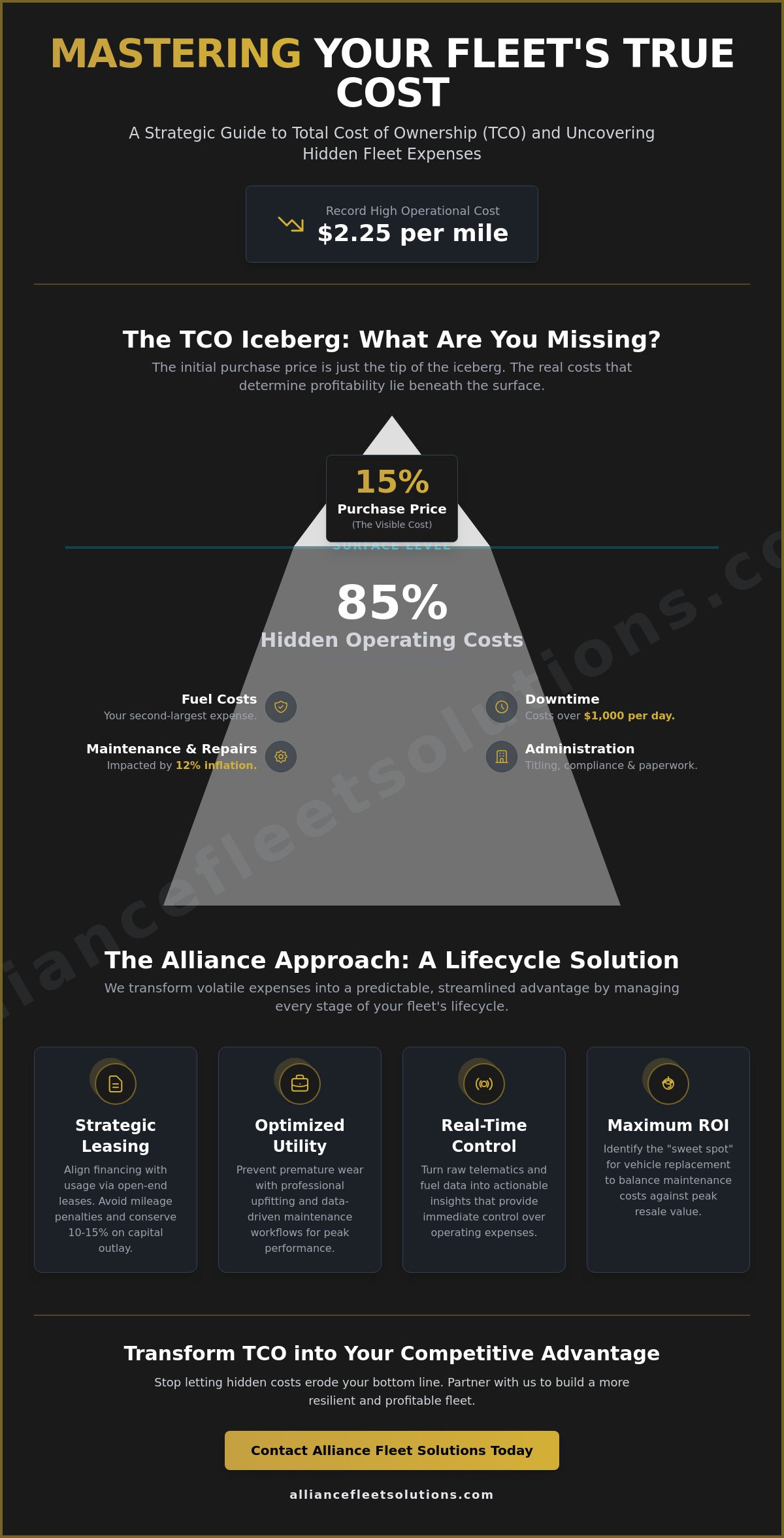
Did you know that the purchase price of a heavy-duty truck represents only about 15% of its lifetime expenses? If you’re focusing solely on the initial deal, you’re missing the 85% of hidden costs that actually dictate your profitability. Learning how to reduce total cost of ownership for a fleet is no longer just a financial goal; it’s a survival requirement in a market where operational costs have climbed to a record $2.25 per mile according to recent industry data. We understand the stress of watching unpredictable maintenance spikes and idling fuel costs erode your bottom line.
You deserve a partnership that transforms these volatile expenses into a predictable, streamlined advantage. This strategic guide promises to help you master the entire vehicle lifecycle, from tactical leasing structures to aggressive remarketing. We’ll preview the exact data-driven maintenance workflows and disposal strategies you need to lower your cost-per-mile and maximize resale value. It’s time to move beyond reactive repairs and start building a more resilient fleet alliance that secures your long-term success.
Key Takeaways
- Shift your perspective beyond the initial purchase price to master the 70% of lifecycle expenses that determine your true profitability.
- Evaluate how specific lease structures can either protect your margins or hide costly inefficiencies within your financial operations.
- Discover how to reduce total cost of ownership for a fleet by leveraging professional upfitting to prevent premature wear and ensure vehicles are perfectly matched to their roles.
- Transform raw telematics and fuel data into actionable insights that provide real-time control over your second-largest operating expense.
- Maximize your final return on investment by identifying the precise “sweet spot” for vehicle replacement to balance maintenance costs against peak resale value.
Redefining TCO: Why the Purchase Price Is Only the Beginning
Managing a fleet in 2026 requires a fundamental shift in perspective. Many managers focus heavily on the initial acquisition, yet the sticker price often accounts for less than 30% of the actual expenses incurred over a vehicle’s life. To truly master your budget, you must look at the Total Cost of Ownership (TCO), which represents the sum of every expense from the moment a vehicle is ordered until it’s decommissioned. Understanding how to reduce total cost of ownership for a fleet starts with acknowledging that every mile driven carries hidden financial weight. At Alliance Fleet Solutions, we advocate for the “Alliance” approach. This means we treat fleet management as a strategic business asset rather than a simple line item. We don’t just fix trucks; we partner with you to ensure your equipment supports your long-term growth.
The 2026 TCO Landscape: New Challenges
The economic environment in 2026 has introduced hurdles that didn’t exist a decade ago. Inflation has pushed maintenance pricing up by roughly 12% over the last two years, while vehicle supply chain shifts continue to create volatility in parts availability. Rising interest rates have also made capital cost management more critical than ever, as the cost of financing assets eats into profit margins. You can’t rely on outdated spreadsheets when the cost of borrowing has shifted so drastically. TCO is a metric of operational health, not just a budget line. By tracking these variables in real-time, you can pivot your strategy before a minor price hike becomes a major deficit.
Hard Costs vs. Soft Costs: The Hidden Profit Killers
Hard costs are the visible expenses that show up on every invoice. These include the initial acquisition, fuel, insurance premiums, and scheduled maintenance. While these are significant, soft costs are often the real profit killers that go unnoticed. Vehicle downtime is the most aggressive of these, often costing companies over $1,000 per day when you factor in lost revenue, missed delivery windows, and idle driver wages.
Administrative overhead is another silent drain on resources. Managing titling, registration, and tax compliance across a national fleet requires hundreds of man-hours that could be better spent on core business activities. You can leverage our Comprehensive Fleet Management Services to see how professional oversight can streamline these burdens. Ultimately, learning how to reduce total cost of ownership for a fleet involves identifying these invisible leaks and plugging them with proactive, data-driven solutions.
- Acquisition: Less than 30% of lifetime costs.
- Downtime: Can exceed $1,000 per day in lost revenue.
- Maintenance: Impacted by 12% inflation in parts and labor.
- Administration: A major soft cost involving titling and compliance.
Strategic Leasing: Choosing the Financial Structure That Protects Margins
Your lease structure acts as the financial foundation of your entire operation. It determines how you perceive every other expense, from fuel to tires. A poorly structured agreement can bury maintenance costs or hide the true impact of depreciation. To understand how to reduce total cost of ownership for a fleet, you must first align your financing with your actual usage patterns. The right choice highlights TCO inefficiencies before they drain your quarterly margins.
Open-End Leasing: Flexibility for High-Mileage Fleets
Open-end leases, often called TRAC leases, provide the highest level of flexibility for commercial operators. These structures typically offer lower monthly payments because the lessee assumes the risk of the vehicle’s residual value at the end of the term. For fleets running high-mileage routes, this is often the most cost-effective path. You avoid the restrictive mileage caps and wear-and-tear penalties that plague retail-style leases.
- Capital Conservation: Strategic procurement through an expert partner can lower initial capital outlay by 10% to 15% compared to traditional bank financing.
- No Penalties: You gain total control over the vehicle’s lifecycle without worrying about “excessive use” charges at the end of the term.
- Asset Control: If the vehicle is worth more than the residual at the end of the lease, your business keeps the equity.
Closed-End Leasing: Predictability and Risk Mitigation
Closed-end leases prioritize budget certainty. In this model, the lessor assumes the risk of the vehicle’s market value at the end of the contract. This “walk-away” structure is ideal for fleets with predictable, low-mileage local routes where the wear is consistent. By transferring residual value risk to the lessor, you protect your balance sheet from sudden shifts in the used truck market. This stability is a cornerstone of Efficient Fleet Operations, where the focus is on maximizing ROI through predictable cost cycles.
Cost of capital remains a critical factor in 2026. If your internal rate of return is higher than the lease’s effective interest rate, leasing preserves capital for core business investments like technology or facility expansion. Alliance Fleet Solutions tailors these financial structures to your specific goals. We analyze your route data and financial health to recommend a structure that streamlines your how to reduce total cost of ownership for a fleet strategy. We believe your fleet should function as a strategic asset, not a mounting liability. If you are ready to optimize your financial structure, our team can help you build a more resilient fleet today.
Optimizing Utility Through Professional Upfitting and Maintenance
Professional upfitting is far more than an aesthetic choice or a convenience for the driver. It is a calculated financial strategy. When you invest in custom configurations, you’re engineering the vehicle to handle the specific stresses of its daily duty cycle. This alignment between the machine and its mission is a primary lever in how to reduce total cost of ownership for a fleet. Without it, you’re essentially forcing a general-purpose tool to perform a specialist’s job, which leads to accelerated component fatigue and premature replacement cycles.
The Cost-Saving Power of Professional Upfitting
Precision weight distribution is the hidden hero of upfitting ROI. When shelving, ladder racks, and heavy equipment are installed without considering the center of gravity, the vehicle suffers. Uneven loads put localized stress on the suspension, tires, and braking systems. A truck that is properly balanced through professional upfitting sees significantly less “unscheduled” wear on these consumables. This level of detail ensures the chassis isn’t fighting against its own cargo during every turn or stop.
Ergonomics also play a massive role in administrative TCO. When tools are stored in intuitive, easy-to-reach configurations, the risk of repetitive strain injuries and on-the-job accidents drops. Lowering worker compensation claims and reducing driver turnover are essential for maintaining a healthy bottom line. Data shows that a vehicle custom-built for its specific task lasts 20% longer on average because every component operates within its intended mechanical parameters. This longevity directly defers the massive capital expenditure of fleet replacement.
Preventive Maintenance Management: The Uptime Engine
The difference between a “pay-as-you-go” repair model and a managed maintenance program is often the difference between profit and loss. Reactive repairs are notoriously expensive. They involve emergency towing, last-minute parts surcharges, and, most importantly, the lost revenue of a downed vehicle. A managed program shifts the focus to predictive intervals, catching a $500 wear-and-tear issue before it evolves into a $5,000 catastrophic failure. This proactive stance is a cornerstone of how to reduce total cost of ownership for a fleet in 2026.
Alliance Fleet Solutions monitors service intervals with clinical precision to ensure your assets never miss a beat. By tracking real-world usage rather than just calendar dates, we keep your trucks on the road longer. Our commitment to uptime is backed by mobile and on-site repair capabilities. This eliminates the “empty miles” spent driving to a shop and waiting in a lobby. We bring the shop to your yard, performing high-quality service while your drivers are off-clock. For a deeper dive into these strategies, explore The Strategic Guide to Maintenance Management. Our alliance with your business means we treat your uptime as our own primary metric of success.
Leveraging Telematics and Fuel Management for Real-Time Control
Fuel expenses represent roughly 24% of total fleet operating costs. This makes fuel the second-largest TCO component, trailing only behind vehicle depreciation. You can’t manage what you don’t measure. Telematics and GPS solutions bridge the visibility gap by converting raw data into actionable intelligence. By monitoring driver behavior, fleet managers can directly address the 30% of fuel efficiency that is typically influenced by the person behind the wheel. Speeding, harsh braking, and excessive idling don’t just waste fuel; they accelerate mechanical wear and inflate your TCO through increased repair frequency.
Data-Driven Fuel Management Programs
Fuel cards do more than simplify payments at the pump. They provide the granular data necessary to identify “gas-guzzling” vehicles or unauthorized transactions. According to industry benchmarks, reducing idle time by just 10% across a national fleet can save thousands of dollars in fuel and maintenance costs annually. These insights are a critical part of Fuel Management Programs designed to curb fraud and optimize spending. When you integrate fuel data with telematics, you gain a clear picture of how to reduce total cost of ownership for a fleet by eliminating waste before it impacts your bottom line.
Telematics: Moving from Tracking to Optimization
Modern telematics has evolved beyond simple vehicle tracking. Real-time engine diagnostics now trigger alerts for minor sensor issues or fault codes before they escalate into catastrophic failures. This proactive approach keeps your trucks on the road and out of the shop. Route optimization plays an equally vital role in your strategy. By streamlining paths and avoiding traffic congestion, you reduce total miles driven. This directly preserves tire tread and extends the life of your engine oil.
- Predictive Maintenance: Monitoring engine health in real-time reduces the risk of expensive emergency roadside repairs.
- Asset-Specific TCO: Detailed logs allow you to calculate the exact cost-per-mile for every individual vehicle, identifying which assets are no longer profitable.
- Reduced Tire Wear: Optimized routing and smoother driving habits extend the lifespan of expensive tire sets across the fleet.
Mastering how to reduce total cost of ownership for a fleet requires a commitment to data over guesswork. Our team helps you turn these complex data points into a sustainable business strategy that prioritizes uptime and safety. Partner with Alliance Fleet Solutions to streamline your maintenance and maximize your operational efficiency.
The Exit Strategy: Maximizing ROI Through Strategic Remarketing
Your calculation of how to reduce total cost of ownership for a fleet isn’t complete until the title is signed over to a new owner. Remarketing is your final opportunity to reclaim capital. Many fleet managers treat disposal as an afterthought; however, it represents the final profit lever in the asset lifecycle. If you ignore the exit strategy, you effectively ignore the residual value that offsets your initial investment.
Finding the “sweet spot” for vehicle replacement requires balancing rising maintenance expenses against falling resale values. For heavy-duty trucks, maintenance costs typically increase by 20% to 25% annually once the vehicle passes the five-year mark. If you hold an asset past this point, the repair bills often outpace the remaining equity. Strategic managers monitor these intersecting lines to trigger a sale before the asset becomes a financial liability.
Vehicle Remarketing: Turning Assets Back into Capital
Waiting too long to replace a vehicle triggers a TCO “death spiral.” This occurs when emergency repairs and prolonged downtime costs exceed the asset’s monthly depreciation value. We prevent this by employing a multi-channel remarketing approach. While wholesale auctions offer immediate liquidity, private sales often net 10% to 15% higher returns for units with documented preventive maintenance records. The replacement cycle is the most critical timing decision in fleet management. It determines whether you exit the lifecycle with a profit or a significant loss.
- Data-Driven Timing: We analyze 2026 market trends to identify peak demand periods for specific equipment types.
- Condition Documentation: Detailed service logs from Alliance Fleet Solutions increase buyer confidence and resale prices.
- Channel Optimization: We match each asset to the sales channel that yields the highest net return after fees.
Fractional Fleet Management: Expert Oversight on a Budget
Fractional management delivers high-level TCO expertise without the burden of a six-figure executive salary. It’s an efficient way to access advanced analytics and market insights that are usually reserved for mega-fleets. Alliance Fleet Solutions acts as your dedicated partner, managing complex vendor relationships and ensuring strict DOT compliance across your entire operation. We understand how to reduce total cost of ownership for a fleet by looking at the big picture, not just individual repair bills.
Our team manages the entire lifecycle, from the moment of procurement to the final disposal. This comprehensive oversight ensures that every decision made during the vehicle’s life is designed to maximize its eventual resale value. We handle the technical burdens so you can focus on your core logistics. By treating maintenance as a strategic investment rather than a sunk cost, we protect your margins and keep your drivers safe. Partner with Alliance Fleet Solutions to optimize your TCO today.
Mastering Your Fleet’s Bottom Line for 2026
Managing a modern fleet requires looking far beyond the initial sticker price. Industry data from the 2024 Geotab State of Fleet Management Report shows that telematics alone can lower fuel expenses by 14%, proving that real-time data is essential for margin protection. Success in 2026 hinges on integrating professional upfitting with a national maintenance network to maximize vehicle uptime. By the time a vehicle reaches its exit date, a disciplined remarketing strategy ensures you capture the highest possible residual value. Black Book data indicates that vehicles with documented maintenance history can command up to 10% higher resale prices. Learning how to reduce total cost of ownership for a fleet isn’t a one-time task; it’s a continuous cycle of optimization that turns your vehicles into strategic assets rather than simple expenses.
Alliance Fleet Solutions provides the comprehensive lifecycle management and expert upfitting your industry demands. Our national service coverage keeps your drivers on the road while we handle the complexities of procurement, leasing, and maintenance. It’s time to stop reacting to costs and start controlling them.
Streamline your operations and reduce TCO with Alliance Fleet Solutions
Your fleet’s efficiency is the backbone of your success, and we’re ready to help you build a more profitable future.
Frequently Asked Questions
What is the biggest factor in reducing fleet total cost of ownership?
Preventive maintenance is the single most effective lever for those looking at how to reduce total cost of ownership for a fleet. According to 2024 industry benchmarks, a structured maintenance program can reduce emergency repair costs by 30 percent. You’ll avoid the high price of roadside breakdowns and extend the usable life of your assets. Consistent service schedules ensure your trucks stay on the road instead of sitting in a shop, maximizing your daily uptime.
How does leasing help reduce a fleet’s TCO compared to buying?
Leasing lowers TCO by providing predictable monthly expenses and protecting your business from vehicle depreciation, which typically accounts for 40 percent of total costs. You’ll gain access to newer, fuel efficient models without the heavy upfront capital of purchasing. This strategy ensures you’re always operating under warranty, which eliminates the risk of catastrophic repair bills. It simplifies your budget while keeping your fleet modern, safe, and highly productive.
Can telematics really lower my fleet’s TCO?
Telematics systems directly lower TCO by identifying 15 percent or more in fuel waste caused by excessive idling. These tools provide real time data on driver behavior and engine health, allowing you to catch small mechanical issues before they become failures. By monitoring these metrics, you’ll optimize routes and reduce unnecessary mileage by at least 10 percent annually. It’s a strategic way to streamline operations and cut overhead through actionable intelligence.
What is the difference between hard and soft fleet costs?
Hard costs are tangible line items like fuel, insurance, and vehicle acquisition prices. Soft costs include indirect expenses such as driver downtime and administrative labor, which can represent 20 percent of a fleet’s total budget. Understanding both categories is essential for anyone researching how to reduce total cost of ownership for a fleet. You can’t manage what you don’t measure, so tracking these hidden expenses is vital for maintaining long term profitability.
When is the best time to replace a fleet vehicle to minimize TCO?
The optimal time to replace a fleet vehicle is typically at the 5 year mark or when maintenance costs exceed 50 percent of the vehicle’s resale value. Industry data from 2023 shows that repair expenses often spike by 25 percent once a truck passes the 100,000 mile threshold. Replacing vehicles at this juncture maximizes your trade in value and keeps your fleet under warranty. You’ll avoid the money pit phase of an aging asset’s lifecycle.
How does professional upfitting impact the resale value of a fleet truck?
Professional upfitting can increase a truck’s resale value by 10 to 15 percent when using high quality, modular components. Buyers in the secondary market pay a premium for vehicles that are already equipped with durable shelving or specialized racks. It’s important to choose reputable installers who follow OEM standards to ensure modifications don’t void warranties. This proactive approach ensures your equipment remains a valuable asset rather than a liability when it’s time to sell.
What are the benefits of fractional fleet management for cost reduction?
Fractional fleet management reduces costs by providing expert oversight at a fraction of the cost of a full time executive salary. You’ll benefit from the strategic insights of a seasoned professional who manages your maintenance schedules and vendor contracts. This model typically saves small to mid sized businesses 12 percent on annual operating expenses by optimizing service intervals. It’s an efficient way to get high level expertise without increasing your permanent headcount or benefits costs.
How do fuel management programs prevent TCO bloat?
Fuel management programs prevent TCO bloat by eliminating unauthorized spending and tracking consumption patterns across your entire operation. These programs can reduce total fuel spend by 5 to 10 percent through strict card controls and data transparency. You’ll receive detailed reports that highlight inefficient vehicles or poor driving habits that waste resources. This level of accountability ensures every gallon purchased contributes directly to your bottom line and improves overall fleet efficiency.