
Is your in-house fleet management actually saving you money, or is it a financial iceberg waiting to sink your 2026 margins? Many business owners believe keeping operations under their own roof ensures control and cost savings. However, with diesel prices hovering around $5.40 per gallon and commercial insurance premiums spiking by up to 25% this year, the visible expenses are just the surface. The true hidden costs of in-house fleet management often lie in the “soft” leakages: executive time spent on vehicle logistics and the administrative burden of staying compliant with stricter ELD enforcement.
We understand the pressure of managing high-stakes logistics while trying to focus on your core business goals. You deserve a strategy that transforms your fleet from a cost center into a strategic asset. In this article, we’ll provide a clear framework to calculate your true Total Cost of Ownership (TCO) and share strategies to slash your administrative workload. We’ll also help you determine if a fractional management model is the right move to recapture your lost ROI and stabilize your operational budget for the long term.
Key Takeaways
- Learn why traditional accounting often misses the “invisible iceberg” of expenses, leading to a significant miscalculation of your fleet’s true total cost of ownership.
- Identify the specific hidden costs of in-house fleet management that stem from unmanaged maintenance cycles and fuel slippage.
- Discover how to quantify the executive opportunity cost wasted on logistics, allowing your leadership to refocus on core business growth.
- Understand the impact of value erosion and how professional vehicle remarketing can recapture equity at the end of a vehicle’s lifecycle.
- Gain actionable strategies to transition from a reactive maintenance model to a proactive, fractional management approach that stabilizes your 2026 budget.
The Invisible Iceberg: Why In-House Fleet Management Costs More Than You Think
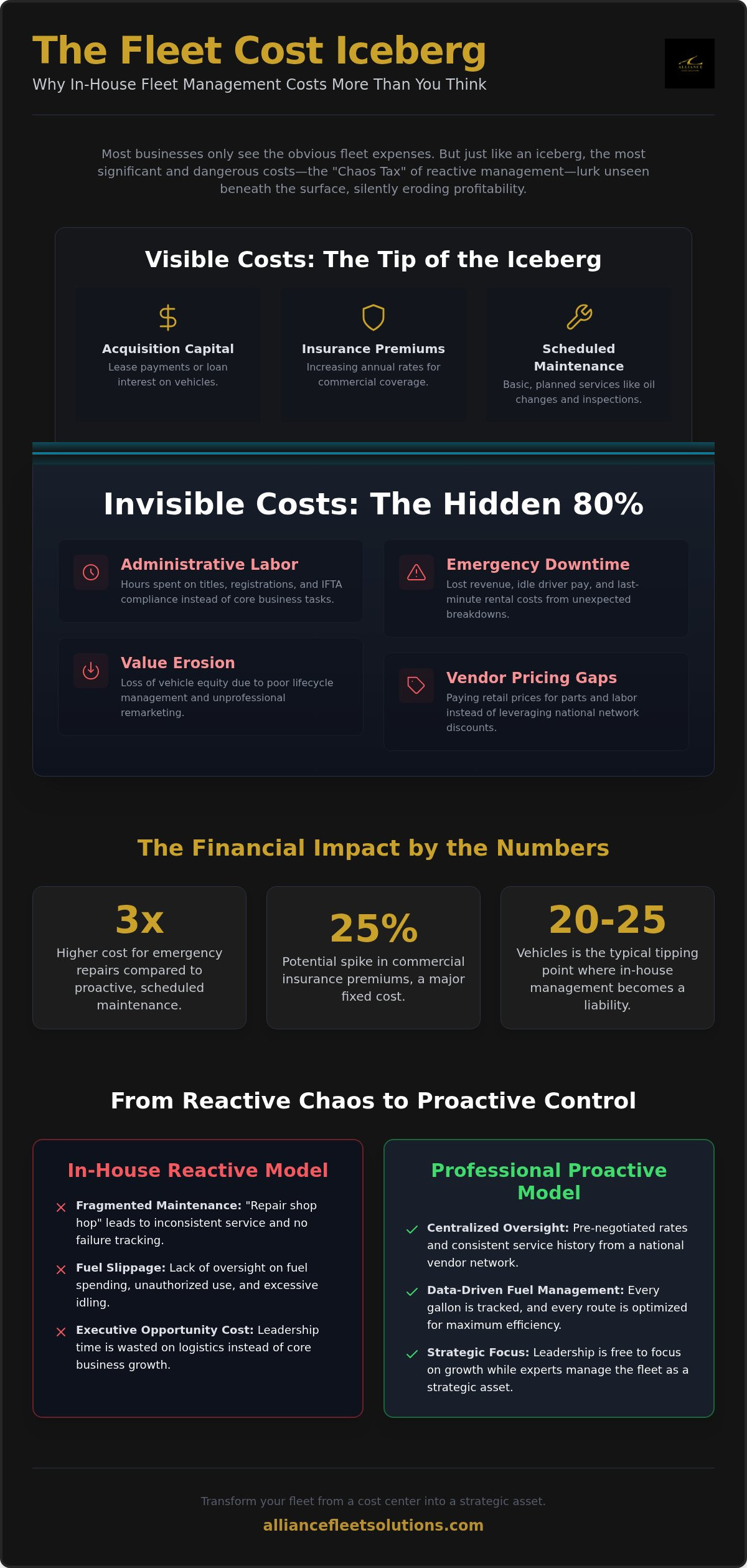
Most business owners view their fleet expenses through a narrow lens. They look at the monthly lease payment, the fuel bill, and the occasional repair invoice. This perspective creates a dangerous illusion. In the industry, we call this the “Fleet Cost Iceberg.” The expenses you see on your monthly P&L represent only the tip of the iceberg. Beneath the surface lies a massive, submerged mass of hidden costs of in-house fleet management that can quietly erode your profitability.
Miscalculating the Total Cost of Ownership (TCO) is a common pitfall. Many managers focus heavily on acquisition, especially with the 12% Federal Excise Tax on new heavy-duty trucks adding up to $30,000 to the initial price in 2026. While that’s a significant capital outlay, it’s a fixed, predictable number. The real danger comes from the variable, unmanaged “soft” costs that accumulate over the vehicle’s lifecycle. Professional fleet management services serve as your sonar, identifying these submerged risks before they impact your bottom line.
There is a specific transition point where in-house management stops being a “free” internal task and becomes a liability. For most businesses, this happens when the fleet reaches 20 to 25 vehicles. At this scale, the administrative burden exceeds the capacity of a part-time office manager or busy executive. When fleet tasks are “fit in” between core business duties, mistakes happen, deadlines are missed, and costs spiral out of control.
Visible Costs: The Tip of the Iceberg
These are the line items your accounting department tracks easily. They are necessary, but they rarely tell the whole story of your operational efficiency:
- Acquisition Capital: Monthly lease payments or the interest on vehicle loans.
- Insurance Premiums: With 2026 renewal rates increasing by 8% to 25%, these are harder to ignore but still represent a known quantity.
- Scheduled Maintenance: The basic oil changes and inspections required to keep a truck on the road.
Invisible Costs: The Hidden 80%
The true hidden costs of in-house fleet management are often found in the “Chaos Tax.” This is the premium you pay for being reactive rather than proactive. It includes:
- Administrative Labor: The dozens of hours spent every month tracking titles, managing registrations, and ensuring IFTA compliance.
- Emergency Downtime: When a truck breaks down without a managed maintenance program, you don’t just pay for the repair. You pay for the lost revenue, the driver’s idle time, and the cost of a last-minute rental.
- Vendor Pricing Gaps: In-house managers lack the national scale to negotiate parts and labor discounts. You’re likely paying retail prices at the local shop while a managed fleet pays significantly less through a national network.
Operational Leakage: How Maintenance and Fuel Inefficiencies Drain Your Budget
Operational leakage is the slow bleed of capital that happens when fleet processes lack centralized structure. Without a professional oversight system, drivers often practice “repair shop hop,” taking vehicles to different mechanics based on convenience rather than quality or pre-negotiated rates. This creates inconsistent service history and makes it nearly impossible to track recurring mechanical failures. These fragmented workflows are primary drivers of the hidden costs of in-house fleet management.
Fuel expenses represent another significant area of leakage. In 2026, with national average diesel prices reaching up to $5.40 per gallon, even minor inefficiencies are magnified. Without robust fuel management programs, businesses struggle to catch fuel slippage, unauthorized spending, or excessive idling. A data-driven approach ensures every gallon is accounted for and every route is optimized for maximum efficiency.
The High Cost of Reactive Maintenance
Reactive maintenance is a budget killer. Industry data shows that emergency repairs typically cost three times more than proactive, scheduled maintenance management. Beyond the shop bill, you must account for the impact on your revenue stream. Downtime Cost is the sum of lost driver wages and missed service revenue. When a vehicle sits idle, your business pays for an asset that isn’t producing, often forcing you to maintain “spare” vehicles just to cover for unmanaged breakdowns. This redundancy is an expensive safety net that most businesses can’t afford.
Professional Upfitting as a Cost-Saver
Many managers overlook how vehicle configuration impacts the bottom line. Generic van or truck setups often force drivers to “make it work,” which leads to disorganized workflows and increased physical strain. Professional upfitting ensures that every tool has a place, reducing the time spent searching for equipment and preventing premature wear on the vehicle’s interior. Poorly configured vehicles are also more prone to safety violations during roadside inspections, adding unnecessary fines to your operational expenses. Custom-configured assets last longer and hold their value better, making them a smarter long-term investment. If you’re concerned about your current configuration, it’s worth exploring how professional upfitting can streamline your daily operations.
The Administrative Burden and Compliance Risk
Administrative work is a silent killer of productivity. Managers often underestimate the sheer volume of paperwork required to keep a commercial fleet legal. From tracking title transfers to managing registration renewals across state lines, the man-hours add up quickly. These hours represent significant hidden costs of in-house fleet management because they distract your team from revenue-generating activities. When your operational staff spends their day chasing toll violations or driver safety records, you aren’t just paying for their time; you’re paying for the projects they aren’t completing.
The complexity of these tasks often leads to “compliance drift,” where small errors eventually trigger massive financial penalties. Implementing efficient fleet operations automates these tedious processes, ensuring that your business stays ahead of the regulatory curve without sacrificing leadership bandwidth.
Licensing and Regulatory Compliance
Staying compliant in 2026 is more complex than ever. Federal enforcement of Electronic Logging Device (ELD) mandates has become more stringent, with civil penalties for single violations reaching up to $16,000. Administrative errors, like failing to keep proper documentation in the cab, can trigger fines starting at $550 per day. For national fleets, the complexity multiplies. Registration fees vary wildly by state. For instance, a tractor in California might cost $2,064 to register annually, while in Missouri, the same vehicle ranges from $688 to $1,720. Missing a single renewal deadline doesn’t just result in a fine. It risks vehicle impoundment and massive legal liability if an unregistered vehicle is involved in an accident. Managing these deadlines in-house requires a level of precision that most general administrative staff cannot maintain without specialized systems.
Vendor and Invoice Management
The “Soft Cost” of processing hundreds of individual invoices is a massive operational leakage. Every time a driver stops for fuel or a repair, a new piece of paper enters your system. Processing these manually consumes dozens of hours each month and leaves your business vulnerable to errors. Without a centralized audit trail, you likely miss out on warranty recovery opportunities. In-house shops often pay for parts or repairs that should have been covered by the manufacturer simply because they lack the tracking systems to flag them. Transitioning to a management partner consolidates these hundreds of touchpoints into a single, audited monthly billing statement. This transparency allows you to see exactly where your money goes, ensuring you never pay for the same repair twice. It turns a chaotic paper trail into a predictable, manageable business expense.
Quantifying the Opportunity Cost: Personnel and Executive Time
The most pervasive myth in commercial logistics is that internal labor is “free.” Many business owners assume that because an Operations Manager or HR lead is already on salary, assigning them fleet duties costs the company nothing extra. This assumption is a fundamental driver of the hidden costs of in-house fleet management. Every hour an executive spends coordinating a tow truck or arguing with a mechanic is an hour they aren’t spent optimizing routes, closing new contracts, or managing high-level strategy. This “Executive Drain” siphons away your most expensive talent to handle tasks that a specialist could resolve in minutes.
To combat this, many growing companies are turning to Fractional Fleet Management. This model allows you to gain expert oversight and industry-leading systems without the burden of a full-time executive salary. It bridges the gap between a chaotic, DIY approach and the high overhead of a dedicated internal department.
The “Part-Time” Fleet Manager Trap
Assigning fleet responsibilities to an employee who lacks specialized training is a recipe for waste. When an HR person handles vehicle renewals or an Ops person manages repairs, they often overlook the technical nuances that save money. Industry professionals observe that this “part-time” approach typically leads to over $10,000 in annual waste through unoptimized maintenance and missed warranty claims. These employees generally lack the time and training to perform deep-dive telematics analysis, meaning driver inefficiencies and fuel waste go unchecked. Fractional Fleet Management provides Tier-1 expertise at a fraction of the cost.
In-House Hire vs. Managed Services
If you decide to hire a dedicated in-house Fleet Manager, the true cost extends far beyond the base salary. You must factor in benefits, payroll taxes, office space, and ongoing professional development. Furthermore, you face a significant “Knowledge Gap” risk. If your sole fleet expert leaves the company, they take their processes and vendor relationships with them, leaving your operations in a state of paralysis. Managed services eliminate this single-point-of-failure risk by providing a standardized, scalable infrastructure. As your business expands, your management capacity grows automatically without the need to add more headcount or increase your internal administrative footprint. If you are ready to reclaim your leadership team’s time, it is time to explore how Fractional Fleet Management can stabilize your overhead and drive long-term ROI.
Strategic Lifecycle Management: Converting Fleet Liability into Business Assets
Managing a fleet effectively requires a perspective that extends far beyond the daily route. Many organizations fall into the trap of viewing their vehicles as permanent fixtures rather than depreciating assets with a specific shelf life. One of the most significant hidden costs of in-house fleet management is failing to recognize the exact moment an asset turns from a tool into a liability. This phenomenon, known as “Value Erosion,” occurs when a vehicle is kept past its optimal replacement cycle. At this stage, the combined cost of increased maintenance and rapidly declining resale value far outweighs the expense of a new lease.
Your choice of financing also dictates your long-term flexibility. Open-end leasing often provides the most benefit for commercial fleets, allowing for flexible terms and the ability to capture equity at the time of sale. Closed-end leasing, while offering fixed monthly costs, can lead to expensive “over-mileage” or “wear-and-tear” fees at the end of the term. Alliance Fleet Solutions acts as your strategic partner throughout this entire journey, providing expert guidance from initial procurement to final disposal.
The Replacement Cycle Strategy
Finding the “Sweet Spot” for vehicle disposal is a data-driven science. If you retire a vehicle too early, you leave money on the table; if you wait too long, you face a spike in major component failures. Data-driven telematics determine the exact moment to retire a vehicle by analyzing real-time performance against historical repair trends. The cost of “running it into the ground” is a false economy. While you avoid a new monthly payment, you pay a much higher price in unpredictable downtime and diminished safety. Strategic replacement ensures your fleet remains modern, efficient, and attractive to the secondary market.
Maximizing ROI through Remarketing
When it’s time to sell, your exit strategy determines how much capital you recapture. Relying on local trade-in values is a common mistake that leaves thousands of dollars on the table. Professional vehicle remarketing channels reach a national audience of buyers, ensuring you receive true market value for your assets. You must also consider how upfitting impacts the final sale. In some cases, transferring specialized equipment to a new chassis is more cost-effective than buying new. In others, removing upfitting properly can significantly increase the vehicle’s appeal to a broader range of buyers. To see how these variables impact your bottom line, Schedule a TCO Analysis with Alliance Fleet Solutions. We help you navigate these complexities to ensure your fleet remains a strategic business asset rather than a drain on your 2026 budget.
Stabilize Your Bottom Line and Reclaim Your Executive Focus
We’ve explored how “soft” expenses like compliance risks and executive drain create the true hidden costs of in-house fleet management. Managing a fleet in 2026 requires more than just keeping trucks on the road; it demands a data-driven approach to the entire vehicle lifecycle. From custom professional upfitting solutions that reduce wear to a national remarketing network that captures maximum equity, every phase offers an opportunity to recapture lost profit.
You don’t have to navigate these complexities alone. Partnering with a specialist provides access to Fractional Management expertise that an in-house team simply can’t match. It’s time to stop the operational bleed and start treating your fleet as a strategic business asset. Request a Comprehensive Fleet Cost Audit from Alliance Fleet Solutions and discover exactly where your budget is leaking. Your fleet should be the backbone of your success, not a burden on your leadership.
Frequently Asked Questions
What is the most common hidden cost of in-house fleet management?
The most common hidden cost is the loss of executive and administrative time spent on vehicle logistics. When high-value employees handle title renewals or repair coordination, they aren’t focusing on revenue-generating tasks. These hidden costs of in-house fleet management accumulate silently, often exceeding the price of a professional service through lost opportunity and administrative “chaos taxes” that occur when processes lack specialized oversight.
How does fractional fleet management save money compared to a full-time hire?
Fractional fleet management provides access to a team of experts at a fraction of the cost of a full-time salary and benefits package. Instead of paying for a single person’s overhead, training, and office space, you pay for specialized results and industry-leading systems. This model eliminates the “Knowledge Gap” risk associated with internal staff turnover while ensuring your fleet has professional oversight that scales automatically as your business grows.
Can outsourcing really reduce my monthly fuel and maintenance spend?
Outsourcing reduces these expenses by leveraging national vendor networks to secure lower labor rates and parts pricing. Professional fuel programs eliminate “slippage” and unauthorized spending through real-time purchase tracking and data audits. By moving away from a reactive “repair shop hop” model, you prevent the 3x cost multiplier typically associated with emergency breakdowns and unmanaged downtime, stabilizing your monthly cash flow through predictable, pre-negotiated service agreements.
What is the difference between hard costs and soft costs in a fleet budget?
Hard costs are the visible, line-item expenses found on a P&L statement, such as monthly lease payments, insurance premiums, and direct fuel purchases. Soft costs are the “invisible” operational leakages that are harder to track. These include the man-hours spent on registration compliance, the lost revenue from vehicle downtime, and the administrative burden of processing hundreds of individual maintenance invoices every month without a centralized audit trail.
How does telematics help in identifying hidden operational costs?
Telematics identify hidden costs of in-house fleet management by surfacing data on driver behavior, excessive idling, and inefficient routing. These systems flag mechanical issues before they lead to catastrophic failure, allowing for proactive maintenance. By monitoring real-time performance, you can identify which vehicles are nearing the end of their optimal lifecycle, preventing the “Value Erosion” that occurs when assets are kept past their most profitable replacement window.
Is fleet management outsourcing only for large companies with hundreds of vehicles?
Managed services are often most beneficial for small-to-medium fleets with 20 to 50 vehicles where internal resources are already stretched thin. Larger corporations have the budget for dedicated departments, but smaller businesses frequently fall into the “Part-Time Manager Trap.” Professional management provides these growing companies with the same technical authority and national scale as their larger competitors, allowing them to compete more effectively without adding internal headcount.
What happens to my custom upfitting if I decide to remarket a vehicle?
Professional management ensures your custom upfitting is either transferred to a new chassis or removed to maximize the vehicle’s resale value. Generic trade-ins often ignore the value of quality equipment, but specialized remarketing channels reach buyers who understand the worth of professional installs. This strategic approach prevents you from “giving away” expensive equipment and ensures you recapture the highest possible equity at the end of the vehicle’s service life.
How does an open-end lease help manage hidden depreciation costs?
An open-end lease manages hidden depreciation by allowing you to capture any equity remaining in the vehicle at the time of sale. Unlike closed-end leases, which carry strict wear-and-tear penalties and mileage caps, open-end structures offer the flexibility to retire a vehicle exactly when the data suggests it is most profitable. This prevents you from being locked into a lease for an asset that has become too expensive to maintain or operate.