
Did you know that vehicle maintenance and repair costs surged by 41% in the five years leading up to 2025? For business owners exploring commercial vehicle leasing denver, these rising operational expenses, combined with high upfront acquisition costs, can make fleet expansion feel like a financial gamble. You’re likely feeling the pressure of unpredictable downtime and the headache of managing custom upfitting for specialized equipment. It’s frustrating when your capital is tied up in assets like Class 8 trucks that can lose 18% of their value in the first year alone.
We understand that a fleet is the backbone of your operation, not just a line item on a balance sheet. This guide will show you how to master the complexities of modern leasing to reduce your total cost of ownership and scale your business with expert precision. We’ll examine strategic 2026 fleet optimization, from securing custom-configured vehicles ready for immediate use to professional lifecycle management that maximizes resale value at the end of the term. By the end of this article, you’ll have a clear roadmap for turning your fleet into a predictable, high-performing strategic asset that supports your long-term growth.
Key Takeaways
- Understand the shift toward “Access-as-a-Service” and how commercial vehicle leasing denver programs help businesses preserve working capital for core expansion.
- Compare the flexibility of open-end TRAC leases against the predictability of closed-end models to determine which structure aligns with your risk tolerance.
- Increase technician productivity and safety by integrating professional upfitting and telematics into your initial acquisition strategy.
- Reduce total cost of ownership by mastering the full vehicle lifecycle, from leveraging fleet-buying power to maximizing resale value through professional remarketing.
- Scale your operations efficiently with fractional fleet management, providing expert oversight without the overhead of a dedicated in-house department.
Navigating the Landscape of Commercial Vehicle Leasing in 2026
The commercial transportation industry is undergoing a fundamental shift. We’re moving away from traditional asset ownership toward an “Access-as-a-Service” model. This transition allows your business to focus on its core competencies while we manage the complex logistics of vehicle procurement and maintenance. For organizations researching commercial vehicle leasing denver, the primary driver is often the preservation of working capital. By choosing to lease rather than buy, you keep your cash reserves liquid for business expansion or emergency needs. This is especially critical given that maintenance and repair costs surged by 41% between 2020 and 2025, making the predictability of a lease more attractive than the volatility of ownership.
Current market conditions in 2026 favor flexible leasing over traditional financing. With the used truck market experiencing price swings as high as 25% over the last 18 months, ownership carries significant residual value risk. Leasing shifts this burden away from your balance sheet. Additionally, a modern fleet serves as a rolling billboard for your company. Utilizing a lease ensures your drivers are always behind the wheel of safe, compliant, and late-model vehicles that project a professional brand image to your clients and the public.
Leasing vs. Buying: A Strategic Financial Analysis
The decision to lease is often rooted in tax efficiency and credit management. Unlike traditional financing, lease payments are often fully deductible as a business expense. Under IRS Revenue Procedure 2026-15, updated inclusion tables provide specific guidance for vehicles first leased in 2026. This creates a predictable tax landscape for your accounting team. Understanding vehicle leasing fundamentals is essential for recognizing how off-balance sheet financing protects your corporate credit lines. This financial structure ensures your debt-to-equity ratio remains healthy, making it easier to secure funding for other critical infrastructure projects without the weight of heavy equipment loans.
Identifying Your Fleet’s Operational Requirements
Success starts with a clear assessment of how your vehicles actually perform in the field. We look at annual mileage and wear patterns to determine the most cost-effective replacement cycle. For instance, Class 8 trucks can lose roughly 18% of their value in the first 12 months. Holding onto these assets too long can trap you in a cycle of high maintenance costs and plummeting resale values. A well-structured agreement for commercial vehicle leasing denver provides the scalability required to adjust your fleet size as demand fluctuates. We help you determine the ideal replacement interval to ensure maximum uptime and safety for your operators.
Open-End vs. Closed-End Leases: Which Model Fits Your Business?
Selecting the right lease structure is a strategic financial decision that impacts your bottom line for years. As you explore the options for commercial vehicle leasing denver, you’ll find that the choice between open-end and closed-end models hinges on your operational goals. One provides the flexibility of a long-term partnership, while the other offers the simplicity of a fixed-cost procurement. Understanding how these structures handle residual value is the key to minimizing your total cost of ownership.
The Open-End Advantage for High-Mileage Fleets
Service-heavy industries like construction or heavy logistics often prefer open-end structures, specifically the Terminal Rental Adjustment Clause (TRAC) lease. In this model, your business assumes the risk and reward of the vehicle’s residual value. If the vehicle is well-maintained and sells for more than the projected book value at the end of the term, you keep the gain. This structure is essential for fleets with high or unpredictable mileage that would otherwise trigger heavy penalties in a standard contract. It’s vital to stay aligned with federal leasing regulations to ensure your agreements meet all commercial compliance standards. For businesses with specialized needs, our team can help you structure an Open-End Leasing agreement that aligns with your specific operational cycles.
Closed-End Leasing for Predictable Budgeting
If your priority is budget certainty, a closed-end lease is the “walk-away” solution. You pay a set monthly fee for a predetermined term and mileage limit. When the term ends, you return the vehicle without worrying about market fluctuations or resale value. This is ideal for executive cars or light-duty vans on fixed routes where mileage is easy to forecast. However, you must manage usage carefully. Overage fees, often around $0.15 per mile, can add up quickly if your drivers exceed the agreed-upon limits. This model effectively shifts the depreciation risk to the lessor, which is a significant advantage given that Class 8 trucks can lose 18% of their value in the first year. Optimizing your fleet through commercial vehicle leasing denver requires balancing this predictability against your actual field requirements.
Maximizing ROI Through Professional Upfitting and Telematics
An off-the-lot vehicle is rarely more than a blank canvas. For organizations optimizing commercial vehicle leasing denver, the real value lies in how that asset is equipped to perform in the field. A standard cargo van doesn’t generate revenue until it’s transformed into a mobile workstation. When you integrate professional upfitting and telematics into your lease from day one, you move beyond simple procurement. You’re building a precision tool designed to reduce the total cost of ownership while enhancing driver safety and productivity.
Custom Configurations for Industry-Specific Needs
Professional upfitting is about more than just adding shelves. It’s a strategic engineering process that ensures your vehicles meet specific operational demands. We focus on internal shelving systems, ladder racks, and specialized cargo solutions that maximize every square inch of space. This organization allows technicians to find tools faster, directly impacting billable hours. Proper upfitting also ensures your vehicles comply with strict safety and weight distribution standards. Overloading an axle or poorly securing equipment can lead to premature wear or dangerous road conditions. Additionally, high-quality vehicle wraps turn your leased fleet into a powerful branding tool, ensuring your company looks as professional as the services you provide. Consulting a Guide to Commercial Truck Leasing can help you understand how these customizations affect your long-term residual value.
Leveraging Telematics for Operational Excellence
Data is the most effective tool for combatting the 41% rise in maintenance costs seen over the last few years. By integrating Telematics and GPS Solutions, you gain real-time visibility into your fleet’s health and driver behavior. These systems allow for precise route optimization, which significantly reduces fuel consumption and idle time. More importantly, telematics provides predictive maintenance alerts. Instead of waiting for a catastrophic engine failure, your team receives notifications for minor issues that can be handled during scheduled service windows. This proactive approach eliminates the stress of unplanned downtime and keeps your logistics moving. For those managing commercial vehicle leasing denver, this level of data-driven control ensures that your fleet remains a predictable, high-performing asset throughout its entire lifecycle.
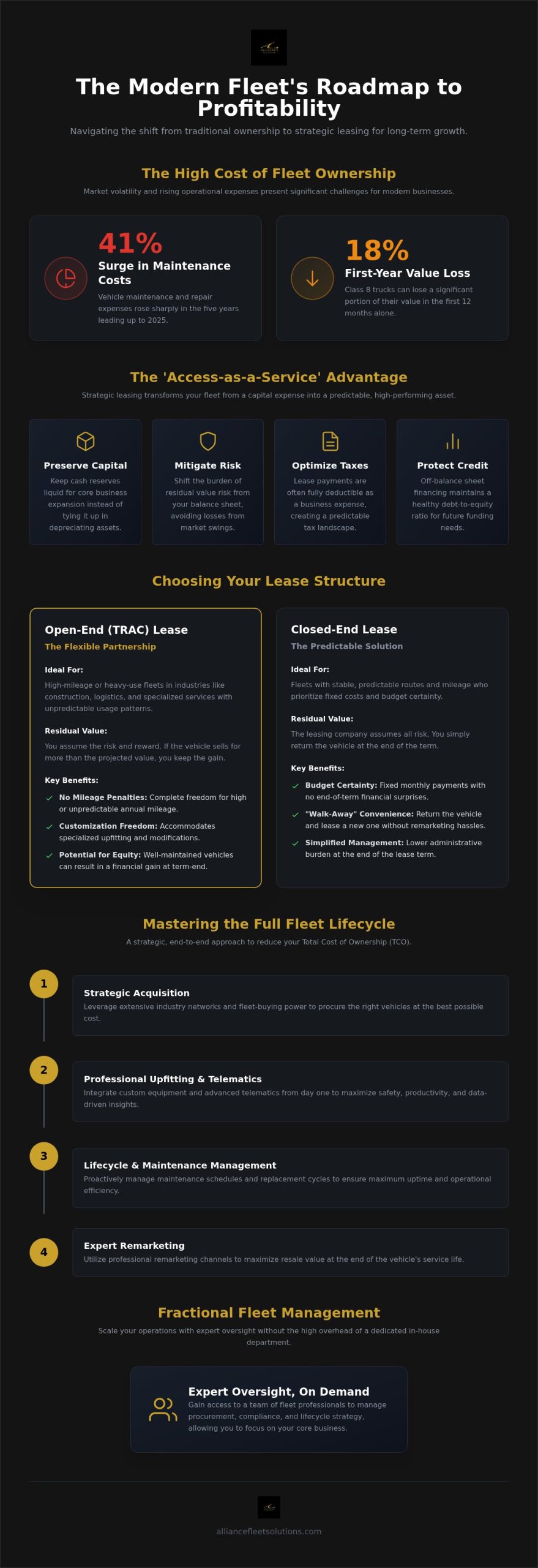
Strategic Fleet Lifecycle Management: Acquisition to Remarketing
Professional fleet management views every vehicle through the lens of a five-stage lifecycle: sourcing, acquisition, upfitting, operation, and remarketing. Companies exploring commercial vehicle leasing denver often focus heavily on the first two stages while neglecting the final exit strategy. This oversight can be a costly mistake. Effective management requires a partner who understands how to leverage national buying power to lower initial costs and how to exit the asset at the peak of its market value. Every decision made during the acquisition phase directly impacts the eventual resale price.
Optimizing the Procurement Process
Strategic sourcing involves more than just finding an available van; it requires negotiating fleet incentives directly with manufacturers. We use our national scale to secure terms that are typically unavailable at a local dealership level. This process also involves coordinating the complex logistics of upfitting so that vehicles arrive at your job sites fully equipped and ready for service. Integrating professional Vehicle Acquisition into your long-term growth plan prevents bottlenecks and ensures your capital is deployed efficiently. Our approach focuses on getting the right equipment into your drivers’ hands without the traditional delays of a fragmented supply chain.
The Power of Professional Vehicle Remarketing
The traditional “trade-in” is a losing strategy for commercial operations. Dealerships typically offer wholesale prices that don’t reflect the true market value of a specialized commercial asset. Professional Vehicle Remarketing uses multi-channel sales strategies to reach a broader pool of buyers, often beating local trade-in offers by significant margins. Timing is the most critical factor in this process. A vehicle becomes a liability the moment its projected repair costs begin to outpace its depreciating resale value. By maintaining meticulous, data-backed service records throughout the lease term, you provide the transparency buyers crave. This documentation proves the asset’s worth and helps you capture the highest possible residual value. This data-driven approach to disposal ensures you maximize your return, allowing you to reinvest that capital into the next generation of your fleet. If you want to stop leaving money on the table at the end of your lease, our remarketing experts can design an exit strategy that protects your bottom line.
Managing the transition from an aging asset to a new lease requires expert coordination. We monitor market volatility, which saw price swings of up to 25% in the 18 months leading up to April 2026, to identify the perfect window for disposal. This proactive stance ensures your commercial vehicle leasing denver program remains a high-performing financial tool rather than a mounting operational burden.
Fractional Fleet Management: Scaling Without the Overhead
Managing a fleet in-house often carries hidden expenses that don’t appear on a standard ledger. Beyond the vehicle payments, you’re investing significant time in administrative tasks, vendor negotiations, and compliance tracking. For companies exploring commercial vehicle leasing denver, the realization often hits that a fleet is a full-time job. This is where fractional fleet management becomes a game-changer. It provides you with the high-level expertise of a seasoned fleet professional without the overhead of a dedicated executive salary. We act as your strategic backbone, consolidating fuel programs, maintenance, and leasing into a single point of accountability. This model turns a fragmented operation into a streamlined business asset that supports your bottom line.
Outsourcing the Fleet Manager Role
Business owners and CFOs should spend their energy on growth, not on tracking oil changes or registration renewals. By outsourcing the fleet manager role, you reduce the administrative burden that slows down your leadership team. You gain immediate access to enterprise-level management tools and data analytics that were previously reserved for the world’s largest logistics firms. This includes expert oversight of Maintenance Management, ensuring your vehicles stay on the road and out of the shop. You get the benefit of a professional headcount without the actual headcount. It’s about having a partner who watches the technical details so you can focus on the high-stakes decisions that drive your company forward.
Achieving Long-Term Strategic Partnership
A successful operation requires moving away from transactional relationships. Holistic fleet optimization means looking at the big picture, from the initial acquisition to the final remarketing stages we discussed earlier. As your business grows, you need a partner capable of scaling your fleet nationally with a dependable, safety-first approach. We don’t just provide vehicles; we provide a functional infrastructure that supports your long-term vision. This collaborative model ensures your fleet remains a predictable asset rather than an operational liability. Our commitment to your success is grounded in a safety-first mindset that protects your drivers and your brand image. Discover how Alliance Fleet Solutions optimizes your fleet today and take the first step toward a more efficient, professional operation.
Future-Proof Your Fleet for 2026 and Beyond
Optimizing your fleet is no longer just about vehicle procurement; it’s about building a sustainable financial engine for your business. We’ve explored how moving toward an “Access-as-a-Service” model preserves your working capital while professional upfitting and telematics turn standard vehicles into high-performance tools. By mastering the full lifecycle, from strategic acquisition to professional remarketing, you ensure every asset delivers maximum value until its final day in service. These strategies are the essential components of a functional, efficient operation.
Managing these complexities doesn’t have to be a burden on your internal team. For those navigating commercial vehicle leasing denver, the right partnership provides the technical authority and operational control needed to eliminate downtime. You may require specialized professional upfitting or access to a national remarketing network. We provide comprehensive maintenance and fuel programs to ensure your fleet works as hard as you do.
It’s time to move beyond transactional relationships and embrace a holistic strategy that scales with your ambition. Scale your business fleet with Alliance Fleet Solutions and secure the expert backbone your operation deserves. Your growth is our priority, and we’re ready to help you drive it forward with confidence.
Frequently Asked Questions
What is the difference between commercial leasing and a traditional auto loan?
Commercial leasing focuses on the vehicle’s usage rather than ownership. While a traditional loan requires a large down payment and ties up your credit, a lease preserves your working capital for business growth. Leasing also offers off-balance sheet financing benefits that keep your debt-to-equity ratio healthy. This approach allows you to replace vehicles more frequently, ensuring your team always has access to the latest safety technology and fuel-efficient engines.
Can I lease custom-upfitted trucks for my specific industry?
Custom upfitting is a standard part of our vehicle acquisition process. We work with you to design industry-specific configurations, including specialized shelving, safety lighting, and heavy-duty racks. By integrating these costs into your lease, you avoid the high upfront expense of outfitting a new truck. Your vehicles arrive fully equipped and branded, allowing your technicians to start working immediately without the delays of coordinating with multiple third-party vendors.
How does an open-end TRAC lease benefit my business taxes?
An open-end TRAC lease provides unique tax flexibility for commercial entities. Because it includes a Terminal Rental Adjustment Clause, the IRS typically allows the lessee to claim depreciation benefits. This structure is ideal for businesses that want the cash flow advantages of a lease while maintaining the tax position of an owner. It’s a sophisticated financial tool that helps you manage your tax liability while keeping your fleet modern and efficient.
What happens if my fleet vehicles exceed the mileage limit in a lease?
The consequence depends on your lease structure. In a closed-end agreement, exceeding the limit triggers per-mile overage charges that can impact your budget. Conversely, an open-end lease doesn’t penalize you for high mileage directly. Instead, the increased wear simply lowers the vehicle’s residual value at the end of the term. When setting up commercial vehicle leasing denver, we help you analyze your route data to choose the model that fits your actual usage.
Is maintenance included in a commercial vehicle lease agreement?
While not automatic in every contract, maintenance management is a critical service you can add to your agreement. This program covers everything from routine oil changes to complex engine repairs through a national vendor network. It eliminates the stress of unpredictable repair bills by providing a fixed, manageable monthly cost. This proactive approach keeps your drivers safe and ensures your vehicles stay on the road, directly reducing the total cost of ownership.
What is fractional fleet management, and how does it save money?
Fractional fleet management gives you access to a professional fleet manager on a part-time basis. It’s designed for businesses that have grown beyond basic vehicle needs but don’t need a full-time employee. This model saves money by leveraging expert negotiation skills for repairs and fuel, reducing administrative overhead. You get enterprise-level oversight and data-driven insights that prevent costly downtime, ensuring your fleet remains a strategic asset rather than a logistical headache.
How does professional remarketing improve my fleet’s ROI?
Professional remarketing maximizes your return by selling vehicles through a multi-channel network rather than accepting a dealer’s wholesale trade-in price. We use meticulous maintenance records and market data to identify the optimal time for disposal. This ensures you sell the asset when its value is highest and its repair risks are mounting. By capturing these higher resale values, you effectively lower the net cost of the lease and improve your overall ROI.
Can a small business with only three vehicles benefit from fleet leasing?
Small fleets gain a competitive edge by utilizing professional leasing structures. Even with just three vehicles, you can access manufacturer fleet incentives and professional upfitting that aren’t available to individual buyers. This allows you to project a more professional brand image and enjoy predictable monthly costs. For small operators considering commercial vehicle leasing denver, this partnership provides the technical support and safety standards needed to scale your business without increasing your internal headcount.