
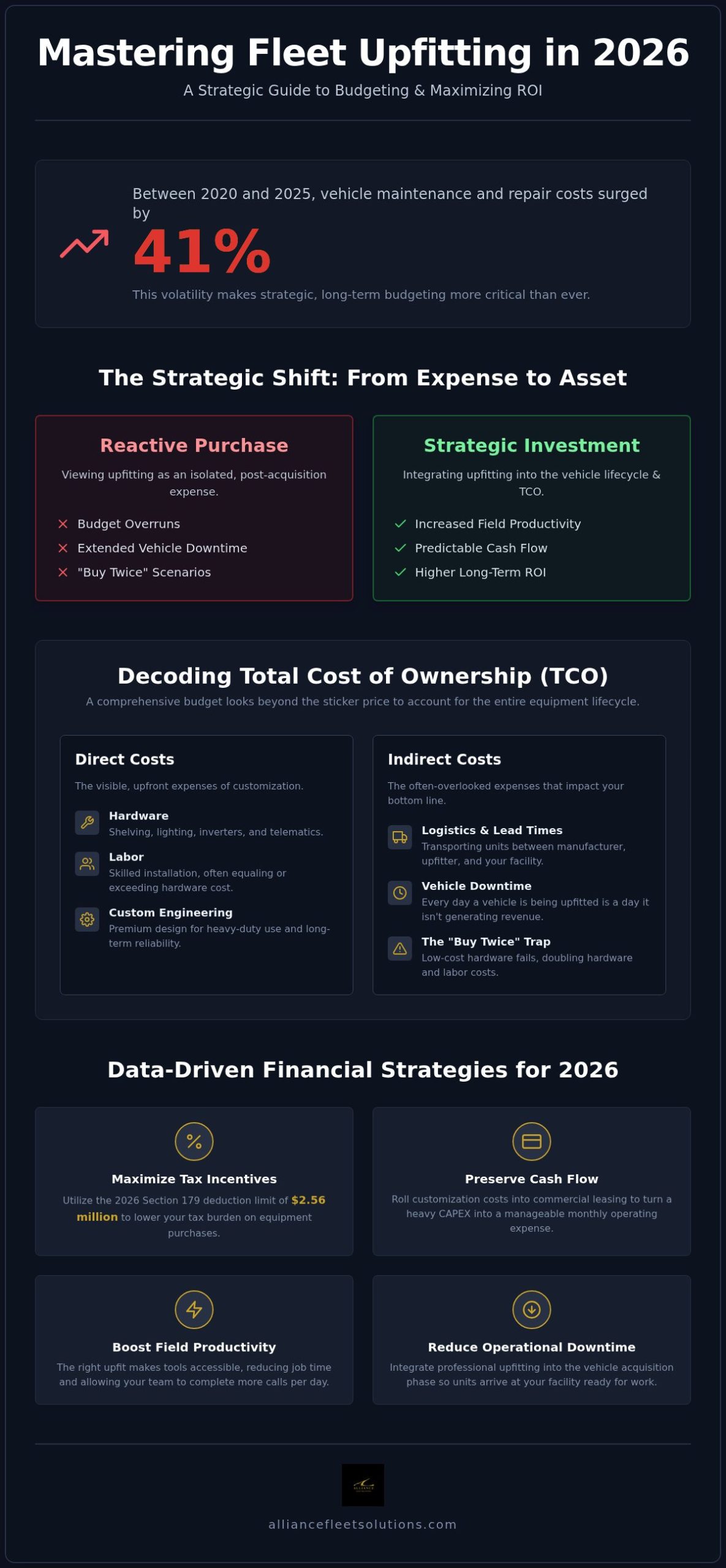
Did you know that vehicle maintenance and repair costs surged by 41% between 2020 and 2025? For fleet managers, this volatility makes it harder than ever to protect the bottom line while ensuring your team has the tools they need. You likely understand that standard vehicles rarely meet the demands of the field, yet the sticker shock of customization often creates friction with executive leadership. Learning how to budget for fleet upfitting in 2026 requires more than just a spreadsheet; it demands a strategic look at the entire vehicle lifecycle.
We understand that unforeseen hardware price hikes and operational downtime are the primary enemies of a healthy balance sheet. This guide promises to help you master these financial complexities with a data-driven approach that maximizes your ROI and stabilizes cash flow. We’ll explore the latest 2026 tax incentives, such as the $2.56 million Section 179 deduction limit, and explain how modular equipment and smart leasing structures can turn a heavy upfront expense into a predictable, manageable monthly investment that actually improves driver productivity.
Key Takeaways
- Learn how to budget for fleet upfitting by looking beyond hardware costs to include labor, maintenance, and the long-term impact on Total Cost of Ownership (TCO).
- Discover the financial advantages of rolling customization expenses into commercial leasing models to preserve cash flow and simplify your monthly accounting.
- Implement a data-driven, five-step framework that aligns driver needs with financial goals to ensure every upfit choice increases field productivity.
- Reduce operational downtime by integrating professional upfitting into the vehicle acquisition phase, ensuring units are fully equipped before they reach your facility.
- Streamline your vendor management by partnering with a single provider that handles everything from factory logistics to final vehicle remarketing.
Beyond the Sticker Price: Why Strategic Fleet Upfitting Budgeting Matters
Strategic fleet upfitting budgeting is a proactive financial roadmap designed to align vehicle customization with your company’s operational goals. It moves beyond simply picking out shelves or ladder racks. Instead, it integrates customization costs into the broader scope of fleet management to protect your cash flow. When you understand how to budget for fleet upfitting, you stop viewing these modifications as isolated expenses and start seeing them as critical drivers of your Total Cost of Ownership (TCO).
In the 2026 market, equipment costs and labor rates continue to fluctuate. A reactive approach, where you address upfitting only after a vehicle arrives, often leads to budget overruns and extended downtime. Strategic lifecycle planning ensures that every dollar spent on customization contributes to the vehicle’s long-term utility and eventual resale value. By accounting for these needs during the acquisition phase, you create a predictable financial model that executive leadership can support.
The High Cost of Under-Budgeting
Choosing the lowest-cost hardware often results in a “buy twice” scenario. Non-durable equipment fails under heavy industrial use, forcing your vehicles back into the shop for re-fits. This doesn’t just double your hardware costs; it doubles the labor expense, which often equals or exceeds the cost of the parts themselves. Beyond the direct financial hit, poor equipment choices negatively impact driver retention. Technicians who struggle with inefficient or broken tools are more likely to seek employment elsewhere, adding recruitment and training costs to your hidden expenses.
Upfitting as a Strategic Business Asset
Shift your perspective from viewing an upfit as a line-item expense to seeing it as a productivity tool. The right configuration reduces on-site job time by ensuring every tool and component is easily accessible. This efficiency allows your team to complete more calls per day without increasing overhead. Additionally, professional installations ensure your fleet remains compliant with the 2026 North American Standard Out-of-Service Criteria. Safe, ergonomic designs protect your most valuable assets: your people. When you prioritize high-quality customization, you turn your vehicles into mobile work centers that drive revenue rather than just consuming it.
Decoding the Total Cost of Ownership (TCO) for Custom Configurations
Understanding the full financial impact of vehicle customization requires looking past the initial quote. In 2026, the Total Cost of Ownership (TCO) stands as the most critical metric for any successful operation. If you’re learning how to budget for fleet upfitting, you must recognize that the sticker price for hardware is just the starting point. A truly comprehensive budget accounts for the entire lifecycle of the equipment, from installation to the eventual remarketing of the vehicle.
Direct Costs: Hardware, Labor, and Engineering
Direct expenses include the tangible components your team uses daily. This list typically covers heavy-duty shelving, interior and exterior safety lighting, power inverters, and advanced telematics. While these parts are the most visible line items, labor often equals or exceeds the cost of the hardware itself. Precision installation requires skilled technicians, especially when integrating complex electrical systems or safety sensors that must meet 2026 compliance standards.
For heavy-duty fleets, custom engineering carries a premium because it ensures the configuration can withstand years of industrial use without failure. Using Tier-1 components is essential for long-term reliability. While cheaper alternatives exist, they rarely survive the rigors of the field, eventually undermining your strategic fleet upfitting budgeting goals through frequent repairs and replacements.
Indirect Costs: Lead Times and Logistics
Many managers overlook the expenses that occur before a vehicle even enters service. You must account for the logistics of moving units between the manufacturer, the upfitter, and your final destination. These transportation costs can swell if not managed efficiently. Even more significant is the cost of vehicle downtime. Every day a new truck sits in an upfit bay is a day it isn’t generating revenue for your business. This lost opportunity cost must be a central pillar of your financial planning.
In 2026, supply chain fluctuations mean lead times can shift unexpectedly. A delay in receiving a specific specialized component can push back your entire deployment schedule. To mitigate these risks, many savvy operators choose professional upfitting partners who manage the entire logistics chain from factory to field, ensuring the vehicle is ready for work the moment it arrives.
Finally, consider the residual value of your equipment. High-quality, modular upfits can sometimes be transferred to new chassis or significantly increase the vehicle’s value during remarketing. By calculating these factors upfront, you ensure your budget reflects operational reality rather than just a best-case scenario.
Financial Strategies: Leasing Upfits vs. Capital Expenditure (CAPEX)
Deciding between cash payments and financing is a critical step in learning how to budget for fleet upfitting. While paying upfront via capital expenditure (CAPEX) eliminates interest costs, it also drains liquid reserves that might be better spent on core business expansion or emergency needs. In contrast, financing your customizations allows you to spread the cost over the vehicle’s entire service life.
Many successful managers choose to roll their upfit costs directly into commercial vehicle leasing agreements. This approach creates a single, predictable monthly payment that covers both the chassis and the specialized equipment. Beyond cash flow management, this strategy has significant tax implications. For the 2026 tax year, businesses can leverage Section 179 to deduct the full purchase price of qualifying equipment up to a limit of $2.56 million. For trucks with a Gross Vehicle Weight Rating between 6,001 and 14,000 pounds, the deduction limit is $32,000, providing a powerful incentive to invest in high-quality professional upfitting.
The Advantages of Open-End Leasing for Upfits
For fleets requiring deep customization, open-end leasing offers unmatched financial flexibility. This model is ideal because it doesn’t penalize you for the unique wear or specific configurations that might affect a vehicle’s standard resale value. By amortizing the upfit over the lease term, you lower the initial barrier to entry for expensive, productivity-boosting gear. At the end of the term, you retain the flexibility to sell the vehicle and keep any equity, or even transfer modular components to new units in your fleet.
When CAPEX Makes Sense
Ownership via CAPEX is typically reserved for specialized auxiliary gear with a very short operational life or for companies with substantial cash reserves and a “buy and hold” philosophy. Owning assets outright places them on the balance sheet as depreciable property, which may suit specific corporate financial structures. However, you must weigh this against the risk of technological obsolescence. In a fast-moving industry, owning equipment that becomes outdated in three years can lead to a competitive disadvantage that outweighs the initial savings of a cash purchase.
A 5-Step Framework for Building a Data-Driven Upfitting Budget
Mastering how to budget for fleet upfitting involves moving from gut feelings to hard data. A systematic approach prevents the “feature creep” that often inflates costs without adding real value. By creating a repeatable framework, you ensure that every dollar spent on customization directly supports field operations while remaining within the bounds of your financial plan. This process requires close collaboration between the drivers who use the equipment and the finance teams who track the ROI.
Step 1: Operational Needs Analysis
Success begins with a clear understanding of daily workflows. Interview your drivers to identify specific pain points, such as difficult-to-reach tools or inadequate lighting. You should also leverage data from your telematics and gps solutions to audit existing vehicles. This data reveals which units are overloaded and which specialized tools are rarely utilized. A Minimum Viable Upfit is a configuration that provides only the essential safety and productivity tools required for a vehicle class to perform its core function without excess weight or cost.
Step 2: Standardization and Volume Planning
Standardizing your fleet into 3 or 4 core “templates” significantly reduces engineering costs and simplifies the procurement process. When you order multiple identical upfits, you gain the power of volume discounts that aren’t available for one-off custom jobs. Simplification also speeds up lead times, as upfitters can stock the necessary components in advance. This predictability is a cornerstone of learning how to budget for fleet upfitting effectively, as it removes the pricing volatility associated with unique, complex builds.
Step 3: Vendor Vetting and Quote Comparison
The lowest bid often results in the highest long-term cost due to poor durability and lack of support. When vetting vendors, ask about their warranty terms and their ability to integrate with your maintenance management software. You need a partner who provides long-term reliability rather than just a cheap installation. Build your next configuration with professional upfitting experts who understand your industry’s specific demands and can provide the technical support your team needs after the vehicle hits the road.
- Does the upfit stay within the GVWR limits to avoid 2026 safety compliance issues?
- Have you accounted for the labor costs of installation and decommissioning?
- Are the components modular enough to be transferred to future vehicles?
- Has the finance department confirmed the tax advantages for this specific configuration?
- Is there a clear timeline for delivery that avoids unnecessary vehicle downtime?
Partnering with Alliance Fleet Solutions for Seamless Upfitting
Choosing the right partner transforms the way you view vehicle customization. Alliance Fleet Solutions acts as your single point of contact, bridging the gap between vehicle acquisition and field deployment. We simplify how to budget for fleet upfitting by integrating professional upfitting costs directly into your acquisition plan. This unified approach eliminates the headache of managing multiple vendors and disparate invoices. By coordinating factory-to-upfitter logistics, we ensure your vehicles move efficiently from the assembly line to the upfit center without unnecessary delays.
Our goal is to help you build efficient fleet operations that prioritize uptime and long-term ROI. We handle the technical complexities of electrical integration, safety compliance, and ergonomic design so your team can focus on their core work. This proactive management style prevents the common pitfalls of post-delivery modifications, which often lead to higher labor costs and extended vehicle downtime.
The Alliance Advantage: From Procurement to Remarketing
Alliance manages the entire vehicle lifecycle to protect your investment and maximize resale value. We understand that a well-maintained, professionally upfitted vehicle commands a higher price at the end of its service life. For businesses that lack a dedicated internal team, our Fractional Fleet Management model provides expert oversight at a fraction of the cost of a full-time hire. We provide the technical authority and financial perspective needed to navigate the 2026 market. Alliance treats your upfit as a strategic business asset that drives long-term profitability and operational reliability.
Getting Started with Your 2026 Fleet Budget
Ready to refine your financial strategy for the coming year? We invite you to schedule a comprehensive budget review with our team. We offer specialized trade packages tailored for HVAC, electrical, and delivery sectors, ensuring your equipment meets the specific demands of your industry. Whether you’re looking to standardize a new fleet of 50 trucks or need a custom configuration for a specialized service unit, we provide the data-driven insights you need to succeed. We encourage a long-term partnership approach to fleet growth, helping you scale your operations while maintaining expert control over your costs. Reach out today to start building a more predictable and productive fleet for 2026.
Securing Your Fleet’s Financial Future for 2026
Mastering the complexities of how to budget for fleet upfitting requires a shift from reactive purchasing to strategic lifecycle management. By focusing on the Total Cost of Ownership and implementing a data-driven framework, you ensure that every customization serves as a productivity tool rather than a drain on capital. We’ve explored how standardized templates and collaborative needs analyses reduce long-term costs while keeping your technicians safe and effective in the field.
Managing these logistics at scale is a significant undertaking, but you don’t have to handle it alone. Alliance Fleet Solutions provides the national coverage and specialized B2B fleet management expertise needed to streamline your operations. Whether you require flexible open-end leasing to roll upfit costs into one payment or closed-end options to suit your balance sheet, we are here to support your growth. Optimize your fleet budget with a custom upfitting consultation from Alliance Fleet Solutions today. Your vehicles are the backbone of your business; let’s ensure they’re built for success.
Frequently Asked Questions
How much should I typically allocate for commercial van upfitting?
Allocation depends heavily on your industry and the complexity of the build. For basic shelving and safety lighting, a smaller percentage of the vehicle’s base price is common. However, specialized trades like mobile HVAC or electrical repair require more significant investment to ensure long-term durability. When you determine how to budget for fleet upfitting, we recommend reviewing your previous three years of maintenance data to see where equipment failure occurred most frequently.
Can I lease the upfitting equipment separately from the vehicle?
While it’s possible to secure separate financing for equipment, it’s rarely the most efficient path. Most managers find that rolling customization costs into a single lease agreement simplifies their monthly accounting and preserves working capital. This unified approach also ensures that the equipment’s lifecycle matches the vehicle’s service term. Integrating the upfit into the primary lease often provides better interest rates compared to standalone equipment loans.
Does upfitting a vehicle decrease its resale or remarketing value?
High-quality, professional upfitting typically maintains or even enhances a vehicle’s remarketing value, provided the configuration is standardized for a specific trade. Highly niche or permanent modifications can narrow the pool of secondary buyers. To protect your investment, choose modular systems that can be removed or adjusted without damaging the chassis. This flexibility ensures the vehicle remains attractive to a broader market once its initial service term ends.
How long does the professional upfitting process usually take in 2026?
In 2026, a standard trade package usually takes between two to four weeks once the vehicle arrives at the upfit center. More complex builds involving custom electrical systems or heavy-duty hydraulic gear can extend this timeline. To minimize operational downtime, we coordinate factory-to-upfitter logistics so the work begins immediately upon delivery. Proper planning during the acquisition phase is the best way to avoid delays caused by component shortages.
What are the most common hidden costs in fleet upfitting budgets?
Hidden costs often stem from transportation logistics and the labor required to decommission old equipment. Many managers also forget to account for the impact of added weight on fuel efficiency and payload capacity. When learning how to budget for fleet upfitting, you must also consider the cost of training drivers on new technology or safety features. Ignoring these secondary expenses can lead to budget overruns that erode your projected ROI.
Should I choose an open-end or closed-end lease for an upfitted truck?
Open-end leases are generally the preferred choice for customized trucks because they offer more flexibility regarding mileage and wear. Since you bear the residual risk, you aren’t penalized for specific modifications that a closed-end lessor might deem “excessive.” This model allows you to maximize the utility of the upfit without worrying about turn-in fees. However, closed-end leases might suit fleets with highly predictable, low-impact usage patterns.
How does telematics data help in planning an upfitting budget?
Telematics provide an objective look at how your vehicles are actually used in the field. By analyzing weight distribution and tool access frequency, you can identify which parts of an upfit are essential and which are wasted space. This data-driven approach allows you to trim the excess from your budget while prioritizing features that improve driver safety. It ensures your 2026 configurations are built for real-world performance rather than theoretical needs.
Is it better to upfit a vehicle at the dealership or a specialized shop?
Specialized upfit centers generally offer a higher level of technical expertise and more durable components than standard dealerships. While a dealer might offer convenience, they often use generic kits that fail under heavy industrial use. Specialized shops provide custom engineering and better integration with your existing fleet management software. This ensures your equipment is installed correctly the first time, reducing the risk of future maintenance headaches and downtime.